“My Husband Gave His Ex The Last Antidote While I Was Dying.” My Exposure Monitor Flashed Red, But Hers Was Only Amber. He Carried Her Away, Leaving Me Beside An Unconscious Technician. I Froze. Then The Steel Door Sealed, Trapping Me Inside The Toxic Chamber. Thirty-Six Hours Later, I Awoke In Intensive Care. His Lawyers Had Already Blamed Me.
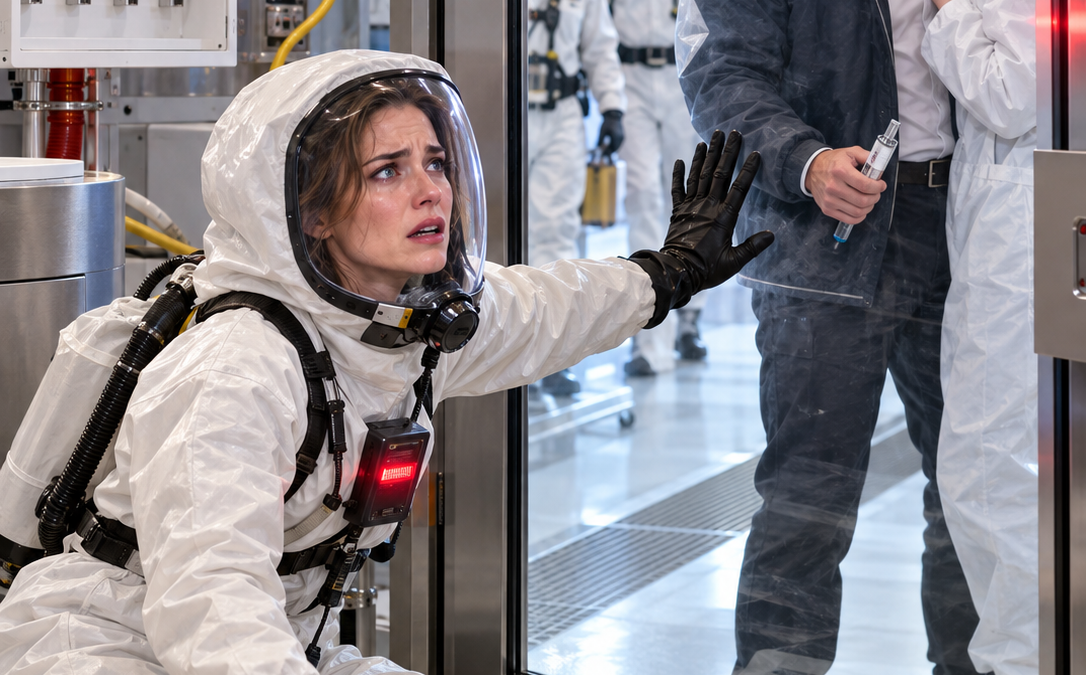
The alarm had been screaming for forty-three seconds when my husband pulled the last antidote injector from the emergency cabinet and drove it into Camille Vale’s thigh.
I was ten feet away, kneeling beside an unconscious technician, watching the chemical exposure monitor on my suit flash red.
Camille was still standing. She was coughing, but she was standing.
I had already lost feeling in two fingers. Every breath through my respirator tasted like metal, and the edges of my vision had begun to darken.
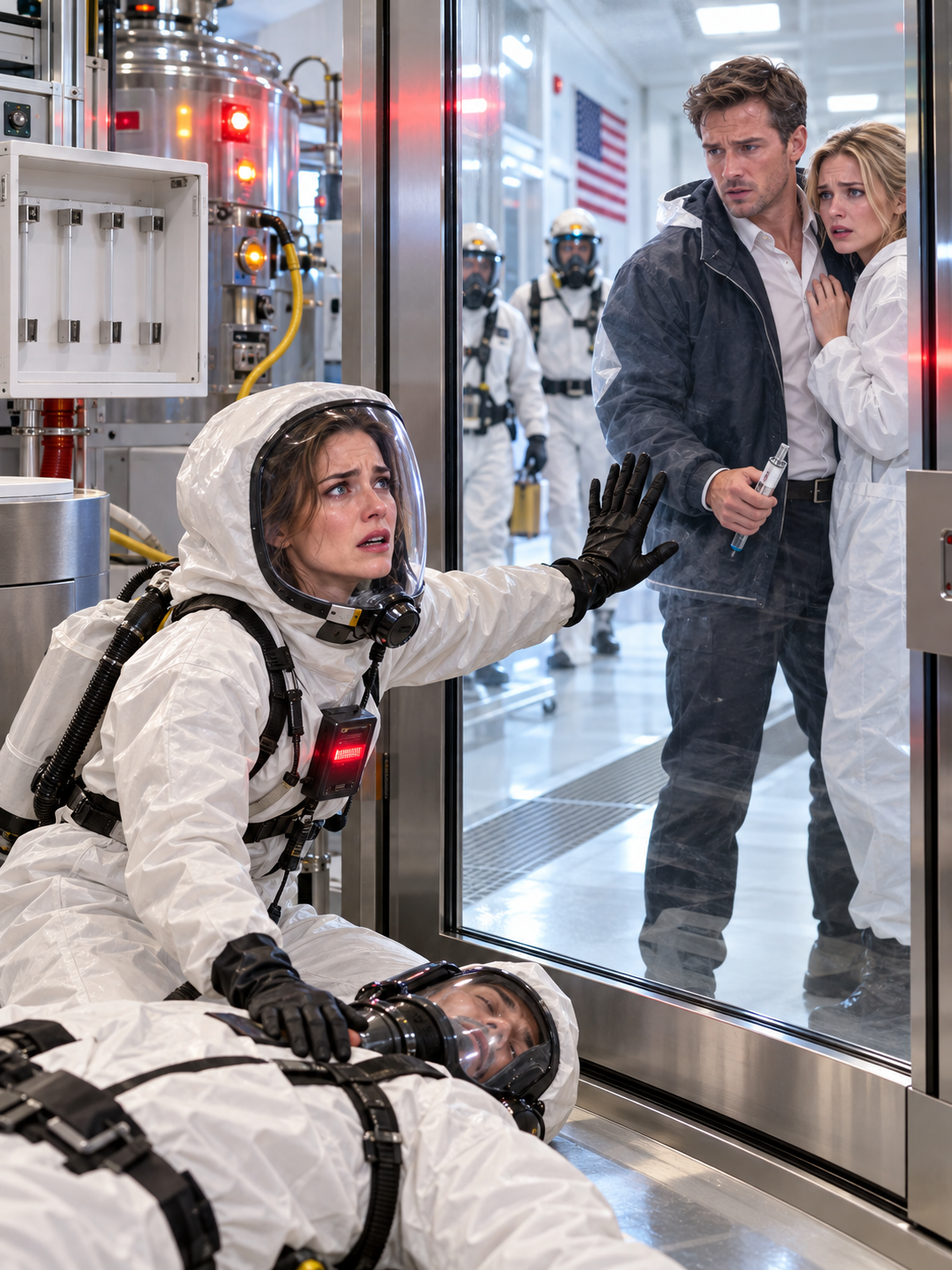
Owen looked at me through the glass panel of the decontamination door.
For one suspended moment, the injector remained in his hand, and I thought he would compare our readings. I thought he would remember the emergency response protocol I had written, assess the evidence, and do what the situation required.
Then Camille said his name.
Not loudly.
She had never needed to say it loudly.
“Owen, I can’t breathe.”
He turned toward the woman he had loved before he met me.
He pressed the injector against her leg, released the spring, and wrapped an arm around her waist while the medication entered her bloodstream.
“The secondary response team is coming!” he shouted at me. “Stay at the emergency controls, Lena! You know the system better than anyone!”
Behind me, another warning appeared.
The reactor was still receiving chemicals. Its temperature was climbing.
“There is no secondary team in this corridor,” I said.
Whether he couldn’t hear me over the alarms or simply chose not to, I never learned.
He lifted Camille into his arms and backed through the decontamination doorway.
As the heavy panel began to close, I saw the expression on his face.
It wasn’t confusion. It wasn’t the helpless terror of a man forced to choose between two lives.
It was certainty.
He believed Camille needed saving.
He believed I would somehow save myself.
I pressed my gloved palm against the glass.
“When that door closes, don’t tell yourself you chose the woman who was sicker,” I said. “You chose the woman you wanted.”
His mouth opened.
The steel panel sealed before he answered.
My name is Lena Mercer. I was twenty-nine years old that night, the senior process safety engineer at Argent Biosolutions, a defense contractor outside Richmond, Virginia.
Owen had been my husband for five years and the site’s operations director.
Dr. Camille Vale was Argent’s chief research scientist, Owen’s college girlfriend, and the woman he had spent eighteen months insisting was merely a colleague.
None of those relationships mattered to the reactor behind me.
It was overheating, and if I didn’t stop it, forty-two people sheltering in the adjacent warehouse could be exposed.
The pilot bay contained a hazardous industrial compound used in Argent’s Rapid Shield research program. It wasn’t a weapon, but under the wrong conditions, concentrated vapor could cause devastating respiratory injuries.
Emergency antidote injectors were intended to stabilize exposed workers until medical personnel could take over.
Company policy required four injectors inside the pilot wing.
The cabinet Owen had opened contained one.
Now it contained none.
Beside me, Rafael Morales made a wet, choking sound.
Rafi was twenty-four, a technician who had joined my team less than a year earlier. He loved terrible jokes, brought homemade salsa to every staff lunch, and owed me twelve dollars from a sandwich order the previous Tuesday.
His respirator had shifted when the first pressure surge threw him against a storage rack.
I pressed the rubber seal back against his face, opened the emergency oxygen valve on his hood, and watched his chest begin moving more steadily.
My own respirator sounded another warning.
The filter was approaching its limit.
I crawled toward the control panel.
The automatic shutdown hadn’t merely malfunctioned. Someone had bypassed it with a yellow maintenance jumper, allowing the feed pump to continue pushing material into an increasingly unstable reactor.
I pulled the jumper free.
Nothing happened.
The pump’s local drive remained latched in its running state. The control panel no longer had authority over it.
I checked the temperature trend.
Another ninety seconds at that rate, perhaps less, and the vessel could exceed its safe operating envelope.
I had two options.
I could abandon the bay, reach the exterior emergency stairwell, and possibly survive.
Or I could cross the contaminated pilot area, close the manual feed valve, and attempt to contain the release before it reached the warehouse.
I remember thinking that Owen had already made one decision for me.
I wasn’t going to let him make the next.
I hooked my arms beneath Rafi’s harness and dragged him toward the protected emergency alcove.
He outweighed me by at least sixty pounds.
Every movement sent a sharp pain through my ribs. Halfway there, the heel of his boot caught beneath a floor bracket. I kicked it loose, pulled him behind the fire curtain, and connected his air hose to the wall supply.
“Stay with me,” I told him, although his eyes were closed. “You still owe me twelve bucks for lunch.”
It was a ridiculous thing to say.
But it was the only human sound left in that room.
I crossed the pilot area on my hands and knees because standing made my vision collapse into a narrow tunnel.
Red emergency lights flashed through the vapor. My gloves slipped against the wet floor, and I had to stop twice to keep from vomiting inside my mask.
When I reached the reactor, I found the manual valve wheel and threw my weight against it.
It wouldn’t move.
A maintenance wire and a silver service tag had been wrapped around the assembly.
The tag should have been red.
Six days earlier, I had personally placed a red lockout tag on that exact valve after a pressure integrity test revealed unacceptable corrosion.
Someone had removed it.
Someone had replaced a genuine safety prohibition with something that merely looked official.
I took the ceramic rescue blade from my belt and cut the wire.
The wheel resisted through half a turn.
Then it moved.
The feed pump emitted a high mechanical whine.
The flow indicator fell.
Finally, it reached zero.
I stayed against the valve for a moment, struggling to understand the numbers through the dizziness.
The uncontrolled feed had stopped.
But the air was still contaminated.
Stopping the reactor would prevent the emergency from growing. It wouldn’t protect the warehouse unless I activated the containment system.
I staggered back toward the control station and found the manual levers for the neutralizing foam and exhaust fans.
Pulling them would create negative pressure and keep the toxic plume inside the pilot wing.
For approximately ninety seconds, however, the airflow would pass directly through the area where I was standing.
Under the approved operating classification, everyone in the wing should have been wearing supplied-air suits.
Camille had kept the demonstration categorized as a limited laboratory test to avoid another delay. Her unauthorized increase in batch volume had made our filtration respirators dangerously inadequate.
I knew what activating those levers would do to my exposure.
I pulled both anyway.
The building shuddered.
Somewhere overhead, dampers slammed open.
White neutralizing foam poured from the ceiling, covering the floor in a bitter-smelling flood.
My respirator alarm became a continuous tone.
I held both levers down until two green indicator lights appeared.
Then I released them.
The last thing I remember seeing was the old pressure chart recorder mounted above the eastern airlock.
Its pen trembled across a strip of paper, drawing a thin blue line while the digital screens around it went black.
I didn’t know then that the line would become the most important witness in my life.
I woke thirty-six hours later with a raw throat, a heavy ache in my chest, and my older sister asleep in a plastic chair beside my hospital bed.
Tessa had never learned how to sleep gracefully.
Her head rested against the wall, her mouth hung slightly open, and one sneaker was planted on top of my overnight bag as though she expected someone to steal it.
When I moved my hand, her eyes opened immediately.
“Don’t try to talk,” she said. “They took the breathing tube out two hours ago. You’re at VCU Medical Center. You’re safe.”
Safe was an enormous word for a room where every breath felt borrowed.
I pointed toward the whiteboard.
Tessa understood and handed me a marker.
With trembling fingers, I wrote two questions.
Rafi?
Other workers?
“Rafi’s alive,” she said. “He’s sedated, but he’s alive. Twenty-one people were treated. Six are still hospitalized. Nobody died.”
Relief hurt almost as much as breathing.
I closed my eyes.
Then Tessa added, “Owen’s outside.”
I opened them again.
“He was with Camille until this morning. Apparently she had a reaction to the antidote and needed observation. He’s asked to see you nine times. I refused eight because you couldn’t answer. This time it’s your decision.”
Even then, my sister gave me the one thing my husband had taken away.
A choice.
I nodded once.
Owen entered without his jacket.
His white shirt was wrinkled, dark stubble covered his jaw, and his eyes looked as though he hadn’t slept.
He stopped beside the bed.
“Lena.”
I stared at him.
He reached for my hand.
I moved it away.
“Sweetheart, I know—”
“How many antidotes were in the cabinet?”
He blinked.
Of all the things he had expected me to say, that apparently wasn’t one of them.
“You’ve just come off a ventilator. We can talk about the investigation later.”
“How many?”
“One.”
“How many were required?”
His eyes shifted toward Tessa.
“Four,” I answered for him. “Where were the other three?”
“Supply is reconstructing the inventory records. There was a field exercise last week. It’s possible the cabinet wasn’t replenished.”
His words were careful.
Not the way a husband speaks at his wife’s hospital bedside.
The way an operations director speaks after a lawyer tells him not to speculate.
“Did you read our exposure monitors?”
“Camille was in obvious respiratory distress. She has scar tissue from an earlier laboratory exposure. I made the best decision I could in seconds.”
“My monitor was red.”
“Those devices estimate chemical exposure. They aren’t substitutes for medical assessment.”
“Hers was amber.”
“Lena—”
“Did you see them?”
His expression hardened.
Tessa stood.
“You need to leave.”
“This is between me and my wife.”
“Your wife has chemical burns in both lungs,” Tessa replied. “Nothing in this room belongs to just the two of you anymore.”
Before Owen could answer, the door opened.
Dr. Ada Meskal, the occupational medicine specialist assigned to the exposed employees, entered carrying a tablet.
She was a compact woman in her early fifties, with silver threaded through her braids and very little patience for performance.
“Mrs. Mercer needs rest,” she said. “And since the antidote has come up, I’ll clarify something.”
She looked at Owen.
“Her chemical dosimeter recorded the highest cumulative exposure among the surviving employees. That doesn’t allow us to reconstruct every symptom at the precise moment treatment was administered. But it means any claim that Dr. Vale was objectively the most exposed is unsupported.”
Owen swallowed.
“I thought the backup team was right behind me.”
Dr. Meskal tapped her tablet.
“The backup team didn’t enter the inner corridor until eight minutes after you left.”
“My radio was breaking up.”
“So you didn’t know they were behind you,” I whispered. “You just hoped they were.”
He looked at me for a long moment.
Then he placed a sealed envelope on the bedside table.
“Argent needs preliminary statements while everyone’s memory is fresh,” he said. “Legal prepared this for key personnel. It isn’t an admission of fault. Don’t sign anything until you feel ready.”
Tessa stared at the envelope after he left.
“That man’s timing has always been spectacularly awful.”
I broke the seal.
The statement was three pages long.
It described the release as an unforeseen equipment malfunction during an authorized demonstration.
It stated that Operations Director Owen Mercer had evacuated a critically ill scientist and immediately coordinated the external response.
It said Senior Process Safety Engineer Lena Mercer had remained in the pilot bay to repair the ventilation system and initiated manual decontamination approximately four minutes after the alarm.
The important sentence appeared near the bottom.
Preliminary analysis suggests that delayed manual activation may have increased vapor migration into the western service corridor.
I read it twice.
They had turned the minutes I spent dragging Rafi to safety into a delay.
They had turned the decontamination procedure that protected the warehouse into a possible cause of additional exposure.
Owen had left me without an antidote.
Now he had brought me paperwork that placed the blame at my feet.
I looked at Tessa.
“Call a lawyer.”
She didn’t ask whether I was sure.
She took out her phone.
My attorney arrived the next morning.
Maya Brooks had previously investigated retaliation cases involving government contractors before opening a small practice in Richmond.
She listened without interrupting while I described the empty antidote cabinet, the disabled shutdown, the false maintenance tag, and the paper pressure recorder.
When I finished, she set her notebook on her knee.
“The site is under an evidence-preservation order,” she said. “Do you have proof you warned them before the demonstration?”
I did.
Six days before the release, my team had failed the pressure integrity test on the pilot transfer valve.
I issued a formal stop-work order.
When Owen overrode that suspension, Argent’s system automatically sent a confirmation receipt to my personal email because I was the originating safety officer.
Tessa found it on her laptop.
The override permitted only a limited test, subject to three conditions: no more than twenty liters, a fully stocked emergency cabinet, and renewed safety approval after the valve assembly was repaired.
Every condition had been violated.
Maya read the document twice.
“This doesn’t establish why the valve failed,” she said. “But it establishes that your husband knew there was a hazard and authorized operations to continue anyway.”
That evening, Argent’s general counsel arrived with the human resources director and an enormous fruit basket.
They offered a year’s salary, payment of my medical expenses, and a company apartment if I agreed not to make public allegations while the internal investigation continued.
“Does cooperation include signing my husband’s statement?” I asked.
The general counsel smiled without warmth.
“Nobody will force you to sign anything. We’re simply asking you not to prejudge whether your exhaust decision contributed to vapor migration.”
“The paper pressure recorder will show what the fans did.”
His smile disappeared.
Maya pushed the agreement back across the table.
“My client will accept the benefits she’s already entitled to,” she said. “She won’t sell you her silence.”
After they left, Tessa donated the fruit basket to the nurses.
I spent six more days in the hospital.
Owen came every morning.
Some days I refused to see him.
On the days I allowed him inside, he brought coffee I couldn’t drink, books I didn’t have the strength to hold, and explanations that became smoother with repetition.
He believed Camille was deteriorating faster.
He believed the response team was seconds away.
He believed the cabinet had been restocked.
He believed the automated systems would protect me.
He believed everything except me.
Camille visited on the seventh day.
She waited until Owen had gone to a meeting and Tessa was downstairs getting lunch.
When she entered, she wore a cream-colored cardigan, dark trousers, and a surgical mask. A thin red mark ran along the left side of her neck.
Her voice retained the breathy softness people had mistaken for fragility ever since she returned to Argent.
“I wasn’t sure you’d let me in.”
“Neither was I.”
She placed a paper bag on the windowsill.
“Your belongings from the clean locker. Security released them. I thought you’d want your wedding ring back.”
The ring sat in a plastic evidence bag on top of my folded clothes.
A nurse had removed it when my hands began swelling.
Camille knew exactly what she was doing by placing it where I would see it first.
“Owen saved my life,” she said quietly. “I know what that cost you.”
“Do you?”
Her eyes filled with tears.
“My lungs seized. I couldn’t inhale. He made a medical decision. If there had been two doses, he would have treated us both.”
“If the cabinet had been stocked, there would have been four.”
She lowered her gaze.
“They say the training team failed to replace them.”
“Who says?”
“Supply. Compliance. Everyone’s trying to understand what happened.”
I watched her carefully.
Then she added, “You chaired the demonstration readiness meeting that morning. Did you verify the emergency inventory?”
“That was Operations’ responsibility.”
“But did you verify it?”
“No.”
“Did you run thirty liters?”
The question changed her expression.
A tear slipped down each cheek.
“You nearly died, and you’re still conducting an audit.”
“I nearly died because somebody didn’t conduct one before the demonstration.”
Her mouth tightened.
The wounded expression remained, but something colder appeared behind it.
“You’ve always resented Owen trusting my scientific judgment. Please don’t turn a terrible accident into evidence of whatever you think exists between us.”
“I don’t have to turn it into anything. He did that when the door closed.”
For a second, neither of us spoke.
Then Camille looked toward the ring.
“Owen loves you.”
“That isn’t the defense you think it is.”
The door opened behind her.
Tessa walked in carrying soup and stopped so abruptly that broth splashed against the lid.
“You have ten seconds to leave,” she told Camille.
Camille gave me one final sorrowful look and walked out.
Tessa set the soup down.
“I watched that woman accept a research award on television last year. Didn’t cry once. Apparently she saves it for private performances.”
I almost laughed.
Laughing still hurt too much.
I had met Owen six years earlier at a manufacturing safety conference in Baltimore.
I was twenty-three, barely two months out of graduate school, and terrified that everyone would notice how young I was.
During my first presentation, a retired plant manager interrupted to ask whether I had ever stood inside a real emergency or merely simulated them on a computer.
Before I could answer, Owen raised his hand from the back row.
“Her model identified the pressure sequence behind the Chesterfield fire,” he said. “My response team used her evacuation map. We got everyone out.”
I had never met him.
He had read my work.
Afterward, he bought me coffee and asked better questions than anyone else at the conference.
Owen was thirty, broad-shouldered, direct, and recently out of the military after serving as a chemical response officer.
He listened in a way that made the rest of the room seem to disappear.
When we married a year later, I believed competence was the language we shared.
For a while, it was.
He never mocked my checklists.
I never treated his field experience as less valuable than my calculations.
We argued about risk assessments, ate dinner at midnight, and spent Sundays renovating a narrow brick house near the James River.
His first anniversary gift wasn’t jewelry.
It was a brass compass engraved with three words.
Always find home.
I carried it in my work bag for years.
Camille returned to Virginia during our fourth year of marriage.
She and Owen had dated through college and his first military posting. Their relationship ended when she accepted a research fellowship in Switzerland and he refused to ask her to stay.
That was the story Owen told me.
He described their breakup as mutual, distant, and long finished.
Argent hired her to lead the Rapid Shield project.
At first, I tried hard to like her.
She was brilliant, funny when she chose to be, and capable of explaining complicated science without making other people feel small.
She also understood Owen’s memories in a language I didn’t speak.
She knew the names of the soldiers he trained with, the bar where his unit celebrated coming home, and the story behind the scar on his shoulder.
An emotional affair doesn’t always begin with a dramatic confession.
Sometimes it begins with permissions.
The first was a late-night call about a laboratory problem that could have waited until morning.
The second was a private dinner after a client meeting that somehow excluded the rest of the team.
The third came when Owen told me I was being unreasonable for asking why Camille knew the code to our side gate.
“She dropped off contract files,” he said. “You’re turning ordinary work into something ugly.”
I wanted to be rational.
Rational women didn’t cause trouble over an old girlfriend.
Rational wives understood long hours, confidential deadlines, and professional friendships.
I kept moving my boundaries until they protected nothing at all.
Three months before the demonstration, I learned Owen had nominated Camille for an industry award without disclosing that his wife had written the safety validation supporting half her project.
When I confronted him, he said the award recognized scientific innovation, not infrastructure.
“Your work makes everyone else’s work possible,” he told me, as though invisibility were a compliment.
Six days before the demonstration, my team discovered unacceptable corrosion in the pilot transfer valve.
I shut the unit down.
Camille appeared in my office within an hour.
“The deputy secretary is coming Friday,” she said. “If we postpone again, the funding committee will walk.”
“Then let them walk.”
“You know the valve held at low flow.”
“Because we stopped the test before it failed. A calendar doesn’t change pressure tolerance.”
Owen joined us halfway through the argument.
Camille proposed a limited run: twenty liters, diluted catalyst, full emergency inventory, and a maintenance technician stationed at the local controls.
I said I wouldn’t approve anything until the valve assembly had been replaced and retested.
That evening, Owen overrode my stop-work order.
He told me at home, standing beside the kitchen counter with his tie loosened and his phone vibrating in his pocket.
“The contract permits Operations to authorize a limited test.”
“You’re overruling a safety shutdown.”
“I’m not sidelining you. Your conditions are written into the exception.”
“A condition on paper doesn’t repair a valve.”
“The replacement part arrives tomorrow. Camille agreed to keep the batch at twenty liters.”
“You trust her promise more than my stop-work order.”
“I trust both of you.”
That was Owen’s favorite lie.
Whenever two people wanted contradictory things, he claimed to trust them both and then gave Camille what she wanted.
I slept in the guest room.
Friday morning, he kissed my forehead before leaving.
“After today, we’ll slow down,” he promised.
By sunset, he had used the last antidote on her.
When I left the hospital, I didn’t go home.
Tessa lived in a two-bedroom apartment above the bakery she owned in Richmond.
Climbing the stairs exhausted my lungs, but her small guest room had a lock and held no memories of Owen choosing somebody else.
He stood beside my wheelchair at the hospital entrance while Tessa brought the car around.
“Come home,” he said. “I’ll sleep downstairs if you want space. Dr. Meskal said someone should monitor you overnight.”
“Tessa will.”
“She goes to bed at four in the morning.”
“Then I’ll call the nursing line.”
“Lena, this is our marriage.”
I looked up at him.
“No. This is my hospital discharge. Our marriage is what you carried through that door while I was still inside.”
He accepted the words without raising his voice.
“I know you’re angry.”
“Angry is what I felt when you overrode the safety shutdown. This is different.”
“What is it, then?”
“Clarity.”
Tessa pulled up before he could answer.
That first night above the bakery, I woke convinced the guest room door had sealed shut and the alarm was about to begin.
I swung my legs toward the floor, but my lungs tightened before I could stand.
For several seconds, I couldn’t tell whether I was back in the pilot bay or trapped inside a memory of it.
Tessa appeared in the doorway wearing sweatpants and one of our mother’s old college sweatshirts.
She didn’t rush toward me.
Dr. Meskal had warned her that unexpected physical contact during a flashback could intensify the panic.
“Look at me,” she said. “You’re in my apartment. The window’s open two inches. You can smell the bread downstairs. Breathe with me.”
I followed her voice until the room became a room again.
She brought my inhaler and sat on the carpet with her back against the wall.
I hated that she had to see me shaking.
I hated the stack of medical instructions on her counter and the bakery schedule she had rearranged because I couldn’t safely remain alone for long.
“I’m sorry,” I said.
“For what?”
“For taking over your life.”
“You slept beside me for three weeks after Mom died because I couldn’t close my eyes without hearing the hospital phone. Did you think I was keeping score?”
“That was different.”
“It was different because you were the one helping. You like that side of the equation.”
Her words landed painfully close to the truth.
Tessa rested her head against the wall.
“Camille needing Owen wasn’t the problem,” she said. “The lying was the problem. The way she used that need to control him was the problem. Asking me to sit here while you breathe doesn’t make you like her.”
I looked at my hands.
“I didn’t ask.”
“No. You planned to fall apart quietly so you wouldn’t inconvenience anybody. That’s not better.”
I laughed once, which immediately turned into coughing.
She waited until it passed.
“Next time,” she said, “call my name before you try to rescue yourself alone.”
It sounded simple.
For me, it wasn’t.
I had built my identity around being the person who knew what to do.
Owen had loved that identity until he used it as evidence that somebody else deserved rescuing first.
That night, I practiced something that felt harder than pulling the emergency levers.
I asked my sister to stay until I fell asleep.
Recovery moved in slow, humiliating increments.
I could walk from the guest room to the kitchen but couldn’t always make the return trip without resting.
Showering left me trembling.
Food carried a faint chemical taste.
At night, I woke to alarms that existed only in my memory, touching my throat before remembering there was no respirator there.
Dr. Meskal couldn’t predict whether the damage to my lungs would be permanent.
She explained that inflammation might improve over months, but scarring could develop slowly.
She prescribed inhaled medication, pulmonary rehabilitation, and patience.
“I don’t have much of that,” I told her.
“Then this will teach you.”
Argent placed me on paid investigative leave.
My building access and company accounts were suspended to preserve evidence.
Maya insisted we treat every formal action precisely rather than labeling every inconvenience retaliation.
“If we exaggerate the ordinary parts,” she said, “they’ll use that to discredit the extraordinary ones.”
The extraordinary part arrived in a registered letter eleven days after the incident.
Argent’s internal review claimed my decision to activate the ceiling exhaust fans at full capacity had pulled vapor into the western service corridor before negative pressure stabilized.
Three employees there had been treated for exposure.
The review didn’t accuse me of misconduct outright, but it referred my actions to the company’s professional standards committee and reserved the right to pursue damages if gross negligence was established.
I read the paragraph until the words blurred.
Maya read it once.
“They need your exhaust decision to become a competing cause,” she said. “If all the injuries resulted from an unauthorized batch and disabled interlock, senior management carries the responsibility. If your response made things worse, they can argue shared liability.”
“The fans protected the warehouse.”
“Then we’ll prove it.”
“The digital recorder was damaged.”
“You mentioned a paper chart.”
“The differential pressure recorder above the eastern airlock. It’s not connected to the network. The pen should show exactly when pressure reversed.”
Maya contacted the federal technical review office and submitted a written preservation notice identifying the recorder by manufacturer, location, and equipment number.
The investigator who answered refused to say whether it had already been secured.
Two hours later, Rafi’s mother sent me a photograph from his hospital room.
He still couldn’t speak, but he had written two words on a board.
SILVER TAG.
The valve had carried my red lockout tag when I left it.
Replacing that tag required completed repairs and independent safety verification.
Rafi’s message confirmed that someone had created the appearance of approval without doing the work.
Maya contacted Benjamin Crowe, the maintenance supervisor, while I listened.
Ben was sixty-one, hated neckties, and was famous for keeping a handwritten shift log even after every other record became digital.
“I never released that valve,” he said.
He explained that Camille had described the automatic shutdown as overly sensitive and ordered a contract mechanic to bypass it for calibration.
Ben had ordered the bypass removed.
Owen approved a work ticket allowing it to remain in place through the demonstration.
Ben had already submitted his log to the government review team.
It recorded his warning, the false tag, and the names associated with the work.
He hadn’t stolen company property or handed me confidential evidence.
He had simply refused to change what he wrote before anyone knew somebody would get hurt.
“Be careful,” I told him.
“I’m old, Lena. That’s different from being brave, but it looks about the same from across a room.”
When the call ended, I stared through Tessa’s window at people buying bread downstairs.
Owen hadn’t installed the bypass himself.
But every shortcut carried his authorization because he had treated Camille’s urgency as expertise and my caution as an obstacle.
“That leaves the empty cabinet,” Maya said.
The answer came from the last person I expected to provide it.
Owen arrived outside Tessa’s apartment after dark.
He texted first.
I didn’t answer, so he waited across the street instead of coming upstairs.
The old version of me would have rewarded that small courtesy by agreeing to see him.
The new version understood that basic restraint wasn’t a gift.
I went downstairs because I wanted answers.
He stood beside his SUV holding a document envelope.
Rain had darkened the shoulders of his coat.
“I brought the antidote transfer log,” he said.
“How did you get it?”
“Requested it through counsel. I’m still Operations Director, technically, although I’m on administrative leave.”
He handed me a copy.
Three days before the demonstration, two usable antidote injectors had been transferred from the pilot wing reserve to the executive decontamination suite.
A deputy secretary and two defense procurement officials were scheduled to tour the building.
The executive suite’s emergency medication had expired.
Rather than postpone the tour or obtain an emergency replacement shipment, Operations moved two injectors from the pilot reserve so the VIP area would pass its readiness inspection.
Owen had signed the authorization.
“There should still have been two available in the pilot wing,” he said. “One in the wall cabinet and one in the mobile response pack. The mobile pack was used during last week’s exercise. Apparently it never came back.”
“You reduced the required inventory before a hazardous demonstration to make a room nobody was using look compliant.”
“I approved a temporary transfer because Procurement confirmed replacements would arrive Thursday. They didn’t. Nobody notified me.”
“My override condition required a full emergency inventory. Did you verify it Friday morning?”
He said nothing.
“Did Camille?”
“She signed the readiness checklist.”
“Then she either didn’t check or she lied.”
His jaw tightened.
“I’m not defending that.”
“You defended it with an injector in your hand.”
He looked away toward the wet street.
“I’m trying to tell you the truth.”
“You’re telling me the part investigators are going to find anyway.”
He rubbed his forehead.
Then he said, “Camille called me before the alarm.”
The rain seemed to go silent.
“How long before?”
“Two minutes. Maybe less. She said the feed pump was surging and asked me to come to the pilot bay. I was in the eastern conference room.”
“Did she hit the emergency stop before calling you?”
“She said she did.”
“Did she call the control room?”
“I don’t know.”
“Did she call me?”
He didn’t answer.
I took one step closer.
“She called your personal phone instead of the emergency desk because she believed you’d protect the demonstration before you protected the building. And you proved her right.”
“That isn’t fair.”
“Fair was four antidotes in the cabinet. Fair was a repaired valve. Fair was an alarm two minutes earlier. We’re a long way past fair.”
He wiped his face with both hands.
“Come home, Lena. We can hate each other under the same roof if that’s what you need. Just don’t do this from a borrowed room over a bakery.”
“Why? Does it look bad?”
His silence answered.
I returned the transfer log.
“Send this to Maya and the government review team. And don’t come here again unless I invite you.”
“You’re my wife.”
“For now.”
His head lifted sharply.
I left him standing in the rain.
The first story appeared online the next morning.
Its headline called Owen a hero who carried a scientist through a cloud of poison.
The accompanying photograph showed Camille wrapped in a silver emergency blanket against his chest outside the decontamination tent.
His face was turned toward hers.
My name appeared in the sixth paragraph, where an anonymous company source raised questions about a delayed ventilation decision by an engineer involved in a personal dispute with Dr. Vale.
By noon, three other websites had repeated the same framing.
None of the reporters had my medical records or the technical review.
Someone had handed them a ready-made narrative.
Owen had saved a brilliant scientist.
His jealous wife had made a questionable decision.
Now a professional investigation was being contaminated by a marriage in crisis.
Tessa found me at the kitchen table with my laptop open and my inhaler in my hand.
“Close it,” she said.
“They’re building a story.”
“And what exactly are you gaining by reading strangers’ comments?”
I closed the laptop.
Maya advised me not to respond publicly.
The facts were still protected by the investigation, and anything I said could be twisted into a personal dispute.
Instead, I filed a formal whistleblower disclosure with the Department of Defense Inspector General.
It identified the overridden safety suspension, conditional service authorization, disabled interlock, antidote shortage, and apparent attempt to blame my containment decision.
The disclosure didn’t accuse Camille or Owen of crimes.
It requested preservation of records and protection for witnesses.
“A carefully supported allegation is harder to bury than an angry one,” Maya told me.
The government review team interviewed me two days later.
For six hours, they made me return to the room I was trying to escape in my sleep.
They asked why I had worn a filtration respirator instead of supplied air, who changed the operating classification, why I spent valuable minutes moving Rafi, and whether my exhaust decision had spread vapor.
When they asked whether Owen and Camille were having an affair, I kept my answer relevant to the workplace.
“I have evidence that he repeatedly deferred to her judgment despite documented safety objections. I don’t have proof of a physical relationship. I want you to determine whether that pattern influenced operational decisions.”
One of the engineers requested the hazard analysis supporting my containment procedure.
Argent had provided revision six.
“Revision seven models this exact emergency,” I told them. “It was approved eight months ago.”
A receipt in my personal email showed that Compliance had distributed the newer version to Operations, Research, and Emergency Response.
Owen had received it.
Someone at Argent had supplied an outdated file that made my decision easier to question.
By the time the interview ended, my voice was fading.
Tessa drove me home while Maya demanded preservation of every version and transmission record.
Rafi gave his first formal statement the following week.
Investigators recorded it at the hospital with his attorney and mother present.
Because I was also a witness, I wasn’t allowed in the room.
Maya later received a summary through official channels.
Rafi remembered Camille ordering him to add a second container of precursor material to the vessel.
The batch record on his tablet still showed twenty liters.
When he objected, she said the digital record would be corrected after the demonstration and told him the concentration had been approved at the highest level.
He noticed the silver tag on the transfer valve and asked whether Maintenance had cleared it.
Camille said Owen had personally authorized the run.
Then the pump began surging.
Rafi reached for the emergency stop.
Camille delayed him long enough to remove a black data cartridge from the analyzer beside the reactor.
She said years of research were stored on it and that the automatic quench sequence could damage the files.
Rafi pressed the stop anyway.
The pump indicator went dark.
But because the physical bypass defeated the low-flow interlock and an auxiliary drive latch remained engaged, the feed resumed seconds later.
Camille called Owen before she called the control room.
When Rafi tried to pull the wall alarm, the first pressure surge knocked him down.
The black cartridge was missing from the site.
That changed the direction of the investigation.
Until then, the release could be understood as the result of recklessness and poor maintenance.
Removing a data cartridge during an emergency suggested Camille recognized the danger and prioritized the project over the people in the room.
Its disappearance suggested someone had carried it out.
Argent’s lawyers challenged Rafi’s memory because of sedation and chemical exposure.
They were entitled to do that.
The review team began looking for independent evidence.
It came from the decontamination station.
Every piece of outer clothing removed from exposed employees had been photographed, bagged, and logged before anyone left the medical tent.
The following morning, a technician checking Owen’s sealed response jacket against the inventory felt a hard rectangular object in an interior pocket.
She stopped, called her supervisor and the government investigator, and documented the unopened pocket in the presence of two witnesses.
Inside was the missing cartridge.
Owen told investigators Camille’s left hand had moved across his chest while he carried her.
Medical tent footage showed the same hand entering the pocket while paramedics removed her contaminated coat.
Investigators later found her fingerprints and fibers from her sleeve on the cartridge and inside the pocket.
The recovered data established what memory alone couldn’t.
Camille had loaded thirty liters.
She had acknowledged two warnings.
She had removed the cartridge after Rafi pressed the emergency stop.
Phone records showed she contacted Owen before anyone activated the building alarm.
Owen subsequently amended his statement and admitted he had reached the corridor while there was still time to trigger an earlier alarm.
The evidence didn’t make my lungs heal faster.
But it meant the story no longer depended on whether anyone believed me.
During the third week, Dr. Meskal cleared me to visit Rafi, provided I wore a mask and stayed no longer than twenty minutes.
I expected his hospital room to frighten me.
Instead, it made me angry.
He was twenty-four.
His mother had taped pictures of his dog and softball team around equipment he should never have needed.
Rafi still couldn’t speak above a whisper.
A tablet on his lap converted typed words into a flat electronic voice.
He typed a sentence, erased it, and tried again.
YOU CAME BACK FOR ME.
“You were between me and the valve,” I told him. “I was headed that way anyway.”
His mother gave me a look suggesting she recognized a kindly intended lie.
Rafi typed again.
YOU SAID I OWED YOU LUNCH.
“You do. Interest is accumulating.”
He reached into the drawer beside his bed and produced a crumpled ten-dollar bill and two singles.
His mother explained that he had insisted she bring them from his wallet.
I took the money because refusing would have turned his joke into charity.
“Fine,” I said. “Debt paid. But when you can eat something that doesn’t come through a tube, lunch is on me.”
His eyes brightened.
He typed more slowly this time.
I SHOULD HAVE REFUSED HER.
The electronic voice made the sentence sound calm.
His hands weren’t.
“You reached for the emergency stop,” I said. “You were the newest person in a room where the chief scientist told you senior management had approved everything. Responsibility travels upward with authority. Don’t let the people above you push all of it back onto you.”
I heard my own situation in that advice.
Rafi’s mother told me Argent had offered to transfer him to a private rehabilitation facility if he signed broad access forms and agreed to let the company coordinate every interview.
He had followed my advice and obtained independent counsel.
His treatment was proceeding without surrendering his rights.
“I used to think smart people kept us safe,” his mother said. “Now I think it’s people willing to say no.”
Rafi looked at me.
I thought about the Baltimore conference where Owen had defended my work.
I thought about all the years I had mistaken respect for my intelligence for respect for me.
“Smart people help,” I said. “But only if they’re willing to listen when the answer is inconvenient.”
When my twenty minutes ended, I stood too quickly.
The room tilted.
My first instinct was to pretend nothing had happened.
Then I remembered Tessa sitting on the guest room floor.
“I need a chair,” I said.
Rafi’s mother brought one without pity.
I sat until my breathing steadied.
Nothing terrible happened because I admitted I needed help.
Nobody respected me less.
It should have been an obvious lesson.
The most necessary lessons often are.
Four days later, Camille’s attorney contacted Maya and requested a limited meeting.
Camille would identify one document Argent had failed to produce, but she wouldn’t answer questions about the cartridge or the unauthorized batch.
Her lawyer attended, the ground rules were recorded, and a recorder remained visible on the table.
Camille wore a dark suit.
She looked directly at me only once.
“Owen signed a second research deviation Thursday night,” she said. “It permitted the principal scientist to adjust scope within approved limits.”
Her attorney slid a copy toward Maya.
Owen’s electronic signature appeared at the bottom.
“This doesn’t authorize thirty liters,” Maya said.
“I didn’t say it did,” Camille replied. “I said he knew the scope might change.”
“He wasn’t an innocent observer,” I said.
Camille’s mouth tightened.
She was sacrificing Owen because the cartridge made it impossible to save herself alone.
“What do you want?” I asked.
Her lawyer began answering.
Camille spoke first.
“I want the record to establish that the corridor decision was his.”
“I didn’t take the injector out of his hand.”
The sound of the alarm returned to me with terrible clarity.
Owen, I can’t breathe.
“You called his personal phone before you called Control,” I said. “You knew which part of him would answer.”
Her attorney ended the meeting before she could respond.
After they left, Maya told me the document increased Owen’s responsibility without reducing Camille’s.
The approved limit remained twenty liters.
The warnings were still hers.
The hidden cartridge was still hers.
“Then why give us this?” I asked.
“Because people who build a secret together usually stop protecting each other when the secret becomes expensive.”
That evening, I called Owen and asked him to meet me at our house.
It was the first time I’d returned since my discharge.
The porch lights came on as I walked through the gate.
Inside, the hallway smelled of furniture polish and cinnamon candles Owen had bought because he thought they were my favorite.
Camille loved cinnamon.
I preferred cedarwood.
Owen waited in the kitchen.
I placed the research deviation on the counter between us.
“Before we discuss your signature, I want one honest answer.”
He looked at the document.
“What happened in Denver?”
His hand closed around the back of a chair.
Six months earlier, he had called me after an awards ceremony and said he was alone.
I’d heard Camille laugh before he moved into a quieter room.
The following morning, I’d apologized for questioning him.
“I kissed her,” he said.
I remained standing.
“I should have told you.”
“Did you go to her room?”
“Yes.”
“Did you sleep with her?”
“No.”
I sat down.
“We talked until four in the morning. You can believe that or not, but it’s the truth.”
“What did you tell her?”
“That I felt like I was failing you every day. That the more capable you became, the less useful I felt beside you.”
He swallowed.
“And she remembered who I was before every decision came with a hundred signatures.”
“What did you tell me when you came home?”
He closed his eyes.
“That the conference ran late.”
“You let me apologize for suspecting you.”
“I was ashamed.”
“Shame didn’t make you protect me. It made you protect your image.”
I placed two additional documents on the counter.
One was a draft separation agreement.
The other outlined the legal steps Maya recommended for preserving marital assets if we couldn’t reach an agreement.
Virginia didn’t provide a simple, automatic legal separation status, and Maya had been careful to explain the distinction between living separately, documenting our agreement, and eventually qualifying for divorce.
Owen looked at the papers.
“Lena, don’t do this. Not now.”
“Why?”
“Because everything’s burning down. Because I made terrible decisions, but I’m finally telling you the truth. Because five years deserve more than one week of judgment.”
“This isn’t one week,” I said. “This week just made everything visible.”
He stared at the research deviation.
“Camille told you about this, didn’t she?”
“It’s real, then?”
He muttered a curse.
“Did you sign it?”
“She said adjusting scope meant five percent. Maybe ten. She never told me thirty.”
“The form gave her discretion. Did you read it?”
“Not carefully enough.”
That sentence could have been engraved on our marriage.
He stepped toward me.
I stepped back.
He stopped.
“I didn’t choose her because I wanted her more,” he said. “I chose the person I thought was going to die first.”
“You spent a year teaching your instincts that her fear mattered more than my facts. The injector wasn’t an isolated choice. It was the last choice in a long rehearsal.”
He began crying then.
Owen didn’t cry beautifully.
His shoulders bent, and he covered his mouth with one hand as though he could hold the sound inside.
I felt sadness.
I didn’t feel doubt.
I left the separation papers on the counter and took the brass compass from its hook beside the back door.
The engraving had grown smooth where my thumb had rubbed it over the years.
Always find home.
I slipped it into my coat pocket and walked away from the house we had renovated together.
Forty-eight hours after Owen disclosed our separation to Argent, a defense industry blog described me as an abandoned wife exploiting a safety review to punish her husband and his former girlfriend.
The language later matched an internal crisis communications memorandum produced during the investigation.
Argent released a statement expressing sympathy for affected families while warning that personal conflicts should not interfere with an objective inquiry.
It repeated that my exhaust decision might have contributed to the release.
The smear reached Tessa’s life before it reached mine.
A longtime customer canceled a holiday catering order because she didn’t want reporters near her event.
The bakery phone filled with calls.
Tessa lost money because she had given me a safe place to sleep.
“I can leave,” I told her.
“No.”
“You shouldn’t have to pay for this.”
“You can help me frost three hundred cupcakes when your lungs recover. That’s the only debt I’ll collect.”
Her refusal hurt more than pity would have.
I was learning that accepting help didn’t make me Camille.
Need wasn’t manipulation when it came with honesty and gratitude.
Two mornings later, I went downstairs before opening and found Tessa trying to replace the canceled order with walk-in sales.
She had three hundred unfrosted cupcakes on cooling racks and a calculator beside the register.
I couldn’t carry a tray without losing my breath, but I could sit at a worktable.
“Give me a piping bag,” I said.
“Your hands still shake.”
“Then we’ll start a trend in crooked frosting.”
She handed me the bag.
For the first hour, every swirl leaned left.
Tessa didn’t correct them.
She placed each cupcake in its box as though it looked exactly the way we’d intended.
Around noon, a nurse from my hospital floor came in with two colleagues.
They’d heard about the cancellation and wanted a dozen cupcakes for their night shift.
A firefighter bought another dozen.
By closing, only seven remained.
The day’s sales didn’t fully replace the lost catering contract, but they covered the ingredients and most of the labor.
Tessa handed me one of the crooked cupcakes.
“Your wages.”
“This is below minimum wage.”
“File a complaint.”
I ate it at the worktable and realized I had gone almost four hours without thinking about Owen.
The discovery felt small and enormous at the same time.
By the sixth week, I could climb the stairs without stopping.
Dr. Meskal allowed me to begin light resistance exercises and warned that cold air might remain painful for a long time.
She also gave me a copy of my final exposure summary after investigators authorized its release.
My dosimeter had accumulated nearly three times Camille’s estimated exposure.
Rafi’s reading was slightly below mine.
The three employees in the western corridor showed brief, lower-level exposure during the first minute of decontamination, followed by a rapid decline.
Warehouse air monitors recorded no measurable exposure at all.
The data supported exactly what my model predicted.
Activating the fans created a temporary draw toward the service corridor, then established negative pressure that contained the larger release.
Had I waited, the reactor pressure model showed a high probability of roof-stack venting toward the warehouse.
Argent quietly withdrew its threat to pursue damages.
It didn’t publicly correct the allegation.
Maya advised patience.
“A correction forced out of them now will look like another argument,” she said. “The government report will have dates, exhibits, and signatures. Let that speak louder.”
The official review moved slowly because real investigations do.
Laboratories tested residues.
Engineers reconstructed valve performance.
Lawyers argued over document requests.
Witnesses corrected small details they’d remembered incorrectly.
Every month, my leave statement arrived before any answer about my professional future.
During that time, Owen and I communicated only through attorneys.
The recovered cartridge and hidden research deviation drew an important distinction between his responsibility and Camille’s.
He had signed a document he barely read, but it still limited her to twenty liters.
She had exceeded that limit herself.
Precision didn’t make his negligence kinder or her deception smaller.
It simply put each choice where it belonged.
The technical review scheduled a controlled site inspection for early December.
Because my decisions were under review and I understood the containment system better than anyone available, I was invited as a technical witness.
Dr. Meskal objected to my entering any contaminated area.
The review team developed a route through the clean control corridor, required supplied air to be available, and agreed that I could leave at any time.
Tessa hated the idea.
“You still cough when I open the freezer door,” she said. “They can show you pictures.”
“Pictures won’t tell me whether the manual linkage is where I left it.”
“You don’t owe them another rescue.”
“I’m not rescuing anyone. I’m answering questions and coming home.”
She made me promise to call from the parking lot before and after.
It was the kind of promise that acknowledged risk without pretending love could eliminate it.
The pilot wing looked smaller than it had in my nightmares.
Plastic barriers covered the corridor.
Every entrance carried a federal evidence seal.
The air smelled of cleaning solution and damp concrete instead of chemicals.
Ben joined us with his maintenance log beneath one arm.
He had been placed on paid leave after refusing to alter his account, but the government considered him a protected witness.
Rafi remained in rehabilitation and participated through recorded interviews.
The investigators had already reconstructed the disaster as a series of decisions.
Owen transferred two antidotes to an unused VIP suite and failed to verify their replacement.
Camille ordered the automatic shutdown bypassed and increased the batch beyond its approved limit.
Owen authorized the work without reading Ben’s attached warning.
At the valve, the false silver tag still hung where my red lockout tag should have been.
Ben’s log and access records showed who changed it and who approved the work.
No single record told the whole story.
Together, they left little room for accident.
We reached the eastern airlock.
The wall above it was bare.
Four screw holes marked the place where the paper pressure recorder had been mounted.
“Where is it?” I asked.
The site custodian checked his inventory.
“Facilities collected it during initial cleanup.”
“It was under a preservation notice.”
“The notice specified electronic monitoring equipment.”
“Maya identified this recorder by manufacturer and equipment number.”
He read the notice again.
His face went pale.
An investigator called Facilities.
The recorder had been moved to an archive room two corridors away.
According to the log, it was scheduled for disposal that evening because it had been classified as too contaminated to recover.
We found it on a cart headed toward an automated wash station.
The lead investigator stopped the disposal in writing, photographed the sealed housing, and arranged direct transfer to an independent laboratory.
We had reached it less than twenty minutes before a cleaning cycle would have destroyed the paper roll.
I stared at the machine.
I remembered the blue pen moving while I was losing consciousness.
For weeks, I’d wondered whether I’d imagined it.
The laboratory confirmed the chart was faint but readable.
It showed the initial pressure surge.
Then a disturbance consistent with the eastern shelter curtain opening during the period when other records placed me beside Rafi.
Finally, it showed room pressure reversing and stabilizing within eighty-seven seconds of my pulling the manual levers.
My decision had contained the release.
Argent’s original evidence inventory had listed the recorder for analysis.
Two days later, someone had reclassified it as contaminated scrap.
That change expanded the document-preservation investigation and eventually contributed to the chief executive and general counsel being placed on leave.
The panel didn’t pretend the chart proved who made every movement in the room.
It proved what pressure recorders are designed to prove.
The fans worked.
The larger toxic plume stayed contained.
The company’s accusation against me was false.
I didn’t celebrate.
Sitting in Tessa’s car afterward, I realized how close the truth had come to being washed away like garbage.
“You went back because you thought nobody else could explain it,” she said.
“They needed me.”
“Yes. But needing you doesn’t give them permission to use you up.”
I looked down at the brass compass in my hand.
I’d carried it to the inspection without realizing it.
“Then I have to stop going alone,” I said.
It wasn’t a grand revelation.
It was practical.
Strength had never meant doing everything without help.
That belief was what Owen used to justify choosing Camille.
Lena will manage.
Lena knows the system.
Lena always finds a way.
I’d spent years allowing people to turn my competence into permission to abandon me.
That evening, I gave the compass to Tessa.
“Keep this until the review is over.”
“Why?”
“Because home should be someone who waits for you to return, not a direction somebody engraved on a lie.”
She closed her fingers around it.
“Fine. But when this is over, I’m selling it and buying a commercial mixer.”
I laughed until I coughed.
She made tea.
Owen came to the bakery two days later with my permission.
He requested twenty minutes and agreed that Tessa could remain in the next room.
We sat across from each other at a small table after closing.
Flour dusted the floor.
A tray of cooling rolls filled the room with warmth, making the December rain against the windows seem very far away.
“I heard the recorder cleared you,” he said. “I’m glad.”
“The evidence cleared me. The recorder survived long enough to show it.”
He accepted the correction.
The weeks had changed him.
His beard was uneven, and the skin beneath his eyes had darkened.
Argent had terminated him for cause after the cartridge evidence and amended statement established the delayed alarm.
His professional certification board had opened a disciplinary case.
The Department of Defense had suspended his access to contracting facilities.
None of those actions was a criminal conviction.
They were employment and licensing consequences supported by documented failures.
“I turned everything over,” he said. “Emails, texts, approval records. I authorized disclosure of the communications I was permitted to release. I’m not fighting the facts anymore.”
“Why are you telling me?”
“Because I want you to know.”
“You’re six weeks late.”
“I know.”
He pushed a handwritten letter across the table.
I didn’t touch it.
“I’m not asking you to reverse the separation,” he said. “Just read it when you’re ready. No defense. No request. Only what I should have said in the hospital.”
“Tell me now.”
He met my eyes.
“I saw your dosimeter.”
The refrigerator hummed behind us.
“I knew your red reading was worse. I also saw you moving while Camille was collapsing against me. I told myself the device could be wrong. I told myself you designed the site and knew where to go. I told myself the response team was close.”
He looked down.
“Every one of those thoughts made it easier to do what I already wanted to do, which was get her out.”
“Why?”
“Because when Camille is frightened, she makes me feel necessary. When you’re frightened, you become more capable.”
His voice broke.
“I loved that about you until I used it against you.”
It was the truest thing he’d ever said.
“Did you consider coming back?”
“Yes. In decontamination, they cut off my suit and took my radio. I told the entry team you were at the controls. I believed they’d reach you. Camille was reacting to the injection, so I stayed with her. Then I heard the ceiling fans and assumed you were safe.”
“You heard the system I built and treated it as proof I didn’t need you.”
He closed his eyes.
“Yes.”
“That’s why we can’t fix this.”
“Because I chose wrong once?”
“Because you still call it once.”
He looked toward the letter I hadn’t touched.
“I’ll sign fair divorce terms. I won’t contest the separation date.”
“Thank you.”
“I love you, Lena.”
I believed him.
That was the final cruelty.
Love had existed.
It had simply been weaker than his need to be admired, his fear of disappointing Camille, and his confidence that I could survive every neglect.
“I love the man I thought you were,” I said. “But I can’t keep betting my life on him coming back.”
He stood.
At the door, he stopped.
“For what it’s worth, if I could go back to that corridor, I’d give you the injector.”
“That isn’t what I wanted.”
He turned.
“I wanted four injectors in the cabinet. I wanted the valve repaired. I wanted the alarm activated before anyone had to choose. You’re still trying to make this about one heroic decision.”
He stood very still.
“It was always about whether you respected the boring decisions that keep us from needing heroes.”
Owen nodded slowly.
Then he walked out into the rain.
The independent review panel held its final hearing four months after the release.
It wasn’t a criminal trial.
It was a closed administrative proceeding capable of determining responsibility, protecting injured workers, and referring evidence to other authorities.
Maya sat beside me.
Tessa waited downstairs with coffee, my inhaler, and the brass compass in her purse.
I didn’t need an audience.
I needed a record nobody could twist into the revenge of a jealous wife.
The panel summarized the established causes rather than making every witness repeat them.
Camille had run thirty liters despite warnings against doing so.
The automatic shutdown had been bypassed at her request.
Owen approved the work without reading the attached maintenance warning.
Two antidotes were transferred for a VIP tour.
Another was never returned after training.
Camille falsely signed the readiness checklist indicating the required four were present.
Then the panel addressed the only accusation still threatening my professional name.
Had I made the emergency worse?
The occupational physician was precise.
My dosimeter strongly indicated higher cumulative exposure, but retrospective medical review couldn’t establish with certainty which patient would have benefited most at the exact moment Owen acted.
That was why objective inventory and triage procedures existed.
No unprotected decision-maker should have been forced to distribute the final dose while personally entangled with both patients.
The panel chair summarized the finding.
“We cannot convert medical uncertainty into proof that Mr. Mercer’s choice was clinically indefensible. We can establish that his earlier inventory decision created the shortage, and that his personal conflict should have prompted him to defer medical triage to qualified responders.”
It was less dramatic than declaring that he’d deliberately left me to die.
It was also harder to challenge.
The pressure chart vindicated my containment decision.
Its blue line appeared on the screen.
Surge.
Displacement.
Reversal.
Containment.
A fluid dynamics model showed the plume that could have traveled toward the warehouse had I waited.
No model could guarantee how many people would have been injured, but the panel concluded that my response was necessary and consistent with the best available emergency option.
Rescuing Rafi accounted for most of the time Argent had called a delay.
He appeared by secure video from his rehabilitation center.
A scar crossed his neck, and his voice remained rough, but he insisted on giving his statement himself.
“Ms. Mercer could have reached the stairwell,” he said. “She came back for me.”
He paused to drink water.
“The last thing I remember before the foam was her telling me I owed her lunch.”
He managed a small smile.
“And I still do, by the way. I’ve got the twelve dollars.”
Quiet laughter moved through the room.
I pressed my fingers against my eyes.
Camille testified after lunch.
She hoped cooperation would mitigate the professional sanctions against her.
Without a hospital gown, cameras, or Owen beside her, she no longer performed fragility.
She wore a navy suit and answered with disciplined control.
She admitted exceeding the batch limit.
She admitted signing the emergency inventory checklist without personally checking the cabinet.
She admitted removing the cartridge.
She continued denying that she deliberately placed it in Owen’s jacket.
“Why did you remove it?” the chair asked.
“It contained the only complete formulation record. I believed the automatic quench system would work. I intended to secure the data, activate the alarm, and return the cartridge once conditions stabilized.”
“Why did you leave the bay and then reenter?”
“I placed what I believed was my field notebook in my locker. I realized Mr. Morales hadn’t followed me.”
“Why did you call Mr. Mercer before the control room?”
Her eyes moved toward Owen.
“I trusted him.”
“To do what?”
For the first time, she had no prepared sentence.
“To help me.”
The chair let the silence remain.
“Did you trust him to protect the building, Dr. Vale, or to protect you from the consequences of stopping the demonstration?”
Owen testified last.
He admitted transferring the antidotes, overriding my safety suspension, signing Camille’s deviation without adequately reading it, and delaying the alarm after she asked him to protect the demonstration.
His attorney objected twice when questions moved toward our marriage.
The chair permitted only matters relevant to conflict of interest and judgment.
“When you reached the exposed employees,” she asked, “did you notice their dosimeter readings?”
“Yes.”
“Was Mrs. Mercer’s reading higher?”
“Yes.”
“Why did you administer the remaining medication to Dr. Vale?”
Owen looked directly at the panel.
“Dr. Vale appeared to be losing her ability to breathe. Mrs. Mercer was moving and giving instructions.”
He paused.
“I used those observations to justify an instinct I should not have trusted. I had a personal relationship with Dr. Vale and an emotional attachment I concealed from my wife.”
He drew a slow breath.
“I did not consciously decide my wife mattered less. I acted as though her competence made her less vulnerable. The result was the same.”
Nobody spoke for several seconds.
He continued.
“I also knew there wasn’t a secondary team at the door when I told Mrs. Mercer one was coming. I needed to believe they’d arrive in time. My initial statement implied greater certainty than I had. That was a lie.”
The admission cost him.
His attorney might have advised him against making it.
Part of me respected that he finally told the truth without another document forcing him.
Respect wasn’t reconciliation.
At the end of the hearing, I was allowed to deliver a statement on safety recommendations.
I didn’t discuss the kiss in Denver, my marriage, or Camille’s tears.
I talked about systems.
“The release didn’t begin when a valve failed,” I said. “It began when warnings became inconvenient.”
I looked around the room.
“Every safeguard existed in some form. A stop-work order. A maintenance tag. An interlock. A batch limit. An inventory rule. An alarm. A conflict-of-interest policy.”
I paused to breathe.
“None failed alone. People with authority treated each one as negotiable until all that remained was an injured person at a manual lever.”
The panel chair asked what I recommended.
“Independent stop-work authority. Two-person approval before bypassing automatic safeguards. Real-time medication inventory. And a rule requiring anyone with a personal conflict to surrender medical triage decisions to a neutral professional whenever possible.”
“Would you return to Argent to implement those changes?”
The question hadn’t been discussed beforehand.
Across the room, the interim chief executive looked hopeful.
Saving the contract would be easier if the injured whistleblower returned as safety director.
They could call it reform and put my photograph in the annual report.
“No,” I said.
His expression changed.
“But I’ll help the government write requirements that apply to every contractor, including Argent. I won’t become the ribbon they tie around their rehabilitation campaign.”
The panel released its report six weeks later.
It ran more than three hundred pages.
Its central finding was simple.
The release resulted from cumulative management and research decisions that defeated multiple independent safeguards.
My decontamination procedure contained the event.
My rescue of Rafi was reasonable.
There was no evidence supporting the allegation that jealousy influenced my technical decisions.
Argent lost the next phase of the Rapid Shield contract and entered a three-year corrective action agreement before it could compete for similar work.
The board removed its chief executive and general counsel.
An independently supervised compensation fund covered medical expenses and lost wages for affected employees beyond ordinary workers’ compensation benefits.
The agreement didn’t extinguish anyone’s right to pursue an individual claim.
Ben returned long enough to train his replacement, then retired with his pension intact.
The contract mechanic surrendered his contractor certification for two years and cooperated with investigators.
The pharmacy technician responsible for part of the inventory process received retraining instead of becoming a scapegoat for decisions made above her.
Camille was terminated and barred from federal contract work while a criminal investigation continued.
Ten months after her release from the hospital, she pleaded guilty to making a false statement to investigators and attempting to conceal a material record.
A state reckless-endangerment charge was resolved as part of the same negotiated disposition.
The judge imposed a prison sentence followed by supervised release.
I didn’t attend.
Maya read me the final order and asked whether I wanted to know the number of months.
I said no.
That number wouldn’t restore Rafi’s voice or return the air I’d lost.
The consequence mattered.
The spectacle didn’t.
Owen wasn’t criminally charged.
Investigators found gross negligence but insufficient evidence that he had deliberately caused the release or knowingly made a materially false statement after correcting his account.
Argent had already fired him.
His professional board suspended his emergency management certification for three years and required ethics and conflict-of-interest training before reinstatement.
He sold the Richmond house and moved to North Carolina to work for a small logistics company unrelated to hazardous materials.
Some people online called his outcome unfairly light.
Others said destroying his career was excessive.
I stopped reading both groups.
Justice was never going to be a punishment severe enough to erase that corridor.
Our divorce took seven months.
There was no dramatic courtroom confrontation.
Virginia required paperwork, financial disclosure, and time.
We sold the house, divided the equity and retirement accounts according to our agreement, and kept our respective vehicles.
Owen offered me more than my attorney calculated as my share.
I declined the excess because I wanted a clear settlement, not because refusing money made me morally superior.
At the final remote hearing, the judge asked whether the marriage had broken down and whether we entered the agreement voluntarily.
“Yes,” I said.
Owen took a moment before giving the same answer.
Afterward, he called me once.
I answered because the legal process was finished and I no longer feared hearing his voice would change my decision.
“I received the decree,” he said.
“So did I.”
“I’m sorry for everything. Not just the corridor. Not just Denver or the approvals. For making you carry every difficult thing because you were good at carrying it.”
“I know.”
“Do you think you’ll ever forgive me?”
I looked through the window of the apartment I’d rented two blocks from Tessa’s bakery.
Three small herb pots stood on the sill, gifts from Rafi’s mother.
Rosemary, thyme, and basil.
Ordinary living things that needed attention before they began to wilt.
“I don’t wake up every day wanting to punish you,” I said. “That may be as close as I get.”
“Is there somebody else?”
The question made me sad for him.
“There is me.”
He exhaled.
“You should know by now that she matters.”
“Goodbye, Owen.”
“Goodbye, Lena.”
I ended the call before either of us could turn that boundary into another conversation.
A year after the release, I stood inside a new state emergency response training center outside Richmond.
The Department of Defense had asked me to lead a working group translating the panel’s recommendations into contractor standards.
I agreed after negotiating one condition.
Field workers, maintenance technicians, and paramedics would hold voting seats alongside executives and scientists.
My lungs had recovered enough for ordinary life, but not enough for high-risk environments.
Cold mornings still tightened my chest.
I carried an inhaler and no longer pretended needing it made me weak.
Rafi worked part-time with the training center while completing rehabilitation.
He might never regain his old voice, but he discovered that speaking quietly made students lean closer.
Ben visited whenever retirement bored him, which happened frequently.
Tessa’s bakery had recovered its lost business.
She’d finally bought the commercial mixer she’d wanted, although she insisted she’d paid for it with cupcake profits rather than selling my compass.
On the anniversary morning, we conducted a full evacuation drill.
I watched from the clean control room as trainees detected a simulated feed failure, stopped the pump, and reported a faulty sensor.
One trainee reached toward the temporary bypass model.
Another shook her head and placed a red tag on the valve.
“No bypass without independent second approval,” she said.
At the emergency cabinet, the team leader opened the door and counted aloud.
“One. Two. Three. Four.”
He checked the seals.
“Intact.”
The expiration dates.
“Current.”
Four injectors.
Not one had been moved to an executive suite to impress a visitor.
Not one had disappeared after a training exercise.
Not one had been placed in a frightened man’s hand so he could decide which woman mattered more.
The final alarm sounded.
The trainees checked every name against the electronic roster and its paper backup.
Rafi waited at the exit until the last person crossed the designated safe line.
Only then did he close the training door.
Tessa watched from the observation balcony.
When the drill ended, she came downstairs and placed the old brass compass in my hand.
“I decided not to sell it,” she said. “You should keep it. It belongs to a different story now.”
The engraved words were still visible.
Always find home.
For years, I’d thought home meant the person who promised to find me.
Then I learned how dangerous that promise could be when it replaced a plan.
I turned the compass over.
There were scratches along its brass edge from years of use, but the needle still moved freely.
“Does it work?” Tessa asked.
I held it flat in my palm.
The needle settled.
“Perfectly.”
“Good. Because if you get lost on the way to my bakery, I’m charging you for delivery.”
Rafi laughed behind us.
It came out rough and uneven, but it was unmistakably his.
I looked at him.
“You know,” I said, “you still haven’t bought me that lunch.”
He raised an eyebrow.
“I paid you twelve dollars in the hospital.”
“That covered the original debt. I’m talking about the interest.”
“You’re a terrible accountant.”
“I’m an excellent engineer.”
“Debatable.”
Ben appeared in the doorway holding his maintenance notebook.
“Are we conducting a safety drill or negotiating a sandwich?”
“Both,” Tessa said. “Apparently.”
For a moment, we were simply four people standing in a training center, arguing about lunch.
Nobody was bleeding.
Nobody was waiting for an antidote.
Nobody was being asked to prove their worth by surviving what should never have happened.
I hadn’t realized how much I wanted an ordinary moment until I had one.
Before leaving, I walked back to the emergency cabinet.
The four injectors remained in their marked positions.
Beside them hung the completed inspection sheet.
I signed my name beneath the trainee’s entry.
Lena Mercer.
For once, my signature didn’t authorize an exception, defend a decision, or challenge somebody else’s version of events.
It confirmed that the safeguards were present.
Outside the control room window, every trainee stood accounted for beneath the clear morning light.
I put the compass in my pocket and went to join my sister, my friends, and the people who understood that safety wasn’t a promise made at the moment of disaster.
It was the work done long before disaster arrived.
I would always remember the sound of the steel door closing.
I would always remember Owen’s hand around the final injector and the certainty on his face when he turned away.
Some mornings, cold air still reminded my lungs of what happened.
Some nights, I still woke expecting an alarm.
But those memories no longer decided where I belonged.
I had survived because I understood the system, because Rafi had tried to stop the pump, because Ben had preserved his warnings, because a technician had documented a sealed jacket, because Maya had demanded evidence, and because Tessa had refused to let me confuse independence with isolation.
None of us had done it alone.
That was the lesson Owen never understood when he told himself I would find a way.
I had found one.
But it had never been his right to leave me searching for it.
At the training center, the next group was already preparing to begin.
A young technician checked the emergency cabinet before anyone asked him to.
He counted each injector, verified its seal, and marked the inspection sheet.
Then he closed the door.
No applause followed.
Nobody called him a hero.
He had simply done his job.
I smiled.
That was exactly the future I wanted.
A future where nobody had to beg for rescue by appearing helpless enough to deserve it.
A future where competence wasn’t mistaken for invulnerability.
And a future where no one would ever again have to trust that the person holding the last antidote would love them enough to make the right choice.
Because there would be four.
THE END
Disclaimer: This is fictional AI-generated content created solely for entertainment purposes and is not intended to offend, target, defame, or harm any individual, group, or organization.







