I was performing CPR on an unidentified man when our hospital CEO entered the trauma bay with six investors watching through the glass. He ordered me to stop because the scene looked bad for a $7 million expansion deal. I told him the patient could die. He said he’d accept that outcome, then grabbed my shoulder. I refused to move—and he threatened to fire me…
I was performing CPR on an unidentified man when our hospital CEO entered the trauma bay with six investors watching through the glass. He ordered me to stop because the scene looked bad for a $7 million expansion deal. I told him the patient could die. He said he’d accept that outcome, then grabbed my shoulder. I refused to move—and he threatened to fire me…
“Stop the compressions.”
I heard Garrett Hollis clearly, even over the cardiac monitor.
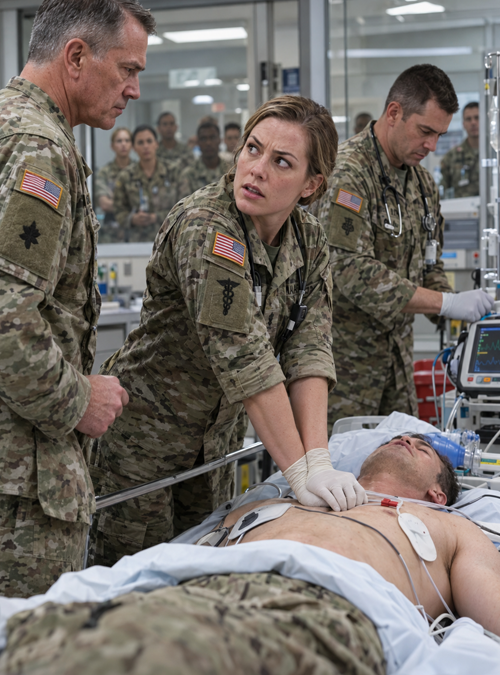
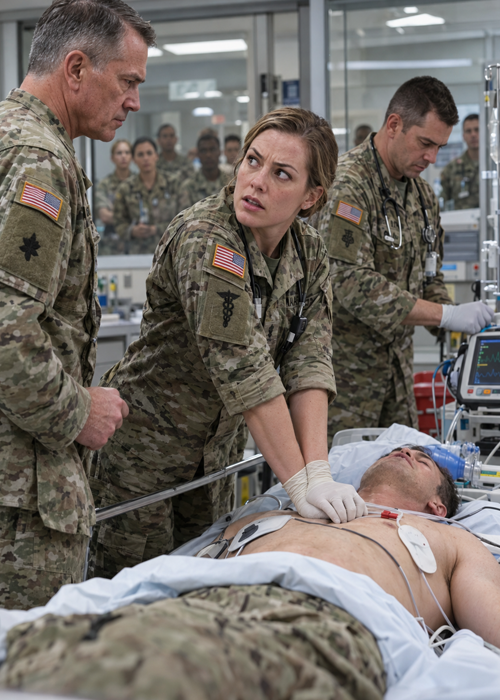
My hands were pressed against an unconscious man’s chest. His heart had stopped, Dr. Oay was directing the resuscitation, and I was working to keep blood circulating until we could restore a rhythm.
I looked up at the man standing beside the bed.
“Sir, if I stop, he could die.”
Hollis glanced through the glass wall at six wealthy visitors watching us from the corridor.
Then he said something I will never forget.
“I’ll accept that clinical outcome.”
My name is Cassidy Vance. I was thirty-three years old, an emergency room nurse at Harlo Regional Medical Center in Milhaven, Colorado.
I’d been at that hospital for three years.
Before becoming a civilian nurse, I’d spent four years in the Army, including time attached to a forward surgical unit.
I knew what it felt like to work in places where resources were limited, decisions had to be made quickly, and somebody’s life depended on the person standing closest to the bed.
But I’d never had a hospital CEO tell me that a patient’s death was an acceptable price for making investors comfortable.
That morning began with snow.
It had been falling since four, covering the streets in a soft layer of white.
Inside the emergency department, everything smelled like disinfectant and old coffee.
I’d already been on my feet for nine hours.
My shift was over.
I’d reached the locker room, put on my coat, and started unclipping my badge when the radio crackled.
“Trauma incoming. Male, forties. Unresponsive. Blood pressure dropping. Four-minute ETA.”
I stopped moving.
I remember looking at my coat sleeve.
There was a tiny loose thread near the cuff that I’d been meaning to trim for weeks.
For some reason, that detail stayed with me.
I was exhausted. My apartment was waiting. I had food in the refrigerator and a paperback I’d been carrying around without finding time to read.
I could have gone home.
There were other nurses on duty.
But I knew the department was stretched thin, and an unstable trauma patient was minutes away.
I hung my coat back up.
Then walked out.
At 6:14 a.m., the ambulance doors opened.
The paramedics brought in a large man, broad-shouldered and blue around the lips from the cold.
They’d found him collapsed beside an access road near the Milhaven overpass.
No wallet.
No phone.
No identification.
He wore work pants, a thermal shirt, and rugged boots. His clothing reminded me of military field gear, though there was nothing that established who he was.
One paramedic said he’d briefly regained consciousness but hadn’t been able to explain what happened.
Then he’d deteriorated again.
Dr. Raymond Oay met the gurney before it was fully inside.
I’d worked with Raymond long enough to trust him in a crisis.
He wasn’t dramatic.
He didn’t waste words.
He listened to the paramedics, assessed the patient, and began directing the team.
“Pressure?”
“Sixty by palpation. We had seventy earlier.”
“Breathing?”
“Labored.”
I pulled on gloves.
The patient’s skin was cold.
There was a bruise across his jaw, and his clothing was damp with melted snow.
I checked the equipment while Raymond assessed him.
We began working.
The first several minutes were busy but controlled.
Medication.
Monitoring.
Repeated assessments.
People moving around one another without needing much explanation.
Then the cardiac monitor sounded.
The patient’s condition had worsened abruptly.
Raymond looked at the rhythm.
“Start compressions, Cassidy.”
I was already moving into position.
People who’ve never watched CPR sometimes imagine something gentle.
It isn’t.
Effective chest compressions require sustained force.
They exhaust your arms and shoulders.
And sometimes, despite doing everything correctly, you feel a rib give beneath your hands.
I knew that from training.
I knew it from the Army.
I knew it from years in emergency medicine.
But knowing what to expect doesn’t make the sensation pleasant.
Several minutes into the resuscitation, I felt a sharp change beneath my palms.
A muffled crack.
I kept going.
Raymond was directing the resuscitation and preparing the next intervention.
A second nurse managed the equipment.
The monitor continued sounding.
We were focused on the man in front of us.
None of us was thinking about the investor tour.
Harlo Regional was in the middle of seeking funding for an expansion.
Garrett Hollis, our fifty-one-year-old CEO, had organized a visit for six potential investors that morning.
The proposed commitment was worth $7 million.
I’d seen the announcements around the hospital.
New facilities.
Better patient services.
Modernization.
The sort of language administrators used when they wanted donors and investors to feel confident.
There was nothing wrong with seeking funding.
Our hospital needed equipment.
We’d been asking for upgrades for months.
But Hollis cared deeply about appearances.
The executive hallways had expensive furniture and polished floors.
The emergency department had aging equipment and staffing shortages.
Our requests moved slowly through administration.
The investor tour, on the other hand, had been arranged down to the minute.
Unfortunately for Hollis, real emergencies don’t follow presentation schedules.
At approximately 6:31, he and his visitors reached the glass corridor outside Trauma Bay 2.
From there, they could see everything.
Me performing chest compressions.
Raymond working beside the patient.
The crash cart.
The monitors.
The staff moving quickly through a resuscitation.
I didn’t notice the group at first.
Then the trauma bay door opened.
Hollis entered wearing a tailored suit.
He looked around the room as though we’d arranged an embarrassing display specifically to upset him.
“Dr. Oay.”
Raymond glanced up.
“Sir, this isn’t a good time.”
“I need this situation relocated or resolved immediately.”
I kept my hands moving.
Raymond said, “We’re in the middle of a resuscitation.”
Hollis looked toward the investors.
Then back at the bed.
“This is an important tour.”
Nobody answered.
He stepped closer.
“Do you understand who’s standing outside that glass?”
I couldn’t believe we were having this conversation.
I was counting compressions.
Keeping my elbows locked.
Watching for Raymond’s next instruction.
Hollis turned toward me.
“And who are you?”
“Cassidy Vance. Emergency nursing.”
He looked at my hands.
I told him we were trying to save the patient’s life.
He said he was the CEO.
I looked directly at him.
“And he’s our patient.”
Something changed in his face.
I hadn’t raised my voice.
Hadn’t insulted him.
But I’d contradicted him in front of people he wanted to impress.
“Step away from the bed,” he said.
I kept working.
“Not while he needs compressions.”
Raymond moved toward the equipment.
Hollis stared at me.
Then he lowered his voice.
“Stop the compressions.”
I looked up.
“His heart has stopped. If we interrupt care without a clinical reason, he may die.”
Hollis gestured toward the corridor.
“The investors out there are deciding whether to commit seven million dollars to this hospital.”
I could see them through the glass.
One older man stood very still, watching.
The others looked confused.
Hollis continued.
“They’re watching you perform something that looks violent. I can’t have this representing our institution.”
I looked at the man beneath my hands.
His face was pale.
He couldn’t explain himself.
Couldn’t tell us his name.
Couldn’t object to what Hollis was asking.
He had only the medical team around him.
I told Hollis again.
“He could die.”
He didn’t hesitate.
“I’ll accept that clinical outcome.”
Raymond drew a sharp breath.
For one second, I heard the monitor, the movement of the equipment, and the blood rushing in my ears.
I thought about a patient I’d lost during my Army service.
Someone who’d needed care but hadn’t received the right resources in time because of a command decision.
I’d left the military with that memory still lodged inside me.
I hadn’t come to Harlo Regional to relive it.
Hollis stepped forward.
His hand closed around my shoulder.
He tried to pull me away from the bed.
I shrugged him off and returned my full attention to the patient.
“Don’t touch me while I’m working.”
His face flushed.
“You’re finished at this hospital.”
I kept the compressions steady.
“You’re fired, Vance. Do you understand me?”
I could feel my arms tiring.
But the patient’s life was still in our hands.
“Fire me tomorrow,” I said. “Right now, he needs us.”
Raymond prepared the defibrillator.
I moved clear when instructed.
“Everybody clear.”
The shock was delivered.
I watched the monitor.
For one terrible moment, I couldn’t tell whether it had worked.
Then the rhythm changed.
Raymond checked the patient.
“We have a rhythm.”
I stepped back, breathing hard, my arms trembling from the effort.
The man still needed critical care.
But his heart was beating again.
I looked at Hollis.
He was already reaching for his phone.
And the first person he called wasn’t a doctor.
Part 2…..
FULL STORY
IF FACEBOOK BROUGHT YOU HERE, HERE’S THE CONTINUATION YOU’VE BEEN WAITING FOR. ENJOY! 👇
Garrett Hollis called security.
Not another doctor.
Not someone who could help stabilize the patient.
Security.
I watched him speak into his phone while Dr. Oay continued directing care.
The man on the bed had a heartbeat again, but his blood pressure remained dangerously unstable.
We weren’t finished.
He still needed monitoring, treatment, and transfer to a higher level of care.
I turned toward Raymond.
“Keep watching his pressure.”
He nodded.
“I’ve got him.”
Those three words were the only reason I allowed myself to step farther from the bed.
Two security officers appeared outside the trauma bay.
Hollis walked toward them.
Then turned back to me.
“Miss Vance. Your badge.”
I looked at him.
“Right now?”
“Right now.”
Behind him, the investors were still standing near the glass.
Some had moved away.
The older gentleman who’d been watching throughout the resuscitation remained near the doorway.
Hollis seemed to be concentrating on maintaining his composure.
I was trying to understand how a man could order someone to stop lifesaving care and then behave as though the nurse was the problem.
“You’ll be escorted to the locker room,” he continued. “Collect your personal belongings and leave the premises.”
I felt the familiar beginnings of anger.
But underneath it was something colder.
I had done my job.
My patient was alive.
And the hospital administrator responsible for supporting that work was removing me because I’d refused to obey an unsafe instruction.
I unclipped my badge.
Held it out.
Hollis didn’t take it himself.
He nodded toward the officer beside him.
The officer stepped forward and accepted it.
I looked back through the trauma bay window.
Raymond was beside the patient’s head, watching the monitor.
Another nurse was managing the equipment.
I wanted to go back inside.
I wanted to make sure the man’s blood pressure stabilized.
Instead, I told Hollis the patient still needed close monitoring.
“That’s no longer your concern,” he said.
I looked at him for a long moment.
Then nodded.
There wasn’t anything useful left to say.
The officers walked me to the locker room.
I changed out of my scrubs.
Folded them.
Placed my belongings into a plastic bag.
A spare hair tie.
A granola bar I’d been carrying around for days.
My paperback.
A few small things that didn’t add up to much.
I kept expecting myself to cry.
But I didn’t.
Not in the locker room.
Not in the elevator.
Not when I walked past the reception desk.
Outside, the snow was still falling.
I crossed the parking lot with my shoulders straight.
My car was parked near the far fence.
It took three attempts to start the engine.
That was normal in a Colorado winter.
I sat there with the heater running and watched my breath fog the windshield.
Then I began making a list in my head.
Check savings.
Update my résumé.
Look at travel nursing positions.
Find out what documentation I needed.
Figure out whether I could afford my apartment until I found another job.
It was the sort of list I’d learned to make when something went wrong and there was no time to sit with how frightened I felt.
I pulled out of the parking lot.
Three miles from the hospital, my phone rang.
An unfamiliar local number.
I almost ignored it.
Then I answered.
“Ms. Vance?”
“Speaking.”
“My name is Sergeant First Class Darren Enosy.”
His voice was controlled and direct.
“I’m calling on behalf of people with a significant interest in the patient admitted to Harlo Regional this morning.”
I tightened my grip on the steering wheel.
“The unidentified trauma patient?”
“Yes.”
He paused.
“We understand you were involved in his resuscitation.”
“I was.”
“And that you were subsequently removed from the hospital.”
I stared through the windshield.
“That’s accurate.”
He asked about the patient’s condition.
I explained that the man had regained a cardiac rhythm but remained unstable when I was taken off the case.
I couldn’t tell him anything beyond that.
Then he asked whether I’d noticed anything unusual about the man’s presentation.
His clothing.
His belongings.
Anything that might help explain what had happened.
I thought about the boots.
The thermal shirt.
The weathered hands.
The military style of his clothing.
“Who are you asking on behalf of?” I said.
There was a brief silence.
Then Enosy answered.
“Someone who will want to know you kept him alive.”
Before I could ask another question, he said they would be in touch.
The call ended.
I sat at the next red light staring at my phone.
Then somebody honked behind me.
I drove home.
My apartment was small but organized.
There was a corkboard above my desk holding nursing certification reminders and course schedules.
A mug sat beside my laptop.
The window faced a residential street where snowplows were beginning to make their rounds.
I opened a nursing job website.
Then sat looking at the search bar.
I’d spent years building my civilian career.
Harlo Regional was supposed to be a place where I could practice emergency medicine without the complications I’d left behind in the Army.
Now I was unemployed because I’d refused to abandon a patient.
I tried typing a job title.
Stopped.
Then closed the laptop.
My phone buzzed.
A message from Raymond.
He’s stable. Moved to ICU.
I read it twice.
A minute later, another message arrived.
For what it’s worth, you did the right thing.
I sat back.
The relief came so suddenly that my eyes filled.
The man was alive.
He’d made it through the immediate crisis.
I set the phone down and pressed my palms against my eyes.
For the first time that morning, I let myself feel how close we’d come to losing him.
A local news alert appeared later that afternoon.
Police were investigating an unidentified man found near Overpass Road.
The report suggested a possible military connection.
I read it carefully.
Then called the number Sergeant Enosy had used.
Nobody answered.
That evening, I spoke to Raymond again.
He told me identification had been discovered among the patient’s belongings.
Something concealed in one of his boots.
“What kind of identification?” I asked.
Raymond hesitated.
Then said, “Cassidy, I think this is going to become a lot bigger than either of us expected.”
He couldn’t tell me more.
I didn’t push.
At 11:47 that night, another unfamiliar number appeared on my phone.
This time the caller identified himself as Major Elliot Carr.
He was calling on behalf of Colonel Voss’s command.
“Colonel Voss?” I repeated.
“The patient admitted this morning.”
My eyes closed.
At least I finally knew his name.
“Is he alive?”
“Stable as of two hours ago.”
I exhaled.
Carr explained that several hospital employees had already been interviewed.
They knew about the confrontation in the trauma bay.
They knew Hollis had ordered me to stop compressions.
And they knew I’d been fired afterward.
He wanted to know whether I would provide a formal statement.
“About what specifically?” I asked.
“About what the CEO ordered you to do while Colonel Voss was in cardiac arrest.”
I thought about Hollis’s hand on my shoulder.
The investors beyond the glass.
The sound of the monitor.
And his words.
I’ll accept that clinical outcome.
“Yes,” I said.
“I’m willing.”
The following morning, I arrived at the Milhaven field office of the Inspector General’s Division.
Major Carr met me in the lobby.
He introduced me to Captain Reyes and a representative from the state health department’s regulatory division.
We sat in a small conference room with harsh lighting and terrible coffee.
They asked me to begin at the ambulance arrival.
I told them everything.
The patient’s condition.
The resuscitation.
What Hollis said.
Where he was standing.
How he’d tried to pull me away from the bed.
How I’d responded.
And what happened when the patient’s rhythm returned.
Carr took notes.
The regulatory representative wrote almost continuously.
When I repeated Hollis’s statement about accepting the patient’s death, Carr looked up.
“Those exact words?”
“Those exact words.”
“And he physically touched you?”
“He placed his hand on my shoulder and attempted to pull me away from the patient.”
“What did you do?”
“I removed his hand and continued.”
The regulatory representative asked whether my response had been forceful.
“Yes,” I said.
Then I explained why.
“He was interfering with emergency treatment. The patient was in cardiac arrest.”
Nobody argued.
The interview lasted more than two hours.
When it ended, Carr walked me toward the lobby.
“What happens now?” I asked.
He stopped.
“Your account will be reviewed alongside the other statements and available records.”
“And my job?”
“I can’t make promises about your employment.”
He looked directly at me.
“But I can tell you this isn’t over.”
I went home.
Opened my laptop.
And tried again to look for work.
The following day, the story reached the news.
A reporter from the Milhaven Gazette had spoken with hospital sources.
The headline described a nurse who’d been dismissed after helping save an unidentified patient.
By afternoon, regional television stations were covering it.
People were angry.
Some demanded an explanation.
Others questioned whether the reports were accurate.
A few defended the hospital without knowing what had happened.
My friend Priya called.
She worked in hospital administration two cities away.
“Please tell me you have a lawyer.”
“I’m looking.”
“Cassidy.”
“I know.”
“No, you don’t. You saved a man’s life, and your CEO fired you for it. Get a lawyer.”
She was right.
I began making calls.
Then another message arrived.
It came from Marcus Reyes, a younger nurse at Harlo I’d helped train eighteen months earlier.
He’d forwarded an internal hospital communication.
Hollis had sent it to department heads.
The statement described my dismissal as the result of insubordination and inappropriate professional conduct.
It said he had been exercising executive oversight during a serious clinical event.
It did not mention the cardiac arrest.
It did not mention his order to stop CPR.
And it did not mention that the patient had regained a rhythm before I was escorted away.
I read the memo twice.
Then forwarded it to Carr.
He replied shortly afterward.
Received. Thank you.
A few minutes later, another message appeared.
Please don’t speak to the press yet. We’re close to something.
I stared at the screen.
Close to what?
That evening, I called my mother in Phoenix.
She answered immediately.
“Cassidy? It’s Thursday.”
She knew my routine.
I usually called on Sundays.
I told her enough to explain why I was upset.
She listened.
Then asked, “Did you do what you knew was right for the patient?”
“Yes.”
“Then don’t start doubting yourself because somebody important didn’t like it.”
I looked toward the snow outside my window.
“I know, Mom.”
“Good.”
She paused.
“Now eat something and get some sleep.”
For once, I listened.
The next morning, Marcus texted again.
There are military people here. A lot of them.
I sat up.
Then called Raymond.
He answered almost immediately.
“How many?” I asked.
“Four vehicles. At least eight personnel.”
He lowered his voice.
“One of them is a brigadier general.”
I pressed my hand against my forehead.
“Who?”
“Helena Marsh.”
He explained that the general had visited Colonel Voss in the ICU before going to the executive offices.
Apparently, she’d spent time with him before speaking to the hospital leadership.
That sequence mattered.
She hadn’t come to the hospital merely to confront an administrator.
She’d gone to see the patient first.
Raymond was quiet for a moment.
Then said, “Cassidy, I should’ve done more when Hollis came into the trauma bay.”
I looked down.
“Raymond, you were treating the patient.”
“I know. But I heard everything.”
“So did I.”
“You shouldn’t have had to stand there alone.”
I thought about him preparing the defibrillator while I kept compressing.
“You didn’t leave the patient,” I said. “Neither did I.”
He didn’t sound entirely satisfied.
But he understood.
We ended the call.
A short time later, somebody knocked on my apartment door.
I looked through the peephole.
A woman in military dress uniform stood on my porch.
She was in her fifties, with a compact build and the stillness of somebody who didn’t waste movements.
I recognized the rank insignia.
I opened the door.
“Ms. Vance?”
“Yes.”
“I’m Brigadier General Helena Marsh.”
She paused.
“May I come in?”
I stepped aside.
She followed me to the kitchen table.
I offered coffee.
She accepted.
For a few moments, we sat across from one another in the pale winter light.
Then she said, “Colonel Voss is expected to recover.”
My hands tightened around the mug.
“How well?”
“As far as his physicians can tell, the damage from the cardiac event was manageable.”
I looked down.
The relief felt almost painful.
“He was fortunate.”
Marsh watched me.
“He was.”
Then she continued.
“But fortune didn’t perform those compressions.”
I didn’t answer.
She’d reviewed my military service records.
She knew about my time with the 214th Forward Surgical Team.
She knew I’d left the Army voluntarily.
Then she asked why.
I rarely discussed that decision.
But something about the way she asked made me answer honestly.
During my final deployment, we’d lost a patient after a decision about medical transportation and resource priorities.
The choice hadn’t been mine.
And the consequences hadn’t been something I could fix.
I hadn’t handled what followed particularly well.
I’d remained in service for several more months.
Then I knew I needed to leave.
Marsh listened without interrupting.
When I finished, she nodded.
Then said, “Your nursing record at Harlo Regional is excellent.”
I shrugged.
“Different environment.”
“Same person.”
I looked at her.
She placed her mug down.
Then explained why she’d come.
The state health department was reviewing Hollis’s interference in emergency medical care.
The hospital board had been notified.
Witness statements had been collected.
And there was something else.
“Trauma Bay 2 has surveillance footage,” she said.
I sat completely still.
“The recording captures the confrontation.”
“Everything?”
“The relevant footage includes his orders, the physical contact, and your response.”
I stared at her.
For days, I’d been replaying that moment in my head.
Wondering whether Hollis would claim I misunderstood him.
Whether he’d say I’d become aggressive.
Whether the hospital would believe his account because he was the CEO.
Now I knew the evidence didn’t depend only on my memory.
“He said it on camera,” I whispered.
“Yes.”
Marsh studied me.
“The question now is what you want to do when this is resolved.”
I opened my mouth.
Then my phone lit up on the table.
Marcus.
Hollis just called security.
A second message appeared.
On the board members.
I showed Marsh.
She read both messages.
Then stood.
“Where’s your coat?”
We reached Harlo Regional a short time later.
Three black vehicles pulled toward the main entrance.
Marsh walked through the lobby with several personnel.
I stayed beside her.
The executive offices occupied much of the fourth floor.
When we reached the conference room, Hollis was sitting at the head of the table.
The hospital’s legal counsel stood nearby.
Several board members were present.
So was Dr. Reed, the chief medical officer.
A woman with short silver hair introduced herself as Sandra Ellery, the board chair.
Hollis looked at me first.
Then at Marsh.
“General, I wasn’t aware you would be attending.”
“I’m not here to attend your meeting,” Marsh said.
She placed a folder on the table.
“I’m here to provide information about what happened to Colonel Voss.”
The room became quiet.
Inside the folder were records from January 9.
A timeline.
Clinical documentation.
Witness statements.
And a transcript of the surveillance footage.
The board members began reading.
I stood near the door.
For several minutes, nobody spoke.
Then one man looked up.
“Garrett.”
Hollis turned.
“Did you actually say this?”
Hollis leaned forward.
“The statement is being taken out of context.”
The board member looked back at the paper.
“It’s a direct transcript.”
Hollis began explaining the investor tour.
The funding pressure.
The importance of maintaining confidence in the hospital.
Dr. Reed closed her folder.
“Cassidy Vance followed appropriate resuscitation procedures,” she said.
Her voice was clear.
“The patient regained a rhythm after the interventions directed by Dr. Oay. Her actions were clinically justified.”
She turned toward Hollis.
“You were attempting to interrupt that care.”
He looked at her.
“I was managing institutional risk.”
Sandra Ellery stared.
“Your risk-management decision was to tell a nurse to stop CPR?”
Hollis tried to answer.
Ellery cut him off.
“I’ve served on hospital boards for years. I have never seen documentation like this.”
She looked toward me.
“Ms. Vance, were you dismissed that morning?”
“Yes.”
“Immediately after the patient’s resuscitation?”
“Yes.”
She nodded.
Then looked at Hollis.
“Garrett, I need you to leave the room.”
He stared.
“What?”
“The board needs to meet without you.”
Hollis stood slowly.
His attorney followed him.
When he passed me, he didn’t look in my direction.
The door closed behind him.
I stood there for a moment.
Then Marsh guided me into the corridor.
“Now we wait.”
I was placed in a small conference room with a window.
Somebody brought coffee.
I didn’t touch it.
The hospital continued operating around us.
Ambulances arrived.
Doctors made rounds.
Families waited for news.
People still needed care.
Whatever happened upstairs wouldn’t change that.
Dr. Reed came to see me while the board was meeting.
She sat across from me.
Then said, “I owe you an apology.”
I frowned.
“For what?”
“I knew Hollis had interfered with clinical decisions before.”
I looked at her.
She explained that she’d documented smaller incidents.
Decisions about staffing.
Equipment.
Resources.
Administrative pressure that made patient care more difficult.
She’d raised concerns internally but hadn’t pushed them far enough.
“I convinced myself I was managing the problem by staying close to it,” she said.
She looked down.
“But I wasn’t fixing it.”
I watched her.
There was something difficult about seeing a competent physician admit that she’d allowed a bad situation to continue.
She wasn’t looking for forgiveness.
She was acknowledging responsibility.
Then she told me something unexpected.
The board was considering funding a restructured trauma division.
The hospital needed someone to lead it.
And Dr. Reed had recommended me.
I stared.
“I’m a floor nurse.”
“You’ve been doing much of the work of a senior department leader for years.”
“That’s different from running a division.”
“Yes,” she said. “It is.”
She paused.
“But I’ve seen how you work, Cassidy. I know what you’re capable of.”
I looked toward the window.
For three days, I’d been wondering whether I’d ever work at Harlo Regional again.
Now somebody was suggesting I might return with more authority than I’d ever had.
I didn’t know what to do with that possibility.
Dr. Reed stood.
“Don’t decide anything until the board has finished.”
Then she left.
A while later, my phone rang.
An unfamiliar number.
I answered.
“Hello?”
A low, rough voice said, “Is this the nurse who cracked my ribs?”
I closed my eyes.
“Colonel Voss?”
“I’ve been trying to get someone to give me your number.”
He sounded tired.
And uncomfortable.
But very much alive.
I sat up.
“How are you feeling?”
“Like somebody dropped a truck on my chest.”
“That’s fairly consistent with what happened.”
He made a sound that might have been a laugh if his ribs hadn’t hurt.
He told me he’d heard about the resuscitation.
About Hollis.
About the order to stop.
Then he became quiet.
“I wanted to thank you.”
I looked down at my hands.
“You don’t have to.”
“I know.”
He paused.
“I’m saying it anyway.”
I waited.
“I’ve been in situations where somebody made a decision that kept me alive. Sometimes I didn’t get a chance to tell them what it meant.”
His voice steadied.
“I didn’t want that to happen this time.”
I swallowed.
“You’re welcome, Colonel.”
He asked whether I was coming back to the hospital.
“I don’t know yet.”
“You should.”
I almost smiled.
“For whatever that’s worth coming from the patient whose ribs you broke.”
“It’s worth something.”
Then I heard him shifting.
“Are you trying to sit up?”
A pause.
“Possibly.”
“Lie down.”
“How did you know?”
“Because you sound like somebody trying to sit up.”
Another pause.
“Yes, ma’am.”
When the call ended, I sat holding the phone.
I’d been fired.
Humiliated.
Questioned by investigators.
And pulled into a situation I still didn’t fully understand.
But the man from Trauma Bay 2 was alive.
He’d called to tell me himself.
For a moment, that was enough.
At 1:51 that afternoon, Sandra Ellery entered the room.
General Marsh followed.
Ellery sat down.
“The board has made three decisions.”
I waited.
“First, Garrett Hollis’s contract as CEO has been terminated, effective immediately.”
I stared at her.
The words took several seconds to register.
She continued.
“He has been removed for conduct that endangered patient welfare.”
I looked down.
Part of me expected satisfaction.
Instead, I felt an enormous weariness.
For days, I’d been bracing against the possibility that Hollis would emerge from the situation untouched.
Now he was being held responsible.
And I was too tired to celebrate.
“Second,” Ellery said, “we’ve requested a broader regulatory review of executive interference in clinical operations.”
She explained that Dr. Reed and several other physicians had provided documentation of earlier incidents.
The board wanted those investigated.
Then came the third decision.
“Your dismissal has been classified as wrongful under our emergency care protocols and applicable employee protections.”
I stared.
“You’re entitled to reinstatement, back pay, and a formal apology.”
She paused.
“There’s also the trauma division proposal.”
I looked at Marsh.
The general said nothing.
Ellery continued.
“We’ve provisionally approved funding for a restructured emergency trauma service. Dr. Reed recommended you to lead it.”
My mouth went dry.
“We’re offering you the directorship.”
For several seconds, I couldn’t speak.
I thought about my old badge.
The security officer taking it from my hand.
The plastic bag containing my belongings.
The snowy parking lot.
Then I looked at Ellery.
“I have conditions.”
She raised her eyebrows.
“Tell me.”
“The equipment requests that have been ignored for two years need to be reviewed before I accept.”
She nodded.
I continued.
“Our emergency department has been understaffed for eighteen months. That needs a real staffing plan, not more pressure on exhausted nurses.”
Ellery began taking notes.
“And I want Dr. Oay’s leadership responsibilities formalized.”
She looked up.
“Anything else?”
“Not today.”
I paused.
“But there will probably be more.”
For the first time, she smiled.
“I expect there will.”
Later that afternoon, I visited Colonel Voss in the ICU.
Marsh had arranged it.
He was propped against the pillows, bruised and pale, with monitors surrounding his bed.
He looked at me.
“You’re younger than I expected.”
I pulled a chair closer.
“You’re more intact than I expected.”
He smiled.
Then immediately regretted it when his ribs hurt.
We sat quietly for a moment.
He told me what little he remembered.
The cold near the road.
A brief moment of awareness in the ambulance.
Then nothing.
When he woke, his chest hurt, and people were telling him about the nurse who’d refused to stop CPR.
“I don’t know how to thank you,” he said.
“Then don’t make it complicated.”
He looked at me.
“All right.”
He paused.
“Thank you for not stopping.”
I nodded.
He seemed satisfied with that.
Then he asked whether I’d accepted the new position.
“Not officially.”
“Are you going to?”
“Probably.”
He studied me.
“Ask for what you need.”
“I already started.”
“Good.”
When I left his room, I felt more certain than I had that morning.
The hospital could offer me a title.
But if nothing changed for the people working at the bedside, the title wouldn’t mean very much.
I wanted the work to matter.
I walked toward the elevator.
The doors opened.
Garrett Hollis stood inside.
He wore his coat and carried a cardboard box beneath one arm.
His badge was gone.
For a moment, neither of us moved.
Then he stepped out.
I moved aside.
He walked past without looking at me.
I watched him go.
I didn’t say anything.
I didn’t need to.
I stepped into the elevator.
Then, as I reached the main lobby, I noticed something unusual.
Three people in civilian clothes were moving toward the service corridor leading to the east wing.
One carried a hard case.
They weren’t dressed like hospital employees.
Their movements were controlled, purposeful, and oddly careful.
One glanced at me.
Then quickly looked away.
Something about it reminded me of situations I’d encountered during my military service.
I stopped near the corridor entrance.
Then pulled out my phone.
I called Major Carr.
No answer.
I called General Marsh.
She picked up after several rings.
“Where are you?” she asked immediately.
“The main lobby.”
I kept my voice low.
“Three people just headed toward the east wing service corridor. One has a hard case.”
There was a pause.
Then Marsh’s voice changed.
“Do not follow them.”
I looked toward the corridor.
“General—”
“Go to the main exit. There’s a black vehicle at the curb. Get in.”
I started moving.
“What is going on?”
“Cassidy.”
She used my first name.
“Move now.”
I reached the main doors.
The black vehicle was waiting.
The driver unlocked the back door before I touched the handle.
I climbed inside.
Then heard a distant electronic tone from somewhere inside the building.
A system notification.
Something going offline.
I looked back at the hospital.
Marsh was still on the phone.
“What is in the east wing?”
She hesitated.
“Network infrastructure. Servers. Hospital records. Monitoring integration.”
I felt cold.
“ICU monitoring?”
“Yes.”
Colonel Voss was upstairs.
Recovering.
Dependent on a hospital whose systems might be under attack.
“General—”
“I have people inside. Stay where you are.”
Then she stopped speaking.
I sat in the vehicle with the phone against my ear.
Four minutes passed.
They felt much longer.
Finally, Marsh returned.
“We have them.”
I closed my eyes.
“All three?”
“All three.”
She explained that the individuals had been stopped before reaching the server room.
The hard case contained equipment consistent with an attempted network intrusion, including devices apparently intended to interfere with signals and connect to hospital data systems.
My hands began trembling.
I looked at them.
It was the same delayed reaction I’d experienced after the resuscitation.
At the time of the danger, my body had simply worked.
Afterward, when there was nothing left to do, everything I’d held back started catching up.
“Who are they?” I asked.
“That’s being investigated.”
Then she said something I couldn’t stop thinking about.
“The timing isn’t being treated as a coincidence.”
I thought about Hollis leaving with his cardboard box.
The three strangers moving toward the server annex minutes later.
The investor tour.
The unidentified patient.
The orders to stop CPR.
I looked through the tinted window.
“Did Hollis make a call?”
Marsh was quiet.
“That’s one possibility we’re examining.”
Later, Major Carr interviewed me again.
I described exactly what I’d seen.
Where the three people had been standing.
Which direction they walked.
The hard case.
The glance from the man nearest the service door.
Carr recorded everything.
Then told me the individuals were in federal custody while their identities and activities were investigated.
Some of their documentation didn’t withstand preliminary checks.
One had communications investigators were examining.
I asked about Hollis.
Carr looked at me.
“He’s been detained for questioning.”
I sat very still.
Not arrested.
Not convicted.
Questioned.
But the story was growing beyond a hospital administrator who cared more about investors than patients.
And I was beginning to understand that it might not have been only about appearances.
The next evening, Carr called again.
Investigators had identified a connection between one of the detained individuals and a healthcare investment advisory firm.
The firm had links to the group involved in Hollis’s investor tour.
I thought about the older man standing near the glass on January 9.
The way he’d watched the resuscitation.
“Are you saying someone in that group knew who Colonel Voss was?”
“We’re still verifying that.”
He paused.
“But we’re examining whether the investor visit had another purpose.”
I stood near my apartment window watching the snow begin falling again.
“Do you think Hollis knew?”
“That’s part of the investigation.”
Carr then told me investigators were examining the CEO’s phone records from the morning of the resuscitation.
Some calls were accounted for.
Others required more work.
I remembered Hollis’s manner in the trauma bay.
His insistence that we clear the room.
The speed with which he’d threatened my job.
The phone in his hand.
I no longer felt certain that his behavior had been motivated only by embarrassment.
But suspicion wasn’t proof.
I’d spent enough years documenting clinical events to understand why the distinction mattered.
Carr agreed.
Then told me he’d contact me when they had more.
After hanging up, I sat at my kitchen table.
I opened a spreadsheet.
Not the financial records of the investigation.
My equipment list.
Portable ultrasound replacement.
Cardiac monitoring upgrades.
Defibrillator servicing.
Staffing coverage.
The practical things Harlo Regional should have addressed long before January 9.
I couldn’t conduct the federal investigation.
Couldn’t undo what Hollis had done.
But I could help rebuild the emergency department.
So I worked.
The following morning, Sandra Ellery met me in the hospital lobby.
Two investigators were standing with her.
She looked exhausted.
“There’s something you need to know.”
I stopped.
“The phone records identified another person.”
“Who?”
She hesitated.
“Warren Aldrich.”
I recognized the name.
He was a member of the hospital board.
One of the men who’d sat across from Hollis during the emergency meeting.
The man who’d read the surveillance transcript and asked whether Hollis had really said those words.
I stared.
“He’s on the board.”
“Yes.”
“He voted to dismiss Hollis.”
“Yes.”
I tried to understand.
Ellery explained that investigators had identified a four-minute telephone conversation between Hollis and Aldrich on the morning of January 9.
The call took place shortly before Hollis ordered me to stop the resuscitation.
Aldrich hadn’t disclosed it during the board meeting.
He’d voted to terminate Hollis while withholding his own involvement in the events under investigation.
I looked at Ellery.
“Why would he do that?”
She didn’t answer immediately.
Instead, she led me upstairs.
Investigator Diane Fowls was waiting.
She worked through the available records carefully.
For months, Hollis and Aldrich had been involved in discussions surrounding a proposed hospital data partnership.
A healthcare investment group stood to benefit from it.
The arrangement involved access to sensitive hospital data infrastructure.
And the full board hadn’t been properly informed.
The more Fowls explained, the more familiar the pattern became.
Hollis had been making decisions without meaningful oversight.
Aldrich had been helping him.
They’d treated the hospital’s data systems as something they could negotiate over without the scrutiny those decisions required.
Then Colonel Voss had arrived as an unidentified patient.
His presence introduced the possibility of military and federal attention.
The investors’ proposed data arrangement could face scrutiny it hadn’t been designed to survive.
Fowls was careful about one thing.
They had evidence of an undisclosed arrangement and an attempted network intrusion.
They were still investigating how much Hollis and Aldrich knew about the precise plan.
They couldn’t yet establish every motive behind Hollis’s behavior in Trauma Bay 2.
I appreciated that caution.
Because the known facts were already disturbing enough.
I thought about my hands on Colonel Voss’s chest.
The cardiac monitor sounding.
Hollis looking through the glass.
And that calm, terrible sentence.
I’ll accept that clinical outcome.
Whatever else he knew, he’d been willing to interfere with a resuscitation.
That part wasn’t speculation.
It was documented.
Warren Aldrich was escorted from the building later that morning.
I saw him passing through the main lobby with federal officers.
His badge was gone.
He carried nothing.
He noticed me standing near the corridor.
For a moment, we looked at one another.
Then he turned away.
I didn’t feel satisfied.
I thought about the patients upstairs.
The people waiting for test results.
The nurses working double shifts.
The families who trusted Harlo Regional because they had nowhere else nearby to turn.
Those people hadn’t agreed to become part of a secret business arrangement.
They’d come for medical care.
That was what the institution was supposed to provide.
I went back to the trauma department.
Dr. Oay found me walking through the treatment bays with a clipboard.
“You’re back.”
“Almost officially. Friday.”
He looked at the list.
“Equipment?”
“Yes.”
I showed him the entries.
He immediately pointed toward Bay 3.
“That ultrasound is two generations out of date.”
“I know.”
“I’ve been requesting a replacement for eighteen months.”
“I read the reports.”
He looked surprised.
“All of them?”
“Enough to know nobody was responding.”
Raymond leaned against the counter.
For a moment, he looked older than I’d ever seen him.
“I should have escalated those complaints beyond Hollis.”
I put the clipboard down.
“Raymond, I don’t need you to spend the next year apologizing for what happened.”
He looked at me.
“I need you to help change it.”
He was quiet.
Then asked, “What do you need?”
“A department head who understands the problems and is willing to make difficult decisions.”
I paused.
“That’s you.”
He stared.
“I need you to want the responsibility, not just accept it because somebody asks.”
Raymond looked around the treatment bay.
Then nodded.
“I want it.”
“Good.”
He pointed to another item.
“The crash cart near the corridor also needs servicing.”
I handed him the clipboard.
“Show me.”
We spent the next forty minutes walking through the department.
Checking equipment.
Reviewing deferred requests.
Discussing staffing.
It was the most useful forty minutes I’d had all week.
No cameras.
No investors.
No executives talking about image.
Just two clinicians figuring out what needed fixing.
Later, I visited Colonel Voss again.
He looked better.
Still bruised.
Still uncomfortable.
But alert.
He noticed the clipboard.
“Equipment list?”
“Yes.”
“How bad?”
“Manageable, if somebody finally pays attention.”
He nodded.
Then asked about Aldrich.
I told him I was still trying to understand how someone could vote to remove Hollis while concealing his own connection to the investigation.
Voss considered that.
“He may have believed the inquiry would end once Hollis was gone.”
I looked at him.
“Make Hollis the whole story?”
“Possibly.”
We sat quietly.
Then I asked what would happen to them.
Voss didn’t pretend to know the outcome.
He explained that state regulators were examining the emergency-care interference and that federal investigators were reviewing the network intrusion and the possible data arrangement.
Those processes would take time.
The evidence would have to establish what each person knew and did.
There were serious potential consequences.
But those consequences wouldn’t be decided in a hospital room.
I nodded.
That was the right answer.
Then Voss leaned back.
“There’s something else I want to say.”
I waited.
“What you did in the trauma bay mattered.”
“I know.”
“Not just the compressions.”
I looked at him.
“You understood that a man with authority over your employment didn’t have authority to order you to abandon a patient.”
He paused.
“That’s harder than it sounds.”
I thought about how many times I’d watched people hesitate before challenging someone senior.
Not because they were bad people.
Because jobs mattered.
Paychecks mattered.
Reputations mattered.
And because institutions had a way of making an unsafe instruction sound like an ordinary professional expectation.
“I wasn’t trying to make a statement,” I said.
“I know.”
“He was going to die if we stopped.”
Voss nodded.
“And you acted on that.”
He looked directly at me.
“Don’t let anyone convince you that wasn’t enough.”
For a moment, I couldn’t speak.
I thought about the patient I’d lost during my military service.
The transport decision.
The feeling of watching circumstances move beyond the reach of the people trying to provide care.
I hadn’t gone into nursing because I believed every patient could be saved.
I knew better.
I’d gone into nursing because when there was something useful I could do, I wanted to do it.
“Thank you,” I said.
Voss smiled faintly.
Then winced.
“You’re welcome.”
I stood.
“Now stop moving around so much. Your blood pressure’s still higher than I’d like.”
He sighed.
“Yes, ma’am.”
On Friday morning, I returned to Harlo Regional for my formal reinstatement.
I’d told Ellery I didn’t want a ceremony.
No photographs.
No assembled staff.
No public congratulations.
Just the contract and the people who needed to approve the work.
She respected that.
We met in a conference room.
Sandra Ellery.
Dr. Reed.
Dr. Oay.
The interim administrative team.
Representatives involved in the regulatory process.
And Marcus Reyes.
I’d specifically asked for Marcus to attend.
He sat near the end of the table looking uncomfortable.
When I caught his eye, he seemed ready to explain why he’d come.
“You’re supposed to be here,” I told him.
He straightened.
We reviewed the employment agreement.
The equipment requests.
The staffing proposal.
The responsibilities of the new trauma division.
I asked questions.
So did Raymond.
There were practical disagreements about timelines and procurement.
We worked through them.
Nobody left early.
At 9:53 a.m., I signed.
Ellery slid a new identification badge across the table.
CASSIDY VANCE
DIRECTOR OF EMERGENCY TRAUMA SERVICES
I stared at it.
Five days earlier, a security officer had taken my badge in front of the investors.
Now I was being handed another.
I clipped it to my shirt.
Dr. Reed smiled.
“Welcome back.”
Raymond pushed a folder toward me.
“The first equipment approvals.”
Marcus looked up.
“The crash cart servicing is already scheduled.”
I smiled.
“Good.”
After the meeting, Carr stopped beside the door.
“The investigation will probably be in the news again.”
“I know.”
“Your name may come up.”
“I understand.”
He watched me.
“Are you comfortable with that?”
I thought about it.
I didn’t particularly want my face on television.
I wasn’t interested in becoming a symbol.
But the investigation concerned real misconduct.
Real patients.
Real consequences.
And keeping quiet because attention made me uncomfortable wouldn’t help anybody understand what happened.
“If the reporting is accurate,” I said, “then yes.”
Carr nodded.
Then left.
For a few minutes, I remained alone.
I looked at the new badge.
Then at the equipment folder.
The title mattered.
But not as much as what came next.
For years, nurses had submitted reports about aging equipment and insufficient staffing.
The hospital had acknowledged them without making meaningful changes.
Now I had an opportunity to insist that those problems receive attention.
I opened the folder.
At the top was a report that Marcus and three other nurses had spent six weeks preparing.
It documented staffing shortages over several months.
Equipment requests totaling approximately $240,000.
Repeated delays.
And specific problems affecting patient care.
The report had gone to Hollis.
He hadn’t acted on it.
I stared at the author names.
Then made a note beside Marcus’s.
Include in senior review planning.
I wanted the people who understood the problems to have a place in the decisions.
Not just the executives who signed the budgets.
By afternoon, the state health board had issued another decision.
Harlo Regional would enter a provisional oversight period.
For twelve months, an independent administrator would review major executive decisions.
The hospital’s proposed data partnership was suspended pending a full disclosure review.
Investment groups connected with the network intrusion attempt would not be allowed to continue contracting with the hospital.
The regulatory record would also document what had happened in Trauma Bay 2.
Hollis’s interference.
The resuscitation.
The clinical response.
And the failure of hospital leadership to protect emergency care.
The official who called me explained that the documentation would form part of the hospital’s permanent quality records.
I listened.
Then asked, “What does that mean for the staff?”
“It means the conduct is formally acknowledged.”
She paused.
“And the leadership failure is formally acknowledged, too.”
I thanked her.
After hanging up, I stood in the trauma department.
A nurse was treating a minor laceration in Bay 1.
The ambulance radio sounded from the station.
Somewhere down the corridor, a family was asking whether they could visit a patient.
Ordinary work.
Necessary work.
I walked toward Marcus.
He was updating a chart.
“How’s the staffing review?”
“Draft is almost finished.”
“Send it to me tonight.”
He nodded.
Then hesitated.
“Dr. Oay said you’re restructuring the senior review process.”
“Yes.”
“Would there be room for me to help?”
I looked at him.
Marcus was twenty-six.
He’d risked retaliation by forwarding Hollis’s internal communication after my dismissal.
He’d helped write a detailed staffing report that management ignored.
And he was standing in front of me asking whether he could participate in fixing the problems he’d already spent months documenting.
“I was going to ask you to lead part of it,” I said.
He stared.
“Really?”
“You know what the nurses on this floor need. You helped identify the gaps.”
I paused.
“It would be a mistake to make decisions about those things without you.”
He looked down at the chart.
For a moment, his expression changed.
Then he nodded.
“Okay.”
I waited.
“Yes,” he said. “I’d like that.”
“Good.”
I smiled.
“Staffing draft tonight.”
He laughed.
“Tonight.”
At 4:45, Raymond appeared at the doorway of my new office.
It was a small room near the trauma bay that had previously been used for storage.
The place still smelled faintly of cardboard.
There was a crack in the plaster near the ceiling.
I’d already written it on the maintenance list.
“Reporters are in the lobby,” Raymond said.
I looked up from the procurement documents.
“Which outlet?”
“Two television stations. The Gazette also called.”
“Refer them to the board’s communications office.”
“I did. They want a statement from you.”
I sat back.
For days, people had been trying to turn January 9 into a simple story.
A brave nurse.
A cruel CEO.
A powerful commander.
A sudden reversal.
I understood why.
It was dramatic.
But every time I thought about that morning, I remembered other things.
How exhausted I’d been before the ambulance arrived.
How understaffed the department was.
The aging equipment.
The nurses who’d written reports nobody answered.
Dr. Reed, who’d documented concerns but hesitated to escalate them.
Raymond, who’d been trying to keep the emergency department functioning while asking for resources that never came.
None of those problems could be solved by telling everyone I was brave.
I picked up a pen.
“Tell them I’ll send a short written statement before the end of the day.”
Raymond nodded.
“How short?”
“Very.”
Forty minutes later, I’d finished.
Four sentences.
On January 9, I did my job. The patient survived. The investigation that followed is ongoing, and I’ll support it fully. What I want people to take from this is not a story about exceptional heroism. It’s a reminder that the most important decisions we make are the ones nobody is watching, in the moments when stopping would be easier than continuing.
Ellery read it.
She looked up.
“It’s very short.”
“I know.”
She read it again.
Then nodded.
“It’s exactly right.”
I asked her to release it.
At six that evening, I stopped by Colonel Voss’s ICU room before going home.
He was sitting in a bedside chair with a tablet resting on his knee.
He looked uncomfortable.
But he looked stronger.
“You’re leaving?” he asked.
“My shift ends at six.”
He raised an eyebrow.
“Does that rule apply to directors?”
“Not usually.”
I smiled.
“But it’s my first day, and I’m setting a precedent.”
He laughed.
Then regretted it.
I pointed at him.
“Those ribs.”
“I’m aware.”
He set the tablet aside.
“I saw your statement.”
I waited.
“Four good sentences.”
“Thank you.”
“The last one especially.”
We were quiet.
Then I asked when he expected to be transferred.
“Probably three days, if everything continues going well.”
He told me there would be more questions about how he’d ended up near the overpass.
About his identification.
About the attempted intrusion.
And about what had happened during his hospitalization.
He didn’t pretend the investigation was finished.
Neither did I.
He looked toward the window.
“At some point, my account of January 9 will become part of the official record.”
I nodded.
“I know.”
“I intend to be specific about what happened in that trauma bay.”
I looked at him.
“Thank you.”
He considered me for a moment.
“Once all this settles down, I’ll probably be back through Milhaven.”
I raised an eyebrow.
“Hopefully not as a patient.”
“That’s the plan.”
He smiled faintly.
“I’d like to buy you a coffee.”
I thought about the horrible coffee in the Inspector General’s office.
The cups I’d abandoned during the investigation.
The cold mug sitting beside my computer the day I was fired.
“That sounds good,” I said.
“I’ll be here.”
I walked out of the ICU.
Down the corridor.
Into the elevator.
And through the hospital lobby.
Outside, the Colorado air was sharp and cold.
The snow had stopped.
The sky was clear enough to see stars above the city.
I stood on the front steps for a moment.
Five days earlier, I’d walked out of those same doors carrying my belongings in a plastic bag.
I hadn’t known whether I’d find another job.
Hadn’t known whether the patient would live.
Hadn’t known whether anybody would believe what Hollis had ordered me to do.
That fear had been real.
The exhaustion had been real.
So had the anger.
I wasn’t going to pretend those days hadn’t hurt simply because the outcome was better than I’d expected.
And I wasn’t going to tell myself that the system had magically corrected everything.
It hadn’t.
People had made choices.
Marcus chose to forward the internal memo.
Raymond chose to speak honestly about the resuscitation.
Dr. Reed chose to acknowledge earlier problems and provide her documentation.
Sandra Ellery and the hospital board acted after reviewing the evidence.
Major Carr and the investigators followed the records.
General Marsh insisted that the patient and the events surrounding his care receive proper attention.
All of those decisions mattered.
So did the fact that the hospital had ignored warnings for months before January 9.
The problems didn’t begin when Hollis walked into Trauma Bay 2.
They had been building quietly.
Every equipment request that went unanswered.
Every staffing shortage handled by telling nurses to work harder.
Every complaint treated as an inconvenience.
Every moment when somebody was encouraged to protect the institution’s appearance rather than confront what wasn’t working.
I knew that kind of institutional failure from my Army service.
I’d seen what happened when people became accustomed to compromising a little at a time.
Sometimes the consequences arrived slowly.
Sometimes they arrived all at once.
In my case, they arrived on a snowy morning when a man without identification was brought through the ambulance doors.
I’d been tired.
I could have gone home.
Instead, I stayed.
Then somebody told me to stop treating the patient.
And I didn’t.
That decision hadn’t felt heroic.
It felt necessary.
But I understood now that doing the necessary thing could come with consequences nobody had prepared you for.
I thought about the work waiting for me the following morning.
Marcus’s staffing proposal.
Raymond’s equipment requests.
A meeting with the interim administrator.
Updated emergency care protocols.
The first steps toward making sure staff knew how to escalate unsafe instructions without sacrificing their careers.
None of it would be glamorous.
Most of it wouldn’t make the news.
And some of it would take months.
Probably longer.
That was fine.
Rebuilding a department was harder than standing up to one man.
The crisis had lasted minutes.
The repair would take much longer.
But I wanted to be there for it.
I looked back at the illuminated Harlo Regional sign.
There was still plenty wrong inside that building.
The new oversight process wouldn’t erase every bad decision.
My new title wouldn’t make equipment arrive overnight.
And there would be days when I disagreed with the board, when budgets were tight, and when the people trying to change the hospital grew frustrated.
I knew all that.
But we could start.
We could listen to the nurses who knew where the problems were.
We could give physicians clearer authority over clinical decisions.
We could make sure emergency equipment was maintained.
We could build a workplace where saying a patient needed help mattered more than whether somebody important disliked the way the emergency looked.
I pulled my coat tighter.
Then walked toward my car.
It started on the second try.
An improvement.
I turned on the heater and sat for a moment, waiting for the windshield to clear.
Somewhere upstairs, Colonel Voss was recovering.
A family in the waiting room was hoping for good news.
The emergency department was preparing for whatever ambulance came next.
And tomorrow morning, I’d be back.
Not because somebody had finally called me a hero.
Not because I’d been given a better badge.
Because there were patients I hadn’t met yet.
People whose names I didn’t know.
People who would arrive frightened, injured, or unable to speak for themselves.
They wouldn’t care about Garrett Hollis.
They wouldn’t know about the investor tour.
They wouldn’t know I’d once been escorted out of the building.
They would need competent people willing to do their jobs.
And I intended to make sure those people had the support to do them.
I drove onto Caldwell Avenue.
The city moved past my windows.
Lights glowed in apartment buildings.
Traffic waited at intersections.
Somewhere, a radio played a song I didn’t recognize.
For the first time in nearly a week, I wasn’t thinking about what had already happened.
I was thinking about tomorrow.
And the day after that.
And the day after that.
That was enough.
It had always been enough.
THE END.