My wife ordered me out of the delivery room after I told a nurse she was exaggerating, and I missed our daughter’s birth. Then my mother posted the baby’s full name before my wife was ready, and I had to face how many times I’d called control “help”…
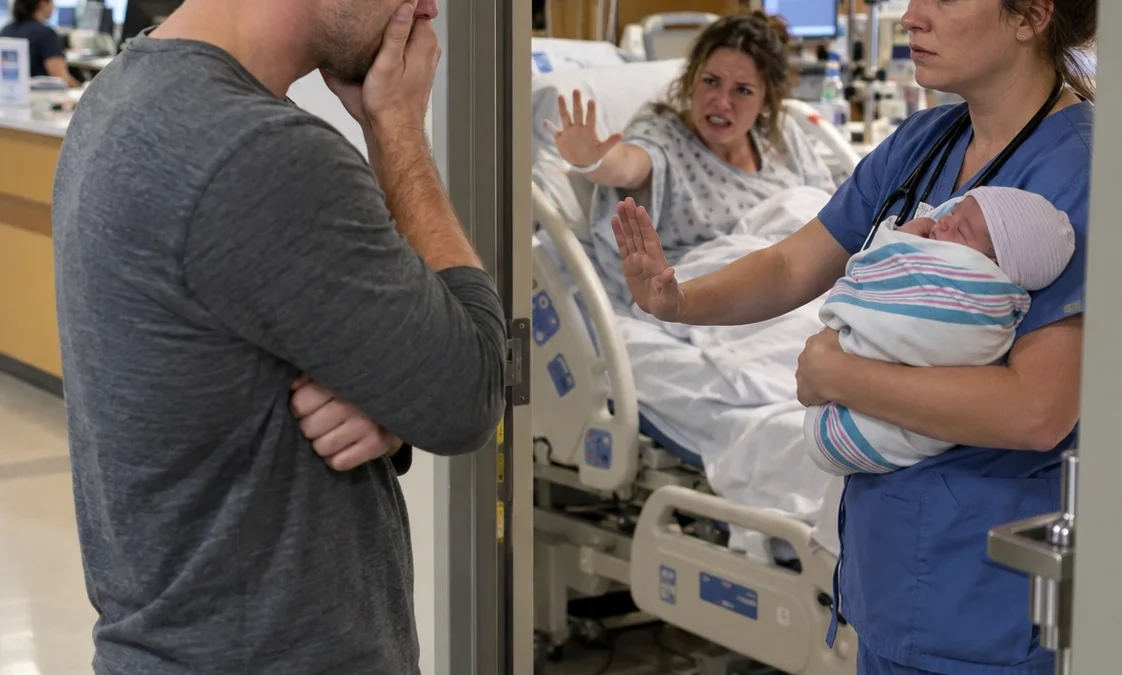
Part 2/5: I wait outside, miss the birth, and learn that my mother’s comfort can make my wife feel even more alone.
The waiting area was nearly empty. I sat down, stood up, paced to the vending machines, and sat again. I kept replaying what had happened, but each time I went over it, I changed the emphasis. I told myself I’d used the wrong words. I told myself Dana had heard them through the pain. I told myself she’d calm down and ask for me.
I called my mother because I was angry and embarrassed, and because I knew she would tell me what I wanted to hear.
She listened while I described Dana asking for an epidural, my telling her to wait, and the nurse sending me out. I left out the part where I’d called my wife dramatic until Mom asked what I had said that made Dana so upset.
When I repeated it, Mom sighed. “She’s frightened. She doesn’t mean it.”
I said I hoped she was right.
“Women say all kinds of things during labor,” she continued. “You know how hard childbirth is. They don’t always realize what they’re saying.”
My mother had delivered five children. I’d grown up hearing that she’d endured long labors, kept her composure, and managed the household afterward. Whenever I felt overwhelmed, her stories had made difficulty seem like something you could push through. I believed her when she said Dana would get over it.
That gave me relief. It also gave me an excuse not to think about the words I’d used.
I waited for someone to come get me. Nobody did.
At around eight, a nurse came out and told me our daughter had been born. For a few seconds, I didn’t understand what she was saying. I asked if Dana and the baby were okay, and the nurse said they were being cared for and that Dana was resting.
I was stunned that the birth had happened without me. I wanted to go in. The nurse said Dana would let them know when she was ready for visitors.
I sat back down and stared at my phone, trying to understand how I could have been there for the beginning of labor and still missed my child’s arrival. I was hurt. I was also ashamed, though I hadn’t yet figured out what to do with that feeling.
Dana’s older sister, Paige, arrived later that morning. I hadn’t known Dana had called her. Paige walked past me and went into the room without asking my permission.
I got up and followed her to the doorway. “Why can you go in when I can’t?”
“She asked me to come,” Paige said.
“I’m the baby’s father.”
“Then maybe you should’ve acted like someone she could depend on.”
Her answer made my face burn. I wanted to argue with her. I wanted to say she didn’t know what had happened in the room, or that I’d been scared, or that nobody was asking what this felt like for me. But she had heard enough from Dana to know why she was there, and I had not.
About an hour later, Dana agreed to see me. She was lying in bed with our daughter in her arms. I walked over, kissed her forehead, and told her I was sorry she’d had such a difficult time.
She didn’t answer.
I asked if I could hold the baby. Dana said yes, so I carefully lifted our daughter into my arms. She was tiny, warm, and perfect. Her face was scrunched up, her fingers curled, her breathing soft against me. For a moment, everything else disappeared.
I started crying. I felt joy and wonder, and the sudden knowledge that I’d missed the moment I had imagined so many times.
Then I said I was hurt that Dana had made me miss the birth.
She looked at me. “I was begging for help, and you told a nurse I was exaggerating.”
“I was trying to keep you calm.”
“You told her I was dramatic.”
“I thought you were panicking.”
“I was busy having a baby,” she said.
I had no answer to that. I still wanted to defend myself, but I could hear how small my explanation sounded beside what she’d been going through.
When I went home that evening, I wanted to announce our daughter’s arrival. I had already prepared a post with a photograph of the nursery and the baby’s full name. I sent it to Dana for approval, assuming she’d be happy to share the news once she had seen how the picture looked.
She replied, “Please don’t post anything yet.”
I asked why. She said she wanted a few days to recover before sharing the news publicly.
“Our families are excited,” I said.
“The people who needed to know already know.”
I felt as if I were being punished all over again. I could see the announcement ready on my phone, and I thought about all the relatives waiting for news. I didn’t consider that Dana might want time to recover before our daughter’s arrival became something everyone could comment on.
I called my mother and told her what had happened. Mom was upset. She said Dana shouldn’t use the baby to get back at me over an argument, then asked if she could post the announcement herself.
I told her to wait.
Mom posted anyway. She shared a photograph of a pink baby blanket with the caption, “Our beautiful granddaughter has arrived!” She included our daughter’s full name.
Within an hour, relatives were calling and messaging. Dana saw the post and asked if I’d told my mother to announce the birth. I said I hadn’t. Then she asked why Mom knew the baby’s name when we’d agreed to wait.
I explained that I had told her privately.
Dana started crying. “You ignored my wishes again.”
“I can’t control what my mother posts,” I said.
“You could have respected my request and kept the information private.”
We argued, and eventually Dana asked me to leave the hospital room. This time, I didn’t protest. I left, but I still told myself I was being punished.
Part 3/5: At home, I try to help while repeating the same mistake, until Dana names the loneliness beneath it.
Two days later, Dana and the baby were discharged. Paige brought them home. I was waiting in the living room, nervous and hopeful, with flowers on the table. I had cleaned the house, stocked the refrigerator, and tried to make the bedroom comfortable.
Dana thanked me, but she stayed distant.
For the first week, she barely spoke to me unless it involved the baby. I took that as proof that she was holding on to the fight. I wanted things to return to normal. I didn’t see yet that “normal” was part of the problem. I wanted the tension to end before I had done the work to understand why it was there.
I tried helping with feedings, changing diapers, and laundry. I was clumsy with the first onesies and had to ask how she preferred the bottles arranged. If I did something wrong, Dana’s irritation showed. I would get defensive and think, I’m trying. I rarely asked what she needed from me before acting.
One night, our daughter wouldn’t stop crying. Dana had been up repeatedly, and the baby’s cries filled the bedroom. I carried her for a while, walking back and forth and trying to settle her. I could feel how exhausted Dana was, and I wanted the crying to stop for both of us.
When it continued, I said, “Maybe she’s picking up on how stressed you are.”
Dana looked at me. For a moment, she didn’t say anything. Then she handed me the baby and walked into the bedroom.
I stayed with our daughter for a few minutes, then followed Dana. She was sitting on the edge of the bed, crying.
“What’s wrong?” I asked.
“You keep telling me my feelings are the problem.”
“I’m trying to help.”
“I don’t need someone constantly evaluating whether I’m calm enough. I need a partner who listens.”
I told her I was sorry. I meant it, but I was still thinking about how to explain what I’d intended. Dana said she wasn’t sure I understood what I was apologizing for.
I didn’t know what to say. I wanted to reassure her that I loved her, that I was trying to be a good husband and father. But she had heard those words before, and they hadn’t changed how alone she felt when something went wrong.
The following weekend, my mother came over with food and gifts for the baby. Dana was upstairs resting. Mom asked why she still seemed upset, and I told her we’d been arguing.
“Dana needs to stop holding grudges,” Mom said. “You should remind her that childbirth is hard on fathers, too.”
I didn’t answer. Maybe I was finally beginning to hear how that would sound to Dana. I also didn’t tell Mom she was wrong. I stayed quiet, as if silence could keep everybody from being upset with me.
Dana heard her anyway.
She came downstairs and asked Mom what she meant. Mom said she’d been worried about me because I’d missed such an important moment. Dana replied, “He missed it because I needed him to leave.”
Mom called that cruel.
Dana asked her to go home.
Mom looked at me. I hesitated long enough for Dana to see it. Then I told Mom it might be better if we talked another day.
She left crying. I watched the door close and felt caught between them, though I knew I had helped create the situation. Dana thanked me for supporting her, but later that evening she said she wanted us to attend counseling.
I asked whether it was really necessary over something I’d said during labor.
“It isn’t just about labor,” she said. “I’ve spent years feeling like my emotions are inconveniences to you.”
I asked her for examples. Some part of me was still looking for a way to prove I wasn’t as bad as she thought. Dana reminded me about the time she cried after losing her job and I told her to stop worrying because crying wouldn’t pay the bills.
She brought up when her father was hospitalized and I told her she was imagining the worst. She remembered other moments too, times I had tried to reassure her by telling her not to worry, not to cry, not to assume things would go badly.
I barely remembered some of them. I remembered the circumstances, but I had filed my words under “encouraging.” I hadn’t stored the way she looked when I said them.
“I was trying to help,” I said.
“You keep calling it encouragement,” she replied. “I remember feeling alone.”
That conversation made me uncomfortable because I couldn’t dismiss it as one bad sentence during labor. The same idea ran through all of it: if Dana was upset, I tried to make her stop being upset. I wasn’t asking what had hurt her. I was trying to manage her reaction so I could feel less helpless.
I agreed to counseling. Our first appointment was the next day.
The counselor asked Dana what she had needed from me during labor.
“I needed him to believe me when I said I was hurting,” she said.
Then the counselor asked me what I’d been thinking when I told the nurse Dana was exaggerating. For once, I tried not to tidy up the answer.
“I was frightened,” I said. “I’d never seen her in that much pain. I didn’t know what to do, and hearing her scream made me feel helpless. So I tried convincing myself things weren’t as bad as they looked.”
The counselor asked if I had considered that Dana might actually have been experiencing exactly the level of pain she described.
I said yes.
That was when Dana told me what happened after I left the delivery room.
Part 4/5: Dana reveals what happened after I left, and I begin to understand why my intentions never erased the harm.
The medical team had become concerned about our daughter’s heart rate. Things changed quickly, Dana said. The delivery needed assistance, and she was terrified.
She told me she had asked for me once. Then she remembered what I’d said to the nurse and asked for Paige instead.
I started crying. I’d spent days thinking mostly about the moment I missed, the hours outside, and how unfair it felt that I hadn’t been invited back in. Hearing what Dana had faced after I left shifted the whole memory. She hadn’t been making a point or setting up a punishment. She had been frightened and needed someone she trusted.
“I wish you’d called me back,” I said.
“I wished you’d believed me the first time,” she replied.
We didn’t fix everything in that appointment. The counselor didn’t give us a sentence that could undo what had happened, and Dana didn’t suddenly forgive me. I had to sit with the fact that the person I had wanted beside me when our daughter was born had needed distance from me in one of the hardest moments of her life.
On the drive home, I wanted to fill the silence with explanations. I wanted to say I’d never meant to humiliate her, that I was scared, that I had been following the lessons I’d grown up with. I knew all of that might be true. I also knew I’d used those explanations to make my actions easier to live with.
When we got home, I apologized again. This time, I didn’t explain what I’d meant or why I’d said it.
“I was wrong,” I told her. “I should have listened when you said you were hurting. I shouldn’t have talked about you like that, and I shouldn’t have told Mom our daughter’s name after we agreed to wait.”
Dana cried. I sat beside her without reaching for her until she leaned toward me.
She said she wanted to believe things would change, but she needed to see it. I understood why she didn’t want to promise forgiveness just because I had finally said the right words. I had been able to say the right words before. What she needed was for me to behave differently when she was upset, frightened, or not ready to make me feel better.
The next morning, my mother called. She asked whether Dana had finally apologized for excluding me from the birth.
I told her Dana didn’t owe me an apology for that.
Mom went quiet, then said I was letting my wife treat me badly. I told her I’d made a mistake during a vulnerable moment, and Dana had every right to decide who supported her.
“She’s manipulating you,” Mom said.
Then she asked when she could come see the baby again.
I told her we’d arrange a visit when Dana felt ready. Mom’s voice sharpened. “So now I need permission to see my own granddaughter?”
“Yes,” I said. “You need to check with us before visiting.”
She hung up.
An hour later, she sent a message saying she’d raised me to be a strong man, not someone who apologized for trying to help his wife. I read it twice. The first time, I felt the old instinct to call her and smooth things over. The second time, I saw how familiar that instinct was: someone was unhappy, so I wanted to change the conversation until I felt comfortable again.
I didn’t reply.
Dana saw the message when my phone lit up. She asked if I agreed with Mom. I said no.
Then she asked a question I hadn’t expected.
“If your daughter grows up and her husband speaks to her the way you spoke to me, what would you tell her?”
I looked at our little girl sleeping beside us. Her tiny hand was curled near her cheek. I thought about the way I’d spoken in the delivery room, as if Dana’s pain were a story I could correct for the nurse. I thought about my daughter someday asking for help and being told she was too sensitive or too frightened to know what she needed.
“I’d tell her she deserved better,” I said.
Dana nodded. “That’s all I wanted you to understand.”
I wanted to say I understood now. But I knew understanding one thing in a quiet room was different from responding well when I felt scared or defensive. So I didn’t ask her to take my word for it.
Part 5/5: I stop asking Dana to hurry through forgiveness and learn that trust returns through ordinary choices, not one apology.
We’re still working through things. Dana hasn’t forgiven me completely, and I can’t expect her to do that on my schedule. The birth is not the only hurt we’re trying to understand. It gave a name and a shape to a pattern that had been there for years.
I used to think support meant calming someone down. Now I’m trying to understand that support can mean staying present while someone is upset, even if I can’t solve the problem or make the feeling disappear.
That sounds simple until I’m in the middle of a hard moment. When the baby cries and Dana looks exhausted, I still feel the urge to explain why she shouldn’t worry. When Dana tells me she’s angry, I still catch myself preparing a defense before she has finished speaking.
I’m learning to pause. I ask what she needs instead of assuming. Sometimes she wants me to take the baby. Sometimes she wants me to sit beside her. Sometimes she wants a few minutes alone. The answer changes, and I’m trying to treat that as information instead of criticism.
I’ve also had to talk to my mother about the announcement. I told her she should not have posted our daughter’s name after I’d asked her to wait, and I should never have given it to her while Dana and I had agreed to keep it private.
Mom didn’t accept that easily. She said she was excited and didn’t understand why Dana needed to control everything. I told her Dana wasn’t controlling the family. She was recovering from giving birth, and she had asked for privacy. I should have respected that.
Mom said I was making her the villain. I told her I wasn’t calling her a villain. I was asking her to follow a boundary we had set as parents. I didn’t try to make her agree with every part of it before I ended the call.
She still hasn’t visited. I told Dana we could arrange a visit when she felt ready, and I meant it. I don’t know when that will be. I know my mother is disappointed. I also know Dana shouldn’t have to manage her disappointment while healing and caring for a newborn.
At our next counseling appointment, we talked about the difference between intent and impact. I said I had not meant to hurt Dana. The counselor asked what I thought that changed for her.
I had no quick answer. I’d used my intentions as a shield. If I meant well, I wanted that to count more than the result. But Dana had still heard me call her dramatic. She had still felt alone. My fear explained where my words came from; it didn’t erase what they did.
Dana told the counselor she didn’t want to punish me. She wanted to feel safe being honest with me. I listened. I didn’t tell her she could have said it differently or that I was trying my best. I let the words sit there without turning them into a debate about my character.
It was harder than I expected to accept that I could love my wife and still have failed her in ways that mattered. I had thought love was obvious in the things I did: showing up to appointments, building furniture, buying flowers, carrying the car seat. Those things mattered, but they didn’t cancel out the moments when I made her defend her own feelings to me.
One afternoon, Dana was feeding the baby in the living room. The house was quiet except for the soft sounds of the baby and the refrigerator humming in the kitchen. I was standing nearby, unsure whether she wanted company.
“Do you want me to sit with you?” I asked.
She looked at me for a second. “Yes. Just sit.”
I sat beside her. I didn’t touch her shoulder or ask if she was okay. I didn’t tell her she looked tired or remind her that she was doing great. I stayed there while she fed our daughter, and for once, I didn’t treat silence as a problem I had to solve.
After a while, Dana shifted closer to me. It was a small movement. I didn’t make it bigger than it was by asking whether it meant she had forgiven me. I just stayed beside her.
That night was the first time since we’d come home that she asked me to sit with her while she fed the baby. It wasn’t a grand reconciliation, and I don’t want to pretend it settled everything. It was a moment of trust, small enough to be fragile and real enough that I understood why it mattered.
I still feel grief when I think about missing our daughter’s birth. For a while, I treated that grief as proof that Dana had done something to me. Now I can see that I was focusing on my loss because it was easier than facing why she had asked me to leave.
I also feel regret for the things I said before the delivery room. Dana had tried to tell me she felt alone. I kept turning her feelings into problems to fix, as if she were asking for a solution when she needed me to believe her.
I can’t change the words I used or enter the room I left. I can choose what I do when Dana speaks to me now. I can listen without correcting her, protect our family’s privacy, and respect her boundaries even when my mother is upset about them.
Our daughter is still small enough to sleep curled against Dana’s chest. I watch them together and think about the kind of husband I want her to expect someday. I don’t want to be the kind of man who calls his wife dramatic when she needs help and then asks to be comforted because he feels excluded.
I want our daughter to know that a person can be frightened and still know what they need. I want her to see that love means taking her words seriously, especially when they’re inconvenient.
Dana has not forgiven me completely. We’re still going to counseling. We’re still learning how to talk without falling into the old pattern. But tonight, she asked me to sit beside her, and I listened.
That is where we are: not finished, not fixed by one conversation, but trying to build something better one ordinary choice at a time.
THE END