They Shot Her Dog and Left a Three-Day Warning—But the Widow Had One Promise to Send Into the Mountains
Part 2/5: Clara buries Scout, sends his collar to the mountains with a boy, and waits while a former marshal returns to face the men threatening her.
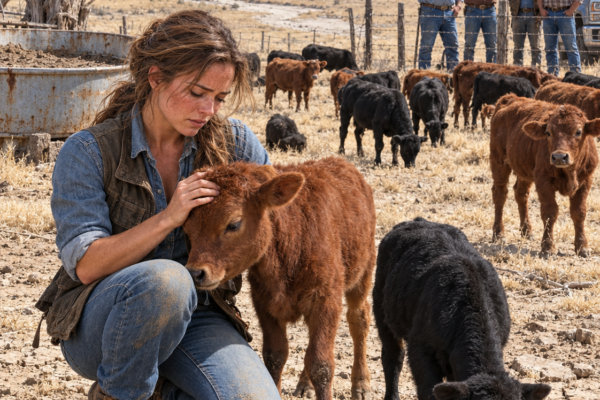
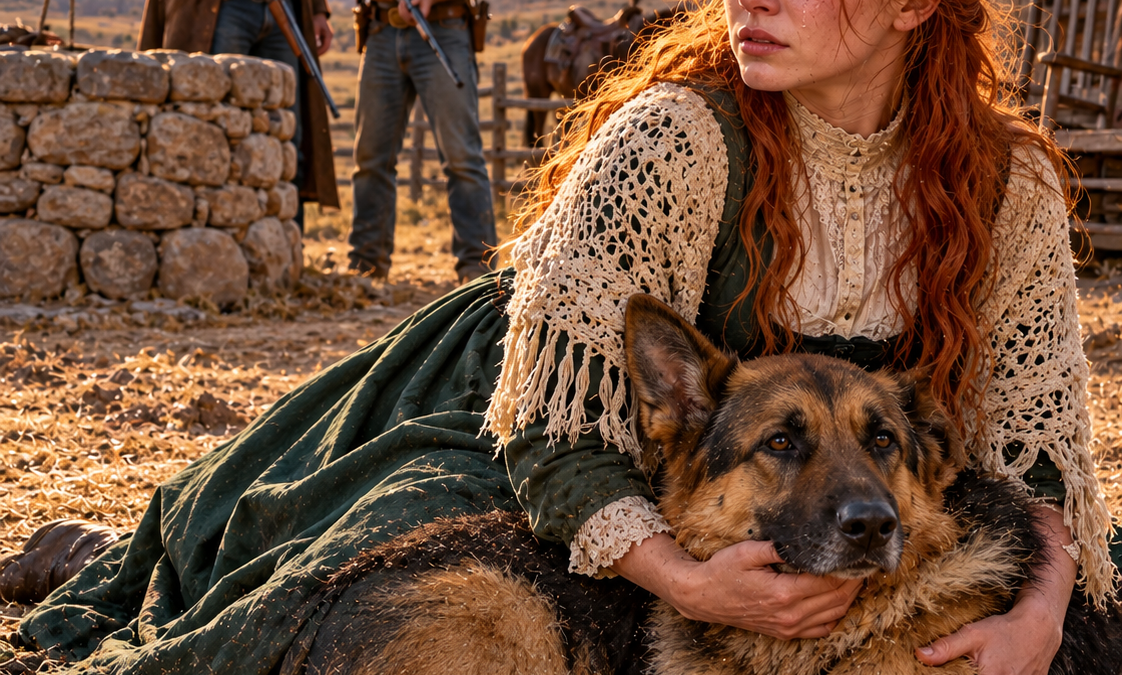
Clara found Scout beside the well. She knelt in the dust and buried her face in his fur. For a long time, the wind in the cottonwood was the only sound in the valley.
Then she lifted her head and saw the note nailed above the well: “Next time, it won’t be the dog. You have three days.”
A bootprint marked the soft ground nearby. It was a large boot, and one nail was missing from the heel. In the grass beside it lay a brass rifle cartridge.
Clara did not scream. She did not cry in front of anyone. She dug a grave beneath the cottonwood, beside Samuel’s, and buried Scout with her own hands. Before she covered him, she unbuckled his leather collar and held it for a long time. The brass tag still bore his name.
She remembered the quiet voice at Samuel’s graveside: Wherever I am, I’ll come.
The Mercers farmed the neighboring land. Their oldest boy, Eli, was twelve, skinny and freckled, with red cheeks and a devotion to Clara that made him eager to help whenever she needed anything. He had loved Scout nearly as much as Clara did.
That afternoon, she rode over to the Mercer farm with the collar in her pocket.
“Eli,” she said, “I need you to do something brave.”
She told him about the man in black and the cabin somewhere near the Popo Agie River in the Wind River Mountains, two days’ ride west. She told Eli what to say and put Scout’s collar into his hand.
Eli did not ask whether the trip was dangerous. He understood that it was. He rode out that evening on his father’s old mule.
He rode through the night and all the following day, climbing through foothills and pine forests, crossing fast mountain streams, and asking at every trapper’s camp and mining claim if anyone had heard of Silas Rourke. He was cold, frightened, and sore from the saddle. He did not turn back once.
On the evening of the second day, he found a small log cabin in a high meadow beside a river. Smoke rose from the chimney, and a tall black horse stood in the corral.
The door opened before Eli could knock.
Silas Rourke stood in the doorway, looking down at him. Eli did not say a word. He held out his hand and opened it.
Rourke looked at the collar and the brass tag that read Scout. For a long moment, his face did not change. Then he took the collar very gently and put it in his coat pocket.
“Is she hurt?” he asked.
“No, sir. But they shot Scout. And they gave her three days.”
Rourke turned around. From a peg on the wall, he took down a gun belt he had not touched in two years. Then he walked outside and began saddling his horse.
Sweetwater was one dusty street of false-fronted buildings along a shrinking river. On the afternoon of the second day after Scout’s death, a stranger in black rode in on a tall black horse, tied up in front of the sheriff’s office, and walked inside.
Sheriff Pruitt looked up from his desk and went pale. He did not know the stranger’s name, but he knew the look of a man who had spent years facing danger without needing to announce it.
The stranger asked who had cut the widow Whitcomb’s fences, burned her hay, and shot her dog.
Pruitt said he did not know.
“Then I’ll tell you what you’re going to do, Sheriff,” Rourke said quietly. “You’re going to stay right here in this office for the next two days. When it’s over, you’re going to remember whose side you were on.”
He did not raise his voice. He did not need to.
Then he crossed the street to the saloon. Half a dozen Bar H riders were drinking there. The largest among them was Voss’s foreman, a brutal man named Brutus Kells. He had a shaved head, a broken nose, and a scar through one eyebrow.
Kells laughed when Rourke walked in and asked who he was.
Rourke did not answer. He looked down at Kells’s boots, focusing on the big right boot with a nail missing from its heel. Then he finished his coffee, put a coin on the bar, and walked out.
At sunset, Clara stood beside her well and saw a rider coming up the valley road on a tall black horse. She did not move. The evening wind blew her red hair across her face as she watched him approach.
He rode into the yard, swung down, and removed his hat.
“You came,” Clara said.
“You sent for me,” Rourke replied.
He saw the two graves beneath the cottonwood: the older one and the fresh one beside it. He walked to Scout’s grave and stood there for a long time, hat in hand.
When he turned back, Clara saw something in his face she had never seen in another man. It was not anger exactly. It was quieter, and far more frightening.
That night, Rourke slept in her barn with his rifle beside him. In the morning, he mended her fences. In the afternoon, he showed her the bootprint by the well and the cartridge in the grass. He wrapped both carefully and put them in his saddlebag.
That evening, as the sun slipped behind the Rattlesnake Hills, Clara asked the question she had carried for nine months.
“Why did you come to the funeral, Mr. Rourke? You hadn’t seen Samuel in seven years.”
Rourke was quiet for a long time. “I owed him my life,” he said at last. “And I’d heard he married the finest woman in Wyoming. I wanted to make sure somebody looked after you.”
He turned his hat slowly in his hands.
“I suppose I wanted to see you, too. Just once.”
Clara looked at him in the fading light. She did not answer, but she did not look away.
The morning of the third day came up cold and clear.
At sunrise, Harlan Voss rode toward the Whitcomb homestead in his black buggy, with Brutus Kells beside him and a dozen Bar H riders behind. Rifles rested across their saddles. They meant to finish the matter.
When they came over the rise above the spring, they stopped.
A man sat on Clara’s porch, his chair tipped back against the log wall. He wore a black coat and a black hat pulled low over his eyes, as if he had been sitting there all night and did not care who was coming.
Clara stood in the doorway behind him.
Voss climbed down from the buggy and walked to the porch steps.
“I don’t know who you are, mister,” he said, “but this is none of your business. This woman has had three days.”
The man in black slowly pushed back his hat.
“The name’s Rourke. Silas Rourke.”
A murmur moved through the riders. Several had been in Montana. Every one of them had heard that name.
Kells’s hand had been resting on his gun. Very slowly, he moved it away.
“That dog you shot,” Rourke said, still sitting in his chair, “was mine before he was hers. I raised him from a pup. I gave him to her the day she buried her husband so nobody would ever hurt her.”
Rourke stood. He was taller than Voss had realized.
“You had no idea who gave her that dog. Now you do.”
Part 3/5: Rourke confronts the Bar H riders with physical evidence, while an old lawman’s name gives the widow time to reveal the larger crime.
Rourke took a brass rifle cartridge from his coat pocket and held it up between two fingers. Then he looked down at Brutus Kells’s right boot.
“There’s a bootprint by that well with a nail missing from the heel,” he said. “This cartridge came from a .44 rifle. The only man in this valley with both is standing right behind you, Mr. Voss.”
Kells went for his gun.
He never cleared the holster.
Rourke crossed the yard before anyone could follow his movement. One moment Kells was upright; the next, he was flat on his back in the dust, his own pistol in Rourke’s hand. The former marshal pointed it at the ground, not at the man.
No one fired. The riders had come expecting to frighten a widow. They had not expected to face Silas Rourke with a dozen witnesses and a foreman disarmed in the dirt.
Then another dust cloud appeared on the valley road from the east.
Six men were riding hard. At their head was a broad-shouldered, dark-skinned man wearing a silver star on his coat. He was Deputy United States Marshal Isaac Bell, riding out of Cheyenne.
Rourke had sent a telegram to his old partner the day he rode into Sweetwater. Bell had arrived with a warrant in his saddlebag.
For the past two days, Bell and his men had been examining land-office records. What they found went beyond a feud over a spring. Voss had filed forty-six false homestead claims in the names of his own cowhands, using them to seize public water across the valley. It was a federal crime.
Kells was arrested for destruction of property and threatening a citizen’s life. Voss was arrested for land fraud.
The Bar H riders quickly discovered they had urgent business elsewhere. One by one, they turned their horses and rode away without looking back.
Sheriff Gideon Pruitt had remained in his office exactly as Rourke told him. By Christmas, he was out of a job.
When the dust settled and Bell’s men had taken the prisoners away, Clara walked down the porch steps. Morning sunlight spread over the spring and the yard, reaching the graves under the cottonwood.
“You came all this way,” she said. “For a dog?”
“No, ma’am,” Rourke said.
He reached into his coat and took out Scout’s collar. He placed it gently in her hand.
“I came for you.”
Clara held the collar and looked at the brass tag. For the first time since the note appeared, the tightness in her chest eased. But relief did not erase what had happened. Scout was still gone, and no arrest could make the nights before his death harmless.
Rourke did not ask Clara to forget. He did not say that everything would be fine. He simply stayed while Bell’s men finished their work and offered to help repair what the Bar H had damaged.
In the days that followed, the valley began to understand how much Voss had controlled. The bank had lent him money against the stolen claims. The store had followed his orders. The sheriff had acted as though no complaint mattered unless Voss approved it.
Some neighbors admitted they had heard rumors about the false claims but had kept silent. Others had been afraid that speaking up would cost them their water or their land. No one had tried to harm Clara before the dog was shot, but many had assumed she would eventually give in.
Rourke stayed at the homestead while Clara decided what came next. He kept to himself, working alongside her when she allowed it and sleeping in the barn until she told him he could use the spare room. He never acted as if the promise he had made gave him any claim on her life.
That mattered to Clara.
For a long time, she had been treated as if her land, her spring, and even her future were things men could discuss among themselves. Voss had looked at her and seen an obstacle. Others had looked at her and seen a woman who needed to be guided. Rourke looked at her as if her answer were the only one that counted.
When he asked whether she wanted him to stay, he asked plainly.
Clara took a breath. “I want you to stay tonight,” she said. “Tomorrow, we’ll see.”
Rourke nodded. “That’s enough.”
The winter was still hard. Water remained scarce across the valley, and some ranchers lost most of their herds. Clara and Rourke made repairs to the fences and barn, then spent the cold months doing what the season allowed. They hauled firewood, tended the animals, and visited the Mercers when the roads were passable.
Eli Mercer never stopped talking about his ride into the mountains. He described the mule’s stubbornness, the streams he had crossed, and the moment Rourke opened the cabin door. Clara listened each time as if the story had changed. Rourke never corrected Eli’s embellishments.
In the spring, the Pike family’s old farm dog had a litter of puppies. Most were brown. One was a fat, clumsy little male with black-and-tan markings, a white blaze on his chest, and amber eyes.
Eli carried the puppy across the fields to the Whitcomb homestead. He held it in both arms and placed it carefully in Clara’s lap.
She looked at the dog’s face and then at the old brass tag in her hand.
“Scout,” she said.
The puppy wriggled against her coat. Rourke smiled, and Clara felt something small and warm settle where grief had lived all winter.
No one could prove where the first Scout had gone on summer nights before the shooting. Eli had his own theory, and the puppy’s markings were enough to make Clara wonder. She did not need certainty to love him.
The new Scout wore a new collar, but the old brass tag went with it.
Voss’s arrest did not fix everything overnight. The water claims had to be reviewed, families had to decide whether they would remain in the valley, and the federal case took time. Still, the spring at the Whitcomb place remained Clara’s, and no one came to her door with another offer.
By the time summer arrived, the valley had seen what happened when a cattleman believed the law belonged to him. Voss had relied on fear and on people’s belief that nothing could be done. Rourke had forced the matter into the open, and Bell had brought the authority to make it count.
Rourke did not return to the cabin in the mountains.
That summer, beneath the cottonwood beside the two graves, he married Clara. Eli Mercer stood as Rourke’s best man, with the new Scout at his feet, wearing the old brass tag.
They raised horses and children on that land for forty years. They had three sons and a daughter with copper-red hair, and their home was never without a line of black-and-tan dogs with white blazes on their chests. Every one of them descended from the puppy Eli had carried across the fields.
The spring never ran dry. In the worst drought years, when ranchers came desperate for water, Clara and Rourke never charged a single one of them a penny.
Part 4/5: The arrests end Voss’s immediate threat, but the choice to remain together belongs to Clara, who must decide what safety means after loss.
The first months after the wedding were not a fairy tale. Clara still woke sometimes in the dark, hearing the single shot that had ended Scout’s life. Rourke sometimes woke from dreams of the years he spent wearing a badge, when danger had seemed easier to understand than peace.
Neither pretended that love could erase what came before. They learned each other’s habits slowly: the way Clara checked the barn door twice before bed, the way Rourke set his hat on the same peg, the way he paused at the graves under the cottonwood whenever he crossed the yard.
He never asked her to stop visiting Samuel’s grave. Clara never asked him to forget the men he had lost while serving as a marshal. They made room for the past without letting it dictate every day.
Their children grew up knowing the story of the spring and the dog, but they also knew the less dramatic parts of the family’s life. They knew their mother could mend a fence faster than most hired hands, that their father could sit quietly for an hour without needing to fill the silence, and that the spring had to be kept clean if it was going to serve the whole homestead.
Clara taught them that land was not valuable only because it could be owned. It was valuable because people depended on it. When a neighbor’s cattle came in weak from a dry stretch, she let them drink. When a family’s well ran low, she sent water without waiting to be asked twice.
Rourke supported her, though he reminded the children that generosity did not mean allowing a person to take whatever they wanted. The distinction mattered to him. He had seen too many powerful men disguise greed as necessity.
The valley changed after Voss’s conviction. The false claims were challenged and untangled. Some parcels returned to public use; others went back to the families whose water had been fenced off. The Bar H remained a large ranch, but it no longer had a sheriff willing to make its owner’s wishes sound like law.
Pruitt left town in disgrace. He did not make a public confession, but he stopped wearing the badge and did not return to Sweetwater. The people who had been afraid to speak began, cautiously, to speak.
As the years passed, the story of the third morning grew larger in the telling. Some said Rourke had crossed the yard like lightning. Others claimed he had faced twenty men alone. The truth was plain enough: he had arrived, held his ground, and waited for the law he had summoned.
Clara never exaggerated it. She remembered the silence before he stood up, the small movement of Kells’s hand away from his gun, and the dust cloud rising along the eastern road. She remembered the collar in her palm afterward more than anything else.
Rourke had promised to come if she needed him. He had kept his word. But Clara understood that the promise had not made her helpless. She had stayed on her land, collected evidence, and sent for help when the danger grew beyond what one person could handle.
Years later, when a neighbor asked how she had managed to hold on, Clara answered, “I didn’t do it alone.”
The sentence was not a surrender of credit. She knew what she had done. She had endured the grief of losing Samuel, faced down Voss, buried Scout, and made a decision to ask for help. Rourke’s return mattered because she had chosen to send the collar.
Rourke understood that, too. He never told the story as if he had rescued a woman who could not save herself. He told it as a story about a promise, a boy brave enough to carry it, and a woman who had not allowed fear to make her surrender her home.
Eli Mercer remained part of the family. He grew into a capable rancher, and whenever he visited, he still called the first Scout “the best dog in Wyoming.” The children teased him that he had only loved Scout because the dog let him share scraps from his lunch.
Eli would shrug. “Maybe,” he said. “But I rode two days into those mountains for him.”
Every spring, another litter seemed to appear somewhere among the neighbors’ dogs. The Whitcomb homestead always kept one. The dogs were not all identical, but the family looked for the black-and-tan coats, the white blaze, and the alert amber eyes.
The old brass tag went from one collar to the next. It was worn smooth at the edges from years of handling. Clara kept it safe when there was no dog wearing it, then fastened it again when a new puppy was old enough to carry it.
When their daughter asked why the tag mattered so much, Clara told her the truth. It had belonged to Scout, the dog who stayed beside her after Samuel died. It had also been the way she reached the man who had given Scout to her.
“That’s all?” her daughter asked.
“That’s plenty,” Clara said.
The spring gave the family more than water. It brought other ranchers to their door, especially when drought returned. Some had once supported Voss, either out of fear or because they believed his promises. Clara did not pretend that history had vanished. She still gave their cattle water.
Rourke kept his own limits. He did not put on the old badge again, and he did not return to the work that had once made him famous. When people asked him to take sides in every argument, he reminded them that a former marshal was not a substitute for a functioning court.
He did help when someone was in danger. He also helped neighbors repair fences, settle disputes, and make sure a complaint reached the right officials. He preferred a problem handled in daylight, with witnesses and records, to a threat delivered in the dark.
Clara never told him he had to be the man he had been before. She was glad he had come back, but she did not build their life around his reputation. The family they made was grounded in work: crops that survived some seasons and failed in others, animals that needed care, children who needed rules and reassurance, and a spring that kept running beneath the cottonwood.
Sometimes, when the wind blew hard through the valley, Rourke sat on the porch and listened. Clara would sit beside him with the brass tag resting in her hand. They could hear the water moving under the rocks, steady and clear.
“Do you ever regret leaving the mountains?” she asked him once.
“No,” he said.
“Not even the quiet?”
He looked toward the barn, where the latest dog was sleeping in the shade. “This is quiet enough.”
She smiled. “You came for me, then?”
“I did.”
“And Scout?”
Rourke glanced at the dog. “I came for both of you.”
Clara did not ask him to say more. By then she knew the difference between words meant to impress and words that had been kept.
Part 5/5: Decades later, their grandchildren ask how the couple met, and Clara remembers that the men who threatened her never understood she could call for help.
Many years later, Clara and Rourke’s grandchildren would ask how Grandma and Grandpa had met. The children liked the parts with the horsemen, the guns, and the man in black. They asked whether Rourke had really sat on the porch all night, whether he had truly disarmed a giant foreman in one quick move, and whether their grandmother had been afraid.
Clara answered each question honestly.
“Yes, I was afraid,” she said. “Being brave doesn’t mean you never feel fear.”
She would touch the old brass tag, now worn smooth, that she kept on a ribbon around her neck. Then she would tell them about Samuel, the husband who had built a home beside the spring and died trying to bring a calf in from a storm. She told them about Scout, the dog who slept across her doorway and stayed close when the house was too quiet.
She told them about the men who came for the water, and the note they left by the well. She told them about burying Scout, and about the boy who rode two days into the mountains with a collar in his hand.
“Some bad men shot my dog,” she would say. “They thought I was alone.”
Rourke, sitting beside her on the porch, would take her hand.
“They had no idea,” he would say, “who gave her that dog.”
The grandchildren understood the line as a story about their grandfather. As they grew older, they understood it meant something else as well. Voss and his riders thought Clara was alone because she lived far from town, because she was a widow, and because she was a woman with a valuable spring.
They mistook isolation for weakness. They believed that a threat would make her leave. They believed no one would answer if she asked for help.
They were wrong on every count.
Clara had not been foolish or invulnerable. She had been grieving, frightened, and under pressure. She had also known what she would not give away. When the danger became too much, she used the promise Rourke had left with her.
Eli had carried it through the mountains. Rourke had come back. Bell had brought the law. And Clara had kept her home.
The spring continued to run beneath the cottonwood, clear even when the creeks around it shrank. In the dry years, ranchers brought thirsty cattle to the Whitcomb land. Clara and Rourke opened the gates and let them drink without asking for payment.
They taught their children that a promise was not a flourish to be spoken at a funeral. It was a responsibility that could take years to fulfill. They taught them that asking for help did not diminish courage. Sometimes it was the clearest way to protect what mattered.
The family dogs grew old and died, as all dogs do. Each time, a new puppy took its place. The brass tag passed from collar to collar, and the white blaze appeared again and again in the generations that followed.
Clara never forgot the first Scout. She never forgot Samuel, either. Beneath the cottonwood, their graves remained close to the spring, near the house they had built and the life she chose to keep.
When Clara’s hair turned silver, it still carried a faint trace of the copper that had once caught the sun. Rourke’s black coat eventually faded, and his sharp hazel eyes softened with age. They sat together through the seasons, watching their children raise children and their dogs stretch out beneath the porch.
The grandchildren sometimes asked if the story was really true.
Clara would look at Rourke. He would look back at her, and neither needed to embellish the answer.
“Yes,” she said. “It’s true.”
Then she would touch the tag and let the story rest. She did not need to explain that the spring had been worth fighting over, or that Harlan Voss had learned too late that threats could not make Clara surrender. The grandchildren had heard those parts already.
What stayed with them was the promise: if she needed him, she could send the collar. Wherever he was, he would come.
The story began with a lonely woman, a murdered dog, and three days to leave. It ended with a family that lasted four decades, a spring that never ran dry, and a reminder that courage can include knowing when to call someone who will answer.
They thought she was alone.
She wasn’t.
THE END