At my seventy-eighth birthday party, my daughter-in-law ordered me out of the house I had helped save. Fifty-two friends heard her call me a parasite while my son stared at the rug
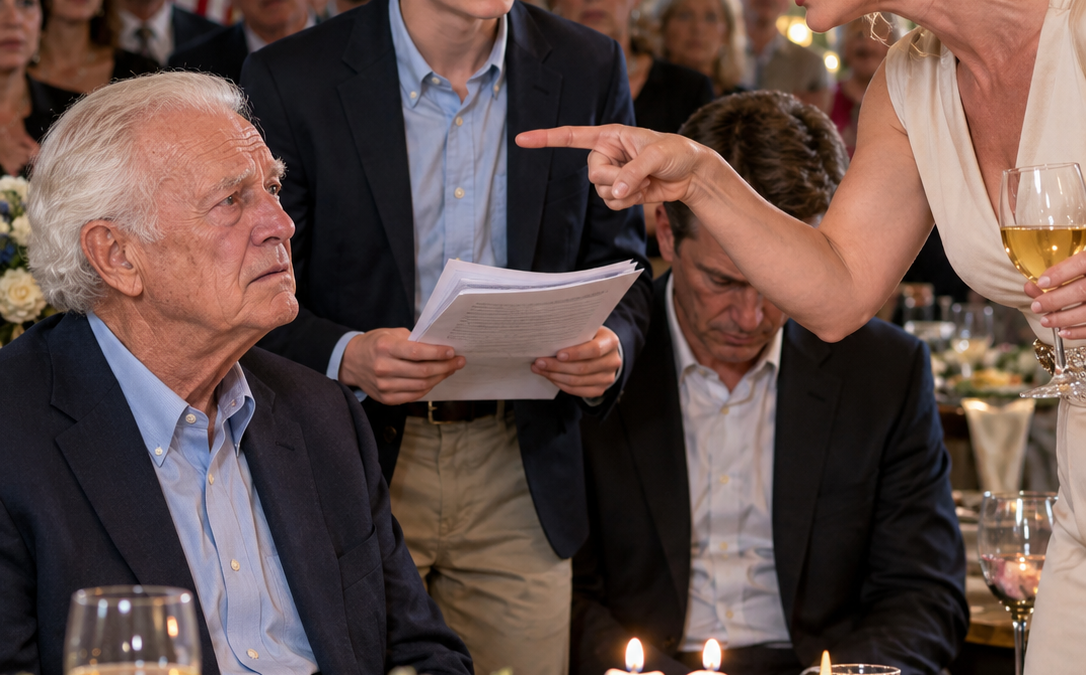
At my seventy-eighth birthday party, my daughter-in-law ordered me out of the house I had helped save. Fifty-two friends heard her call me a parasite while my son stared at the rug. They thought I was too old to fight back. But my fifteen-year-old grandson had spent months collecting the one thing his parents feared: proof. And he stood up.
PART 1 – THE BETRAYAL
“Get out, you parasite. You’ve lived off us long enough.”
Brooke said it before anyone had finished the birthday toast. Her wineglass was raised, fifty-two guests were squeezed around rented tables in my living room, and a sheet cake with 78 written in blue icing sat untouched between a platter of sandwiches and a bowl of potato salad.
I looked at my son. Mike was forty-nine, old enough to know when silence was a choice. He studied the pattern in the rug as if he had lost something there. I waited for him to tell his wife to stop.
“Monday morning,” Brooke continued. “Maple Grove. We’ve arranged everything. We can’t keep carrying you, Ray.”
Then my grandson Eli pushed back his chair. He was fifteen, all elbows and untucked shirt, sitting between two men I had delivered mail with for decades. He looked straight at his mother and began to speak.
Eleven days earlier, on Tuesday, October 14, Mike drove me to the hardware store. My hip was giving me trouble, and I needed a replacement latch for the back gate. He used to complain that I never let anyone help me. Lately, he offered rides before I asked, then drove without a word.
The key lay in the cup holder underneath a grocery receipt and two gas-station slips. Small brass bow, worn teeth, the number 318 stamped on its face. I recognized it faster than most people recognize their own house keys. I had spent thirty-six years carrying mail on Route 14 in the Toledo area. You develop an eye for the things people use to keep their private business private.
“What’s that?” I asked.
“What’s what?”
“The box key.”
Mike glanced down, then lifted it into his jacket pocket with an awkward movement that nearly took his elbow off the steering wheel. “Old thing. Doesn’t matter.”
I watched the road ahead. “All right.”
At first, I thought he was hiding a birthday present. He had been short of money and quieter than usual since spring. I pictured him ordering something small and having it sent someplace Brooke couldn’t find it. I even felt pleased that he’d gone to the trouble.
But I made a note when I got home. Tuesday, 2:40 p.m. Mike’s truck. P.O. box key 318. I’ve carried a pocket notebook since 1974, when a customer insisted I had delivered a registered letter to the wrong address. My written record settled it. After that, I wrote down times, amounts, names, anything I might need to remember accurately.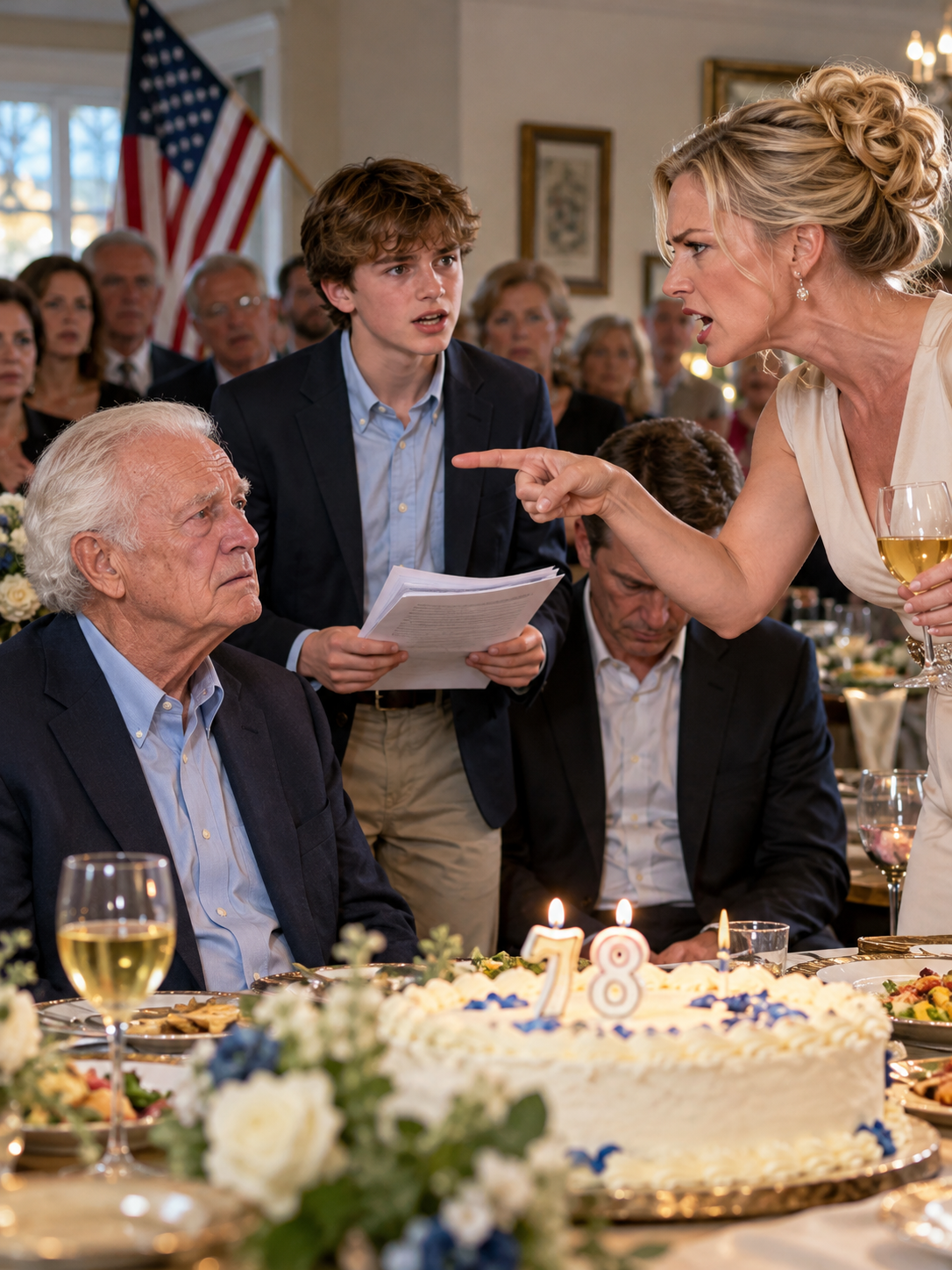
When Eli was nine, he found a stack of my old route books in the garage. He sat on the back step turning the pages like he’d discovered a secret language.
Eli found an entry about a troublesome squirrel and laughed so hard he had to put the book down. I gave him an empty notebook and showed him how to record an ordinary afternoon without making it into a story. His first entry was about a squirrel on a wire. He wrote that Grandpa laughed. Every summer after that, he asked for another book.
Brooke had been planning my birthday for weeks. We lived together at 912 Linden Court, a comfortable house with too much furniture and a porch that needed scraping every other year. Dot and I had moved in during 2021, when she needed a ground-floor bedroom and a bathroom wide enough for her wheelchair. After she died, I stayed in the suite we had built for her. There was room for my armchair, my books, her reading glasses, and the little radio we used to turn on while making breakfast.
That Tuesday evening Brooke was unusually attentive. She refilled my tea, asked whether I wanted extra vegetables, and told me the church choir was coming to the party.
“Thirty people would be plenty,” I said.
“Fifty, at least. Everybody who cares about you should be there.”
After supper she placed a brochure next to my plate. On the cover, two silver-haired people smiled across a sunny courtyard.
“Maple Grove Senior Living,” she said. “Just options. Nothing you have to decide tonight.”
“I already have a room,” I said.
“Of course. But the stairs, your hip, the long-term questions—”
“My room is on the first floor.”
She held her smile. “Mike and I are stretched thin. We don’t want you to feel like a burden.”
“I give Mike fifteen hundred dollars every month.”
“We’re not doing numbers at dinner, Ray.” She touched my wrist lightly. “I’m talking about everyone’s well-being.”
Eli had stopped eating. When Brooke said burden, he looked at me, then at his father. Mike kept cutting a piece of chicken he had already cut in half.
At bedtime I heard footsteps outside my door. Eli stood in the hallway in his socks, staring at the floor. I waited for him to speak. He opened his mouth, thought better of it, and walked away.
The next morning I asked Brooke whether she’d rented a post office box. She stood at the counter making a smoothie and didn’t turn the blender off until the fruit had disappeared.
“A P.O. box? Why would I need that? I have a front door.”
“Mike handles the bills. He gets anything important at work.” She rinsed the pitcher. “And don’t give me that old mail-carrier look. You’re not auditing my kitchen.”
I found Mike in the garage later, checking the oil in his truck. The garage smelled of old tires and the coffee he’d forgotten on a shelf.
“Did you ask Brooke to find me a place at Maple Grove?”
“No, Dad.”
“I’ll talk to her.”
He wiped the dipstick with a rag, checked it again, and put it back without reading the mark. I knew he wasn’t going to talk to her. But I still wasn’t sure whether he feared an argument with his wife or feared the question she might ask him in return.
That afternoon I found Eli on the back step with an algebra book open on his knee. He had been staring at the same problem for several minutes. I lowered myself beside him, my hip making its usual complaint.
He picked at the cuff of his sock. Then he asked me a question that made the little patch of silence between us feel much larger.
“Hypothetically, if somebody knew something about the family, and telling it would blow everything up, but not telling it would be worse—what would you do?”
“Depends who’s going to get hurt.”
“Everybody, maybe.”
“Then I wouldn’t make a boy carry it alone.”
He swallowed. “Mom took my phone Monday. She keeps saying you’re getting confused. She said I should be nicer because you might not remember us next year.”
“If I talk, Dad gets in trouble.”
“Being quiet doesn’t always keep somebody out of trouble.”
Before he went inside, he asked whether I planned to stay for the entire birthday party.
“It’s my birthday.”
“I mean until the end.”
“Just don’t leave early.”
On Monday, October 20, I took the bus to Maple Station, the post office where I had worked before retiring. I told Mike I needed stamps. That was true in a technical sense; I could always use stamps. It wasn’t why I went.
Gloria, who had worked the counter since before I retired, rang me up. I paid cash, then walked along the bank of boxes in the lobby. Third row from the floor. Number 318. I didn’t have the key, didn’t ask for one, and didn’t touch the lock.
Through the small glass window I could see three envelopes. The top carried a red stripe: Lakeshore Credit Recovery, Final Notice. Beneath it was a partial return address from Star Picks Sports Book. The third was turned away.
Gloria came to stand beside me. “I can’t tell you whose box that is.”
“I haven’t asked you to.”
She hesitated. “I can tell you a lot of certified mail has gone through here. I don’t like seeing you look this worried.”
That night I took out the green cloth ledger from my nightstand. Dot called it the Kessler Bible, which was generous considering it mostly contained numbers, oil-change dates, and receipts tucked between the pages.
I turned to October 4, 2021. In my block handwriting: Mortgage payoff, 912 Linden Court, $186,400, First Maumee Federal. Beside it sat two initials in Mike’s hand: MK.
In August of that year Mike had lost his job. By October he’d missed four mortgage payments. He sat across from me at the kitchen table while Dot slept in the next room with her oxygen concentrator humming. He had bills in neat stacks and the expression of a man who couldn’t bear to look at them.
“I should’ve told Brooke. I kept thinking I’d have good news first.”
Dot and I had sold our place on Elm for $265,000. From that money I paid off the $186,400 balance on Mike’s mortgage. We put another $60,000 into a first-floor suite where Dot could move through the doorway without anyone lifting her chair. The remainder covered moving expenses and the care she needed. It wasn’t a gift I could repeat. It was our retirement, transferred into one address.
He signed the page and gripped both of my hands.
“Nobody will ever put you out of this house, Dad. I swear.”
After Dot died, I sent Mike fifteen hundred dollars on the first of every month. Not because I had to be punished for taking up space, but because I ate the food, used the utilities, and wanted to contribute. Each payment went into the ledger, dated and initialed. Forty-eight entries, from November 2021 through October 2025. Seventy-two thousand dollars in all.
On Tuesday, October 21, the mail arrived at 11:15. The carrier placed a thick envelope in our mailbox, addressed to Raymond Kessler. I was the addressee, so I opened it at the kitchen counter.
Welcome to your new home at Maple Grove Senior Living. Your planned move-in date: Monday, October 27.
A receipt was stapled behind the letter. Deposit, $4,500. Paid by check. I knew the signature at the bottom. I had spent an entire summer when Mike was eight correcting how he made the capital M.
Thursday evening he was in the garage with the hood of his truck open. I laid the Maple Grove packet on the fender and opened my ledger to the mortgage entry.
“I went to Maple Station,” I said. “I saw the envelopes through box 318’s window. I didn’t open them.”
He didn’t deny the box. He put his wrench down with great care, as if an abrupt movement might send the whole conversation somewhere he couldn’t follow.
“How much?” I asked.
He pressed his fingers against his eyes. “Two hundred eleven thousand.”
“Sports betting?”
“At first. Then I borrowed against the cards. I was going to win back enough to clear one account, then the next.”
“And Maple Grove?”
His face folded. “I wrote the check. I shouldn’t have. I’ll cancel it tomorrow.”
“Does Brooke know about the debt?”
“No.”
“Does she know I paid off your house?”
His answer came too slowly. “Not all of it.”
“Give me until after the party,” he said. “One good day, Dad. Then I’ll tell her everything. I swear on Mom.”
I should have asked why the birthday mattered so much. I should have insisted he cancel Maple Grove while I stood beside him. But the last time I’d seen him that frightened, he was a little boy with a fever, leaning against my hand while Dot found a thermometer.
I put my palm against his cheek. He closed his eyes.
“All right,” I said. “After the party.”
Friday morning, the day before my birthday, men from a party-rental company carried sixty folding chairs through our front door. The refrigerator guest list had been rewritten in Brooke’s neat lettering. The choir director, Pastor Dave, the Sunday-school group, six men from the post office. Fifty-two names.
I went to my room for the green ledger. The place on the nightstand was empty.
Brooke stood in the kitchen with my ledger beside her coffee.
“Mike told me you’ve been looking through his mail,” she said.
“That’s not normal, Ray. You’ve been suspicious about everything. This is what I’ve been trying to explain to people.”
“Everything in this house belongs to Mike.”
She picked up the ledger, walked into her office, and locked the door. Mike was at the kitchen table with his coffee. He didn’t look up when I said his name twice.
I had believed Brooke was moving me out because she disliked living with me. Now I had another possibility: Mike needed me gone so he could sell the house, and he needed Brooke to be the one to demand it. She thought she was handling a hard family problem. He had kept the real problem locked in box 318.
I called my lawyer, Jerry Pinskey, from the porch. Jerry had handled Dot’s estate and known me since 1991. I told him about the missing book, the payment records, and the letter from Maple Grove.
“Those initials matter,” he said. “So do the financial records behind the payments. A ledger alone doesn’t automatically give you title to a house. Bring everything you have, and we’ll see what we can document.”
“She’s locked up the original.”
“Then we start with what you still have. And Ray? Don’t sign anything.”
That afternoon I packed my old canvas mail satchel. Two shirts, a razor, Dot’s reading glasses, my pocket notebook. I would stay with a friend rather than be humiliated before the neighbors. I told myself leaving first was a choice. It felt dignified until I looked at the suitcase-sized bag and realized how little of my own life I was prepared to carry away.
The son who had promised me a home was sitting across the hall, helping someone take it away.
At eleven that night, Eli knocked. He didn’t wait for me to invite him in. He saw the packed satchel and stared at it.
“You’re leaving.”
“Only for a few days.”
“No. You can’t.”
He put a manila envelope on the bed. The corners were bent and the flap had been sealed, opened, and sealed again.
“I took pictures of your green book in August,” he said. “Dad kept saying you forgot things. Mom kept saying it, too. I got scared and wanted to check.”
“I checked every number. I printed the pages at school. Forty-nine of them. I also looked up the mortgage satisfaction in the county records. It matches the date you wrote down.”
“Does your father know?”
“No.”
“Your mother?”
He shook his head. “I didn’t want to start a fight if I was wrong.”
I opened it. The familiar block letters appeared in black ink, a little crooked from being photographed. On one page, Mike’s initials ran beside the number $186,400. On the next, another amount, another date, another pair of initials. I looked at those marks until I no longer needed to hold the paper close.
“What are you going to do?” I asked.
“I’m going to tell the truth.”
“In front of everybody?”
“If I have to.”
I put the envelope in my satchel, then hung the satchel back on its nail. On Saturday evening I sat at the head of the table with the envelope tucked underneath my chair. Brooke stood to make a toast. Mike sat beside her, eyes fixed on the rug. And when she told me I was leaving Monday, Eli rose from his seat.
His chair scraped the hardwood. He looked at his mother, not at me.
Then he said five words that turned every face in the room toward my son.
PART 2 – THE HIDDEN TRUTH
“Mom, Grandpa paid the mortgage.”
Brooke’s wineglass hit the floor. Red wine spread across the boards toward my shoes, and no one bent to clean it. For a moment Brooke looked more confused than angry.
“What did you say?”
Eli didn’t raise his voice. “Grandpa paid off this house. Dad told you it was his bonus. It wasn’t.”
I drew the envelope from under my chair. Jerry, who had been sitting quietly with an untouched plate, stepped closer so he could see what I was holding. I took out the copies Eli had made and opened my own notes beside them.
“October fourth, 2021,” I said. “One hundred eighty-six thousand, four hundred dollars. First Maumee Federal. Mike initialed the entry.”
I laid the matching county mortgage satisfaction beside it. The public filing confirmed when the loan was discharged, and the ledger showed the amount I had supplied to pay it. The filing alone did not establish who paid, but Mike’s initials confirmed that he acknowledged it. I hadn’t trusted a hunch about his debts; I wasn’t going to trust one about the house.
Then I turned to the monthly entries. “Forty-eight payments of fifteen hundred. Seventy-two thousand dollars. Mike acknowledged each one.”
Brooke looked at Mike. “You told me Ray barely contributed.”
My son didn’t answer.
Jerry spoke carefully. “These documents support a substantial financial claim and an agreement about Raymond’s right to stay. Ownership is a legal matter, not a vote at a birthday party. Nobody should be arranging a sale without addressing that.”
Brooke stared at the papers. She had spent weeks arranging a departure around a story that wasn’t true.
Finally she asked the question I had been waiting for.
“Mike, where did all that money go?”
PART 3 – THE PRESSURE
Mike finally lifted his head. For twenty years I’d watched him avoid disagreements by letting Brooke make the difficult announcement. I had never watched him run out of places to hide.
“Two hundred eleven thousand,” he said. “Betting, then credit cards. I thought I could make it back.”
Brooke put both hands on the table. “You told me the mortgage was paid with a bonus.”
“There wasn’t a bonus.”
“And the Maple Grove deposit?”
“I wrote the check.”
Her gaze moved from him to the brochure at the end of the table. “You said your father was getting confused. You said he wouldn’t agree to move unless I made it public.”
Mike dragged a hand across his face. “I needed to sell. I knew he wouldn’t leave if I asked him.”
“So you made me ask.”
He couldn’t deny it. I could see Brooke reviewing every complaint she’d repeated to friends, every worried conversation she’d had with Eli. She’d chosen to believe the worst of me because it suited the solution she’d been offered. But Mike had supplied the lie.
“I said those things about him in front of everyone,” she whispered.
She looked at me. “Ray, I—”
“Not tonight.”
She nodded. The apology had nowhere to go yet.
I turned toward Mike. “You told me nobody would ever put me out.”
“I know, Dad.”
“You let her do it because you didn’t want to say it yourself.”
He looked down again. I left the envelope on the table. For once, I didn’t offer him a way to change the subject.
PART 4 – THE CONSEQUENCES
There was still a birthday cake in the middle of the table, and fifty-two guests who had been invited to witness my departure. I picked up the knife.
“Thank you for coming,” I said. “I’m sorry about the wine.”
I cut the first slice myself. A few people stood and quietly began stacking plates. Pastor Dave helped move a chair out of the doorway. Nobody offered a speech about what had happened. I was grateful. For most of my life, the people in that room had known me as someone who showed up when he said he would. I wanted to leave them that much.
By Monday, Jerry was working through the financial documents with me and Mike’s own admissions. He recorded notice of my asserted interest and moved to formalize the arrangement; he explained that filing a notice wasn’t the same thing as winning a case. Mike eventually signed documents acknowledging the $258,400 in mortgage payoff and monthly contributions and securing my right to occupy the house for life. The $60,000 renovation was separately documented, not quietly folded into that figure.
None of this canceled Mike’s debts. One account was frozen as his creditors investigated, and a notice from Lakeshore Credit Recovery reached the house. I passed the envelope to Jerry without opening it. Later that week, Mike told me his employer knew he was in serious financial trouble.
Mike could no longer treat the house as money waiting to be taken. His creditors still had whatever rights the law gave them, but any sale had to confront my recorded interest and my lifetime occupancy.
It was a smaller victory than the guests imagined. It was also one I could live inside.
PART 5 – THE CONFRONTATION
After the party, Mike asked to speak to me alone. We sat at the same kitchen table where he had initialed the mortgage payment four years earlier. He kept twisting his wedding band, stopping each time he noticed me watching.
“I thought if you moved out, I could sell before the debts caught up,” he said.
“You could have told me.”
“You’d have been disappointed.”
“I am disappointed.”
He studied the edge of the table. “I was scared Brooke would leave. Every time I lost money, I told myself I’d fix it first. Then your ledger made me feel like I was failing all over again.”
“That’s what you were trying to get rid of? The book?”
“No. What it said about me.”
It was the closest he’d come to explaining himself without turning fear into an excuse. I let the answer stand.
“Will you forgive me?” he asked.
“I can’t answer that just because you’re ready to ask.”
He nodded. His face showed the strain of holding back the next plea. I knew exactly what he wanted: an assurance that he was still a good son, that our relationship would survive if he said the right words.
I couldn’t give him an answer I didn’t have.
“You need help with the gambling,” I said. “And you need to tell the truth without asking somebody else to take the blame.”
“I’ll go to meetings.”
“Go because you need them. Don’t go to earn my permission to forget this.”
PART 6 – THE EMOTIONAL TURN
I kept thinking about Mike at the table in 2021, frightened and grateful, and about the same man watching his wife humiliate me in 2025. I wanted one of those memories to cancel the other. Neither would.
Dot used to tell me that I could forgive a person’s flaws so quickly I sometimes missed the harm they were doing. I called it being practical. She called it trying to repair everything before anybody had to admit it was broken.
When I replayed that Thursday in the garage, I saw my own mistake clearly. Mike had admitted a debt bigger than the mortgage I’d paid, and I had comforted him before asking how he intended to protect his family. I let him postpone the truth because I couldn’t stand seeing him ashamed.
Brooke filed for divorce in November. She and Eli moved to her sister’s place in Columbus. I was angry at the words she’d used and the public humiliation she’d arranged. But I knew whose story she’d been acting on, and I knew she had still made choices of her own.
She sent me a two-page letter. I read it twice. I wasn’t ready to answer. I didn’t throw it away, either.
When I put Dot’s reading glasses back on the shelf, I left them beside the ledger. For years I’d thought taking care of my family meant making sure no one had to be afraid. Now I had to learn to let someone I loved face what he’d done.
PART 7 – THE FINAL TEST
Mike moved into a one-bedroom apartment above a dry cleaner on Detroit Avenue. He started attending meetings in a church basement, and he told me he was working the steps. I hoped he meant it, but I didn’t ask for reports. I was finished being his record keeper.
We agreed to lunch on the first Sunday of each month at Rosie’s on Dorr Street. At our first lunch he reached for the check before it arrived.
“I’ll pay,” he said.
“All right.”
He ordered what I ordered, the way he used to when he was little. Halfway through, he began to describe how he might get things back to normal. I listened until he mentioned coming by the house whenever he wanted.
“You can call first,” I said.
His fork stopped. “You don’t want me there?”
“I want to know when you’re coming. And you won’t be staying the night.”
He stared at the plate. “I understand.”
He wanted the old assurance back, the one where I told him everything was fine as long as he looked sorry. For a second I could hear myself giving it.
I waited for myself to soften the rule. I was good at doing that: setting a boundary, then removing it as soon as somebody looked hurt. This time I took another sip of coffee.
He changed the subject to Eli’s algebra grade. We finished lunch. He paid. We walked out separately, and I went home without explaining the boundary a second time.
PART 8 – THE RESOLUTION
By winter the folding chairs were gone, the stain on the hardwood had faded, and the house had settled back into its usual noises. The furnace clicked before it started. The porch step creaked where Dot always said it would. I still woke at six, even though no one expected me at a sorting case anymore.
I no longer checked the hallway for footsteps announcing where I belonged. I did not mistake quiet for a return to the way things had been. Mike’s gambling debt remained his problem to address through treatment, work, and his creditors. The recorded arrangement protected my ability to stay in my home, but it didn’t erase the damage he had done to his marriage or the way Eli had learned to distrust him.
Brooke’s letter stayed in the drawer with my correspondence. I could recognize her regret without pretending her words had been harmless. She had stood in a room full of my friends and called me a parasite. She would have to live with that. I also understood that she had been frightened by what she believed were rising costs and a decline in my health. Understanding it didn’t require me to tell her she was right.
I didn’t visit Mike’s apartment. I didn’t invite him to sleep over. On the first Sunday each month, we met at Rosie’s. He paid for lunch. Some days he talked about his meetings. Some days we discussed the weather, the Browns, or a loose bolt on his truck. I listened without turning every sentence into a measure of his recovery.
Eli wrote every Thursday. Three pages, handwritten, folded into envelopes with stamps set straight in the corner. He told me about school, the trouble he was having with a history assignment, and the way Columbus felt different from Toledo. He sometimes mentioned his parents. He didn’t have to report on either of them to deserve my attention.
I asked him once why he mailed letters when he could text me in seconds.
“Memory lies, Grandpa,” he said. “Paper doesn’t.”
I laughed. He had kept the notebooks all these years. I had taught him to write down what happened so he could trust his own eyes. At my birthday table, he had used that habit to protect someone he loved. I wished he hadn’t needed to. I was proud that he had.
On Thursday, at 11:15, I walked to the mailbox myself. My hip slowed me at the porch step. I opened the lid and found an envelope with a Columbus postmark. The handwriting slanted left, almost like mine.
I took it inside, put the kettle on, and opened the letter at my own table.
THE END.








