“The keys belong to Marissa,” my father announced, while sixty guests applauded. I had kept his diner alive for nine years. He handed me a spatula instead
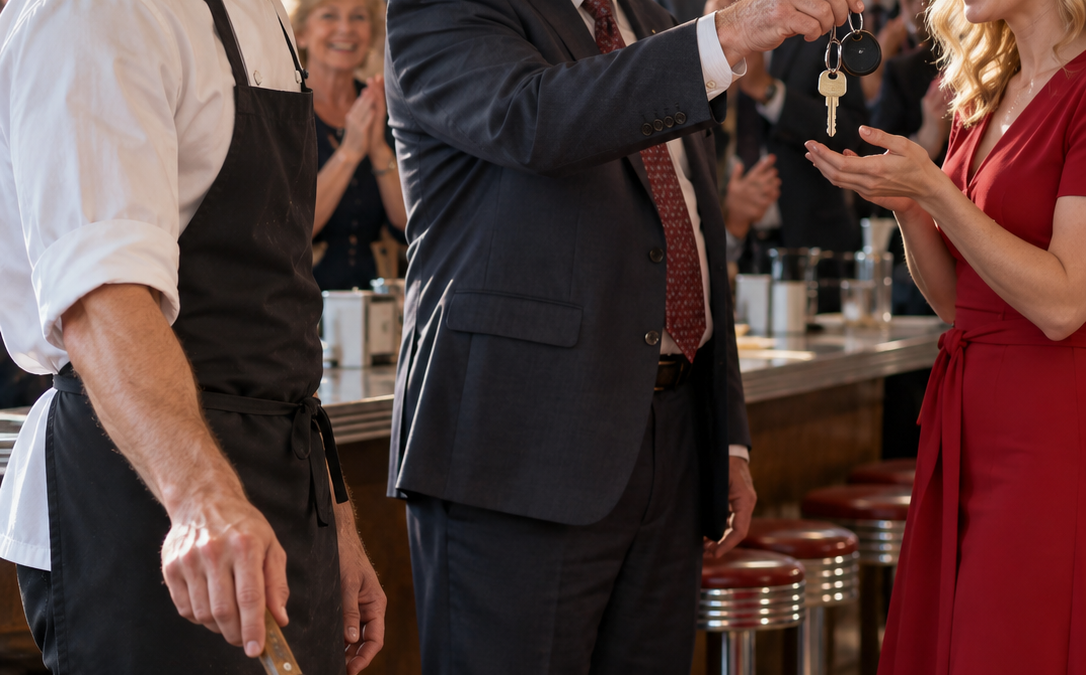
“The keys belong to Marissa,” my father announced, while sixty guests applauded. I had kept his diner alive for nine years. He handed me a spatula instead. I dropped it in the trash and walked out. Ten months later, the business was gone. Two years after that, he came for half of mine. He had no idea what I knew.
PART 1 – THE BETRAYAL
“Marissa has the head for business. Benny knows his way around a grill.”
My father said it into a room full of people who had eaten food I cooked for nearly a decade. Then he tossed my sister his keys, reached beneath the counter, and offered me an old spatula with black electrical tape around its wooden handle.
People laughed at what looked like a family joke. Wanda didn’t.
I had a bank letter in my jacket pocket. It said I was preapproved for financing to buy the diner at a fair price. I had spent four years saving for that conversation. My father didn’t know the letter existed, and I never took it out.
I accepted the spatula, carried it to the garbage can beside the register, and let it drop. Its hollow little clunk cut through the room more effectively than anything I could have said.
Then I walked out.
I’m Ben, thirty-six, and I cook breakfast in Rogers City, Michigan. Back then I worked at Myron’s, my father’s diner outside Alpena. To explain that spatula, I need to explain the nine years before it.
Dad had opened Myron’s in 1987, and mill workers had once filled it at sunrise. By 2013, the food was driving them away.
His knees hurt so badly he could barely get through breakfast service. The hash browns came frozen in bags. Pancakes came from a mix that only needed water. The coffee had an old metallic taste, and nobody bothered to complain anymore. They simply stopped coming.
I was twenty-three, cooking at a hotel restaurant in Traverse City. I liked the work, the crew, and the prospect of moving up. One Sunday in May, Mom called.
“Your father won’t tell you, but we’re closing,” she said.
“Thinking about closing?”
“We’ve done the books, Ben.”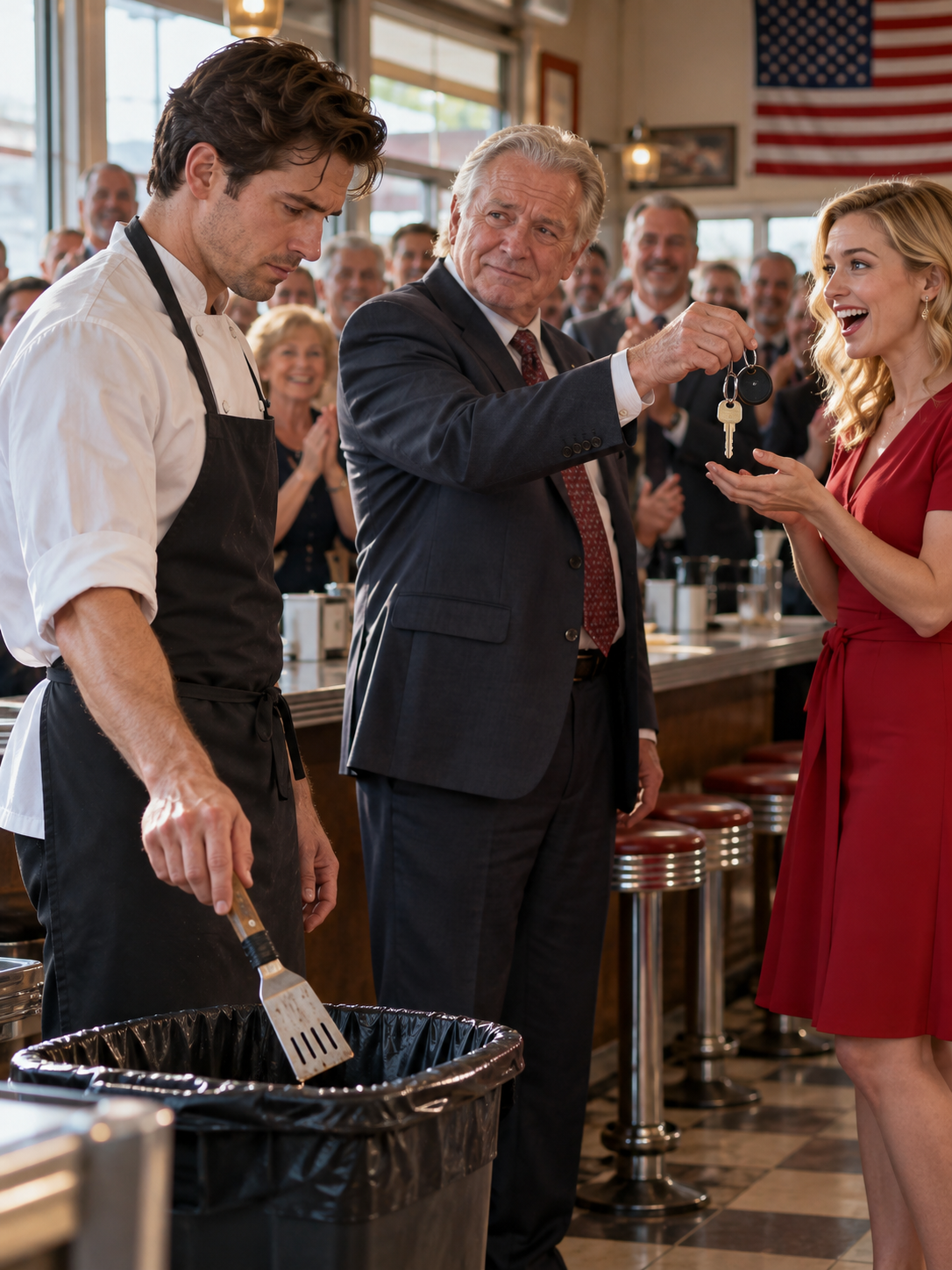
I gave notice and drove home for what I promised would be one summer. I saw a problem I could fix. I’d always been too quick to take responsibility for everyone else’s problems.
The first morning, I got up at 3:45. By 4:30, the grill was hot. The mill changed shifts at six, and a man facing twelve hours of work shouldn’t have to wait for somebody to turn on a stove.
I peeled and grated potatoes the previous evening, soaked them, squeezed them dry with a kitchen towel, then cooked them in butter until the edges went crisp. I mixed buttermilk pancake batter from scratch. I replaced the coffee maker with one that could brew a decent pot and started grinding beans every morning.
Tuesdays and Thursdays became pie days: apple, cherry, and sour cream raisin. Fridays meant fresh whitefish from Rogers City. I wasn’t reinventing breakfast.
The first regular to return was Stash, a mill worker who had eaten two eggs over medium, rye toast, and hash browns at Myron’s for years. He sat at his old stool one October morning and didn’t say much until he’d cleared his plate.
“Who’s back there?” he asked.
Wanda, our waitress, nodded toward the kitchen. “Myron’s boy.”
Stash looked at the plate. “Huh.”
Wanda had worked for Dad since 1992. She called everyone “hon,” remembered every order, and never repeated the private troubles customers told her over coffee.
By year three, Saturdays had a line outside. By year five, a Traverse City television station named us one of Northern Michigan’s best breakfasts and gave us a plaque for the wall.
Dad did the interview. He was a natural on camera, leaning against the counter, telling stories about opening week in 1987. A customer asked about the young man working behind the grill.
“Oh, Ben’s a good cook,” Dad said. “I taught him everything he knows.”
He’d taught me how to make toast. He’d also taught me that a customer should never have to ask for more coffee. I was grateful for both lessons. I just wished he’d noticed what I’d learned on my own.
Dad paid me a fair wage. I rented an apartment over a flower shop on Second Avenue. But I handled the kitchen, ordering, and early shifts. I wanted more than a paycheck forever.
At twenty-eight, I brought up ownership. Dad was on the back step, stretching his bad knees. Mom stood in the doorway with the day’s bank deposit bag.
“I’d like to buy into the business,” I said. “Or buy it from you when you’re ready. We could work out a fair price.”
Dad waved me off. “When I retire, it’s yours, Benny.”
Mom smiled. “You heard him. I’m a witness.”
I kept my old truck, skipped vacations, and saved for four years. I didn’t want a gift. I wanted enough money to buy the place fairly.
Dad owned a cottage on Long Lake, too. Two bedrooms, a dock, an old pontoon that hadn’t run in years. Sometimes, when he was talking about the future, he’d say, “The cottage will be Marissa’s. Ben will have the diner.”
Marissa, two years younger than me, had moved to Grand Rapids, worked in sales, and married Lucas. I had no reason to resent her for leaving. I’d left, too.
In spring 2021, their marriage ended. Lucas kept the house, and Marissa came back to our parents’ place with eleven boxes and a ring light. She was twenty-nine, out of work, and embarrassed to be sleeping in her childhood bedroom. Mom suggested she help at the diner.
At first, Marissa was good with people. She handled the register and posted pictures of customers with their pies. After her divorce, I understood why having something of her own to promote mattered.
She’d appear in the kitchen and say, “That family drove four hours because of my post.”
“Great. What did they order?”
“I don’t know. Breakfast.”
She started referring to me as “the kitchen.” A customer once asked whether I really baked the pies. Marissa waved toward the swinging door and said, “That’s just the kitchen.”
Wanda set her coffee pot down hard enough that everybody at the counter looked up.
That fall, the newly printed menus listed my buttermilk French toast as “Marissa’s Famous French Toast.” I carried one out to Dad.
“Since when is this hers?”
“It’s marketing,” he said. “People like a name.”
“I have one.”
“Don’t make a thing out of French toast.”
The name stayed. A few months later, the local paper credited Marissa with refreshing the menu. The actual recipes hadn’t changed. Neither had the man standing over the grill.
Dad said Marissa brought younger customers, and he was right. But why did acknowledging her work require erasing mine? He changed the subject to tomorrow’s food order.
Two weeks before the retirement party, I found Marissa’s “Ideas for Myron’s” in the printer: open at eight, sell brunch and mimosas, buy frozen potatoes, remove the stools, and borrow against the building for renovations.
The plan ignored the people who paid our bills. More than half our weekday customers arrived before Marissa even proposed unlocking the door.
When Dad arrived, I showed him the pages.
“Eight o’clock loses the mill crowd,” I said. “You know that.”
“Your sister has ideas. You’ve got a grill. Everybody has a department.”
“It’s not a department problem. It’s the whole business.”
I’d recently met Fred Mrossek, a banker on Chisholm Street who loved my sour cream raisin pie. After reviewing my savings and the numbers, he’d given me financing preapproval to buy Myron’s.
“With your down payment and this kind of customer traffic,” he said, “I can work with you. Go talk to your father.”
The party was Sunday, September 18, 2022. We closed early and put a sign on the door. Sixty people came: regulars, former mill workers, Dad’s bowling friends, relatives, and a couple of local reporters.
Wanda wore a dress. Mom made her famous ham buns. I baked three pies. Someone bought a grocery-store cake with a frosting fishing pole, although Dad had never been interested in fishing. It was the kind of party that made a man feel he’d done something worthwhile. Dad had.
Around three, Dad thanked Mom, Wanda, his bowling friends, and the longtime regulars. He told his familiar story about the grill fire during opening week and joked about Stash’s thirty years of complaints.
“Marissa has the head for business,” he announced.
He held up the heavy key ring with the bottle opener attached and tossed it to my sister. She caught it without looking surprised. That’s what I remember most. The decision had been made long before that afternoon, and I was the one person nobody had bothered to tell.
“Starting tomorrow, the business and the building belong to her.”
People applauded. Marissa smiled at the room. Dad reached beneath the counter, retrieved that old spatula, and told me to stick with what I was good at.
I looked toward Mom. She was examining the plate of ham buns in front of her. Wanda wasn’t smiling. Her palm lay flat on the counter.
I dropped the spatula in the trash and left. In the parking lot, I sat in my truck facing the big front window. Behind that glass were the pie case I’d kept stocked, the stools I’d filled, and the counter where Dad had just given away nine years of my working life without asking me a question.
The next morning at 5:10, Marissa called.
“Where are you? The grill is cold. Ten people are waiting.”
“Those are your keys,” I said. “You’ll have to open your kitchen.”
Dad called before six. “Nothing has to change for you, Benny. Your sister handles the business. You keep cooking.”
“You told me the diner would be mine when you retired.”
“Things change. Your sister needed a fresh start after the divorce.”
“And I didn’t need anything?”
“You can cook anywhere.”
“You’re right,” I said.
He started talking about everything he’d done for me. I reminded him that teaching me to make toast didn’t entitle him to my future, and I ended the call.
A week later, I sat in Fred’s office again. I expected him to tell me that financing was off the table. Instead, he took off his glasses and listened as I explained that Dad had transferred the diner to Marissa.
“Could I borrow for a smaller place?” I asked.
“Find one,” he said. “Bring me the numbers.”
I drove through towns along the Lake Huron shore until I found an empty root beer drive-in in Rogers City, thirty-five miles north of Alpena. It had an orange roof and eight stools.
The drive-in had been empty six years. But trucks passed it before sunrise on their way to the limestone quarry. I spent a morning counting them.
I leased the place with an option to buy, spent my savings on repairs, and hauled in a used flat-top grill from a closed truck stop in Gaylord. I rebuilt the counter and painted the sign myself, crooked S and all.
I called the diner The 4:30. The grill would be ready when my customers were.
We opened April 3, 2023, with nine customers. The hood fan failed on day two. I worked in the cold with the back door open until it was repaired. I had bills, no regulars, and more anxiety than sleep.
That Saturday, Stash drove thirty-five miles to sit at the end of my counter.
“Two over medium, rye, and hash browns,” he said. “If the potatoes came with you.”
I put his plate down myself. He ate, pushed it away, and nodded.
“Yeah. They came with you.”
Wanda had started calling from the old diner’s wall phone the previous October, while I was still hunting for a place. Marissa began opening at eight. By Thanksgiving the mill crowd was gone. Stash tried frozen hash browns, sent them back, and got another plate of the same thing.
The mimosa glasses arrived before the liquor license. Marissa borrowed to remodel, removed the beloved counter stools, and doubled the price of eggs and toast. Customers were now served on wooden boards.
In March, Wanda called to report she’d been issued a pink shirt declaring that brunch was her love language.
“I’m sixty-eight,” she said. “My love language is Melvin taking out the trash.”
Marissa called in May. “You opened another diner just when I needed customers.”
“Thirty-five miles away,” I said. “Your customers left when you stopped serving them breakfast.”
“You could’ve taught me the potatoes.”
“I made them in front of you for six months. You photographed them.”
She hung up.
The trouble deepened. A walk-in cooler wasn’t keeping temperature. Repair bills went unpaid. The supplier demanded payment on delivery; eventually the meat deliveries stopped. On July 14, 2023, Marissa locked Myron’s front door and taped up a sign that read “Closed for Renovations.” There was no money left to renovate anything.
That night Dad called. I let it go to voicemail. The message lasted six minutes. I listened the following morning in the walk-in cooler at The 4:30, where the temperature was thirty-six degrees and nobody could interrupt me.
He cried about the building, the name, the money Marissa had borrowed. He apologized twice for the retirement party. Near the end, he said, “I’ll never ask you for another thing as long as I live, son. Not one more thing.”
I listened once from the beginning, my phone balanced on a shelf between cartons of cream. He had rarely sounded uncertain in my childhood. Now his sentences broke apart, and I caught myself waiting for him to ask how I had managed after leaving. He never did. I didn’t delete the recording, either. I wanted to be able to hear what he had actually said, not what I might wish he’d said later.
I didn’t return the call. He sounded sorry he’d lost the diner, but he never said he’d been wrong about the man who had kept it open. I couldn’t bear another conversation in which my work was invisible.
Meanwhile, quarry workers and lakeboat crews found The 4:30. Their families followed. I hired two cooks and Patrice, a waitress who could carry six plates and give her opinion at the same time.
By our second spring, we served breakfast six days a week, closing Mondays. In October 2024, I exercised my option and bought the building. Fred sat beside me at the closing and ate cherry pie while I signed the papers.
Mom and I exchanged Christmas cards, nothing more. Wanda and Stash came on Saturdays to argue about the weather. I gave Wanda her coffee free; she’d carried her last plate and liked being the customer.
In August 2025, the same television station named The 4:30 one of Northern Michigan’s best breakfast places. I stayed in the kitchen while they interviewed Stash.
“Best hash browns since Myron’s,” he told the camera. Then he corrected himself. “Same hands.”
Three days later, Wanda arrived, sat down, and left her coffee untouched.
“Hon,” she said, “your sister’s been telling people she’s becoming your partner.”
The following Wednesday, Mom called. Dad wanted to discuss business. She said he wasn’t doing well and asked me, please, just to hear him out.
I gave her a time: ten o’clock Monday, when we were closed. My restaurant. My terms.
Then I called my accountant, Dorene. She’d done my books since opening day, and I trusted her more than I trusted anyone’s promises. I told her what Wanda had heard about Marissa joining the business.
“Before anybody gets a share of this place, I need you to check their liabilities,” I said.
“Give me two days,” she said. She called back in one.
“Ben, turn down the grill. There’s a state tax claim against Marissa. Forty-one thousand dollars with penalties.”
“Your father’s name is on it, too.”
PART 2 – THE HIDDEN TRUTH
I went into the office and closed the door. The prep cook could manage the grill for five minutes.
“How is Dad involved?” I asked.
Dorene read from the records she’d obtained. Dad had transferred ownership of the building, but Marissa had continued operating the diner through his old business entity. The sales tax customers paid had not been remitted to Michigan. Neither had certain payroll withholding amounts taken from employees’ checks. Penalties had brought the assessed liability to roughly $41,000.
“Are you sure that includes him?”
“His name is on the assessment. Don’t confuse that with me telling you what a lawyer can get reduced. But this is not a clean business history, Ben.”
Not a clean business history. That was Dorene’s version of shouting.
The notices had gone to an address associated with Marissa. Dad might not have seen them.
“There’s more,” Dorene said. “A wage claim. Wanda Shamanssky. Two returned paychecks.”
I sat down.
Dorene explained that the wage claim was separate from the tax assessment. It wasn’t money that vanished into some general accounting dispute. Those were hours Wanda had already worked.
Wanda had driven to Rogers City every Saturday for two years. She’d criticized my coffee, argued with Stash, and asked whether I was eating enough. She hadn’t mentioned the money Myron’s owed her once.
I understood then that Monday couldn’t be about whether my sister had a convincing new marketing plan. I needed to hear exactly what Dad believed he was asking me to risk.
I printed the records Dorene had identified, marked the questions I wanted answered, and put the papers in a folder beside my phone. The voicemail was still there, dated July 2023.
PART 3 – THE PRESSURE
They arrived together on Monday morning. Dad needed a cane to get from the car to the entrance. Mom carried a white gift bag. Marissa carried a thick blue binder with “Five-Year Vision” written on its cover.
I let them in and poured four coffees. No breakfast. We sat in the booth by the window, where Dad spent a long moment examining the stools, the counter, and the television plaque.
“Nice place, Benny,” he said.
“Thank you.”
Marissa opened her binder. “We think it’s time the family worked together again. I’ll handle branding, social media, events, front of house. You keep the kitchen running.”
“And what time would we open?”
“We’d consider eight. There’s a brunch market nobody’s serving.”
“The quarry shift starts at six.”
“They can adapt.”
The words were almost identical to what Wanda had reported two years earlier. I looked at Dad. He had heard them, too, and still didn’t challenge her.
He cleared his throat. “Your sister gets fifty percent. No buy-in. We’re family, and everything you learned started in my kitchen. We could put the Myron’s name back on the sign.”
“Half of this business?”
“You have something. She has nothing,” he said, as if that settled it.
Marissa waited for me to agree.
I asked her what she’d learned from operating the old diner. She replied that she’d run a restaurant. I said she’d closed one.
Her binder snapped shut. “You stole our customers.”
“Your customers were gone before my doors opened,” I said. “Let’s talk about what else happened.”
PART 4 – THE CONSEQUENCES
I placed Dorene’s records on the table.
Dad picked up the first page and held it away from his face. He still refused to wear his reading glasses around me.
“Marissa collected sales taxes and didn’t remit them,” I said. “There are unpaid withholding obligations, too. The assessed amount is forty-one thousand dollars. Your name is connected to the operating business, Dad.”
Marissa reached toward the paper. “I’ve been handling that.”
“Then why didn’t you tell him?”
Dad turned to her. “You said the bank took the building and everything was over.”
“Most of it was.”
“That’s not an answer,” he said.
I kept my voice steady. “If Marissa owns a share here, her creditors could create a serious problem for this business. I’m not going to put the payroll, this building, or the staff’s jobs in that position.”
I wasn’t saying anyone could automatically seize the whole diner. I was saying I had no reason to invite a fight over ownership or liens into a business that was paying its bills.
Mom’s fingers tightened around her coffee cup. She had been looking down since I mentioned taxes.
“There’s a wage claim, too,” I said. “Wanda’s last two paychecks bounced.”
For the first time, Marissa had nothing to say. Dad set down the assessment. The ice machine dumped a load of cubes in the kitchen; every one of them flinched.
“Ben,” Dad said finally, “I’m not asking for myself. I’m asking for your sister.”
He believed it made a difference. Maybe to him it did. But it would still be my name on the papers and my employees depending on the outcome.
I reached for my phone. There was one more promise he needed to hear before this conversation went any further.
PART 5 – THE CONFRONTATION
I put the phone between the coffee cups and played the last part of Dad’s six-minute voicemail.
“I’ll never ask you for another thing as long as I live, son. Not one more thing.”
I stopped the recording.
Dad stared at the screen. Mom pressed a napkin beneath her eyes. Marissa shifted in the booth but didn’t try to speak.
“You’re asking for half my restaurant,” I said. “That’s a thing.”
Dad looked toward the window. “I was trying to help your sister.”
“I know. You were trying to help her when you gave her Myron’s, too.”
Mom placed the white bag on the table and pulled out the tissue paper. Inside was the old spatula, with its taped wooden handle. She said she’d retrieved it from the trash after the retirement party because Dad had always wanted me to have it.
I held it for a moment. I could remember that handle hanging above the old grill when I was a kid. I could also remember working through nine winters while Dad told people Marissa was the one with the business ideas.
I carried the spatula to the dish pit and dropped it in the empty garbage can.
When I returned, I said, “Still not mine.”
Then I opened the front door. Marissa went first with the binder, Mom followed, and Dad moved slowly behind them. He stopped on the threshold, looking as though he wanted to say more.
Nothing came. I kept the door open until he reached the car.
PART 6 – THE EMOTIONAL TURN
I didn’t enjoy the rest of that Monday. I wiped down a counter that was already clean and checked the refrigerator temperatures twice.
For years I’d told myself I was angry because Dad gave Marissa a business I’d earned the right to buy. That was part of it. But the deeper problem had started earlier, when I kept asking for permission to be seen as more than his cook.
I had accepted a verbal promise instead of negotiating a real succession plan. I had tolerated having my recipes renamed and my work credited to someone else. Each time, I told myself that staying quiet was the mature choice. Sometimes it was just easier than hearing Dad dismiss me again.
None of that excused what he did. It did explain why the spatula hurt so much. He’d offered me the thing I was already holding every morning, and expected gratitude for it.
Back in the kitchen, the afternoon light came through the service window onto the flat-top. I checked the next day’s prep list, confirmed the produce order, and made sure Patrice’s hours were correct. Those decisions were mine now. So were the costs when I got them wrong. I could no longer blame my father for the choices I made about my own future.
I didn’t call Mom to argue about the gift bag. I didn’t call Marissa to demand an apology. I called Dorene to make sure our own records and ownership documents were in order.
Then I went home. For once, I didn’t rehearse what I wished I’d said to Dad.
PART 7 – THE FINAL TEST
That fall, the state began collecting against Marissa’s income. When she couldn’t meet the obligation quickly enough, Dad received his own bill. My parents sold the Long Lake cottage that October to help settle what was owed.
It was the cottage Dad used to say Marissa would inherit. I didn’t take pleasure in the sale. I also didn’t offer to solve the problem for them.
Marissa found work at the gas station near the old diner, the same place the mill workers had gone when she pushed opening time to eight. Her shift began at 4:30 in the morning.
Mom told me about it in one of our rare calls. She sounded tired and asked whether I thought I’d ever speak to Marissa again.
“I don’t know,” I said. “But I’m not taking her into my business.”
Dad visited Wanda at her house with an envelope containing her two unpaid checks. Wanda told me he’d stood on her porch, hat in hand, and apologized for letting it go so long.
“I told him it should’ve been done sooner,” she said.
“Did you let him explain?”
“I let him make it down the steps before I shut the door. I’m not a monster.”
The old Myron’s building sold that winter. It became a tire shop. They kept the front window and stacked tires where my pie case used to stand.
I drove past once and kept going. I had an early shift the next morning.
PART 8 – THE RESOLUTION
At The 4:30, we added a second flat-top that spring. It wasn’t glamorous. It meant another piece of equipment to maintain and another cook to train, but Saturday breakfast had outgrown the first grill. The television plaque stayed by the register, and the business name on the paperwork matched the one above the door.
There were still bad mornings. A delivery would arrive late. A new cook would overbrown the potatoes. Someone would forget to restock the rye bread before the quarry shift. Owning a diner didn’t make those problems disappear. It meant nobody else could decide I wasn’t qualified to solve them.
One Tuesday in April, around 6:30 a.m., the bell above the door rang. Dad walked in alone, his cane in one hand.
He’d driven thirty-five miles. I hadn’t known he was coming.
He didn’t push into the kitchen or ask Patrice to send for me. He sat at the far end of the counter, where Stash sat on Saturdays. Patrice handed him a menu. She didn’t know the full history, only that this was my father and that I hadn’t asked her to treat him differently.
He left it closed.
“Two eggs over medium,” he said. “Rye toast. Hash browns.”
She wrote down the order. In the kitchen, I looked through the service window at the back of his head. His hair had thinned since I’d last stood beside him at the old diner. He waited for his food without turning around.
I made his breakfast exactly as I made everyone else’s. Real potatoes, dried before they touched the flat-top. Butter. Edges cooked brown. Toast cut corner to corner. No extra portion, no plate set aside, no message tucked beneath a napkin.
Patrice carried it out. Dad ate every bite. I kept working through three other tickets rather than standing at the window watching him.
When she brought his check, he paid the full amount. I didn’t tell her to waive it. He didn’t ask.
On his way out, he paused where he could see through the kitchen window. He raised his cane toward the hook above my grill. A twelve-dollar spatula from a restaurant-supply store in Saginaw hung there.
“That one any good?” he asked.
“It’s mine,” I said.
He nodded slowly. After a moment, he said, “Good.”
Then he went outside and drove away.
Patrice brought his check folder into the kitchen and opened it. He’d left a twenty-percent tip.
When I told Wanda that Saturday, she looked at the receipt and shook her head. In thirty-one years working for my father, she said, she’d never seen him tip anybody.
I didn’t hang the receipt on the wall. I put it with the day’s paperwork, checked the orders waiting at the window, and reached for my spatula.
THE END








