“Your dog’s at the pound,” my brother said, feeding his cat. “He drank Pepper’s milk,” he added, without looking up. I froze. Mom refused her car keys and threatened to throw me out. She said I had to choose. That night, nobody heard scratching at the basement door. At dawn, Dad lay unconscious by the stairs. Scoob had been warning us.
The first thing I noticed was the silence.
After thirteen hours on my feet, I should have heard Scoob before I even reached the front porch. He knew the sound of my car. He knew the uneven rhythm of my footsteps when I was tired. Sometimes he started barking while I was still digging through my purse for my keys, and by the time I opened the door, his tail would be beating against the hallway wall hard enough to make the family photographs rattle.
That evening, nothing moved.
I stood in the doorway with my work bag slipping off my shoulder and listened.
“Scoob?”
No claws clicking across the hardwood. No excited whining. No familiar brown face appearing around the corner.
I walked into the living room.
His bed was gone.
For a moment, I thought my mother had moved it to vacuum. Then I noticed the empty hook beside the back door. His blue leash wasn’t there. Neither was the faded green towel I kept beneath his water bowl.
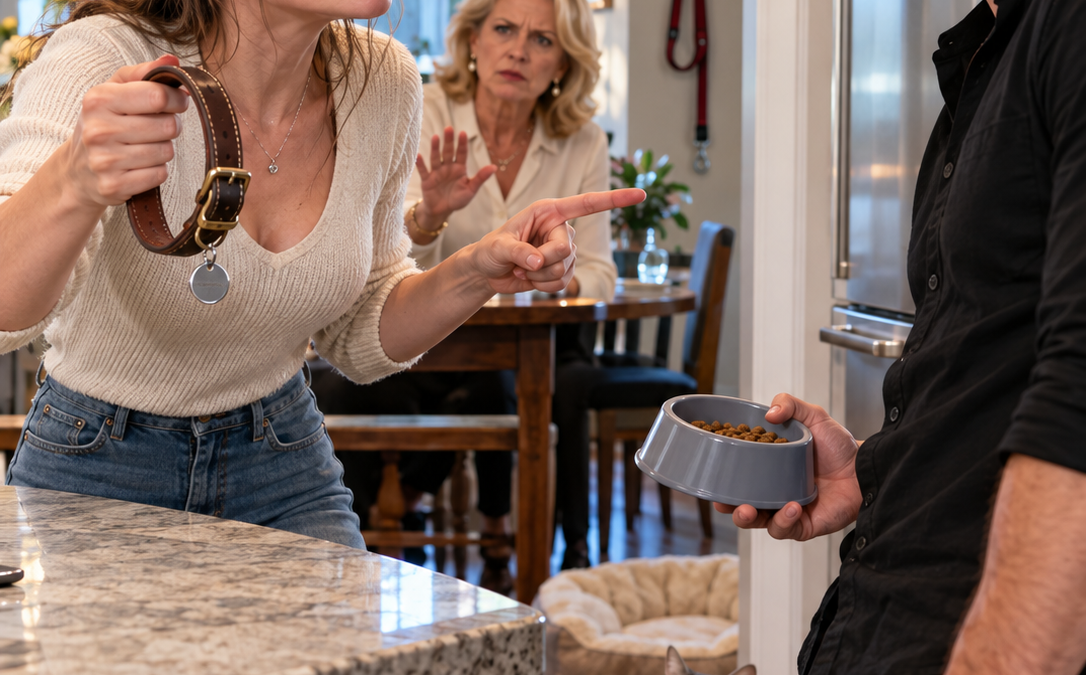
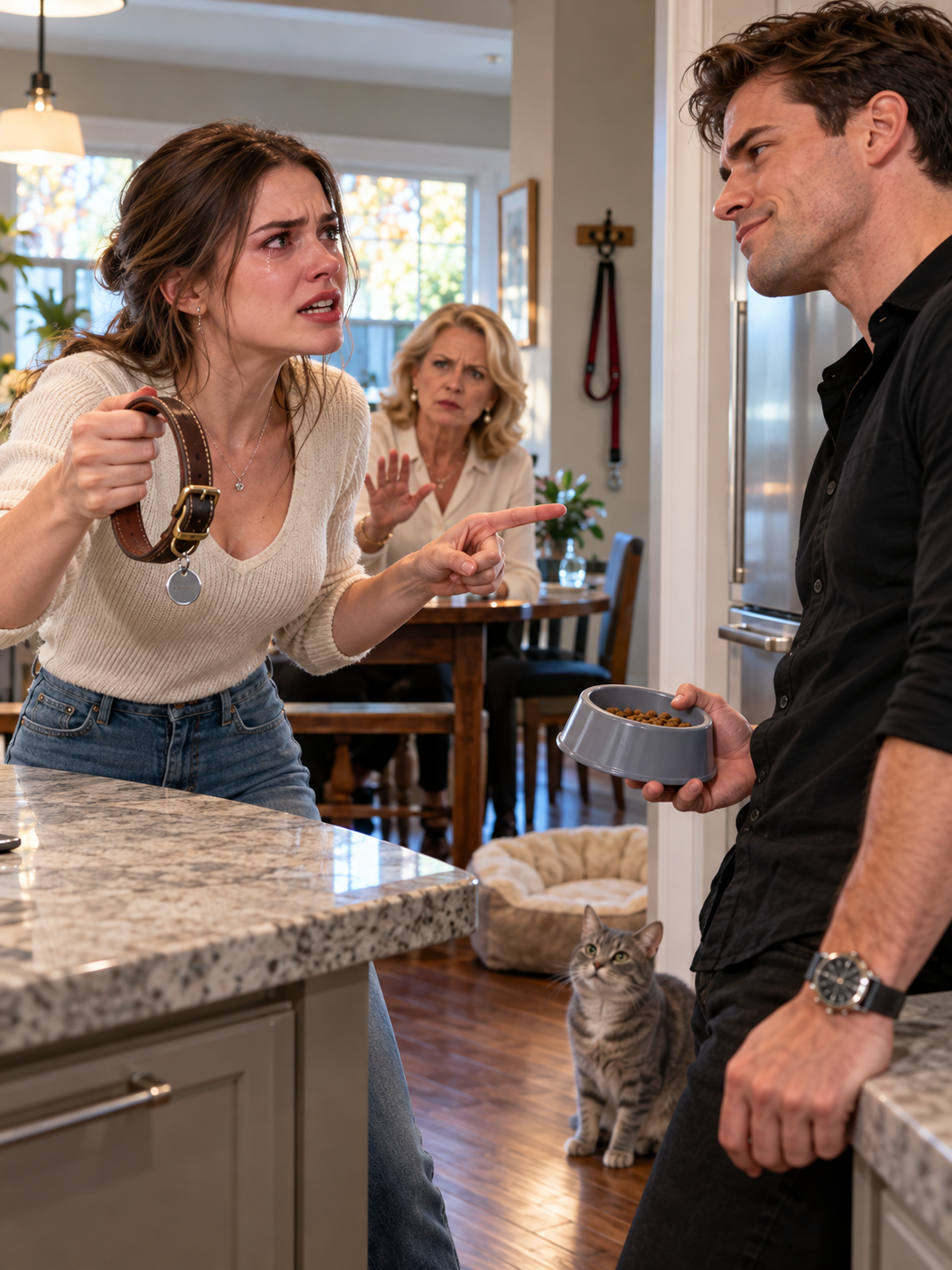
In the kitchen, my older brother Mason was spooning food into a ceramic dish for his cat, Pepper.
“Where’s Scoob?” I asked.
Mason didn’t turn around.
“Gone.”
I waited for him to explain. He scraped the last of the food from the can, set it on the counter, and watched Pepper approach her bowl.
“Mason. Where is my dog?”
“He drank Pepper’s milk, so I surrendered him to the pound.”
He said it with the same bored irritation he used when telling me we’d run out of coffee.
I stared at him, waiting for the punch line.
It never came.
“You did what?”
Mason finally looked at me. He was thirty-one years old, three years older than me, but he still had the expression of a teenager who enjoyed watching someone else get blamed for something he’d done.
“I took him to the shelter. He’s been causing problems for weeks, and today he decided Pepper’s food was his, too.”
“He drank from a bowl?”
“He’s filthy, Sarah. He’s loud. He wakes everybody up.”
“Which shelter?”
He leaned against the counter.
“Doesn’t matter.”
I felt my fingers tighten around the strap of my bag.
“Tell me where you took him.”
“Why? So you can bring him back and start the whole thing over again?”
Pepper rubbed against his ankle. Mason bent to stroke her head, deliberately turning his attention away from me.
That’s when I understood that this wasn’t an argument about a cat’s milk.
Mason had taken the one living creature in that house who loved me without asking what I could do for him, and he was enjoying the moment I discovered it.
What I didn’t know was that Scoob had been trying to warn us about something for three weeks.
And by the following morning, the people who had wanted him gone would be pounding on my bedroom door, begging me to wake up.
My name is Sarah Bennett. I was twenty-eight years old, and until that night, I believed there was a difference between being needed by your family and being loved by them.
I had spent most of my adult life confusing the two.
Every weekday, my alarm rang at 4:45 in the morning. I worked the early shift at Miller’s Bakery, where the ovens were already running by the time I arrived. I spent hours carrying trays, packaging bread, and serving customers who wanted their coffee hot and their orders ready before they reached the register.
In the afternoons and evenings, I worked as a receptionist at Greenfield Veterinary Clinic. There, I answered phones, checked patients in, handled invoices, and tried to reassure frightened owners while their animals were being examined.
By the time I came home, I usually smelled like fresh bread underneath the sharper scent of disinfectant. My hair had escaped its ponytail, my feet hurt, and I sometimes sat in my parked car for a full minute because I needed to gather enough energy to walk inside.
Scoob never cared how exhausted I looked.
He met me at the door every evening as if my arrival were the best thing that had happened all day.
He was a medium-sized brown dog with one slightly damaged ear, a pale patch beneath his chin, and the kind of expressive eyes that made strangers stop to talk to him. His tail had a permanent bend near the end. When he was excited, his entire back half moved with it.
I would drop my bag, kneel on the floor, and let him push his head beneath my arm.
“Hi, handsome,” I’d whisper. “Did you miss me?”
He would sneeze, wag harder, and press closer.
Some evenings, those thirty seconds were the only time all day that I felt someone was genuinely happy to see me.
My father, Paul, generally greeted me with a question about a bill. My mother, Linda, wanted to know whether I’d remembered groceries. Mason usually stayed in his room unless he needed money, a ride, or help paying for something he insisted was urgent.
I told myself that was ordinary family life.
We were all adults. We were tired. Nobody had the energy for elaborate greetings.
But Scoob had never once asked whether I’d paid the electricity bill before deciding I deserved affection.
Two years earlier, I’d been living in a small apartment on the other side of town. It wasn’t impressive, but it was mine. I could leave a mug in the sink without hearing a lecture. I could come home late without explaining myself. And Scoob had a favorite spot beside the living room window where he watched people walk past on the sidewalk.
Then Dad injured his back at the warehouse.
He’d spent years moving heavy shipments, and after the injury, he couldn’t return to full-time work. Medical appointments became more frequent. His paychecks shrank. The mortgage didn’t.
One Sunday evening, Mom called me crying.
“Sarah, I don’t know what we’re going to do. Your father’s hours are gone, and we’re falling behind. We might lose the house.”
I remember sitting on my apartment floor with Scoob’s head resting against my thigh while she spoke.
“How far behind?” I asked.
She gave me a number that made my stomach sink.
Then she said, “If you moved back for a little while, we could all get through this together.”
I didn’t want to move.
I liked my apartment. I liked the quiet. I liked having a place where I didn’t have to negotiate every decision.
But Mom sounded frightened, and Dad had worked hard for that house. I couldn’t bear the thought of them losing it while I had a steady income.
That weekend, I packed.
Scoob watched me carry boxes to the car, then climbed into the passenger seat as soon as I opened the door.
“You and me,” I told him.
He rested his chin on the dashboard.
I thought we were moving in to help my family. I didn’t realize I was giving up the only home where I had been allowed to set my own rules.
The arrangement was supposed to be temporary.
Instead, I began paying $850 every month toward the mortgage and utilities. I spent roughly $140 a week on groceries and covered half of Dad’s physical therapy costs.
Whenever an unexpected bill arrived, Mom placed it on the kitchen counter where she knew I would see it.
“I’m not asking you to pay the whole thing,” she’d say.
Sometimes she didn’t have to ask at all.
I would look at the amount, think about how hard Dad was struggling, and transfer whatever I could.
Meanwhile, Mason occupied the bedroom across from mine.
He didn’t contribute anything regularly.
He had explanations, of course. His hours at work weren’t reliable. He was looking for a better position. He needed to invest in equipment so he could make money online. There was always a reason his next contribution would have to wait.
Mom accepted every one.
“He’s still finding his direction,” she told me whenever I complained.
Apparently, finding his direction required a new gaming console, expensive takeout, and a collection of computer accessories that arrived in boxes several times a month.
It also required a gray cat named Pepper.
I liked Pepper. She was a quiet animal who preferred sunny windowsills and tolerated Scoob as long as he didn’t sniff her too enthusiastically.
Scoob liked everyone, including her.
Mason, however, seemed personally offended that the dog preferred me.
“He follows you around like you’re some kind of celebrity,” he said one evening.
Scoob was lying beneath my chair, his chin resting on my shoe.
“He likes being near me.”
“He’s obsessed with you.”
“No,” I said. “He’s loyal. There’s a difference.”
Mason’s expression changed.
At the time, I thought he was simply annoyed.
Later, I understood that my brother hated being reminded that affection could be earned through kindness rather than demanded through family obligation.
Scoob had been part of my life for three years.
I found him in the parking lot behind Greenfield Veterinary Clinic, on a night when I was certain I wasn’t going to make it safely to my car.
It was late. The clinic had closed, and I had stayed behind to finish paperwork. Most of the businesses nearby were dark.
I noticed the man when I stepped outside.
He was standing near the far end of the lot, close to a delivery entrance. At first, I assumed he was waiting for someone.
Then I started walking toward my car, and he began moving in the same direction.
I changed my pace.
So did he.
I remember the sound of my keys striking one another as I tried to find the right one. I remember glancing toward the clinic and realizing the doors were locked behind me.
The man was close enough that I could hear his footsteps.
Then something moved beneath a parked pickup truck.
A thin brown dog crawled out from the shadows.
He looked terrible. His ribs showed beneath his coat, one ear was torn, and his fur was matted with dirt.
But when the stranger reached toward me, that starving dog stepped directly between us.
He lowered his head and growled.
The man stopped.
“Control your dog,” he snapped.
I didn’t hesitate.
“He is under control.”
The man looked from the dog to me, muttered something I couldn’t understand, and backed away.
Scoob didn’t follow him.
He stayed planted in front of my legs until the stranger disappeared around the building.
Only then did he turn and look up at me.
I crouched carefully.
“Where did you come from?”
His tail moved once.
I offered him my hand. He sniffed it, then leaned forward just enough for me to touch his head.
“You’re coming inside,” I told him.
I named him Scoob before we reached the clinic door.
His treatment cost $620.
He needed medication, vaccinations, proper food, and attention for several neglected injuries. I had been saving that money for new tires, and spending it meant putting off a repair I genuinely needed.
I didn’t regret a dollar.
Once he was healthy enough, I registered his microchip in my name. Two weeks after finding him, I brought him home.
I thought I’d rescued him.
But the truth was that he had already rescued me.
And he kept doing it in quieter ways.
When I had the flu, he stayed beside my bed and refused to leave except when I made him go outside. When I lost a promotion I’d worked hard for, he sat with me on the living room floor while I cried.
When my family interrupted me at dinner or made decisions without asking my opinion, he would settle beneath my chair and rest a paw against my foot.
He didn’t understand mortgage payments or favoritism.
He understood when I was unhappy.
Sometimes that was enough.
Mason never accepted how close we were.
His resentment became impossible to ignore the night he asked me for $900 to upgrade his computer.
We were in the kitchen. I was checking my bank balance while Scoob finished his dinner.
“I’ll pay you back,” Mason said.
“When?”
“When I start making real money.”
“You said that last time.”
“This is different.”
I looked at him.
“I can’t give you nine hundred dollars.”
“Why not?”
“Because Scoob needs dental treatment, and I’ve already scheduled it.”
Mason stared at me, then laughed.
“You’d choose that mutt over your own brother?”
I was too tired to soften my answer.
“Scoob has shown me more loyalty in three years than you have in twenty-eight.”
The kitchen went quiet.
Mason looked toward Scoob, who was licking a few crumbs from his bowl.
Then he looked back at me.
“Good to know where I stand.”
He left without another word.
I should have paid more attention to the way he watched Scoob after that.
But I was busy trying to keep everyone else afloat.
About three weeks before Mason took him away, Scoob started behaving strangely at night.
It began with a cold nose against my shoulder.
The first time, I opened my eyes and found him standing beside the bed, staring at me.
“What is it?”
He nudged me again.
I checked the clock.
12:18 a.m.
“Scoob, I have to be up in four hours.”
He caught the corner of my blanket gently between his teeth and pulled.
That was unusual enough to make me sit up.
As soon as my feet touched the floor, he hurried toward the bedroom door.
I followed him into the hallway.
He stopped beside the basement door and began scratching at the wood.
The sound echoed through the sleeping house.
“Hey. Stop that.”
He scratched again.
I opened the door and switched on the light.
The stairs descended into a cramped basement where we stored holiday decorations, old furniture, and boxes nobody had opened in years. The furnace stood against the far wall.
It had been making a faint clicking noise for months.
Dad insisted that wasn’t unusual.
“It’s an old machine,” he told me whenever I mentioned it. “Old machines make noise.”
I peered down the stairs.
Nothing moved.
I listened for mice or the sound of something shifting inside the walls.
All I heard was the furnace.
“There’s nothing down there, buddy.”
Scoob stood beside me, panting.
Then he hurried toward the kitchen and whined at the back door.
I assumed he needed to go outside.
I let him into the yard and cracked the kitchen window while I waited.
The cold air felt wonderful against my face. I’d been getting headaches after work, and standing near the open window seemed to help.
After several minutes, Scoob came back inside.
He drank some water, circled his bed, and lay down.
I thought that was the end of it.
The following night, he woke me again.
And the next.
Sometimes he nudged my shoulder. Sometimes he pulled my blanket. On one occasion, he barked sharply beside my bed until I sat upright.
Every time, he went to the basement door.
Every time, he scratched.
And every time, he became calmer only after I opened the back door and kitchen window.
I started wondering whether he could hear an animal in the basement.
At the clinic, I’d learned that dogs could react to sounds people barely noticed. I thought there might be mice behind the walls or something rattling inside the furnace.
I never imagined that the air in our home was becoming dangerous.
The rest of the family began complaining.
One morning, Mom sat at the kitchen table with her hands pressed against her temples.
“That dog woke me up again,” she said.
“I’m sorry. I’m trying to figure out what’s bothering him.”
“Well, figure it out faster. I’ve been waking up with headaches, and I can barely think straight.”
I was pouring coffee into a travel mug.
“Maybe you’re getting sick.”
“Maybe I’m exhausted because your dog won’t let anyone sleep.”
Dad had been complaining about dizziness, too. He blamed his pain medication and the fact that he wasn’t moving around as much as he used to.
Mason said his headaches came from staying up too late gaming.
I blamed mine on working two jobs.
We all had explanations.
None of us considered that the explanations might be wrong.
A few nights later, Scoob woke me at 12:43.
He was more agitated than usual. He kept turning his head toward the hallway, then looking back at me.
I followed him to the basement door.
Before I could open it, Mason came out of his room.
“Are you kidding me?”
His hair was disheveled, and he looked furious.
“I’m sorry,” I whispered. “Go back to bed.”
“That thing has been making noise for weeks.”
“Something’s bothering him.”
“There’s nothing down there.”
Scoob scratched the door again.
Mason stepped forward and kicked the lower panel.
The sound made Scoob jump backward.
“There’s nothing down there, you stupid mutt!”
“Don’t do that!”
Mason turned toward me.
“Then control him.”
Scoob didn’t bark at my brother. He didn’t bare his teeth.
He stood beside me, breathing quickly, his eyes fixed on the basement.
I knelt and placed my hand against his chest.
His heart was racing.
“I don’t know what you’re trying to tell me,” I whispered.
He licked my wrist.
Then he looked at the door again.
I opened it, checked the stairs, and saw nothing.
Eventually, I took him into the kitchen, opened the back door, and let the cold air inside.
His breathing settled.
I wish I’d understood what that meant.
I wish I’d called someone to inspect the furnace the next morning.
Instead, I apologized to my family for the noise and went to work.
The morning Mason surrendered Scoob began like any other weekday.
My alarm rang at 4:45. I dressed in the dark, tied back my hair, and pulled on my faded jacket.
Scoob followed me into the kitchen.
I filled his water bowl, checked that he had food, and crouched to kiss the top of his head.
“Be good,” I whispered. “I’ll see you tonight.”
He pressed his nose against my cheek.
I left at 5:15.
At the bakery, one of the ovens needed attention, and a delivery arrived late. By the time I reached the veterinary clinic, I was already tired.
The afternoon was busy. Phones rang constantly, two appointments ran behind schedule, and an anxious client wanted an explanation for every charge on her invoice.
Around lunchtime, my car had started running hot. I noticed the temperature gauge climbing as I drove between jobs and knew I would have to get it checked.
I couldn’t afford another repair.
I remember thinking that I would take Scoob for a short walk after dinner, then go to bed early.
That ordinary plan stayed in my mind all afternoon.
I didn’t know he was already gone.
When I arrived home, the driveway looked normal. Dad’s truck was parked near the garage. Mason’s car was beside it. A light glowed through the kitchen window.
But the moment I stepped inside, I felt the absence.
No paws.
No barking.
No Scoob.
After Mason told me what he’d done, I went straight to my mother.
She was sitting at the kitchen table, staring at her hands.
“Mom, tell me he didn’t actually do this.”
She didn’t look up.
“Sarah, lower your voice.”
“Where is Scoob?”
“Mason took him to the shelter.”
“And you let him?”
She rubbed her forehead.
“He asked me to sign the surrender form.”
I stared at her.
“You signed it?”
“The shelter needed an adult to complete the paperwork.”
“He’s my dog. His microchip is registered to me. You know that.”
Mom finally looked at me.
“The house has been more peaceful without him.”
“He’s been gone for a few hours!”
“Don’t shout.”
“Mom, he saved my life.”
“I know what happened in that parking lot, Sarah. You’ve told us.”
The casual way she dismissed it made me feel sick.
“You know what he means to me.”
“And Mason is your brother,” she replied. “You need to remember that.”
Behind me, Mason made a quiet sound that might have been a laugh.
I turned toward him.
“You knew exactly what you were doing.”
“He drank Pepper’s milk.”
“Then you could have moved the bowl.”
“He’s not worth all this drama.”
I wanted to scream at him.
Instead, I took out my phone.
I searched for local shelters and started calling.
The first number went to voicemail.
The second employee told me they hadn’t received a dog matching Scoob’s description.
The third shelter had already closed.
On the fourth call, a woman answered.
I gave her Scoob’s name, his color, his approximate weight, and the detail about his damaged ear.
There was a pause while she checked her records.
“Yes,” she said. “We have a dog here matching that description.”
I gripped the edge of the counter.
“Is he okay?”
“He’s frightened, but he appears to be physically fine.”
“I’m his owner. He’s microchipped in my name. My brother brought him in without my permission.”
“I understand.”
“I can come right now.”
“I’m sorry. Our public counter closed seventeen minutes ago.”
I glanced at the clock.
“Please. I’m begging you. I can be there as fast as possible.”
“I wish I could help, but we can’t process a release tonight. Come when we open at nine tomorrow morning. Bring your identification and any ownership records you have.”
“Please don’t let anyone adopt him.”
“He won’t be adopted overnight. We’ll make a note about the ownership dispute.”
I thanked her several times.
When I ended the call, my hands were shaking.
Scoob was alive.
He was safe for the night.
I could get him in the morning.
I turned to Mom.
“Can I borrow your car tomorrow? Mine started overheating, and I don’t want to risk breaking down.”
She folded her arms.
“No.”
I thought I’d misheard her.
“Mom, it’s just for the trip to the shelter.”
“No, Sarah. This obsession ends tonight.”
“It’s not an obsession. He’s my dog.”
“And Mason is your brother. This family has spent weeks listening to that animal scratch and bark at night.”
“He’s trying to tell us something.”
“He’s a dog.”
“Mom—”
“If you want him so badly, go live with him.”
The words landed harder than I expected.
I looked at her, waiting for her to take them back.
She didn’t.
“If you leave this house to bring that dog back,” she continued, “don’t come back.”
Mason leaned against the counter.
He looked satisfied.
That was the moment something shifted inside me.
For two years, I’d helped pay for the roof over our heads. I’d bought groceries, covered medical bills, and worked until my feet blistered.
But my place in the house could still be taken away because I wanted to bring home the dog who had protected me when nobody else was there.
I didn’t argue again.
I walked past them, went into my bedroom, and locked the door.
Scoob’s old collar was hanging from the corner of my dresser. I’d replaced it a few months earlier, but I’d kept the first one because it reminded me of the skinny dog who had followed me into the clinic parking lot.
I picked it up.
The metal tag slipped through my fingers and struck the hardwood.
It made a small, sharp sound.
I sat down on the floor and began crying.
I’d held myself together during the phone calls because there had been something practical to do. I’d had questions to ask, information to provide, a problem to solve.
Now there was nothing left to do until morning.
I could picture Scoob in an unfamiliar kennel, surrounded by strange sounds and smells, wondering why I’d left him there.
He had been abandoned once before.
I had promised him that would never happen again.
I called the shelter three more times.
Each call went to voicemail.
After the last beep, I said, “My name is Sarah Bennett. Scoob belongs to me. Please don’t let anyone adopt him. Please tell him I’m coming.”
My voice broke on the last sentence.
I hung up and pressed his collar against my chest.
Outside my room, I heard the television.
Mason laughed at something.
Mom walked down the hallway, passed my door, and kept going.
Nobody knocked.
Nobody asked whether I was all right.
I thought about the apartment I’d given up two years earlier. I thought about all the money I’d spent trying to keep the family together. I thought about the way Mom had looked at me when she told me not to come back.
For the first time, I wondered whether they had ever considered the possibility that I might actually leave.
Near midnight, a dull ache began behind my eyes.
My bedroom felt unusually warm.
I had been crying for hours, and my throat hurt. I assumed the headache was from stress and exhaustion.
But something else felt wrong.
I couldn’t concentrate.
I stood up to get water, then forgot why I’d crossed the room.
When I bent to pick up Scoob’s collar, I became dizzy.
I sat on the edge of the bed and waited for the sensation to pass.
It didn’t.
The room seemed stuffy, so I opened my window.
Cold night air entered, carrying the distant sound of a passing car.
I stood there for a moment, breathing.
My head cleared slightly.
Then I lay on the floor beside my bed, still holding the collar.
Usually, Scoob would have climbed down to join me.
He liked sleeping close enough that some part of him touched my leg. Even on warm nights, he found a way to rest his paw against me.
That night, there was only the hard floor and the sound of my own breathing.
I stared at the empty space where his bed had been.
“I’m coming tomorrow,” I whispered.
I meant it.
If Mom refused to let me return, I would find somewhere else to live. I didn’t know how I’d afford a deposit or how I’d move my belongings, but I knew I wasn’t leaving Scoob behind.
I closed my eyes.
The house was completely silent.
No scratching came from the basement door.
No dog hurried through the hallway.
Nobody opened the kitchen window or the back door.
And while I slept, the old furnace continued running.
I woke to someone pounding on my bedroom door.
At first, I thought the sound was part of a dream.
Then I heard my mother.
“Sarah!”
Her voice sounded strange.
Weak.
Frightened.
“Sarah, open the door!”
I tried to sit up.
The room tilted.
For several seconds, I couldn’t remember why I was on the floor or what time it was.
The light coming through the window was gray. My phone lay beside the bed, and when I reached for it, I saw that it was just after six in the morning.
Another blow struck the door.
“Sarah!”
“I’m coming.”
The words came out thick and slow.
I pushed myself upright, using the mattress for support.
Pain pressed behind my eyes. My legs felt unreliable, as though I’d been standing for hours.
I reached the door and turned the lock.
Mom nearly fell into me.
Her face was pale, and she was breathing too quickly.
“Something’s wrong,” she whispered.
Behind her, Mason stood with one hand braced against the hallway wall.
His expression was blank with confusion.
“I can’t…” He swallowed. “I can’t think.”
Then I saw Dad.
He was lying on the floor near the staircase.
For one terrible second, I thought he was dead.
“Dad?”
He didn’t answer.
Mom grabbed my arm.
“Call 911.”
I reached for my phone.
As I stepped into the hallway, my knees buckled.
I caught the doorframe before I fell.
The air felt heavy. My thoughts moved slowly, and I couldn’t understand why all four of us were sick at the same time.
Mom was gripping my arm. Mason was swaying against the wall. Dad was unconscious.
Then I remembered Scoob.
The scratching.
The basement door.
The headaches.
The way he became calm when I opened the back door and let cold air into the kitchen.
I remembered standing at my bedroom window the night before and feeling a little better.
“We have to get outside,” I said.
Mom stared at me.
“What?”
“Outside. Now.”
I pushed past her toward Dad.
He was heavy, and my arms shook as I tried to lift his shoulders.
“Help me!”
Mason looked at me without moving.
“Mason!”
He blinked, as though my voice had reached him from a long distance away.
“Get the front door open.”
He stumbled toward it.
Mom knelt beside me, and together we managed to pull Dad across the hallway. His shoes scraped the floor, and I kept calling his name.
“Dad, can you hear me? We’re getting you outside.”
He made a faint sound.
That was enough to keep me moving.
Mason opened the front door.
Cold morning air rushed into the house.
“Pepper,” he muttered.
He turned toward the living room.
For a moment, I wanted to tell him to forget everything except getting outside. Then I saw the cat lying motionless near the couch.
Mason wrapped her in a blanket and followed us.
We dragged Dad across the threshold and onto the porch.
My legs gave out as soon as we reached the open air.
I fell beside him, fumbling with my phone.
When the dispatcher answered, I gave her our address and told her four people were sick, one was unconscious, and I thought something inside the house was making us ill.
She asked whether we were outside.
“Yes.”
“Stay outside. Do not go back in.”
I repeated the instruction to Mom and Mason.
Dad was breathing, but he wasn’t responding properly.
The dispatcher kept me talking until the first emergency vehicle arrived.
I don’t know exactly how many minutes passed.
I remember the cold porch boards beneath my knees. I remember Mom saying Dad’s name over and over. I remember Mason holding Pepper so tightly that I told him to loosen the blanket around her face.
Then the street filled with flashing lights.
Paramedics came up the walkway carrying equipment. One knelt beside Dad while another guided Mom toward the ambulance.
An oxygen mask was placed over my face.
I tried to explain about the furnace, but the paramedic told me to breathe normally.
“Have you all been having headaches?” she asked.
I nodded.
“Dizziness? Nausea?”
“Yes.”
“For how long?”
“Weeks.”
She looked toward the house.
Firefighters were already approaching the front door.
One carried a detector.
He stepped into the entryway.
A piercing alarm sounded.
He immediately backed out and shouted for the others to stay clear until they had the proper breathing equipment.
I watched them prepare to enter.
For the first time that morning, I understood that whatever had happened wasn’t simply a medical emergency.
There was something wrong with the house.
Something we couldn’t see.
Dad was loaded into an ambulance. Mom and Mason were receiving oxygen, too. A firefighter brought over a small oxygen mask designed for animals, and Mason watched anxiously as someone helped Pepper breathe through it.
I wanted to ask about her, but another wave of dizziness made me close my eyes.
A paramedic told me they suspected carbon monoxide exposure.
I knew what carbon monoxide was.
At the veterinary clinic, I’d heard people discuss household hazards. I knew it was dangerous and that it couldn’t be detected by smell.
But I’d never connected it to our furnace.
I’d never imagined that the ordinary air inside our home could make us unconscious.
I looked toward the open front door.
Then I remembered the sound of Scoob scratching at the basement.
I pulled the oxygen mask away.
“My dog.”
The paramedic leaned closer.
“What?”
“My dog kept waking us up.”
“Keep your mask on, Sarah.”
I did, but I couldn’t stop thinking.
Scoob had scratched that door night after night.
And night after night, I’d opened the kitchen window.
The fire captain came back outside about twenty minutes later.
He spoke first with the paramedics, then approached us.
“Your furnace has been leaking carbon monoxide,” he said.
Mom stared at him.
“What?”
“We’ve detected dangerously high levels inside the house. The furnace is being shut down, and nobody is going back inside until the system has been inspected and the building is cleared.”
Dad had been taken away by then, and I could see the fear settling across Mom’s face.
“Is my husband going to be okay?”
“He’s receiving medical care. Getting everyone outside was important.”
Mason was sitting on the ambulance step, Pepper wrapped in a blanket beside him.
The captain looked toward the house.
“Given the levels we found, another hour inside could have been fatal for some of you.”
Mom covered her mouth.
For several seconds, nobody spoke.
Then she asked, “But we’ve been feeling sick for weeks. Why did it get so bad last night?”
The captain explained that a faulty heating system could create a dangerous buildup, and that conditions inside the house could change depending on how long the furnace ran and how much fresh air entered.
As he spoke, I kept staring at the basement door, visible through the open entrance.
There were scratches along the lower panel.
Some were shallow.
Others were deep enough to expose the lighter wood beneath the paint.
The captain followed my gaze.
“Do you have a dog?”
My throat tightened.
“Yes.”
“Was he scratching at that door?”
I nodded.
“He started doing it about three weeks ago. Every night, he’d wake me up and run to the basement. I thought he heard mice or something.”
The captain waited.
“He wouldn’t settle down until I opened the back door and the kitchen window. I thought he wanted to go outside.”
“Did you leave those openings uncovered for a while?”
“Usually a few minutes. Sometimes longer.”
He glanced toward the house again.
“That fresh air may have made a significant difference.”
I looked at him.
“You mean Scoob was trying to warn us?”
“I can’t tell you exactly what your dog was sensing,” he said. “Animals can react to changes in their environment or to people becoming unwell. But from what you’re describing, his behavior repeatedly got you out of bed and led you to open doors and windows.”
He paused.
“That may have kept the situation from becoming deadly sooner.”
I couldn’t speak.
For three weeks, I’d apologized for Scoob.
I’d told him to be quiet.
I’d checked the basement and found nothing, then assumed he was being difficult.
Mason had kicked the door beside him.
Mom had called him a nuisance.
And Scoob had kept trying.
He had woken me night after night, even when I was irritated with him. Even when nobody listened.
I thought about the last time I’d seen him, standing in the kitchen at 5:15 in the morning, accepting a kiss on his head before I left for work.
He had no idea what Mason was going to do.
He’d trusted us to keep him safe.
Mason looked down at Pepper.
Her breathing had improved, but she was still quiet in his arms.
Then he looked at the house.
“Bring him home,” he whispered.
I turned toward him.
He swallowed.
“Sarah, please. Bring Scoob home.”
I stared at my brother.
Less than twelve hours earlier, he’d smiled while telling me I wasn’t getting my dog back.
Now his hands were trembling.
He looked genuinely frightened.
I understood why.
He had spent the night in a house where he could barely think clearly by morning. He’d seen Dad unconscious and Pepper struggling to breathe. He had heard a firefighter say we might have died.
For the first time, Mason understood that Scoob’s behavior hadn’t been directed at him.
The dog had been trying to protect all of us.
But fear didn’t erase what my brother had done.
“I am bringing him home,” I said.
Mason looked relieved.
Then I continued.
“But not here.”
His expression changed.
“Sarah—”
“You threw him away because you knew it would hurt me.”
“It wasn’t like that.”
“You told me I couldn’t get him back.”
“I didn’t know about the furnace.”
“Neither did I. That’s not why you took him.”
He looked away.
I glanced at Mom.
She was sitting on the porch with a blanket around her shoulders.
Her face was still pale.
“Mom told me that if I brought Scoob back, I couldn’t live here anymore.”
Mom lowered her eyes.
“Sarah, I was upset.”
“You were very clear.”
“We didn’t understand what was happening.”
“You didn’t have to understand the furnace to know that Scoob was mine.”
She didn’t answer.
I had spent years waiting for someone in that family to acknowledge what I’d given up for them.
Standing there with an oxygen mask against my face, I finally realized that I might wait forever.
A paramedic approached and told me I needed to be evaluated at the hospital.
I didn’t argue.
I asked about Dad.
She assured me that he was receiving treatment and that the medical team would continue monitoring him.
Then I looked at the clock.
The shelter opened at nine.
I had promised Scoob I would come.
At the hospital, they checked my vital signs, evaluated my symptoms, and treated me with oxygen. The medical staff explained that carbon monoxide exposure could be serious even after someone reached fresh air, and that Dad would need closer monitoring because he’d lost consciousness.
I sat on the examination bed and answered their questions.
How long had the headaches been happening?
Had I felt nauseated?
Had I been confused?
Had anyone else in the household complained of similar symptoms?
Each answer made the previous three weeks look different.
Mom’s headaches.
Dad’s dizziness.
Mason’s difficulty concentrating.
My own exhaustion.
We had explained away every warning sign because each of us already had a reason to feel unwell.
Except Scoob.
Scoob had kept pointing us toward the basement.
When I was cleared to leave later that morning, I didn’t go back to the house.
I called the shelter.
“Greenfield County Animal Services,” a woman answered.
“My name is Sarah Bennett. I called last night about my dog, Scoob.”
There was a pause.
“Oh, yes. The brown dog with the damaged ear?”
“Yes. I’m his registered owner. I have my identification and microchip information.”
“We have your note. You can come in.”
I closed my eyes.
“Is he okay?”
“He’s been nervous, but he’s eating.”
“I’m on my way.”
My car was still unreliable, so I arranged a ride.
I spent the drive staring at the documents on my phone: Scoob’s microchip registration, his veterinary records, and the photographs I’d taken when he first came home.
In one picture, he was asleep on my apartment couch with his paws in the air.
In another, he was standing beside me in the park, looking proudly at the camera with his crooked ear lifted.
I had never imagined needing those photographs to prove he belonged to me.
The shelter smelled of cleaning solution and dog food.
Behind the counter, an employee reviewed my identification and the records attached to Scoob’s microchip. She explained that the surrender had been submitted by someone other than the registered owner, and that the paperwork had been flagged after my call.
There were a few forms to complete.
I signed where she indicated.
Then she led me toward the kennels.
I heard barking before we reached the door.
Dogs were calling from both sides of the corridor. Some jumped against their gates. Others watched us pass.
I looked into every enclosure, searching for brown fur and a bent tail.
Then the employee stopped.
“There he is.”
Scoob was standing near the back of his kennel.
His head was lowered.
He looked smaller than I remembered.
For a second, he didn’t move.
Then I said his name.
“Scoob?”
His ears lifted.
“Scoob, baby. It’s me.”
He ran toward the gate so quickly that his paws slipped on the floor.
His tail began moving.
Then his entire body started wiggling.
The employee opened the kennel, and Scoob rushed straight into me.
I dropped to my knees.
He pressed his head against my chest, turned in a frantic circle, and pushed against me again.
I wrapped both arms around him.
“I’m here,” I whispered. “I’m here. I’m sorry.”
He licked my cheek.
I laughed and cried at the same time.
“I told you I’d come.”
He didn’t understand the words, but he knew my voice.
He knew my hands.
He knew he wasn’t staying in that kennel.
For several minutes, I couldn’t bring myself to stand.
The employee waited quietly nearby.
When I finally looked up, she was smiling.
“He seems happy to see you.”
I wiped my face.
“You have no idea.”
I clipped his leash to his collar and walked him outside.
He stopped on the sidewalk, sniffed the air, then looked up at me as though waiting for instructions.
For the first time since I’d opened the front door the previous evening, I could breathe without feeling that something essential was missing.
I took him to a quiet patch of grass beside the parking lot and let him investigate every tree and fence post he could reach.
He was still Scoob.
He didn’t know about the arguments, the bills, or the threat my mother had made.
He didn’t know that the family who had complained about him had nearly died in their sleep.
He only knew that I had come back.
I sat beside him on a low concrete wall and called the veterinary clinic.
A coworker answered.
She knew Scoob well. Everyone at the clinic did.
When I told her what had happened, she was silent for a moment.
Then she asked, “Are you and Scoob safe now?”
“Yes.”
“Do you have somewhere to stay?”
“Not yet.”
She told me about a small pet-friendly apartment that had recently become available. It wasn’t far from the clinic, and the landlord was looking for someone who could move in quickly.
I asked for the number.
By that afternoon, I’d spoken with the landlord and arranged to see the place.
It was a modest one-bedroom apartment with worn kitchen cabinets, a narrow living room, and a patch of grass outside.
The bedroom window overlooked a quiet side street.
There was nothing remarkable about it.
But pets were allowed.
And nobody standing in that kitchen was going to tell me that my dog could be surrendered because he drank from the wrong bowl.
I took it.
The next two days were a blur of paperwork, phone calls, and moving boxes.
The house had to remain off-limits until the furnace problem was addressed and the property was declared safe. When I was permitted to collect my belongings, I took only what belonged to me.
My clothes.
My documents.
A few books.
The photographs I’d kept in my room.
Scoob’s bed, leash, toys, and food bowls.
I left the furniture I’d bought for the common rooms. I didn’t have the energy to argue over a table or a lamp.
Mom called repeatedly.
At first, she wanted to know how Dad was doing and whether I’d heard anything new from the doctors. I answered those questions.
Then she began asking when I planned to come home.
I told her I wasn’t.
“Sarah, you can’t make a decision like this while you’re upset.”
“I’ve already signed the lease.”
There was a long silence.
“What about the mortgage?”
I looked around my new apartment.
Scoob was lying on the floor beside an unopened box, watching me unpack.
“I won’t be paying it anymore.”
“Sarah, we depend on that money.”
“I know.”
“Your father can’t work full-time.”
“I know that, too.”
“Then how can you do this?”
I sat down at the kitchen table.
For two years, I’d dreaded that question.
I’d imagined Mom crying, Dad struggling, and Mason refusing to contribute. I’d imagined feeling so guilty that I would abandon whatever plans I had and go back.
But after everything that had happened, the answer was painfully simple.
“I moved in because you said we would help each other,” I told her. “I’ve been helping for two years. When I needed you to help me, you chose Mason.”
“That isn’t fair.”
“You signed away my dog.”
She didn’t respond.
“You told me not to come back if I brought him home. I’m doing what you asked.”
“I didn’t mean it.”
“You said it anyway.”
I waited.
For a moment, I thought she might apologize.
Instead, she asked, “So you’re really going to leave us with all these bills?”
I looked at Scoob.
He lifted his head when he heard his name on the television in the background, then settled again.
“Yes,” I said. “You’re going to have to work out the bills without me.”
I ended the call before the conversation could turn into another negotiation.
Dad recovered from the poisoning, although the doctors wanted him to continue following their instructions after discharge. Pepper recovered, too.
I was grateful for both.
I didn’t want my family harmed.
I simply wasn’t willing to keep sacrificing my own life to prevent them from facing responsibilities that belonged to all of us.
Mason sent me a message after I moved.
He said he’d been scared that morning. He said he hadn’t realized Scoob was trying to help. He said he hoped I understood that he never intended for anyone to get hurt.
I read the message twice.
Then I put down my phone.
The problem had never been that Mason didn’t understand the furnace.
The problem was that he understood exactly how much Scoob meant to me and had decided that was a reason to take him away.
He hadn’t needed to know the dog was saving our lives to know that what he was doing was cruel.
I didn’t reply.
On our first evening in the apartment, I came home after a shorter shift at the clinic.
There were still boxes stacked against the walls. I hadn’t hung curtains, and I was eating dinner from a paper plate because I couldn’t find the box containing my dishes.
Scoob was asleep near the living room window.
When my key turned in the lock, his head lifted.
Then I heard it.
The familiar sound of paws racing across the floor.
He reached me before I could put down my bag, tail wagging so hard that his whole body twisted sideways.
I knelt and wrapped my arms around him.
“Hi, handsome.”
He pressed his head against my shoulder.
I stayed there longer than usual.
Nobody asked me about the electric bill.
Nobody told me to keep him quiet.
Nobody stood in the kitchen waiting to borrow money.
Later, I took Scoob outside for a walk. The evening air was cool, and the streetlights were coming on. He stopped to sniff a tree, investigated a patch of grass, and greeted a neighbor with his usual enthusiastic tail wag.
When we returned, I filled his water bowl and watched him drink.
Then I placed his bed beside mine.
That night, I lay awake for a little while, listening to the unfamiliar sounds of the building.
A car passed outside.
Someone closed a door down the hall.
The refrigerator hummed in the kitchen.
Scoob slept beside me.
I thought about how close we’d come to dying in that house.
I thought about the basement door, the scratches in the paint, and the nights I’d stood in the kitchen waiting for him while cold air entered through the open window.
I would always wish I’d understood sooner.
But I couldn’t change what had happened.
I could only change what happened next.
Scoob shifted in his sleep and rested one paw against my leg.
I reached down and touched his head.
For three years, he had trusted me to take care of him.
When a stranger frightened me in a parking lot, he’d stood between us. When I was sick or miserable, he’d stayed close. And when something was wrong inside our home, he’d tried to warn us, night after night, even when we told him to stop.
My family had called him noisy, filthy, and troublesome.
Mason had surrendered him over a bowl of milk.
Mom had told me to choose between my dog and my home.
But when the air inside that house became dangerous, Scoob was the one who kept waking us up.
He didn’t know what carbon monoxide was. He couldn’t explain why the basement frightened him or why he needed me to open the doors.
He simply knew something was wrong, and he refused to ignore it.
I looked at him sleeping peacefully beside my bed and understood something I should have learned long before.
Loyalty isn’t proved by demanding that someone stay.
It’s proved by what you do when they need you.
I had spent two years paying bills to earn a place in my family’s home.
Scoob had never asked me to earn a place beside him.
And now, in a small apartment with unpacked boxes and a dog sleeping against my leg, I finally had a home where neither of us had to be afraid of being thrown away.
THE END
Disclaimer: This is fictional AI-generated content created solely for entertainment purposes and is not intended to offend, target, defame, or harm any individual, group, or organization.







