My husband’s co-worker arrived at his 40th birthday party wearing a white dress and announced
Chapter 1: A White Dress, a Tiny Ring, and Sixty Stunned Witnesses
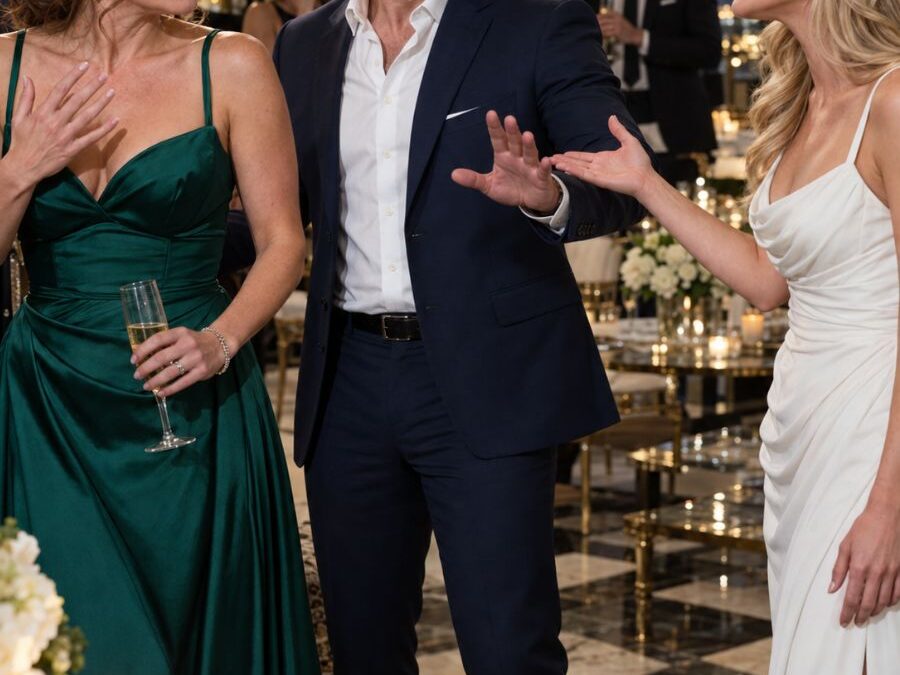
“Joel and I are engaged.” At 8:15 on a Saturday night in August, Briana Yancey’s announcement cut through the music at my husband’s fortieth-birthday party in a rented barn outside Lubbock. She’d asked the DJ for the microphone so sweetly he assumed she was offering a toast and lowered the music. Sixty guests turned toward me as I stood frozen beside the cake, knife in hand; I’d made his childhood favorite, chocolate with peanut-butter frosting. Briana wore a long white satin dress with thin straps and tiny beads at the neckline, and she held up a thin gold ring as if she’d waited years for this moment.
My mother-in-law, Eleanor, rose from her folding chair. “Honey, would you repeat your last name?” she asked, her face suddenly drained of color. Briana leaned toward the microphone and smiled. “Yancey. Briana Yancey.” Eleanor sank back so abruptly her folding chair skidded across the concrete. Across the barn, Joel stared at the ring, went white, set down his beer with careful precision, and walked out without a word.
I’m Rachel Parker, thirty-eight, a high-school counselor in Lubbock, Texas. Joel and I married in 2015; he managed operations at Caprock Implement, where he’d worked for fifteen years. He was steady, quiet, kind, and cried at the end of football movies. In 2014, he told me a high-school friend had died in a car crash. When I asked who, he said, “Just a friend,” turned up the radio, and never mentioned it again.
Every December, around the nineteenth or twentieth, Joel grew distant and spent late nights alone in the garage; I blamed winter sadness and even bought him a light-therapy lamp he never used. Briana joined Caprock’s parts department that March, bringing Friday kolaches, remembering everyone’s order, and asking Joel what Lubbock High had been like back in the day. At the previous company Christmas party, I noticed her standing too close and laughing at everything he said, but told myself she was just friendly. In June, an unknown number texted me, “Ask your husband about B.” Joel read it, frowned, and said Briana was practically a kid and someone was trying to stir trouble; I believed him.
Outside the barn, I found him in his truck, gripping the steering wheel with shaking hands. “Who is she?” I asked. He stared down. “That’s Hannah’s ring.” He couldn’t explain, only whispered, “I can’t do this here, Rachel. I’m sorry,” then drove away.
When I returned, the music had resumed too brightly, and guests whispered while pretending not to watch me. Briana stood by the bar with a champagne glass and a satisfied, almost relieved smile. Eleanor’s face was still colorless; she begged me to take her home and said it was Joel’s story to tell. At eleven, I found him at our kitchen table with an old photograph. “Her name was Hannah Yancey,” he said.
Chapter 2: The Secret Beneath His Silence Finally Comes Back to Life
Joel spoke for two hours, barely looking up from the worn photograph. In December 2003, Joel was seventeen, a junior at Lubbock High; Hannah Yancey, sixteen, was his sophomore girlfriend and first love. She played flute in the marching band, dreamed of becoming a vet, and laughed so loudly in movie theaters that people turned around. Joel bought her an $89 promise ring with his after-school job money, a thin gold band with a tiny diamond chip engraved “S Y 12-03.” She cried when he gave it to her that December.
On December 19, they left a south-of-town party in his father’s pickup. Joel drove three teenagers home as designated driver, without drinking, dropped them safely, then took Hannah home. At 10:40 p.m., after sleet, the road looked wet but was black ice. The truck slid on a curve, its headlights swept across a field, and it rolled twice before landing on its side in a ditch. Joel broke his collarbone; Hannah died there.
His blood-alcohol level was zero. The report blamed black ice and unsafe speed, though he’d been driving forty-five in a fifty-five zone; no charges were filed. At the funeral, Hannah’s father pointed at Joel, arm in a sling, and shouted, “That boy killed my daughter.” In 2005, the Yanceys sued Joel’s parents; their insurance paid the $100,000 policy limit. They divorced the next year, and Patricia moved to Odessa with Hannah’s little sister, Briana, who was eight when she threw a white rose at Joel at the funeral.
“Why didn’t you tell me?” I asked. Joel stared at Hannah’s picture. “I couldn’t say it out loud without becoming that boy again. I didn’t want you looking at me the way her father did.” “We’ve been married eleven years, Joel.” “I know.” I slept in the guest room, not because I thought he’d caused the crash deliberately, but because I’d shared my life with him without knowing the wound that shaped it.
Next morning, Briana posted her ring against the white dress beside a cropped photo of Joel smiling at a company picnic. “He finally said yes to us out loud. No more hiding,” she wrote. Caprock coworkers congratulated her; others asked questions. On Tuesday, Joel came home with his lunch box and told me he’d been suspended with pay. Briana had accused him of pressuring her into a relationship, promising to leave me, and threatening her job when she tried to end things. She’d submitted screenshots that looked like real conversations.
At one in the morning, I read them again, sick with doubt. Joel unlocked his phone and set it on the table, offering his texts and call log. “Look at everything,” he said. “A deleted thread is exactly what a cheater would show me,” I replied. He didn’t argue. I examined the screenshots once more—and one detail stopped me cold: the phone number at the top wasn’t Joel’s.
Chapter 3: The Screenshots Looked Real Until One Phone Number Betrayed Her
I’d spent thirteen years counseling teenagers and knew screenshot apps could invent names, messages, and timestamps. The number in the screenshots had a Lubbock area code, but Joel had used the same number since 2008. I called it; the generic voicemail matched the one I’d heard after the anonymous text in June. A supposed June 9 message at 2:14 p.m. said he couldn’t stop thinking about Briana. But we’d been together at the bank refinancing our mortgage; his work phone buzzed, so he handed it to me, and it stayed in my purse until three.
The messages were fake. Relief came first, then anger and fear about what Briana might do next. I searched her old Facebook page: every December 19, she posted Hannah’s photo with “Justice for Hannah.” In 2021, she shared Joel’s senior portrait: “He walks around free. He got married. He has a nice life. I’ll never forget his face.” Another post showed Hannah’s formal dress in Patricia’s closet, unworn. Briana’s white satin dress wasn’t love; it was public punishment before sixty witnesses.
When I showed Joel, he buried his face in his hands. “Maybe she’s right. Maybe I should quit Caprock and move away.” I took his hands. “You were seventeen. The road was covered in ice. You don’t have to surrender your whole life for an accident, and she doesn’t get to take it from you.” He looked unconvinced, but he wasn’t facing it alone.
That Friday, I visited Eleanor and told her what I’d found. She listened, then returned with an old white Bible. Inside lay a yellowed envelope postmarked Odessa, Texas, in 2009, addressed to Joel. “It came when he was starting college again and finally smiling,” she confessed. “I was afraid it would hurt him, so I hid it. I kept waiting until he was stronger. Then I waited too long.”
Patricia’s letter said she’d been sober for a year and had reread the accident report. Joel hadn’t been drinking; she’d spent six years blaming a seventeen-year-old because blaming the ice—or questioning God—was harder. “I forgive you, Joel. I’m sorry for what my husband said in church. Hannah loved you. She would want you to have a good life. Please have one.” He’d carried guilt without knowing Patricia had forgiven him. I drove to Odessa, explained the fake messages, birthday-party announcement, and HR complaint, and told Patricia Eleanor had hidden the letter. For years, Patricia had believed Joel’s silence meant he didn’t care. At her house, she showed me Hannah’s old room and the empty garment bag. Briana had visited in July, then taken the formal dress, promising to have it cleaned and preserved. Patricia looked at me and said, “I’m coming to Lubbock.”
Chapter 4: A Yellowed Letter Exposes the Cruelty Hidden Behind Her Revenge
Briana kept escalating. She left a birthday cake on our porch with “Happy 40th, my love” piped in blue frosting, then texted me that Joel had planned to leave me for a year. I forwarded every message to Joel’s lawyer and Caprock’s HR department, along with the bank records and my written account of where his phone had been. Patricia called soon afterward. “Briana says she has big news,” she warned. “I think she’s going to try something else.”
One morning, the doorbell rang. Briana stood on the porch holding a black-and-white ultrasound picture. “I’m pregnant. Eight weeks. It’s his,” she announced. “I thought you should hear it from me before he lies to you again.” I stepped aside, and Patricia came into view behind me. Briana’s confident smile vanished. “Mom?” Patricia answered softly, “Hi, baby.”
Briana turned furious. “He killed Hannah. He killed her, and he gets to have a birthday party with sixty people and a cake.” I asked, “Can you say your sister’s name?” She blinked, so I pressed: “Not Joel’s. Not mine. Hers.” She opened her mouth but couldn’t speak; finally, she whispered “Hannah” and crumpled onto the porch, sobbing as the ultrasound slipped onto the welcome mat. Patricia caught her and held her as if she were eight again.
“I miss her, Mom,” Briana cried. “I don’t even remember her voice anymore.” Patricia stroked her hair. “I know, baby. I know.” She didn’t call Briana a liar or mention the complaint; she simply held her and let her grieve, her calmness unsettling her daughter more than anger would have. Patricia had come to Lubbock to face the grief, not help Briana hide inside it. Joel came outside and knelt in front of them. “Briana, I’m sorry. I’ve been sorry every single day for twenty-three years.” Briana looked at him through tears. “You never said it to us.” Patricia gently explained that she had written him a letter years ago, but he’d never received it.
I handed Joel the yellowed envelope I’d brought from Eleanor’s house. He recognized his name, looked at Patricia, and opened it on the sidewalk. As he read, his face crumpled; at the end, he covered his eyes and made a sound I’d never heard from him. The letter didn’t erase Hannah’s death or the grief that had shaped both families, but it finally let him hear the words he’d been denied for years: her mother forgave him. No one mentioned HR or the ultrasound. Briana watched silently as the story she’d built to punish Joel collapsed in front of her. For one quiet moment, the only thing between them was grief none of them had known how to name.
Chapter 5: When Forgiveness Finally Reached the Boy Still Trapped by Guilt
On Monday, Briana withdrew her complaint in writing and admitted she’d created the messages herself with a second phone and an app. Caprock fired her that day; on Tuesday, Joel was reinstated, and the company’s owner apologized to him. There had never been a pregnancy. Briana later admitted she’d printed the ultrasound image from the internet, another lie meant to wound me and keep Joel trapped in the past.
Patricia took Briana back to Odessa, where her daughter began seeing a grief counselor. For the first time in years, someone asked Briana how she felt instead of telling her whom to blame. She returned Hannah’s ring to Patricia, and the formal dress was cleaned, pressed, and placed back in the closet. The dress that had been turned into a weapon could finally be put away without pretending Hannah had never existed.
Eleanor apologized to Joel for hiding Patricia’s letter. He forgave her, though I knew it would take time for both of them to understand what that silence had cost. I moved back into our bedroom, but I was still learning how to live with the parts of my husband’s life he’d kept locked away. We talked in short, painful stretches; I asked why he’d hidden Hannah, and he admitted he’d mistaken silence for protection. I told him I understood the fear better now, but understanding didn’t erase how lonely I’d felt beside him. I knew sharing a bedroom wasn’t the same as returning to the way we’d been. We began rebuilding trust one honest conversation at a time.
At the end of August, I drove Joel to the city cemetery, where Hannah lay beneath a live oak near the back fence. Patricia was already there with a bundle of white roses. I stayed in the truck because this moment belonged to them. Joel crossed the grass toward the woman he’d feared since he was seventeen, and Patricia held out a rose. He accepted it, and they stood together beside Hannah’s headstone for a long time. No one hurried them or tried to turn that grief into a verdict.
Eventually, Patricia placed a hand on his back, and Joel finally cried for the right reason. I thought of the white satin dress, the tiny ring, and the sixty people who’d watched my world tilt in a barn. That night, Briana had used Hannah’s name to punish the living; here, with a white rose in his hands, Joel could finally remember Hannah without believing his own life was a crime. For years, he’d mistaken surviving
You Might Also Enjoy



My Mother Called Me Worthless and Locked Me Out of Her Basement—Four Days Earlier, I Had Received $32.4 Million…





