On Our Wedding Night, He Carried His Ex to Room 402—Then I Heard Why He Married Me
On the night I married Julian Sterling, he carried his former girlfriend past our wedding guests and into a private villa. I followed because I wanted to know when my husband was coming back. Through a door left slightly open, I heard him describe our marriage as something I had never agreed to become. By morning, everything was irrevocably different.
PART 1
“Put her in the wheelchair, Julian.”
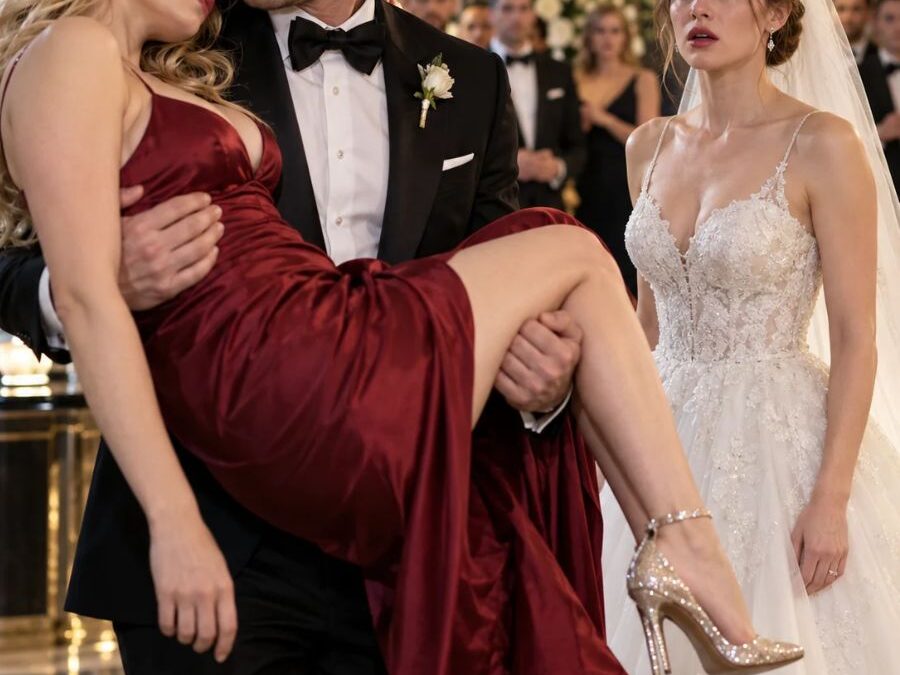
My husband heard me. I know because he looked directly at me before tightening his arms around his former girlfriend and carrying her away from our wedding reception. Vivian Cole’s red satin dress spilled across his white shirt. The medic standing beside us still had the wheelchair unfolded, and an electric cart waited at the edge of the terrace. Neither was used.
All 150 guests watched him disappear toward the villas. I stood in my ivory gown holding champagne I no longer wanted. My mother appeared and asked if I needed water.
“No,” I said. “I need to know whether he’s coming back.”
Twenty-five minutes later, I walked down the corridor toward Villa 402. The door had not caught in its latch. I reached for the handle, heard Vivian laugh, and stopped. What Julian said next would make the wedding vows we had exchanged six hours earlier sound like a carefully rehearsed business proposal.
My name is Helena Vance. I was thirty-two that September, a heritage architect in Manhattan and creative director of Vance & Co., the preservation firm my family had built over generations. I understood buildings better than I understood the man I was about to marry. That is embarrassing to admit, particularly because people paid me very well to notice defects hidden beneath beautiful finishes.
Our wedding took place at a historic coastal estate outside Newport, Rhode Island. My firm had spent two years restoring its eastern wing. Stormwater had penetrated the limestone, the terrace balustrades were failing, and sections of the original roof required careful reinforcement. I had studied the estate so closely that I knew which floor slabs came from the original construction and which were later replacements. I knew where the ocean wind reached the windows first.
My mother, Eleanor, was sixty, precise in every movement, and incapable of mistaking ambition for character. She had never forbidden me to marry Julian. She had simply asked questions whose answers I had spent years explaining away.
Julian Sterling was thirty-four, attractive, tirelessly articulate, and a talented real estate investor. His specialty was rehabilitating neglected properties into high-end residential and commercial developments. He could describe a financing structure with the same excitement I reserved for a restored cornice. When we met five years earlier at a Manhattan preservation panel, he asked whether landmark restrictions could sometimes raise property values by keeping competitors from constructing similar buildings nearby.
At our first dinner, he asked about my work, not my family’s wealth. He listened when I explained why keeping a century-old staircase could matter more than replacing it with something dazzling. He admitted he’d failed at two early investments and had nearly been wiped out on one development. I liked that he didn’t pretend success had come easily.
His father had owned a small brokerage in Westchester that collapsed after the financial crisis. Julian had grown up near considerable money but without its security. “People like your family inherit rooms,” he told me once. “People like mine have to persuade somebody to open the door.”
The relationship moved gradually. We went to work events together, spent weekends walking through old neighborhoods, and argued cheerfully about the merits of replacing original windows. He stayed with me when my grandmother died. Once, when I had pneumonia, he slept on the floor beside my bed, claiming the mattress hurt his back. He was capable of tenderness. It would have been simpler if he hadn’t been.
As Julian’s firm, Sterling Crest Properties, grew, professional connections followed naturally. I introduced him to two lenders. A Vance investment vehicle participated in one of his redevelopment funds after an independent review. Our family name gave some of his projects credibility, but nobody wrote him checks merely because he was dating me. He brought valuable experience and worked hard. Both things were true.
At the same time, help began to embarrass him. If I mentioned an introduction, he reminded me that he’d closed the deal himself. If my mother raised a concern about leverage, he called it another attempt to police him. He became uncomfortable with the very relationships that had once made our conversations exciting.
At Thanksgiving, my mother asked who controlled the sponsor entity on one of his properties and how much debt carried recourse.
On the drive home, Julian said, “She treats me like a borrower asking for permission.”
“She asked four questions.”
“She would never question one of your cousins like that.”
“She questions them more. They’ve learned to bring spreadsheets.”
He didn’t laugh.
Vivian Cole had been part of his life long before we met. They dated for three years in college. At twenty-three, she moved to London for graduate school; he stayed in New York. Julian described their relationship as young love that could not survive two different ambitions. I never expected him to erase those years.
Vivian returned to New York about eighteen months before our wedding. She worked in luxury hospitality branding and moved through some of the same professional circles. She was charming, stylish, and unusually comfortable behaving as though Julian’s attention belonged to her. The first time we met, at a museum benefit, she hugged him for several seconds before greeting me.
“So you’re Helena,” she said. “Julian always did have expensive taste.”
At first, Vivian’s calls sounded reasonable. Her father needed surgery; Julian visited the hospital. Her apartment flooded; he found a contractor. A business dispute upset her; he suggested an attorney. Any single call could be explained by years of friendship. Together, they established a pattern: when she needed him, he left whatever we were doing, and when I questioned it, the subject became my lack of generosity.
“She’s practically family,” he said after skipping a dinner with my colleagues to handle one of her emergencies.
“Then she can call you tomorrow, like the rest of your family.”
“You don’t need me the way she does.”
“I need you to show up when you say you will.”
He kissed my forehead. “You’re the strongest person I know.”
Three months before the wedding, in our Gramercy Park apartment, I finally asked the question plainly. Julian was reading a financing presentation.
“Is anything romantic still going on with Vivian?”
He set the tablet aside. “No. Nothing.”
“I’m not asking whether you plan to leave me. I’m asking whether there’s something I deserve to know.”
“I loved her when I was twenty-two. I love you now.”
“Does she understand that?”
“Vivian likes attention. That doesn’t mean I’m giving her a relationship.”
He took my hands and said he was marrying me because he wanted a life with me, not because of my surname or family money. He even acknowledged how our marriage would look to outsiders. “Believe me before you believe them,” he said.
Six weeks before the ceremony, we signed a prenuptial agreement, represented by separate attorneys. It protected our respective assets and addressed debts. Gavin Ross, my family’s matrimonial lawyer, refused to add a punitive adultery clause.
“Contracts aren’t designed to administer revenge,” he told us.
Julian grinned. “So I’ve got one free mistake?”
“That’s not remotely what I said,” Gavin replied.
The corporate relationships were separate. Vance Heritage Holdings, controlled through voting shares held by my mother, me, and family trusts, owned our operating businesses. Julian had a board seat because shareholders had elected him for his industry experience, not because he was my fiancé. He also managed a joint venture involving Sterling Crest and a Vance investment subsidiary. Agreements, voting rules, and duties governed those positions; they would not automatically disappear if our relationship failed.
The largest pending transaction was a Newport redevelopment fund. Julian hoped the Vance family office would invest sixty million dollars as cornerstone capital. There had been presentations and favorable discussions, but no final committee approval and no binding investment commitment. He needed that distinction to matter less than it did.
During our engagement, I sometimes felt he spoke about the marriage as a signal to lenders. “They’ll see we’re aligned for the long term,” he told me over breakfast.
“We are aligned as people,” I said. “A wedding isn’t an investment agreement.”
“Of course. I’m talking about confidence.”
The night before, he texted, “Tomorrow everything becomes ours.” I joked about protected landmarks. He sent a heart. I smiled.
The wedding morning was bright and breezy. I walked barefoot to the edge of the lawn before the makeup artist arrived. I had spent so much of the engagement managing schedules and contractors that the quiet felt like a gift. I watched the ocean turn silver beneath the rising sun and believed I had finally found someone with whom I could stop anticipating every problem.
At six that evening, Julian stood beside me overlooking the water. My mother wore pale blue silk. I saw tears gathering in her eyes before she looked away. Julian slid a three-carat ring onto my finger and promised, “Whatever comes after tonight, I choose this marriage first.”
By ten-thirty, I wore an ivory silk reception gown with long sleeves and a square neckline. Julian had loosened his bow tie. Jazz played near the terrace doors. For a little while I saw the restored ballroom as a bride rather than an architect.
Vivian arrived late in red satin. Julian had insisted we invite her because excluding her would only make their friendship seem suspicious. She kissed my cheek and told me I looked beautiful.
“You actually did it,” she said.
“Did what?”
“Married him.”
At 10:37, I saw her talking to Julian on the stone steps near the west terrace. Four minutes later, she stepped backward, twisted her ankle, and cried out. I didn’t see enough to know whether the fall was intentional. Two employees rushed over. The event medic arrived, asked her not to put weight on the foot, and offered a wheelchair and an electric cart to take her for evaluation.
Julian pushed between the guests.
“I’ll take her,” he said.
“Sir, the cart is safer,” the medic explained. “We can stabilize her ankle first.”
Vivian lifted a hand toward Julian. “Please. I don’t want to sit in that thing.”
He bent down and picked her up.
“Julian,” I said. “Let the medic help.”
“She’s hurt, Helena.”
“Which is why there’s a medic standing right here.”
He looked annoyed. “I’m not arguing in front of everyone.”
He carried her through the ballroom in full view of our guests. A few phones rose. Other guests became intensely interested in their champagne glasses. Vivian rested her cheek against his shoulder as though it were the most natural place in the world.
My mother came to stand beside me. She offered water and then her champagne. “Don’t decide anything while you’re humiliated,” she said.
“I’m not deciding. I’m finding out what happens next.”
I waited twenty-five minutes, expecting Julian to return with news about the ankle. When he didn’t, I walked to the villas. The hallway was almost empty. A service cart stood near the elevators, its polished tray set with glasses and folded napkins. Vivian’s door was open an inch, the latch not fully engaged.
“You always liked being the hero,” she said.
“You always gave me opportunities,” Julian replied.
They joked about how angry I must be. Vivian said I never looked angry, only disappointed. Then Julian said something that made me forget my own breathing.
“I married a structure.”
Vivian asked whether the bride would have been her if she had never moved to London.
Julian hesitated. “If the Vance deal weren’t involved, do you think I’d be wearing that ring?”
He spoke of the Newport fund, lender renewals, and the credibility marriage gave him with my family. He said our wedding made the relationship look permanent to investors. Once those arrangements were secure, he would have “room” to live his own life.
“With me?” Vivian asked.
“You know where I am.”
Then he described me with a confidence that was worse than contempt. “Helena likes institutions. She’ll protect the family name before she makes me look bad in public.”
I stepped away before either saw me. Eventually Julian emerged, the white rose on his lapel crushed and his bow tie missing. He stopped when he saw me waiting.
“What are you doing here?” he asked.
“I heard you.”
His expression changed. “You were listening at the door?”
“It was open.”
“Then you heard things out of context.”
“Explain the context in which I’m a structure.”
He rubbed his forehead. “We were talking about pressure from your family.”
“And the Newport fund?”
“Helena, don’t do this tonight.”
“And the room you expect to have to live your own life?”
His mouth tightened. “You’ve been drinking. Go back to our suite.”
Instead, I slipped off my wedding ring. A server approaching with fresh champagne paused beside us. I took one glass and let the diamond fall into it. The ring struck crystal, then settled among the bubbles.
Julian stared. “What is that supposed to mean?”
“That I won’t continue financing a lie.”
“You can’t end a marriage because I helped an injured friend.”
“That’s not why I’m leaving.”
He reached for my wrist, then released it when I asked him to. The elevator arrived. I stepped inside without waiting for another explanation.
My mother met me in the lobby. She saw my bare hand and quietly said, “Car?” I nodded.
We drove to her Newport house rather than the bridal suite. Julian’s messages arrived throughout the night: I was embarrassing us; we should talk tomorrow; Vivian had nothing to do with our marriage; he loved me. Shortly after one, he wrote, “Don’t call lawyers before we talk.”
At six-thirty the next morning, I called Gavin Ross. He listened without interruption, then asked whether I’d slept with Julian or resumed living with him after the discovery. I hadn’t. He explained that a New York annulment based on fraud would require substantial proof, not simply my anger or an overheard boast. He warned that continued cohabitation after learning of the alleged fraud could complicate that argument. I asked him to examine the evidence anyway.
By midmorning, Gavin and corporate attorney Rebecca Shaw were at my mother’s dining table. Rebecca reminded me that marriage, governance, and financing were distinct. My family could vote, not cancel contracts out of anger.
That afternoon, after counsel reviewed the governing documents, shareholders with sufficient votes formally removed Julian from the Vance Heritage board. His corporate system access and company-issued cards were suspended or canceled according to his changed role. Three days later, an independent investment committee, meeting without me, declined the proposed sixty-million-dollar Newport commitment on governance and risk grounds. It was free to decline because no binding investment had ever been signed.
Julian called to accuse us of ruining him. My mother calmly corrected him: his board position came from a shareholder vote, and a vote had ended it. Then I spoke.
“You told Vivian you married me for leverage,” I said.
“You have no proof.”
“I have my own ears. And we’ll find out what the documents say.”
He hung up. Gavin filed the New York case with alternative relief in case the annulment claim failed. Julian’s lawyers contested it. Within days, anonymous comments appeared in a society column portraying me as a jealous bride who’d walked out because her husband helped an injured friend.
For a moment, I wondered whether the public would ever hear anything except that version. Then Gavin phoned: the case could move into discovery. We would not be asking a judge to believe my memory alone. We would be looking for what Julian had written before he ever put a ring on my finger.
PART 2
Discovery didn’t give us unrestricted access to Julian’s private life. His attorneys challenged the requests, and the court narrowed them to communications relevant to his promises, our marriage, and the business representations surrounding it. Sterling Crest’s retention system had archived company-phone messages. Three months after the wedding, those records reached Gavin’s office.
Eight months before our ceremony, Vivian had asked Julian if he was really going through with it.
“I need the Vance relationship locked before the Newport vehicle,” he’d answered.
When she asked about herself, he replied, “Don’t make me answer in writing.” Another exchange described me as someone who wouldn’t force him to choose. Closer to the wedding, he told Vivian to give him eighteen months.
An investor presentation also described our impending marriage as long-term alignment with Vance-affiliated capital. Neither my family nor I had approved that implication.
At her deposition, Vivian admitted their romantic relationship had resumed about eighteen months before the wedding. She acknowledged they’d been physically involved during the months when Julian told me nothing remained between them. She also said he’d discussed waiting eighteen months for the Newport fund and lender renewals to settle before leaving the marriage.
“Did you fake your injury?” Gavin asked.
“No. I twisted my ankle.”
“Why refuse the wheelchair?”
She looked at the table. “I wanted Helena to see if he’d choose me.”
Her admission mattered, but it didn’t establish every legal element by itself. The messages, business documents, and her testimony together supplied a timeline independent of my memory. I hadn’t misunderstood an unfortunate joke on my wedding night. Julian had been discussing our marriage as a temporary commercial arrangement months before our vows.
PART 3
Julian’s attorneys maintained that he had loved me and that an affair, however cruel, didn’t automatically prove a fraudulent marriage. They were entitled to make that argument. What frightened him most, though, seemed to be the financing.
Without the Vance family office’s anticipated sixty million dollars, Julian needed replacement investors. The Newport senior lender extended its deadline but demanded additional equity from Sterling Crest. Julian lacked enough available cash and started chasing expensive bridge financing. Each conversation with a potential investor began with an explanation of our family’s absence.
He called late one evening.
“Your family is destroying my company,” he said.
“The committee made its decision.”
“You knew what that money meant.”
“Yes. I also know you advertised our marriage as security that nobody promised.”
He offered therapy, promised to cut Vivian off, and asked me to come home. When I wouldn’t, he accused me of enjoying his financial difficulties. I kept the call brief and made a written record afterward, as Gavin had suggested.
“I wanted a husband,” I said. “Not a financing role I didn’t consent to.”
Vivian later asked to speak with me after her deposition. With attorneys nearby, she apologized and admitted she’d believed Julian’s complaints that my family controlled him. She said he had recently asked her for money and called her disloyal when she couldn’t help.
Not long afterward, photographs showed her with another real estate investor. Julian phoned from an unfamiliar number to complain she’d abandoned him. I ended the conversation. I wasn’t going to become his confidante about the woman he’d betrayed me with.
PART 4
The Newport project did not collapse in one spectacular afternoon. The lender’s deadline passed. A replacement investor withdrew. Sterling Crest lost part of its deposit under the purchase contract after negotiations failed. Other lenders requested more equity for future projects, and investors reconsidered how much of the firm’s reputation had depended on Vance relationships.
Julian sold an apartment he owned to raise liquidity and eventually laid off twelve employees. I hated hearing that. When I asked our human resources director to consider qualified former Sterling Crest employees through normal hiring procedures, she interviewed them on their merits. Three found work within our group. They had not made Julian’s choices.
Seven months after the wedding, the annulment case reached a hearing in New York. Gavin warned me again that financial motives and infidelity alone were not necessarily sufficient. The legal question was whether Julian had knowingly misrepresented an essential intention to induce my consent.
On the stand, Julian admitted he’d lied when I asked directly about Vivian three months before the ceremony. He said he was afraid I’d cancel. He described the messages about eighteen months as exaggerations made during an emotional affair.
Gavin showed him the investor materials and asked whether he’d approved the description of our marriage as permanent financial alignment. Julian acknowledged that he had, even though no such commitment existed.
Then Gavin asked whether he intended to end his relationship with Vivian after marrying me.
Julian stared at the table. “I didn’t know.”
I had spent months imagining that testimony would make me triumphant. Instead, I felt exhausted. The judge took the case under advisement. A decision would come later, and I had to accept that even substantial evidence couldn’t guarantee the result I wanted.
PART 5
Eight days before the decision, Julian appeared outside my SoHo office during heavy rain. Security called upstairs. I said he had no appointment and could contact my lawyer. Two hours later, he was still beneath the awning, his coat soaked and his hair flattened against his forehead.
Gavin offered to accompany me to the garage. Instead, I went through the front entrance with him a few steps behind.
“Vivian’s gone,” Julian said.
“I know.”
“Newport is dead. The company is barely holding together.”
“I know those things, too.”
He swallowed. “I did love you.”
“I remember that possibility,” I said. “I also remember what you did.”
He admitted he’d wanted both me and the status my family offered. Every introduction left him feeling grateful and humiliated, he said. Vivian made him feel like the person he had been before he needed anyone’s approval.
“Then why make me pay for that feeling?” I asked.
He had no answer.
He offered to abandon his remaining business interests, attend therapy, and never contact Vivian again. I didn’t want another transaction. When he dropped to his knees, I asked him to stand. People across the street were already looking.
“Tell me there’s no chance,” he said.
“There isn’t.”
“Because of one night?”
“Because you planned our marriage around a life you intended to lead without me.”
I walked away still remembering the good years. That was the difficult part: accepting that affection and exploitation could exist in one person, and that recognition didn’t require me to return.
PART 6
Gavin called early one morning. The court had granted the annulment on the evidence of fraudulent inducement. The decision considered the deliberate concealment of the ongoing relationship, premarital statements, messages about a temporary plan, business representations, and my immediate separation after learning the facts. It did not say marrying partly for money automatically invalidated a marriage.
“Can he appeal?” I asked.
“Yes.”
I sat on the edge of my bed and cried. Not because I wanted him back. I’d spent so long defending my account of what happened that I scarcely remembered how to live without doing so. My first impulse was to call my mother and ask what she thought. Instead, I told her what I felt.
Julian did not appeal. Separate property and business obligations were addressed under the applicable agreements. Sterling Crest eventually restructured, selling control to a larger platform that preserved several viable investments and jobs. He wasn’t left destitute. I felt relieved about that, too.
For months, I’d thought strength meant keeping my voice level while other people behaved badly. I remembered my mother’s words on the terrace and understood she’d been worried I might make a permanent decision just to escape humiliation. Yet the permanent decision I’d made wasn’t about saving face. It was about declining to keep offering trust after the facts had changed.
One afternoon I took out the wedding photograph in which my mother was laughing before the ceremony. Julian wasn’t in the frame. I placed it on my desk. I could keep that morning without defending what happened that night.
PART 7
The following spring, Vance & Co. returned to the Newport estate to restore the western gallery and improve drainage along the sea terrace. I considered withdrawing from the project. My mother refused to let me make the building pay for Julian’s conduct.
I returned, walked the stone steps where Vivian had fallen, and inspected the repairs. Months later, I passed Villa 402 with a housekeeping cart outside. The room was empty, its curtains open to the ocean. I expected to feel something dramatic. Instead, I noticed a window seal that needed attention and told the maintenance director. I stayed long enough to see him write the maintenance request. Then I went back to the gallery.
At work, we formalized rules requiring enhanced independent review for family partners seeking board positions or investment support. Romantic relationships could no longer substitute for documented governance. I supported those changes without treating every future partner as a suspect.
Several years later, Julian sent me a handwritten letter. He admitted he’d used the love he felt for me as an excuse not to acknowledge the advantages he sought. He wrote that he’d resented me for opening doors he had wanted opened and that Vivian hadn’t made him lie.
I read the apology twice. I believed he meant it. I also understood it didn’t demand a response. I filed the letter and went back to work. The old version of me would have drafted something careful enough to manage his feelings. This time, his feelings were his responsibility.
PART 8
I didn’t fall in love again immediately. I worked in Philadelphia, Boston, Savannah, and New York. I got used to quiet evenings and to being alone without calling it failure.
Gavin and I stayed in touch after his representation ended. He sent articles about badly drafted contracts; I sent courthouse photographs. Two years after Newport, we met for coffee following a preservation nonprofit meeting. I called it professional. He asked whether professional meetings were allowed to become dinner.
We took nine months to call what followed a relationship. Four years after my first wedding, we married at City Hall in Manhattan. My mother, his sister, and six friends attended. I wore cream trousers and a silk blouse. Gavin wore navy. There was no grand reception, and nobody needed our vows to reassure investors.
My mother eventually retired from active management, though she remained involved longer than any of us expected. I became chief executive of Vance & Co. at forty and expanded its work into protecting historic coastal structures from storms and rising seas. The Newport estate was one of our most important projects.
After my mother died at seventy-eight, I found an envelope in her desk warning me not to romanticize Julian. Inside was a joke about his shoes, followed by one serious sentence: “Judgment is what you do when new facts arrive.” I kept it.
Years passed. Vivian built a hospitality consulting business in London. Julian found work again in real estate and eventually remarried. At a Boston conference when I was fifty-two, we crossed paths. He congratulated me on our Newport resilience work. I offered my condolences for none of his losses and asked for no explanation. When he told me he’d finally learned to stand without my family’s connections, I said I was glad. We returned to our separate conversations.
The estate still overlooks the Atlantic. Its terraces drain properly now. The roof has been reinforced, and the ballroom’s delicate plasterwork has survived storms that once would have ruined it. Couples still marry against those windows. I don’t resent them their happiness, or my younger self her belief in it.
Sometimes I walk past the corridor that leads to Villa 402. I remember the champagne glass, the diamond settling at its bottom, and the woman I was when I stepped into that elevator. She wasn’t foolish for believing a promise. She was learning what to do when someone broke it.
One afternoon, Gavin waited for me near the terrace doors while I finished checking the stonework. He held out my coat without asking whether I needed help. I took it, slipped my arm through the sleeve, and walked beside him into the sunlight.
THE END
You Might Also Enjoy


My Parents Secretly Listed the Maine House I Had Cared for for Six Years—Then the Real Estate Agent Read the Owner’s Name

My Adoptive Mother Called Me a Charity Project at the $17 Million Lake House—Then an Attorney Opened the Family Trust