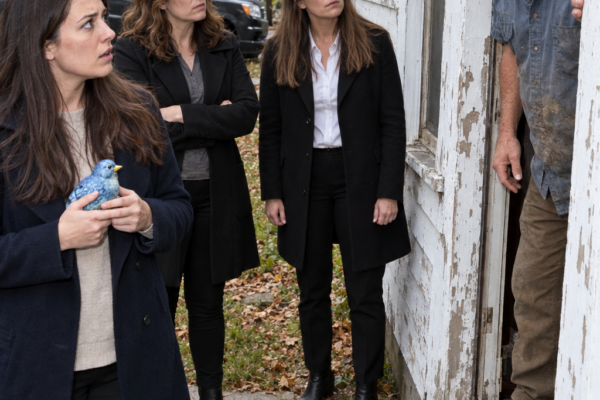
Her Daughter-in-Law Gave Her a $3 Cabin From the Will as a Joke at 75 — Unaware of Its Real Value…
Her Daughter-in-Law Gave Her a $3 Cabin From the Will as a Joke at 75 — Unaware of Its Real Value…
“Three dollars,” my daughter-in-law said, sliding a rusty cabin key across my kitchen table. “That’s what fifty years of marriage got you.”
Nine days earlier, we’d buried my husband. Now his will gave our house and the family store to our son, while I was apparently supposed to be grateful for a shack in the Tennessee mountains. I was seventy-five, with a bad knee, an old hound, and a hundred dollars of my own. I took the key anyway. My husband had spent nearly every Saturday at that cabin for forty years, and when I finally opened the door, I found a reason he’d never invited me inside.
PART 1/5 — My Daughter-in-Law Laughed While She Took Over My Kitchen
The sugar bowl was on the wrong side of the table. That was the first thing I noticed while Shannon unfolded my husband’s will, which says something about how shock works. After fifty years of setting sugar beside my right hand, I knew exactly where it belonged. Shannon had moved it next to her coffee without asking.
She was sitting in Cal’s chair, too. The black tape he’d used to mend the split cushion was still holding. Nine days had passed since his funeral, and the lilies on the windowsill were turning brown. I’d made a whole pot of coffee that morning, forgetting there was only one of us left to drink it.
Our son, Luke, stood by the back door, rolling his ball cap between his palms. He was forty-nine and had done that since he was a boy caught sneaking cookies before supper.
“Sit down, honey,” I told him.
“I’m fine, Mom.”
“Then stop wearing a hole in my floor.”
He sat on the stool beside the refrigerator. Shannon cleared her throat and began reading. The house, its garage, and the two acres went to Luke. So did Mercer’s Market on the highway, including the shelves, equipment, and inventory. Cal and I had run that store together since the seventies. I knew whose checks would clear on Friday and which customers needed until Christmas. Nobody had ever written me a paycheck.
I didn’t argue about the store going to Luke. Cal and I had talked about keeping it in one piece. But I had expected him to make some provision for me besides a paragraph Shannon nearly skipped.
“To my wife, June Mercer, I leave the cabin at Cedar Hollow, as my grandfather Isaac Mercer acquired it in 1931.”
Shannon read that sentence again. Then she laughed.
“Oh, this is rich. Luke, your great-grandfather paid three dollars for that place.” She fished an old brass key out of the envelope. “Three dollars. That’s your share for fifty years.”
Luke said her name quietly. She told him she was only joking.
I picked up the key. A dirty shoestring was tied through its hole. Cal had used that string on every deer-season key ring I could remember. I slipped it into my cardigan pocket because I couldn’t think of anything else to do with my hands.
“Now, June,” Shannon said, closing the folder, “you know we have to be practical. Our rental lease ends in two weeks, and this house has three bedrooms you don’t need.”
“I still live here.”
“Of course. We’re talking about what makes sense for everybody.” Her eyes moved toward the hallway. “There’s that little room behind the store. Cal used to keep a cot there. Or maybe you could stay with your sister.”
“My sister died four years ago. You came to the funeral.”
Shannon stared at the folder. Luke looked as if he’d swallowed a fishhook. He managed to say nobody was throwing me out, but he didn’t tell his wife to stop, either.
I went to the bedroom and packed Cal’s green hunting bag. I took my medicine, a flashlight, underwear, my Bible, and the photograph of him in uniform that had sat on our dresser since I was twenty-five. From the red coffee can above the stove, I took the hundred dollars I’d saved selling eggs and sewing hems. It wasn’t much.
When I came back through the kitchen, Shannon was opening the refrigerator, checking what we’d have to move. I called Copper from beneath the porch. Our fourteen-year-old hound pushed himself up stiffly and followed me to the truck.
“Where are you going?” Luke asked.
“To see what your father left me.”
He offered to drive. I accepted because the hollow was a long way off, and I didn’t trust my knee to manage both the gravel road and the footpath. He drove as far as the old logging turnaround, carried my bag to the trailhead, and tried to apologize.
“I know you didn’t write the will,” I said. “But you were in that kitchen. Remember that part.”
He had no answer. I took my bag and started walking beside the creek, stopping whenever Copper needed to catch up. The October maples were red overhead. Cold water ran over smooth stones below us. Every root in the path seemed determined to introduce itself to my right knee.
I’d visited the cabin once, the year Cal and I married. After that, he went up alone most Saturdays. He called it his one quiet place. I didn’t like being shut out, but there had always been the store, our boy, and supper to get on the table. Eventually I stopped asking.
The cabin stood above the creek, low and gray, with a river-stone chimney and a tin roof. I had expected fallen steps and busted windows. Instead, the porch boards were solid. New screws shone among the rusty roof patches. The padlock looked recently bought, and the key turned smoothly.
Inside were split firewood stacked nearly to the ceiling, canned beans, coffee in my usual brand, and a little iron stove. On the cot lay my mother’s wedding-ring quilt. It had disappeared from our cedar chest ten years earlier. I’d blamed myself for giving it away by mistake.
Pinned to the quilt was a yellow order slip from our store, covered in Cal’s blocky handwriting.
June, the spring is under the big rock. Don’t drink from the creek. Call Wade Kessler in Maryville before you let anybody price these walls. I’m sorry I never brought you here. I was getting it ready.
On the back he’d written four more words: Let them laugh first.
I stood there holding the slip while Copper settled on the rug. Under a shelf, I found Cal’s notebook, each page listing a log by number and condition. Every log in the room had a small penciled mark. He hadn’t been coming here to get away from us. He’d been keeping something alive, one Saturday at a time.
PART 2/5 — The Chimney Held a Secret My Husband Never Explained
That first night nearly sent me back down the mountain. The little stove heated my feet but not the far wall. By two in the morning, frost had formed around the window, and Copper was pressed so close to my legs I couldn’t turn over.
A sheet of rusty tin covered the old fireplace. My father had laid chimneys all over Blount County, and as a girl I’d carried buckets of mortar for him. I recognized good stonework. I also knew an abandoned flue might be blocked, so I left the fireplace cold and began pulling the tin loose to inspect it.
Behind the sheet was a broad hearth, thick with old soot. A stone above the smoke shelf rocked when I touched it. I eased it down and found a metal tobacco tin wrapped in baling wire. Inside were three silver dollars, a thin gold ring, a folded paper, and a letter addressed to whoever came to live in the cabin.
The paper was an old copy of a sale agreement, dated November 1931. Isaac Mercer had paid a widow named Dora Bell three dollars for the cabin and the ground between the creek, the spring rock, and an old fence line. The letter was written in 1959.
Isaac said his brothers had taken the family farm and left him, his wife Ruth, and their baby with nowhere to go. People laughed at his three-dollar purchase. Ruth hauled water and raised their children here. Then Isaac explained what he’d learned about the walls: every log was American chestnut, cut before blight wiped out the mature trees across the mountains.
Don’t let them tear it down just because they think it’s worthless, he wrote. And don’t let them talk you into selling it cheap.
He had enclosed the three dollars and Ruth’s ring for the next woman who needed the place. I tried the ring on. It fit my right hand.
By daylight I found Cal’s maintenance records going back decades. He’d replaced rotten chinking, repaired the roof, and numbered the chestnut logs. One entry from March made me sit down: Doctor says time is short. Get June’s place ready.
I walked to Frank’s bait shop, borrowed the telephone, and called Wade Kessler, whose number Cal had written down. Wade sold reclaimed lumber, and he arrived the next morning with a pocketknife and a notebook. He inspected the joints and a tiny wood shaving, then told me a complete, sound chestnut cabin was rare.
He offered to buy the logs, dismantle the cabin carefully, and pay me more than our house and store combined were worth. I thought of Ruth hauling water and Cal patching the roof. I told him I wasn’t ready. He didn’t argue, which made me trust him.
Wade warned me that word about valuable old wood traveled fast around a small town. On Sunday afternoon, Shannon climbed the trail carrying a bakery pie. Luke followed with groceries. Tucked beneath Shannon’s arm was a folded property map.
PART 3/5 — She Claimed My Cabin Stood on Her Husband’s Land
Shannon took one look at the working fireplace and the quilt on the cot, then smiled as though she were touring a vacation rental.
“It’s adorable, June. Still, you can’t spend winter up here. We painted the back bedroom for you.”
“That was thoughtful,” I said. “Did you save any of my furniture?”
Luke stared into his coffee. Shannon said they hadn’t had time to sort everything. Then she asked why Wade Kessler had been visiting.
“He knows something about old wood.”
“So do I. It burns.” She laughed, but not for long when I told her the logs were chestnut and worth more than she’d guessed.
Her expression changed. “Well, that raises an issue. Cal left Luke the home place. The cabin might be yours, but according to the property map, the ground underneath belongs to him.”
She spread a photocopy across my table. Its boundary line ran through the hollow, but the photocopy was missing the notes and deed references along the edge.
“We’d rather handle this within the family,” she said. “Luke could arrange the sale, and we’d give you a fair portion.”
“How fair?”
“We’d get an appraisal.”
“Of something you just called firewood?”
She folded the map. Luke wouldn’t meet my eyes. After they left, I sat with Isaac’s old paper and realized I didn’t know whether it could protect me. A family story and a handwritten agreement weren’t the same as clear title.
I’d already spent twenty dollars on medicine that week, and the thought of legal fees made my stomach tighten. If I waited until someone removed those logs, no judge could put them back. Shannon already knew I hated making trouble for Luke. She’d seen me swallow little insults for years.
On Monday, Wade drove me to Margaret Price, the attorney who had prepared Cal’s will. I showed her the paper and the exact phrase Cal had insisted on: as his grandfather acquired it. Margaret had already heard from Shannon, who wanted a quick answer about the land.
“I won’t give either of you a legal opinion from a faded photocopy,” Margaret said. “We’ll check the county records.”
We spent the afternoon at the register of deeds. In an old index, she found a recorded 1931 deed matching Isaac’s description. The parcel had been conveyed separately from the Mercer farm. A later survey showed the same creek and fence-line boundaries. Margaret requested certified copies and began preparing a letter for the probate file.
“She can dispute the interpretation,” Margaret told me. “But she cannot simply send men up there and start taking your cabin apart. Call me if she tries.”
Back at her office, she handed me a sealed envelope Cal had left in her safe. Across the front, in his square handwriting, were the words: June, read this where they can hear you.
I hadn’t opened it when we reached the logging turnaround. Luke’s truck was parked there, hitched to the store’s flatbed trailer. From the trail came Copper’s furious barking.
PART 4/5 — The Trailer Arrived Before Anyone Could Settle the Deed
I went up that trail faster than my knee wanted. Shannon was measuring the cabin wall. Luke held the other end of the tape while Copper stood trembling on the steps, barking at both of them.
“We’re getting measurements, June,” Shannon said. “Nobody’s touched anything.”
“You’re making plans for something you don’t own.”
She reminded me that I couldn’t afford a lawyer. I told her Margaret had already found the recorded deed, and that a trailer wasn’t a substitute for permission. Luke let the tape go. Shannon’s face hardened, but she wound it back into its case.
“Saturday morning, at the store,” I said. “Margaret will bring the copies. We’ll settle what we can in front of witnesses, and anything left can go through the proper process.”
Shannon agreed, probably because she still believed the farm map would win. After they left, Wade helped me photograph the porch, the numbered logs, and the tire tracks at the turnaround. I put the copies of my papers in a waterproof bag.
Luke came alone on Thursday with dog food and a gallon of milk. He admitted that Shannon had arranged the trailer, but he’d hooked it up. “I kept telling myself we were helping you,” he said.
“Were you?”
“I don’t think so.”
He stared at my mother’s quilt and told me he remembered how long I’d looked for it. I asked him to stand beside me on Saturday, not behind his wife. He promised he would try. At his age, I wished he’d used a stronger word.
By ten Saturday, Mercer’s Market was crowded. Frank from the bait shop was there, along with customers who’d kept accounts with me for thirty years. Shannon stood behind the register in a pressed blouse. I noticed she’d moved the candy display exactly where I’d always asked Cal not to put it.
Margaret laid the certified deed, survey, and relevant language from Cal’s will on the counter. She explained that the cabin parcel was separate from the home place, and that any challenge belonged in probate court, not on a flatbed. Shannon questioned the boundary and the old deed. Margaret showed her the registry numbers and offered copies for her own attorney.
“I’m not asking you to like this,” Margaret said. “I’m asking you not to trespass while the estate is handled.”
I’d expected to feel triumphant. Instead, I watched my son’s face. Luke had helped me carry feed sacks since he was twelve, and he’d learned the store’s register at my elbow. I couldn’t bear the thought of speaking to him through attorneys for the rest of my life.
Luke finally spoke. “We won’t go near the cabin without Mom’s permission.”
He wasn’t looking at Shannon. He was looking at me.
I could have stopped there. My property had documentation, and Luke had drawn a line. But Cal’s envelope was still in my pocket, and he had asked me to read it where the family could hear. I broke the seal with my thumb.
PART 5/5 — I Kept the Cabin and Finally Chose My Own Future
Cal’s letter was written on two sheets from our store’s yellow order pad. He apologized for hiding the cabin’s value and for pretending it was his private retreat. He’d wanted Shannon to dismiss it long enough for me to see it before anybody pressured me to sell.
“I thought I was being clever,” I read aloud. “Maybe I was being a coward. You deserved to know before I got sick. But I wanted you to have one place nobody could tell you to leave.”
He wrote about the fifty years I’d spent at the register, the groceries I’d carried on credit, and the wages I’d never collected. He told Luke not to confuse inheriting the business with having built it alone. Then came one last line: The cabin belongs to your mother. Help her keep it, or leave her in peace.
I folded the pages. Nobody clapped. This wasn’t a church play, and we still had an estate to settle. Shannon asked for a private meeting. I agreed, provided Margaret stayed.
In the stockroom, Shannon admitted she was frightened of losing the house. Her parents had moved six times before she graduated high school, she said, and she had seen a sale of the chestnut logs as a way to make everybody secure.
“You laughed at me,” I reminded her.
“I know.”
“And you brought a trailer.”
She didn’t have an answer for that. Margaret explained that we would finish the probate paperwork and have the parcel boundaries marked before anyone discussed another transaction. Shannon agreed in writing not to enter or remove anything without my consent. Luke signed too.
I did not sell the cabin. Wade bought one old chestnut sill Cal had removed years earlier and stored beneath the porch. It paid for proper roof repairs, supplies, and a little breathing room. I kept the sale receipt in Cal’s notebook.
That winter was hard. I learned to carry two half buckets of spring water instead of one full one. Frank checked on me when snow blocked the path, and Wade brought seasoned firewood. I also arranged regular rides into town for groceries and my prescriptions. Accepting help was different from signing over a key.
In April, I put Isaac’s letter, Ruth’s ring, and the three silver dollars back in their tin, with a note of my own. The deed stayed in Margaret’s files. Some things belonged in a chimney.
In May, Luke came up with new roofing tin and his own hammer. We worked slowly. He asked how I’d decided which store customers deserved credit. I told him to look at their boots and remember who had children at home. He wrote that on the back of a receipt.
Before he left, he set my old sugar bowl on the cabin table. “Found it in the back cupboard,” he said. “Thought you might want it.”
I put it beside my right hand, poured us both coffee, and watched Copper sleep in the patch of sunlight by the door.
THE END
You Might Also Enjoy
Homeless at 18, He Bought an Abandoned Route 66 Motel for $10 – What He Found Behind the Mirror…
She Thought Her Mother Left Her Nothing… Until She Found the Secret Beneath an Old Cabin
Homeless at 18, Her Cousins Took Everything — So She Reopened Her Aunt’s Boarded-Up Soda Fountain