The Plus-Size Waitress Knocked Her Attacker Down—The Mafia Boss Quietly Smiled in Approval…
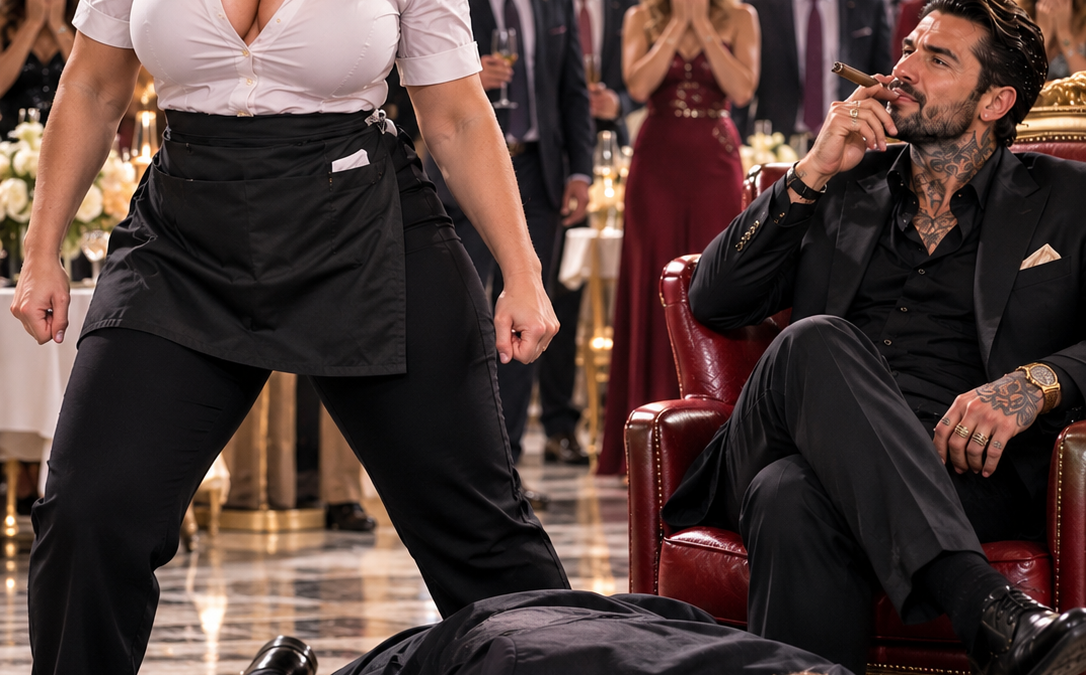
The Plus-Size Waitress Knocked Her Attacker Down—The Mafia Boss Quietly Smiled in Approval…
“Stop pretending you don’t like the attention.” Preston Hail said it while squeezing my wrist hard enough to leave fingerprints. I’d been serving tables at Bellwether Steakhouse for eight years, and I’d heard enough comments about my size to recognize the insult. This time, I couldn’t walk away. When Preston blocked the aisle, I used a move my late father had taught me and put him on the floor. Someone filmed the fall, but not the hand that caused it. Behind the private dining room’s glass, another customer was watching. I didn’t yet know what he owned—or what he might want from me.
PART 1 — A Wealthy Customer Grabbed Me, Then Accused Me of Assault
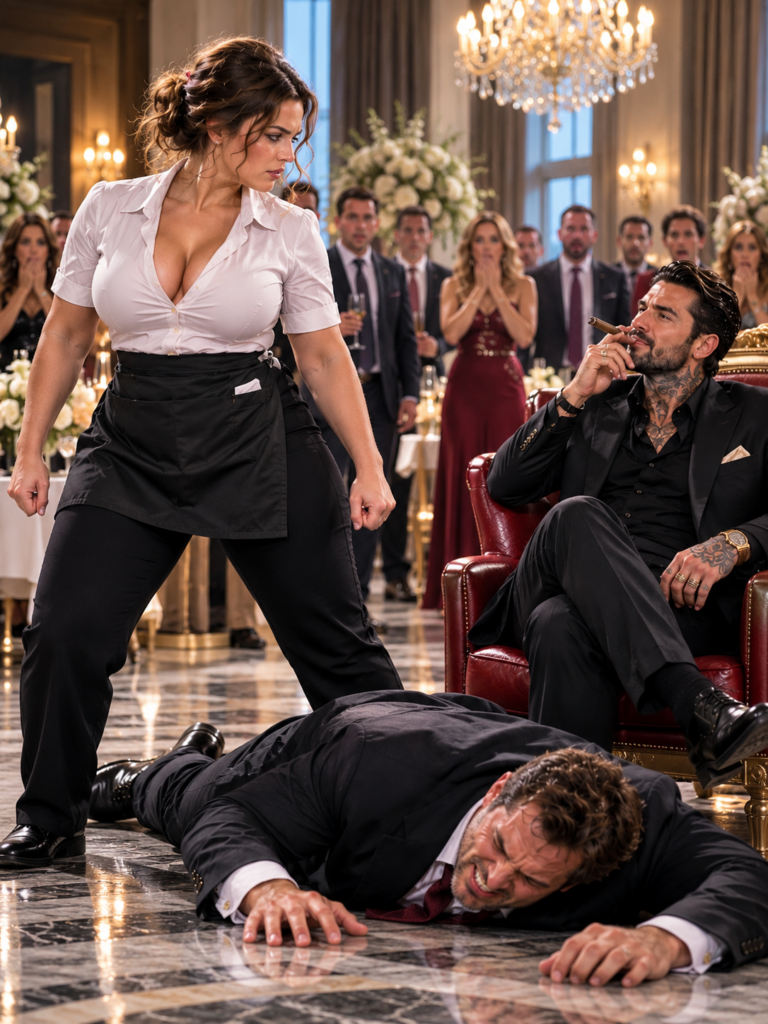
Preston Hail hit the hardwood beside table twelve with a noise like somebody dropping a loaded suitcase. A glass tipped over, and I stumbled against the service station, trying to breathe.
“Are you insane?” Preston demanded, struggling onto one knee. “You assaulted me.”
I was looking at the red marks across my wrist. “I asked you three times to let go.”
“You’re going to regret that.” He straightened his jacket, as if a smoother lapel might restore his dignity. Then he pointed at our bartender. “Call the police.”
I wished someone would. I also wished I hadn’t put a customer on the floor. Both feelings were possible.
I’m Sienna Brooks, thirty-four, a waitress in Chicago. I wear a size twenty, know good steak from expensive steak, and had worked there long enough to recognize regulars who believed a hundred-dollar bill bought them a personality transplant.
Preston was in the second group. He owned commercial properties, brought clients to dinner, and spoke to servers without using their names. Earlier that evening, he’d asked whether I came with the dessert menu. I told him I’d send over our pastry list. He laughed like we’d shared a joke.
Twenty minutes later, after his guests departed, he stopped me beside his table.
“You’d be prettier if you smiled,” he said.
“Can I bring you your check?”
He caught my wrist before I could turn. “Don’t act offended. A woman your size ought to appreciate a compliment.”
I told him to release me. He didn’t. I pulled toward the open aisle, but he stood up and moved between me and the kitchen doors. His thumb pressed against the tender part of my wrist. I heard my father’s voice with startling clarity: Don’t try to win. Make room to leave.
I turned toward the weakest point of his grip and shifted sideways. Preston resisted, lost his balance against my hip, and fell. The whole thing lasted less than two seconds. It felt much longer.
Our security guard, Luis, arrived as Preston began shouting. Manager Elise Morgan came straight from the hostess stand, her face set in the expression she wore when a wine shipment was missing.
“Tell her she’s fired,” Preston said. “And tell her my attorneys will be in touch.”
“Elise,” I said, “he wouldn’t let me go.”
She looked at my wrist, then at the people recording. “Let’s get everyone somewhere private.”
Corporate had been cutting hours for months. Elise constantly reminded us that repeat customers kept Bellwether open. Preston’s name appeared on the reservation list almost every Friday.
Two officers separated us. I gave my statement, including the throw. A couple near the aisle and an older man saw him grab me. Another guest only noticed the fall. The officers asked the restaurant to retain its surveillance recordings and told us they would review the available evidence. Neither of us was arrested that night.
By then, my wrist had swollen enough that Luis brought me an ice pack wrapped in a bar towel. I sat by the employee lockers, listening to the dishwasher hum through the wall, and finally noticed a broken plate near my shoe.
“Please tell me that isn’t one of the imported ones,” I said.
Maya, our youngest server, stared at me. “Sienna, are you seriously worried about a plate?”
“They charge more for those than I make in tips on a Tuesday.”
“I’m pretty sure the plate will recover,” she said, and sat beside me.
I laughed, then started shaking so badly that the ice slid off my wrist. Maya caught it before it reached the floor. She didn’t tell me to be brave. She held the towel while I tried to steady my hands.
My dad would have liked her. He worked maintenance for the Chicago Park District and treated practical knowledge as a family inheritance. When I was thirteen, a boy followed me home from school and wouldn’t stop tugging at my backpack. Dad started teaching me how to get out of a wrist hold. Later, my aunt Gloria, a retired police officer, kept practicing with me in her garage.
It wasn’t martial arts movie stuff. It was awkward, repetitive and occasionally interrupted when Gloria’s terrier stole our practice towel. “Your job is to get home,” Dad used to say. After he died of a sudden heart attack six years ago, those words became something I couldn’t bear to throw away.
Near closing, I spotted a man leaving the private dining room with two associates. Dark suit, silver at his temples, the kind of stillness that made people move around him. Luis stood straighter when he passed.
“Who is that?” Maya whispered.
“Adrien Moretti,” Luis said quietly. “Don’t stare.”
Everybody in Chicago seemed to have a story about Moretti. Newspapers called him a hospitality investor. People who worked late-night businesses called him the city’s most feared mob boss. I knew only that he had watched the commotion from behind the smoked glass and had said nothing.
At home, I put frozen peas on my wrist and watched a phone video of Preston falling. It began at the exact moment I twisted free. By breakfast, strangers were calling me violent, hilarious, heroic and unemployable, sometimes in the same comment thread. I turned off my phone when a stranger posted the restaurant’s address.
At nine, Elise summoned me to her office. She said corporate needed time to investigate and placed me on unpaid suspension. I asked whether she had seen the footage. She said she hadn’t reviewed every angle yet.
“Preston knows people,” she added. “Please don’t make this worse by posting online.”
I promised not to. Then she slid a copy of a letter across her desk. Preston’s attorneys were demanding reimbursement for medical expenses and threatening to sue Bellwether and me personally.
At the bottom, under my full name, someone had written: Employee used unnecessary force without provocation.
That was the version they wanted on paper, in neat black ink, before anyone had even watched what happened.
PART 2 — My Suspension Became Leverage in Preston’s Quiet Legal Threat
Aunt Gloria arrived with grocery bags and the expression she wore when someone parked across her driveway.
“First things first,” she said. “Have you had a doctor look at your wrist?”
I hadn’t. I was worried about the bill. Gloria drove me to urgent care anyway. The clinician documented bruising and a sprain, gave me a brace, and told me to return if numbness spread. I saved the visit summary and photographs, embarrassed that I needed proof.
Gloria didn’t ask why I hadn’t hit Preston harder. She knew exactly what Dad had taught me.
“People who don’t have to worry about losing a paycheck love telling other people to stand up for themselves,” she said. “Let’s figure out how you keep yours.”
Through a bar referral service, I met Dana Kim, an employment attorney with a small office above a pharmacy. She listened without interrupting and was much less impressed by the viral video than I expected.
“A clip isn’t the whole story,” she said. “Neither is your memory, standing alone. We need witnesses, records, and the footage.”
She explained that self-defense and workplace discipline were separate issues. Bellwether could still claim I’d broken policy. And Preston could file a civil complaint without proving it was justified. Winning an argument online wouldn’t pay my rent.
Dana agreed to represent me under a written fee arrangement I could manage. She sent letters asking the restaurant and Preston to preserve relevant recordings and communications. I gave her Maya’s number, the names of the couple who’d spoken to police, and a timeline written while the incident was still fresh.
For two days, I heard almost nothing. I couldn’t afford my regular groceries, and I started looking for temporary work. One diner manager recognized me from the video and said he didn’t want “that kind of excitement” in his dining room. I understood the sentence perfectly, even though he smiled while saying it.
Then Preston appeared outside his lawyer’s office on the local news. He called my response “an unprovoked attack by someone trained to hurt people.” I watched him turn the self-defense lessons my father had given me into a reason to distrust me.
Maya called ten minutes later. “I told Elise I saw his hand on you. She said corporate wants to hear from us separately.”
“Then tell them exactly what you saw,” I said. “Not what helps me. What you saw.”
That afternoon Elise emailed an offer. Bellwether would let me return after a short unpaid leave if I acknowledged that my conduct had breached its guest-contact policy, agreed not to discuss the matter publicly, and released employment-related claims. She attached a signature page and gave me forty-eight hours.
I stared at it until the words blurred. My rent was due in nine days, and the restaurant knew it was my only steady income.
For the first time, the threat wasn’t what Preston might do. It was how easily I could be persuaded to call his version of the evening true.
PART 3 — I Refused the Easy Deal and Found an Unexpected Witness
Dana read the agreement twice while I picked at the paper sleeve on my coffee cup.
“It’s not just a promise to behave,” she said. “You’d be accepting their characterization of the incident and giving up possible claims. Don’t sign it because you’re scared of Thursday’s rent.”
“Thursday’s rent is very persuasive.”
“I know.” She paused. “What choice would you make if we found a way to get you through the month?”
I wanted to say I’d fight, without hesitation. Instead, I asked whether I could lose everything. She didn’t offer false comfort. We made a budget, and I called my landlord to arrange a partial payment. Gloria lent me enough to cover the gap, with an insistence that I pay her back rather than treat myself as a charity case.
I declined Elise’s offer in writing and asked for a fair review. It wasn’t a triumphant moment. My hands were sweating when I hit send.
Maya agreed to speak with Dana, although she hesitated after a customer recognized her in the background of the viral clip. She was twenty-two, paid her own community college tuition, and worried that corporate would cut her shifts. I told her I would understand if she changed her mind. She answered, “I was standing right there. You shouldn’t have to do this alone.”
So did a regular named Mr. Feld, who’d been sitting close enough to hear me say “let go.” Their accounts weren’t identical. Maya had missed Preston’s first remark; Mr. Feld had looked away during the fall. But they agreed on the essential point: Preston held me after I tried to leave.
The police had requested the security recordings. Bellwether’s attorneys confirmed the files were preserved but wouldn’t hand copies to me, which Dana said wasn’t surprising. She pushed for an internal review where I could respond to what the recordings showed, rather than accept a decision made behind a closed door.
On day five, Marco Bellini called Dana. He said he worked for Adrien Moretti and that his employer had witnessed part of the confrontation through the private-room glass. Moretti was willing to provide a statement about what he saw. He wasn’t claiming to have heard Preston’s words.
“Why would he involve himself?” I asked.
Dana gave me a long look. “Maybe because it’s right. Maybe because he has a business interest. We don’t assume either.”
That night Gloria told me what she’d heard about Moretti during her years on patrol. He owned legitimate hotels and restaurants, but his family’s history included investigations, old associates and plenty of rumors nobody wanted to discuss openly. “Being helpful doesn’t automatically make a man safe,” she said.
The next morning, Dana learned that Moretti Hospitality had been negotiating to buy Bellwether’s parent company for months. Closing was scheduled the following week, provided the remaining conditions were met.
So the quiet man behind the glass wasn’t just another diner. He might soon own the restaurant that had suspended me, and now he wanted a meeting.
PART 4 — The Security Footage Played While Preston Tried to Rewrite Everything
I met Moretti in Dana’s office. I insisted on that location, and he arrived with a plain folder, not an entourage. He was handsome in a severe, slightly tired way, which annoyed me because I didn’t need another distraction.
“I saw him block your path,” he said. “I didn’t hear the conversation.”
“Then that’s all I’d want you to say.”
He nodded. “My company has been planning the acquisition since spring. I’m not buying a steakhouse to settle a personal dispute.”
“Good, because I don’t want to owe you one.”
He looked almost amused. “That’s becoming clear.”
He explained that his legal team had asked Bellwether to secure all surveillance files as part of its ongoing review of the business. The sale hadn’t closed, and he couldn’t order Bellwether’s directors to rule in my favor. “I also wouldn’t want a decision I bought,” he said. Gloria would have appreciated that answer, though I wasn’t yet ready to trust him. They hadn’t obtained the recordings secretly or released them online. He also acknowledged the obvious: he wanted to avoid acquiring a company that protected expensive customers at employees’ expense. That sounded partly ethical and partly practical. I appreciated that he didn’t pretend otherwise.
Two days later, Dana and I attended the review at corporate headquarters. Preston came with counsel. Elise sat beside the regional director, looking as though she’d rather be anywhere else.
The video showed Preston taking my wrist. Another camera showed his body blocking the aisle. I tried to pull away before I turned; he kept holding on. When he fell, I stepped backward and stopped. There was no second blow, no pursuit.
Preston’s attorney argued that I could have called security. He asked whether my training had taught me how to hurt a person more severely. I admitted it had taught me enough to recognize when someone was off balance, but I hadn’t wanted Preston hurt. I wanted him to stop holding me. Dana asked whether I could have reached the service station with my arm restrained. The lawyer said we couldn’t know. Maya and Mr. Feld then gave their accounts, and the room became uncomfortable in a way no viral comment section could imitate.
“I was keeping her there to finish a conversation,” Preston finally said.
“You were keeping me there,” I replied. “That’s the part you keep skipping.”
The regional director asked everyone to take a break. In the hallway, Elise offered to recommend paid reinstatement if I agreed to a confidential settlement. It was a better deal than the first one, but there was still no correction of the statement calling my response unprovoked.
I went back inside and asked the committee to put its findings in writing, even if that meant waiting longer and risking the offer. Preston stared at me like I’d missed my chance to be sensible.
I was frightened of being wrong. But I was more frightened of spending the rest of my career apologizing for having tried to leave.
PART 5 — I Returned on My Own Terms and Changed the Rules
The written decision arrived four days later. Bellwether found that the available footage and witness statements supported my account: Preston had restrained me after I tried to leave, and my response had been limited to getting free. The company withdrew its policy accusation, paid my missed scheduled wages, and invited me back. Through counsel, it also arranged a public correction that didn’t expose anyone else’s private information.
Preston’s lawyer stopped sending demands after reviewing the records, although Dana warned me that silence wasn’t a guarantee he’d never sue. The police took no further action. Preston never apologized. I stopped expecting it.
By then Moretti Hospitality had completed its planned acquisition. Elise remained manager while her handling of the complaint was reviewed. I didn’t ask for her to be fired. I did ask that no server ever again be pressured to sign away her account of an incident just to get back on the schedule.
Moretti invited me to join a paid working group on employee safety. At first I told him he needed a qualified trainer, not a waitress who’d been lucky enough to remember a wrist escape. He hired one. Then he asked me to help interview employees about reporting problems, supervisor responses and what happened after customers crossed a line.
I accepted on three conditions: training would be free, hourly staff would be paid for attending, and complaints could go somewhere other than a direct supervisor. The committee adjusted the budget and agreed. This time, there were actual meetings, drafts and arguments about costs. Changes took months, not a dramatic afternoon.
The first workshop was held in Bellwether’s dining room before lunch service. Gloria came to help demonstrate a simple escape. Maya volunteered, pretended to be an impossibly stubborn customer, and made half the staff laugh. Near the end, a shy new hostess asked whether she was really allowed to walk away from a guest who frightened her.
“Yes,” I said. “And your manager’s job is to back you up.”
During those months, Moretti and I sometimes stayed after meetings to argue about which restaurants served decent coffee. He asked about Dad and remembered Gloria’s terrier by name. I learned that he was patient with people who disagreed with him, but terrible at admitting he was tired.
Nine months later, I started at an independent hospitality safety organization. Moretti was no longer responsible for my paycheck when he finally asked me to dinner without pretending it was a business meeting. I said yes, though I made him choose somewhere we could actually hear each other talk.
On the anniversary of Preston’s fall, I stopped by Bellwether to visit Maya. The dining room was busy. A server set down a plate too quickly, and it cracked against the edge of a table. She looked toward the manager, bracing for trouble.
Luis appeared with a broom. “Don’t worry about the plate,” he told her. “Are you okay?”
I stood there a moment, listening to the dishwasher run, then went home.
THE END
You Might Also Enjoy

My Roommate’s AC Died in the Heatwave… She Stood at My Door in a Robe “Can I Sleep in Here Tonight?”


I Gave a Stranger My Address in Case She Needed Help… 3 Days Later, She Actually Showed Up





