A Farmer Nearly Sold His Failing Pond to Save a Nursery — Then an 800-Gallon Test Exposed the Costly Truth Neither Owner Wanted to Hear Before the Dam Repair
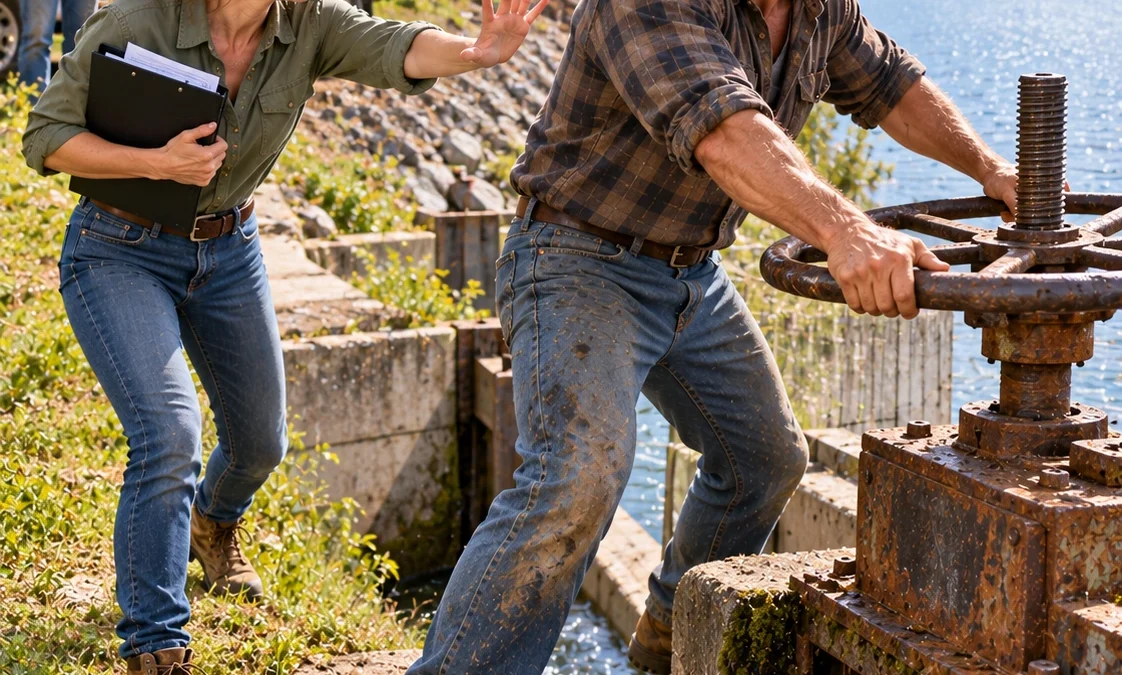
Part 2/5: Their first water trial turns a simple sale into a technical mess, revealing that available water is not the same as usable supply.
By Wednesday morning, Maren had cut her request from twenty thousand gallons a day to eight thousand.
Shade cloth reduced stress in several blocks. Earlier shipments removed part of the inventory. Revised watering schedules eliminated some unnecessary use, and a commercial supplier had committed to a limited delivery.
Four days.
Eight thousand gallons per day.
Thirty-two thousand gallons total.
Maren placed the revised nursery sheet on Everett’s tailgate beside Claire Donnelly’s pond survey.
Everett studied the engineer’s storage estimate.
“Roughly a million gallons in the pond?”
“Within the uncertainty of the survey,” Claire said.
Everett looked from that number to Maren’s thirty-two thousand.
For the first time, the nursery’s request looked almost insignificant.
Claire saw the thought crossing his face.
“Total water is not the same thing as deliverable supply.”
She traced the irregular bottom contours on the survey.
Much of the basin was shallow. The intake could not drag through sediment. Its usable position would shift as the pond level dropped and submerged shelves became exposed.
“Then collect it while the repair lowers the pond,” Maren said.
Claire nodded.
“That is the option worth examining.”
Everett had expected another reason it could not work.
Instead, Claire rotated the contractor’s site sketch toward them.
The pond’s outlet discharged below the dam into a narrow drainage channel. A tanker could not safely reach that channel without entering soft ground inside the active work area.
A temporary intake could collect water from stable ground before it passed through the outlet.
That withdrawal might count toward the planned lowering.
But truck loading, hoses, filters, pumps, traffic, and setup all had to fit the repair—not the other way around.
“We will not hold the pond at a level convenient for Prairie Lantern,” Claire said. “And the excavation crew will not reorganize its work around a water-delivery business.”
Maren studied the drawing.
“Could I collect several days’ worth at once?”
“Store it where?” Everett asked.
Her tanks could not hold an additional thirty-two thousand gallons.
Renting storage meant another truck, another location, more handling, and another bill.
Everett tapped the million-gallon estimate.
“So the pond having enough water isn’t the real problem.”
“Not by itself,” Claire said. “Physically, the pond may contain the volume she needs. We have not proved she can collect, transport, prepare, store, and use that volume within the available work windows.”
Everett felt more disappointed than he expected.
He had already started imagining Maren’s payment covering part of the pasture fence.
That was exactly why Claire kept forcing the conversation back to facts.
They reviewed the remaining questions.
Missouri requirements had to be checked.
Downstream interests mattered.
Site access mattered.
Pumping rates mattered.
The dam repair conditions mattered.
No engineer’s work plan was permission for unlimited commercial pumping.
Maren wrote everything down without demanding that someone simply tell her yes.
Then Claire proposed something smaller.
“One limited collection trial. No change to the repair sequence. It might tell us more than another stack of estimates.”
Maren nodded.
Everett looked over the pond.
“One trial,” he said. “And every cost gets written down before equipment arrives.”
“Agreed.”
Before leaving, Maren carried a sampling cooler to the water.
Everett watched her fill the laboratory bottle according to the instructions she had been given.
“Looks cleaner than my kitchen water some mornings,” he said.
“So does mine.”
She labeled it anyway.
The nursery consultant wanted information on dissolved salts, alkalinity, and other properties relevant to Maren’s plants.
Clear water did not automatically mean appropriate water.
Then came the issue Everett had not considered at all.
Surface water could carry biological risks that ordinary sediment filtration did not remove.
Any batch intended for the designated nursery block would require the preparation, disinfestation, and operating checks specified by Maren’s consultant.
“More equipment?” Everett asked.
“And somebody who knows how to run it.”
“Still cheaper than delivered water?”
“Maybe if we collect several days’ supply through one setup. For one small load? Probably not.”
“Then why continue?”
“Because my supplier can promise certain loads, not unlimited loads. Cost isn’t the only problem. Availability is.”
Everett understood that immediately.
The cheapest excavator in Missouri meant nothing if it could not reach his farm until October.
By Thursday afternoon, the expedited water chemistry report was back.
Nothing in the results automatically ruled out a limited trial, but the report was not a biological guarantee. Maren’s consultant kept the treatment conditions in place.
The trial agreement was written that evening.
Maren would pay for the collection equipment and testing.
She would also pay a capped amount for the specific interruption Everett and the contractor had agreed to tolerate, whether the trial succeeded or failed.
Any additional delay required a new agreement.
Maximum collection: two thousand gallons.
The operation could stop sooner because of equipment limitations, unsuitable water, concerning site conditions, or the end of the work window.
“Who gets to stop it?” Everett asked.
“Any of us,” Maren said.
He signed.
Friday morning, the pump arrived on a flatbed.
A temporary tank was placed on stable ground above the work area. The intake remained suspended above the bottom. A meter measured collection. Gauges tracked pressure across the filter.
Claire checked the setup.
The contractor checked access.
Maren stood beside Everett while the operator tightened the final connection.
“Water goes into the tank first,” she said. “Nothing goes straight to my nursery.”
“And if the trial fails?”
“I don’t buy a load just because I already rented the truck.”
At 7:20, the engine started.
The hose stiffened.
Water rushed into the tank.
For the first time all week, something was happening instead of merely being discussed.
Two hundred gallons.
Four hundred.
Maren photographed the meter.
Then the flow weakened.
The operator checked the gauges.
“Filter’s loading.”
He shut the pump down and opened the housing.
Fine suspended material coated the filter element.
In a sample bottle, it had been almost invisible.
Across hundreds of gallons, it became impossible to ignore.
“Are we pulling bottom sediment?” Maren asked.
The operator checked the intake.
“No. Intake is still clear. There’s enough suspended material to load the filter.”
They cleaned it.
Restarted.
The flow recovered.
Then slowed again.
The contractor’s crew was working elsewhere on the property, but they would need the loading area later.
“Could we use a coarser filter?” Maren asked.
“Only if the rest of your process can handle what passes through,” the operator said. “I’m not changing treatment requirements just to make that meter move faster.”
Maren nodded.
After the second cleaning, they discussed repositioning the intake.
That meant stopping again, securing the assembly, confirming clearance, and losing more time.
Claire would not allow the intake to be lowered toward sediment merely to preserve suction.
The meter showed 1,240 gallons.
At the equipment’s nominal pumping rate, they should have collected much more.
But setup, inspection, filter maintenance, and interruptions were part of reality too.
Maren ran her finger down the cost estimate.
“At this rate,” she said quietly, “eight thousand gallons isn’t a delivery. It’s almost an entire working day before hauling, treatment, unloading, and use.”
No one argued.
Maren looked at the meter one more time.
“Stop the trial.”
Everett turned toward her.
“We learned what this setup can do,” she said.
The engine died.
The collected water stayed at Fox Hollow because it had not completed the preparation required for nursery use. No treatment chemicals had been added, so Claire arranged for it to be returned to the basin as part of the drawdown work.
Everett handed Maren a bottle from his cooler.
She laughed tiredly.
“That may be the most expensive water I’ve touched all week.”
Everett looked at the rental equipment.
He did not laugh.
Maren’s phone buzzed.
Mateo had sent photographs from two nursery blocks along with a question about weekend hours.
She turned the screen facedown.
“A bigger filtration system could do better,” she said.
“It could.”
“I can have one here tomorrow.”
Everett looked toward the contractor walking up the track.
“Ask about it,” he said. “But don’t book another day here.”
Part 3/5: Maren stops chasing a perfect rescue, accepts painful nursery losses, and returns with a smaller request designed around Everett’s repair instead of against it.
The contractor met Everett beside the temporary tank.
“I need to start the scheduled lowering this afternoon.”
Everett nodded.
“If you want me to push it until Monday,” the contractor continued, “say it now. But the excavation window starts Monday morning. If we miss that, I move to the next job.”
“When could you come back?”
“Maybe three weeks. And you pay mobilization again.”
He pointed toward the access area.
“I’ve kept men busy around this trial. I can’t keep inventing places for them to work.”
Everett thanked him for saying it plainly.
Inside the farmhouse, he spread the repair schedule across the kitchen table.
His phone still displayed the photograph of the five heifers.
The farmer had messaged again that morning asking whether Everett wanted them held another week.
Everett had not answered.
Maren walked up to the porch carrying a new equipment quote.
“They can deliver the larger filtration unit tomorrow.”
Everett held up the contractor’s estimate.
“If we delay the lowering, we risk losing the crew. If I lose the crew, I pay another mobilization bill.”
“How much to keep them another day?”
He handed her the paper.
Maren read the number twice.
“That’s on top of everything I already paid for the trial.”
“Yes.”
“And we collected barely twelve hundred gallons.”
“I know.”
“So I spend more money on filtration, pay to keep your contractor waiting, and still don’t know whether it works?”
Everett felt his own temper rising.
“I’m not asking you to.”
Maren looked at him.
Everett lowered the paper.
“That’s what we keep getting wrong. We both want this to work, so every new obstacle starts sounding like something we’re supposed to spend our way through.”
Claire joined them after inspecting downstream conditions.
The trial had not created a new concern at the dam.
It also had not created a reason to delay the repair.
“Could another trial happen during the lowering?” Maren asked.
“If it fits the work,” Claire said. “Not if the work has to fit the trial.”
She looked from one of them to the other.
“You have stressed trees. Everett has an outlet system we already decided needs repair. Neither problem becomes less real because the other one is urgent.”
Maren looked at Everett.
He knew what she was asking without hearing the words.
Which problem mattered more?
He hated the question because it made the situation sound like a moral test.
It was not.
“I can’t give you tomorrow under the same conditions,” Everett said. “And I’m not holding the pond up for the nursery.”
Maren folded the estimate carefully.
“Even if I pay the extra day?”
“That money doesn’t buy back the contractor’s next job. It doesn’t change the excavation sequence.”
She stared at the pond.
Then she nodded.
“I need to call my supplier.”
“Yes.”
Everett watched her make the call beside her pickup.
The contractor approached him again.
“What are we doing?”
Everett looked once toward the tank and then toward the dam.
“Follow the repair schedule.”
That afternoon, the trial water went back into the pond under Claire’s direction.
The controlled lowering began.
Everett finally answered the farmer holding the heifers.
Don’t hold them for me.
He hit send before he could reconsider.
Saturday morning at Prairie Lantern, Mateo stopped beside a dogwood with drooping leaves and opened his hose.
“Wait,” Maren said.
She pushed her fingers into the container.
The growing medium was wet.
Mateo shut the nozzle.
They stared at the leaves.
The symptoms looked disturbingly similar to those on nearby containers that genuinely had been too dry.
“Set it aside for the consultant,” Maren said. “We need the roots checked.”
For most of the week, Maren had described the nursery’s crisis with two words.
Not enough.
Not enough water.
Not enough pressure.
Not enough storage.
Not enough time.
Now the problem was breaking into dozens of smaller problems.
Some plants needed more water.
Some needed less heat.
Some needed diagnosis.
Some had been damaged beyond the nursery’s shipping standards.
Some orders needed to leave immediately.
Others should never have been allowed to remain indefinitely in the first place.
Mateo brought the revised inventory sheet.
Green marks indicated saleable stock.
Yellow meant further inspection.
Red meant the plant had failed the nursery’s quality check.
“You want to look at those again?” Mateo asked.
Maren counted the red marks.
She knew which customer orders they had once belonged to.
“No.”
She swallowed.
“Keep them separated.”
The recoverable stock moved beneath available shade.
Watering schedules changed according to actual block conditions.
Maren confirmed purchased-water deliveries and temporary storage.
Then she called a customer who had postponed an order.
This time, she did not accept another vague promise.
“I need a delivery date. If you can’t receive the trees, I need to offer them somewhere else.”
The call ended with a discount Maren hated and a truck date she could put on the board.
By afternoon, they had an emergency plan capable of supporting the stock they were keeping.
That did not erase the losses.
There would be fewer trees to pack the following week.
Maren gathered her employees outside the shed.
“Some shifts will be shorter.”
Nobody moved.
“I’m posting the schedule today so you can plan.”
Mateo glanced toward the sheet.
“Packing and yard?”
Maren knew what he was really asking.
Would his household lose hours too?
“Yes.”
Nobody asked whether water was coming from Fox Hollow.
That made the next sentence harder.
“I accepted inventory before I had a reliable way to support it if customers delayed.”
She looked around the group.
“The heat made the problem worse. But the decision was mine.”
She told them which hours she could guarantee.
She did not promise everything would return to normal by Friday.
After the meeting, Mateo stayed to revise the irrigation assignments.
Maren picked up a hose.
“You don’t have to finish my block,” he told her.
“I’m not.”
She walked toward the next row.
“I’m taking the next one.”
Near closing time, Everett stopped by on his way home from the hardware store.
From the road, he saw separated rows and Maren’s pickup.
She was removing customer tags from trees that could no longer be shipped.
“How bad?”
She handed him a bundle of plastic tags to hold.
Everett started reading the quantities.
Then stopped.
“I keep thinking I could have given you another day.”
Maren pulled a tag from a branch.
“I would have spent that day trying to turn your pond into a full supply system.”
She placed the tag in Everett’s hand.
“I needed to make these decisions.”
“Supplier covering what’s left?”
“Between deliveries and our wells, we have a plan for the inventory we’re keeping.”
She looked toward the dogwoods under shade cloth.
“I’d still like a small reserve.”
Everett waited.
“But I won’t ask you to delay the repair for it.”
Everett looked at her.
“Write that version down.”
Maren returned to Fox Hollow on Sunday carrying one page.
Attached to it was the supplier’s confirmed delivery schedule.
Everett read that first.
“If my pond gives you nothing, this plan still works?”
“Yes.”
“We’re clear on that?”
“Yes.”
He put the supplier schedule aside.
“Show me the request.”
Up to four thousand gallons total.
Only if collection fit an existing repair window.
No request to hold the pond at a convenient elevation.
No request to postpone excavation.
No guarantee that all four thousand gallons would be available.
The collection and hauling quote was separate from the preparation required for nursery use.
There would be no connection to Prairie Lantern’s permanent irrigation system.
Everett looked at the cost.
“This is more per gallon than your commercial deliveries.”
“Yes.”
“Then why do it?”
“I’m comparing it to buying another emergency delivery slot, not to the price of water sitting in your pond.”
She pointed at another number.
“And that is the maximum I’ll spend finding out.”
Everett noticed the difference immediately.
During the first week, every expense had become a reason to spend more so the previous expense would not feel wasted.
Now Maren had written down a limit.
Claire reviewed the proposal.
“Four thousand is your ceiling,” she said. “It is not an approved collection amount.”
“Understood.”
“We check tomorrow’s pond level, intake position, and the contractor’s sequence first.”
“Understood.”
“If the available window permits less, less is the offer.”
Maren nodded.
No bargaining.
No attempt to convert hope into a promise.
Everett took a pen and added one sentence to the agreement.
No extension negotiated beside a running pump.
Maren read it.
“Fair.”
Part 4/5: Eight hundred gallons leave the farm only after Maren respects a hard cutoff, while both businesses absorb costs no clever bargain can erase.
At 6:30 Monday morning, Everett walked the changing shoreline with Claire and the contractor.
The pond had dropped according to plan.
Exposed shelves had narrowed the practical loading position, and the crew needed the access cleared before the next phase of excavation.
Claire checked intake clearance.
The operator reviewed timing by phone.
When they finished calculating, Maren’s four-thousand-gallon request had become something very different.
One attempt.
One thousand gallons maximum.
Pump off at 8:15.
All hoses and loading equipment removed before the contractor took control of the access.
Everett called Maren.
“That’s one quarter of what I proposed,” she said.
“It’s what today can support.”
“And if the truck only gets half?”
“It leaves with half.”
There was a pause.
“All right. I’ll send it.”
The water truck arrived with the operator and a revised filtration setup.
Maren followed in her pickup.
Everyone checked the intake, meter, gauges, filter, stable-ground position, and deadline.
The operator tapped the worksheet.
“At 8:15, I start packing. I don’t care what the meter says.”
Maren nodded.
At 7:45, the pump started.
This time the first several hundred gallons moved more steadily.
The revised filtration arrangement was better suited to the suspended material than the first setup had been.
Maren kept her phone in her pocket.
Everett stood where he could watch the loading operation and the crew preparing beyond it.
Six hundred gallons.
The operator paused.
The filter pressure had reached its maintenance point.
Nobody argued.
The operator serviced it.
The interruption felt painfully long.
When pumping resumed, only minutes remained.
Seven hundred.
Eight hundred.
Everett checked his watch.
“That’s time.”
The operator shut down.
Maren looked at the meter.
Then at the tank.
“Two hundred more would finish the amount we agreed to try for.”
The operator was already securing a hose.
“I’d probably need another cleaning. Can’t tell you how long.”
Maren turned toward Everett.
He knew the argument before she made it.
The water was right there.
The truck was already there.
The pump was already there.
Everything had been paid for.
Two hundred gallons sounded tiny compared with the million gallons the pond supposedly contained.
For one dangerous moment, Everett felt himself agreeing.
Then he saw one of the contractor’s men standing with a barrier he could not place until the hose moved.
The extra minutes were not empty minutes.
They belonged to someone else.
“We keep the time,” Everett said.
Maren looked toward Claire.
“Is another two hundred gallons dangerous to the pond?”
“Not because of the volume,” Claire said. “Two hundred gallons would barely affect this pond’s level.”
Maren waited.
“The cutoff protects the work sequence and the access we promised to return.”
Claire pointed toward the equipment.
“We do not renegotiate that while the pump is running.”
Maren stood still.
Then she walked to her pickup and moved it farther out of the crew’s way.
“Eight hundred,” she told the operator. “Record it and finish loading.”
The batch would go into isolated storage at Prairie Lantern.
Only after the consultant-specified preparation and operating checks could any portion be used on the designated nursery block.
Maren called Mateo while the truck was being secured.
“Keep the commercial delivery schedule.”
She listened.
“No, nothing changes. This is eight hundred gallons of supplemental water.”
Another pause.
“Eight hundred. Don’t round it up.”
Everett heard that.
He also heard what she did not say.
No promise of another load.
No suggestion that Fox Hollow had solved anything.
The hoses were removed before the contractor needed the access.
Maren returned for the signed meter record.
“I did ask for more,” she said.
Everett handed her a copy.
“I noticed.”
She managed a tired smile.
“Maybe next time I’ll get better at accepting the first answer.”
“So might I.”
The truck drove away.
Behind it, the contractor lifted the barrier into position and waved the crew forward.
Then the repair continued.
There was no dramatic collapse proving Everett had saved the farm at the last second.
No hidden treasure emerged from the mud.
No perfect explanation appeared that made the bill feel worthwhile.
The crew found deteriorated material that needed repair.
They found more cleanup than the estimate had originally included.
They completed the work Claire’s plan required.
And Everett received numbers he did not want to see.
The nursery paid the interruption costs it had agreed to pay.
It paid its collection expenses.
Later, it would pay for the metered water it actually accepted.
Everett still owned the dam.
Which meant Everett still owned the repair bill.
He sat on the edge of the excavator track with the updated figures in his hand.
“That’s everything?” he asked the contractor.
“For what we found and agreed so far.”
Everett appreciated the answer.
He wished honesty were cheaper.
That evening, he called the fencing supplier.
He reduced his order to the materials he could afford immediately.
The rest would wait.
The pasture would remain empty.
At Prairie Lantern, Maren and Mateo recorded the eight-hundred-gallon batch separately.
They did not mix it into the permanent irrigation system.
They did not count all eight hundred gallons as water already used.
Under the consultant’s plan, the batch received the required preparation and operating checks before a portion went to the designated block.
The rest stayed isolated for follow-up.
Maren kept every commercial delivery she had scheduled.
At the end of the week, she reviewed the water records.
Fox Hollow occupied only two lines.
First trial: 1,240 gallons collected and returned to the pond.
Second collection: 800 gallons delivered.
Beside those lines were much larger numbers from the nursery’s wells and purchased loads.
Mateo leaned over the page.
“That was a lot of work for two lines.”
“Yes.”
“Worth it?”
Maren looked at the numbers for several seconds.
“Yes.”
Mateo raised an eyebrow.
“The first trial told us we should stop trying to make Everett’s pond solve the whole shortage,” she said. “The expensive part was that I didn’t want to hear the answer immediately.”
Then she opened the damaged inventory file.
Some losses remained under review because not every plant had failed for the same reason.
But several costs were already undeniable.
Discarded stock.
Discounts.
Emergency deliveries.
Temporary storage.
Reduced packing work.
Shortened employee schedules.
Maren entered every one.
She did not move them into a category called weather.
She did not label them unavoidable.
She did not pretend the nursery had simply been unlucky.
The heat had hurt them.
Customer delays had hurt them.
But accepting too much inventory without enough operating capacity had been her decision.
A week later, Maren drove to Fox Hollow carrying a check and a final cost breakdown.
Everett met her beside the equipment shed.
She pointed out each line.
The agreed interruption payment.
Collection expenses.
The delivered-water charge.
Everett’s dam repair was nowhere on the page.
It remained Everett’s problem because it had always been Everett’s problem.
He looked at the amount left after direct expenses.
The water sale had made him very little.
“Not quite the fence money you pictured,” Maren said.
Everett looked up.
“I never told you I was picturing fence money.”
“You stared at that southern pasture every time we discussed price.”
Everett folded the sheet.
“I suppose I did.”
They walked toward the edge of the repair area.
The lowered pond looked less dramatic than either of them had expected.
Mostly it looked unfinished.
The bank required final work.
The disturbed ground needed to be restored.
The repair still required its scheduled checks.
Maren told Everett she was changing the nursery too.
Future incoming shipments would be smaller.
An irrigation specialist was reviewing system capacity before Prairie Lantern expanded again.
Additional storage was being considered—but only alongside a sustainable water source.
“Expensive?” Everett asked.
Maren smiled.
“Expensive enough that I’m doing the numbers before I buy it.”
Everett smiled too.
That sentence sounded different from the woman who had jumped out of a running truck asking him to delay a dam repair.
Before leaving, Maren looked once more at the pond.
“Would you ever sell water again?”
Everett considered the question.
“After the repair is finished, maybe we figure out whether an arrangement actually makes sense.”
Maren nodded.
“Before there’s an emergency.”
“That would help.”
She climbed into her truck and drove away.
Everett carried the check into the farmhouse.
The reduced fencing order stayed reduced.
The heifers were already somebody else’s cattle.
For the first time since buying the farm, Everett understood something he had spent years telling customers about machines.
A repair did not become unnecessary just because another opportunity appeared beside it.
Sometimes the cheapest decision was the one that refused to pretend two separate problems were one solution.
Part 5/5 (THE END): Months later, repaired ground, a surviving dogwood, and one quiet visit show both owners what the summer taught them about limits and trust.
By the first cool mornings of autumn, the worst heat had broken.
The completed dam repair passed its planned final checks, and Claire confirmed the conditions under which Everett could allow the pond to refill normally.
Rain returned slowly.
Water crept across the shelves that had been exposed during the drawdown.
Grass began taking hold on the restored ground.
Nothing about Fox Hollow suddenly became easy.
The farmhouse roof still leaked.
The southern pasture still ended at a section of fence Everett did not trust with cattle.
Money had not appeared because he had made the responsible decision.
He still had bills.
He still postponed purchases.
He still walked past the pasture some mornings and pictured the five heifers that might have been standing there.
But he no longer looked at the dam and wondered what was happening underneath something he could not see.
He walked the embankment regularly.
He kept observation notes in the kitchen drawer beside a maintenance schedule.
When something looked different, he had previous measurements to compare it with and a number to call.
That alone felt like progress.
Prairie Lantern changed too.
Maren stopped buying inventory based on the assumption that customers would always take delivery on schedule.
Orders were staggered more carefully.
Incoming stock was compared with well output, storage, irrigation capacity, expected weather, and available labor.
It did not make the nursery invulnerable.
It made its limits visible.
Most regular employee hours returned as business stabilized.
Not every order came back.
Some lost sales stayed lost.
Some damaged trees never recovered.
Some customers moved on.
Maren did not try to turn that into an inspirational story for her employees.
Summer had cost them money.
It had cost people hours.
It had exposed mistakes.
The useful part was knowing which mistake belonged to whom.
One Saturday morning, Everett heard tires on the gravel.
A white pickup turned into the drive.
He was standing on the porch when Maren climbed out carrying a black nursery container.
Inside it stood a young dogwood.
Everett walked down the steps.
“How many gallons this time?”
“None.”
She lifted the container slightly.
“I brought something that needs them.”
Everett laughed.
It surprised him how easy the sound came.
He took the tree from her.
The dogwood had come from the nursery’s surviving summer inventory. It was healthy, but not perfect—one side slightly fuller than the other, its branches still young enough to move easily in the breeze.
Maren did not claim Fox Hollow’s eight hundred gallons had saved it.
They both knew better.
“How are your people?” Everett asked.
“Most regular hours are back.”
“Most?”
“Not every order returned when the hours did.”
Everett nodded.
“And Mateo?”
Maren smiled.
“He tells me what I don’t want to hear earlier.”
“Does that help?”
“When I listen.”
Everett looked around the yard.
“Where should this go?”
Maren studied the ground.
They chose a place near the farmhouse, far from the embankment and clear of the access route that would need to remain open for future inspections and maintenance.
Everett fetched a shovel.
Maren watched him begin the hole.
“Wider,” she said.
He stopped.
“How much wider?”
She showed him.
He adjusted.
A year earlier, Everett might have kept digging just to prove he already knew how to plant a tree.
Now he asked questions.
Maren answered them without pretending the process was complicated merely because she knew more about it.
They loosened the root ball, checked the planting depth, positioned the dogwood, and filled the hole carefully.
Everett stepped back when they finished.
The young tree did not transform the farmhouse.
It did not hide the damaged roof.
It did not complete the missing pasture fence.
Its branches threw a thin, uneven shadow across the soil.
Maren looked toward the southern pasture.
“Still planning cattle?”
“Spring.”
“If the money’s there?”
“If the money’s there.”
Maren brushed dirt from her hands.
“I’d like to see them when you finally get them.”
“Stop by.”
She looked toward the road.
“You know the gate,” Everett added.
That made her smile.
Months earlier, she had arrived at that gate with her engine running and a problem large enough, in her mind, to justify asking a stranger to rearrange a dam repair.
Now she had brought him one tree.
No proposal.
No emergency.
No clipboard full of numbers demanding an immediate answer.
After her pickup disappeared down the road, Everett watered the dogwood exactly the way she had shown him.
Then he put the hose away.
Before supper, he walked toward the pond.
He stopped at the gate and rested his hand on the same post where Maren had called out to him that first morning.
The pond reflected the repaired bank and a line of autumn clouds.
Nothing about it looked like a million gallons.
It simply looked like a pond.
Everett checked the outlet.
He compared what he saw with his notes.
Everything looked as expected.
He wrote the observation down.
Then he closed the gate.
On the walk back to the farmhouse, he could see the new dogwood beside the porch.
For months, Everett had thought the summer’s central question had been whether he should sell Maren his water.
Maren had thought the question was whether she could obtain enough of it.
Both had been wrong.
The real question had been how far a person should push one solution after the facts had already begun saying no.
Maren had nearly spent thousands trying to turn an old farm pond into an emergency water system because each new cost made abandoning the plan feel harder.
Everett had nearly let someone else’s urgent problem change a repair schedule because he wanted the sale to pay for something his farm needed.
The first failed trial had given them an answer.
They simply had not liked it.
The second attempt worked only because they stopped asking it to be more than it was.
Eight hundred gallons.
A supplemental batch.
No delayed excavation.
No false promise.
No miracle.
And somehow that smaller success had taught both of them more than a full tanker ever could.
Everett reached the porch.
The dogwood moved lightly in the evening breeze.
He could still see exposed repairs at the pond.
He could still see gaps in the pasture fence.
He could still see work waiting everywhere he looked.
But for once, unfinished did not feel like failure.
It felt like knowing what came next.
Everett turned off the porch light, went inside, and left the little tree standing beside the house beneath a cool Missouri sky.
THE END








