At my high school graduation, the principal called me by my twin brother’s name, and my family didn’t notice. Ten years later, my father drove two hours to ask me to sign a sentence that would erase the only proof I had ever been there.
Part 2
Merv was sixty, missing the tip of his left pinky, and patient in the way of someone who had spent forty years waiting for parts to arrive.
My first week, he handed me a long flathead screwdriver. “Put that to the motor. Ear on the handle. Tell me what you hear.”
“A hum.”
“Listen longer.”
On the third day, I heard a small tick beneath the hum, like a fingernail tapping a table. Merv said that was a bearing that would cost someone a Saturday. Two weeks later, it seized during a night shift. He sent me in to replace it.
I completed the apprenticeship, got my journeyman card at twenty-two, and took over most of Merv’s calls after he retired. I rented an apartment over a florist shop downtown. Everything I owned smelled faintly of carnations.
I didn’t go back to Norfolk.
As best I could tell from a distance, Luke redshirted his first year at Nebraska. That was normal. The strange part came at the fall testing. He ran a 4.67.
I heard about it at Thanksgiving when I was twenty and went home once. Luke told it as a funny story around the table. The strength coach had looked at his clipboard and said, “Son, you ran a 4.48 at my camp. What happened?”
“Hamstring,” Luke said.
Dad laughed. “Those guys don’t know how to train a kid. He tore that hamstring right before camp. Tough kid.”
Mom got up for more gravy. Luke studied his plate. I asked someone to pass the potatoes.
The next spring, the Norfolk paper ran a feature about Luke. Mom mailed me the clipping without a note, which was how she said things.
The article showed Luke in a red practice jersey and Dad on the porch beneath the flag. Most of it was Dad talking. He told the reporter that Luke had torn his hamstring six days before camp, that the doctor had advised him to sit out, and that Luke had said, “No, Dad, drive me to Lincoln.”
“He ran a 4.48 on one good leg,” Dad said. “Proudest day of my life.”
I read the article standing by my mailbox, then read it again in the truck. I didn’t throw it away. I put it in a shoebox with everything else from that summer.
I learned later that Dad carried a folded copy in his wallet. He’d pull it out at the gas station coffee table whenever someone new sat down.
Luke played two seasons, mostly on special teams. Then he left the program. Dad said the trainers had ruined his hamstring. Luke finished his degree at Wayne State and came home to coach at our old high school. By twenty-five, he was the head coach.
He married Danielle, who taught third grade and was kinder to me than anyone in my family had earned.
I didn’t hate Luke. He wasn’t a bad kid. He was a kid who had always been handed things, and people don’t usually get blamed for catching what’s thrown. The blame belonged with the people throwing.
Three years before Dad came to my apartment, Luke called for the first time in a long while. He was getting married and wanted me to be his best man.
“Why?” I asked.
“Mom wants the picture,” he said. “You know, the twins picture.”
“No.”
“Levi, come on. It’s one day.”
“It was one day last time, too.”
I hung up. Mom called that night to tell me I was being petty about something that happened when we were kids.
I asked whether she still had my graduation cap.
She went quiet. “That’s not the point.”
I didn’t attend the wedding. For the twins picture, Luke posed with Danielle’s cousin, who apparently looked enough like me from a distance.
Two summers before Dad showed up with his paper, I ran into Luke at the State Fair in Grand Island. I was waiting for a pork chop on a stick when Danielle said my name. She’d never met me, but she recognized me after a double take.
“You’re Levi,” she said. “You really do look exactly like him.”
Luke was ten steps behind her with two lemonades. He stopped when he saw me, then came over because there wasn’t much else to do.
Danielle asked about the elevator and listened to my answer. Then she said, “Luke says you were the fast one in high school. He says you were the fastest kid in Norfolk.”
I looked at Luke. He looked at the cattle.
“He said that?”
“He says it every time we drive past the track.”
“Babe,” Luke said, “we should find the car before the fireworks.”
They left. At the end of the barn, Luke rubbed the back of his neck, right over the birthmark behind his right ear. He’d done that since we were six, whenever he was nervous.
I thought about what Danielle had said. He’d told his wife I was the fast one. He knew whose legs had crossed that stage under his name. He just hadn’t said it to anyone who could do anything about it.
Dad called around Christmas most years. He’d talk about Luke’s season, the playoffs, the banquet, then say I should come watch a game.
I always said no.
Once, after Luke’s team lost in the state quarterfinals, Dad called in November to ask me to fix his garage door motor.
“I’m booked,” I said.
“For your own father?”
“I’m booked, Dad.”
I was booked on purpose.
Then, in April, Dad drove to my apartment.
He arrived at nine in the morning, wearing his good jacket and carrying the folder. He was sixty-three and had gotten heavier. His knees made him take the stairs one at a time. He smelled like the carnations from the florist shop downstairs.
“Can I come in?”
I let him in. I didn’t offer coffee.
He sat at my kitchen table, which was a card table, and looked around the apartment as if he were pricing it.
“Your brother’s a finalist for a college job,” he said. “Running backs coach out in Kearney. Real money. Health insurance for Danielle. It’s the job he’s waited for his whole life.”
“Good for him.”
Dad opened the folder and slid the paper across the table.
I read it twice. I didn’t touch it.
“There’s a strength coach out there now,” Dad said. “Wall. He used to be at Nebraska. He remembers the kid at camp getting into his stance with his left hand. Luke goes right-handed. He checked Luke’s player bio and saw you’re twins.”
Dad tapped the paper. “The athletic director asked Luke if you went to camp under his name. Luke said no. They’ll make the offer if you sign this.”
“So Luke lied.”
“He protected himself.”
“From what?”
Dad leaned back. The card table wobbled. “Nobody’s asking you to do anything. It’s a piece of paper.”
“No.”
He blinked. I don’t think he’d planned for that. He’d planned the drive, the folder, the jacket, and me signing.
“It’s one sentence,” he said.
“It’s a lie with my name underneath it.”
“Levi, one of you had a shot. Somebody had to take it.”
“Somebody did. It was me.”
Dad stood. At the door, he said, “He resigned from the high school last week. The athletic director told him he was the pick. He told his players at the spring banquet. If this falls through, he’s got nothing.”
He waited for me to answer.
I didn’t.
“Friday,” he said, and went down the stairs one at a time.
After he left, I went to the closet and pulled out the shoebox.
Part 3
I hadn’t opened it since I moved to Grand Island.
Inside were the old phone, a white wristband, a printed results card, and the camp photo. Dad’s typed sentence sat beside them.
Six days before the Nebraska camp, Luke had come home from a seven-on-seven tournament limping. Dad said he’d pulled his hamstring.
All week, Mom iced his leg on the couch, twenty minutes on and twenty minutes off. She used the timer on the stove. Luke watched television with his leg raised while Dad paced the kitchen.
On Thursday night, Dad came into the garage where I was changing the oil in my truck. He sat on a bucket.
I’d never seen him sit on a bucket in my life.
“That camp is his one chance,” he said. “If he doesn’t go, they’ll forget his name.”
“So he goes next year.”
“There is no next year. Senior season. They’ve already got their list. This is it.”
I wiped my hands. I knew where he was going before he got there.
“Nobody knows you two apart,” he said. “Nobody up there has ever seen you.”
“Dad.”
“You’d just be holding his spot. They’ll look at his film, not one camp. You’re keeping the door open for him.”
I was seventeen. My father had never sat down to talk to me like that before.
I said yes.
On Saturday, it was just Dad and me driving to Lincoln. Luke stayed home on the couch, according to Dad.
At a gas station in Wahoo, my phone buzzed. Dad was ten feet away pumping gas, but he texted me:
Remember, you’re Luke today. Answer to his name. Keep your left hand in your pocket.
I still have that phone. It works if you leave it plugged in for an hour.
At camp, they gave me a white wristband with Luke written on it in marker, along with the number 312. They handed me a red shirt. There were two hundred kids, coaches with clipboards and stopwatches, and parents along the fence.
I tried to get into a right-handed stance for the forty. It felt like writing with the wrong hand. I stumbled on the first start.
A coach with a gray goatee said, “Get down however you’re comfortable, son.”
So I put my left hand down.
I was a track kid. I’d started from blocks a thousand times. I ran a 4.48.
I didn’t know if that was fast for football. I knew it was fast for me.
The kid beside me in line was a big linebacker from Kansas with a farmer’s tan.
“Man, where did you come from?”
“Norfolk,” I said, catching myself before I gave him my real name.
“What’s your name?”
I looked at my wrist as if I had to check. “Luke.”
“Well, Luke, you just made the rest of us look bad.”
It was the first time anyone had ever said my brother’s name to me like it was a compliment.
The coach with the goatee checked his stopwatch, then looked at the man beside him. I learned ten years later that the second man was Kenny Wall.
I ran the shuttle and the vertical. I caught passes. I kept my mouth shut, and every time someone called “Luke,” I turned around.
At the end, they gave each athlete a printed card. Mine said Luke at the top, then 40-yard dash: 4.48.
A camp photographer was taking pictures near the finish line. I ran one more forty for fun. As I crossed, I turned my head to look at the clock. The picture went up on the camp’s recruiting page that week.
It showed a kid in a red shirt and wristband, head turned so you could see the left side of his neck—and the brown birthmark behind his left ear.
Luke’s was behind his right.
I kept the wristband and the card. A few weeks later, I printed the photograph at the drugstore. I’m still not sure why. Some part of me must have known I’d need proof someday.
In August, the offer came. The letter praised Luke’s toughness and his film. It also said his camp speed had made the staff take a second look.
Dad read that line out loud at supper twice.
I waited for someone to look at me.
Nobody did.
Dad never thanked me. Neither did Luke. If they had thanked me, they would have had to say what for.
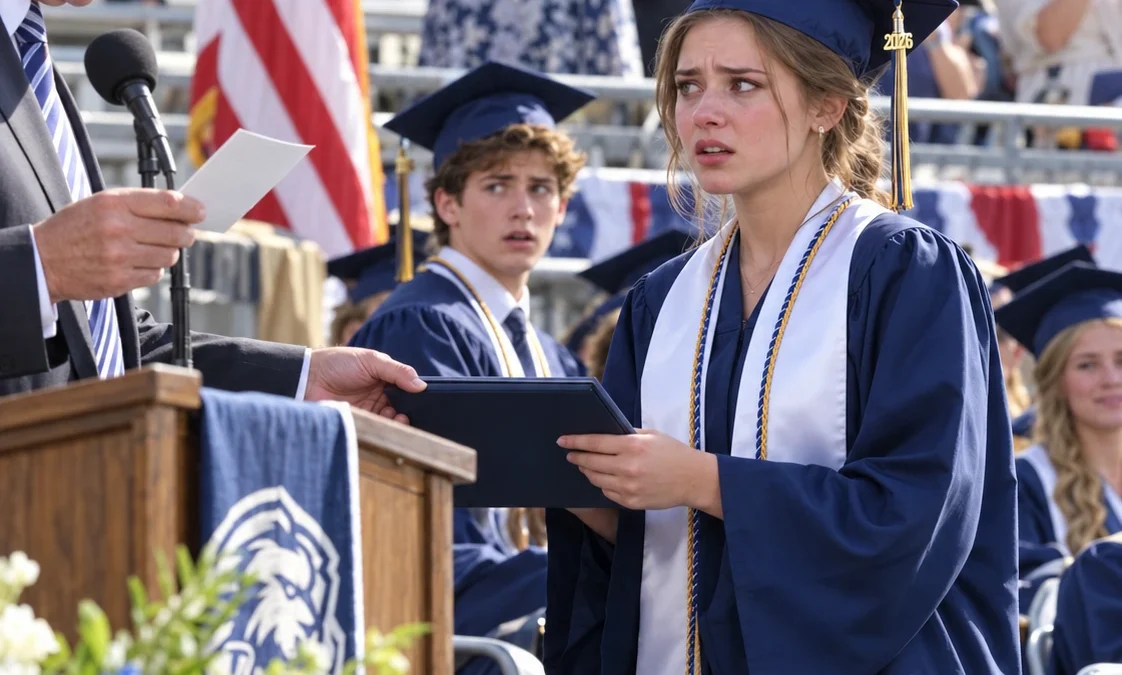
The gym had stood for my 4.48 with Luke’s name on it. The principal had called me by Luke’s name, too. My family had been in the front row taking his picture while I walked across the stage.
That night, I’d put my cap in Mom’s hands.
“Give this to him, too.”
Ten years later, the shoebox sat open on my card table. I knew I wasn’t signing the paper. I didn’t yet know what I would do instead.
On Wednesday night, Mom called. I hadn’t heard her voice in almost a year.
“Your father says you’re being difficult.”
“Did he tell you what the paper says?”
“He said it’s a formality. He said you’d understand.” She paused. “You helped your brother once, honey. You were so sweet about it. Why can’t you help him one more time?”
“Is that what Dad told you? That I offered?”
“Well, didn’t you?”
I didn’t answer. I asked if she still had my cap.
“Levi, not this again.”
“Good night.”
After she hung up, I sat looking at the shoebox and turned one word over in my head.
Offered.
Ten years, and Mom believed I’d raised my hand.
On Thursday, the day before Dad’s deadline, Luke showed up at the elevator. I was on a catwalk sixty feet above the floor, checking a fan motor, when the plant manager radioed that my brother was in the parking lot.
Luke waited by his truck in a gray coaching pullover, his whistle still around his neck. He looked like me after a few bad nights and a long winter.
“You didn’t sign it,” he said.
“I’m not going to.”
“Levi, please. I’ve got a house payment. I resigned. They already gave my job to my defensive coordinator. If I don’t get Kearney, I have nothing in the fall.”
“Tell the athletic director the truth. He might still hire you.”
Luke laughed, but there was nothing behind it. “Tell him what? That my brother got me a scholarship? That I was never fast enough? That’s everything I am up there.”
“You played two years in Lincoln. You’re good enough to coach. You just weren’t 4.48.”
He glanced at the elevator like he’d never seen one before.
“It wasn’t even my idea,” he said. “I wasn’t even hurt. Dad said you were faster and nobody would know. I was at the lake that whole week.”
He stopped talking.
“You were at the lake?”
“Forget it.”
“Mom iced your leg for a week with the timer on the stove.”
Luke climbed into his truck. “Just sign the paper, Levi.”
Then he drove off.
Part 4
I stood in the parking lot until a grain truck honked at me to move.
That night, it took about twenty minutes to find what I needed. Luke’s old high school teammate, Corbin, had posted pictures from the lake ten summers earlier. The date on them was the Saturday of the Nebraska camp.
In one photo, Luke was wakeboarding behind Corbin’s dad’s boat, both legs bent, grinning as he flew over the wake.
There had never been a hamstring injury.
Dad hadn’t sent me to Lincoln because Luke couldn’t go. Dad had watched Luke run a 4.66 in Omaha and decided which son he wanted to send.
The week of icing was a story designed to make me say yes.
I printed the lake photo at the drugstore the next morning. Same drugstore, ten years later.
The clerk asked if I wanted it glossy.
“Matte’s fine.”
Friday came. Dad called at noon. I let it ring. He called again at three. I let it ring.
At four, I called the college in Kearney and asked for the athletic director. His name was Palmquist.
“Your brother told me you’d be calling with a signed statement,” he said after I introduced myself.
“I’m not calling with a statement. Can I come out Monday and show you some things?”
“What kind of things?”
“Things you’ll want to see before you make that offer.”
He was quiet for a moment. “Your brother’s a good coach. His kids love him. I’m not out to get anybody.”
“Neither am I. I’m just not signing something that isn’t true.”
“Come Monday.”
His office was in the basement of the gym, with a window at ground level where I could see people’s shoes passing outside. Palmquist wore a polo shirt and reading glasses on his head. Kenny Wall sat in the corner, older and heavier than I’d imagined, with forearms like fence posts.
Wall watched me walk in.
“Left hand,” he said.
“Yes, sir.”
I laid everything out on Palmquist’s desk, the way Merv taught me to arrange parts before a rebuild. The white wristband. Luke. Number 312. The results card. Luke. Forty-yard dash: 4.48.
Then the photo, with the birthmark behind my left ear. I turned my head and showed them the real one.
Last came the old phone, plugged in and holding Dad’s text from the gas station:
You’re Luke today. Answer to his name. Keep your left hand in your pocket.
Then the lake picture. Luke on the wakeboard the same Saturday, a hundred and fifty miles north of Lincoln.
“My brother wasn’t hurt,” I said. “My dad sent me because I was faster. I was seventeen, and I went. That part’s on me. I’m not here to get my brother in trouble. I’m here because my family asked me to sign my name under a lie, and I won’t.”
Palmquist picked up the wristband and turned it over.
“Your brother sat in that chair two weeks ago and told me he’d never even heard of a twin going to camp under his name,” he said.
Wall leaned forward. “I timed that kid. I went home and told my wife we’d found the fastest back in the state. Then Luke showed up in August and ran a 4.67. I spent two years thinking I’d done something wrong with him.”
He shook his head. “Ten years. I thought it was me.”
“Why now?” Palmquist asked. “You could’ve told someone ten years ago.”
“Ten years ago, nobody asked me to sign anything. They asked me to keep quiet, and I did. This time, they want my name on it. My name’s the one thing I’ve still got that’s mine.”
Palmquist asked if he could make copies. I said yes. He took the evidence down the hall himself.
When he came back, he shook my hand. “For what it’s worth, I’d rather have a man who brings me a shoebox than a man who brings me a sentence.”
I drove home without calling anyone.
On Wednesday, Palmquist withdrew the offer. He told Luke the job was going to another candidate and that if he wanted to talk about why, the office door was open.
Luke asked the high school for his old job back the next morning. The school board had already signed his defensive coordinator to a contract. They offered Luke a long-term substitute position teaching math that fall. He took it. The house payment still needed to be made.
That Saturday, I drove to Norfolk. It was my first time inside my parents’ house in eight years.
The Husker flag still hung from the porch, faded almost pink.
Dad opened the door before I knocked. He’d heard my truck.
“You’ve got some nerve.”
“I brought something for Mom.”
She was at the kitchen table. Luke sat by the window with his elbows on his knees. Nobody offered me a chair, so I stayed standing.
Dad began before I’d taken off my jacket. “You ruined your brother over a forty-yard dash. A forty-yard dash from ten years ago. He’s going to be teaching fractions to fifteen-year-olds.”
“I didn’t ruin anybody, Dad. You did. You used my legs to do it.”
“I gave this family a shot.”
“You gave Luke a shot. You gave me a wristband with his name on it.”
Luke looked toward the window. “Dad, just tell her.”
“There’s nothing to tell,” Dad said.
Mom’s face changed. “Gary, what is he talking about?”
She knew about the camp. She’d known since that Saturday. Dad had told her Luke was hurt and I’d offered to fill in. She’d thought it was a sweet thing for one brother to do for another.
She hadn’t known where Luke had been.
I put the lake photo on the table.
Mom looked at the date. Then she looked at Luke.
“Mom,” he said.
“I iced your leg for a week,” she said. Her voice was flat. “Twenty minutes on, twenty minutes off. I set the timer on the stove.”
Luke said nothing.
She turned to Dad. “You let me ice his leg. You let me think Levi offered.”
The kitchen clock ticked. I’d forgotten how loud it was.
Mom went down the hall and returned with my graduation cap. The tassel was still attached, black and gold, with the little brass 2016 charm. She’d kept it in the closet for ten years.
“I should have given this back that night,” she said, holding it out.
I looked at the cap. For a second, I thought about taking it.
“No, Mom. I told you what to do with it. Give it to him, too.”
“Lynette, take it easy,” Dad said.
“Don’t.”
One word. In twenty-eight years, I’d never heard her say that to him.
Dad turned to me, still looking for the son he could move. “You happy now? You got what you wanted?”
“I wanted my name, Dad. That’s all I ever wanted from you. You didn’t even notice when they got it wrong at graduation.”
He opened his mouth, then closed it.
I left the cap in Mom’s hands and walked out.
Mom moved in with her sister in Columbus two weeks later. As far as I know, she’s still there. Dad called once in June. He didn’t say hello.
“Your mother won’t come home,” he said, as if she were a part he’d ordered and the warehouse had misplaced.
“I know, Dad.”
He hung up.
He took down the Husker flag in July. Coach Ruska heard it from a neighbor and told me later.
Dad had spent years telling the camp story at the gas station coffee table: his boy ran a 4.48 with a bad hamstring. The real version made its way around Norfolk. The coffee table found a new topic. When Dad walked in, people talked about the weather.
Luke teaches fractions now. I hear he’s good at it. He hasn’t called me. I don’t expect him to.
In August, Kenny Wall sent a handwritten letter on the college’s letterhead. He’d gone back through his old camp notebooks. Beside number 312, he’d written in pencil: “Hands left, check.”
He said he never checked. He apologized. He added that if I’d asked him what I could have run at twenty, he’d have guessed 4.42.
I put the letter in the shoebox.
One Sunday in September, I drove to Norfolk again. Not to my parents’ house. To the high school track.
Coach Ruska was waiting by the gate with his windbreaker, thermos, and the same stopwatch on the same old shoelace.
“So,” he said. “June?”
“June.”
I told him everything by the long-jump pit. He listened without moving. When I finished, he said, “I knew it was you. I didn’t know the rest.”
Then he pointed at the starting line with his thermos. “Go on. Forty yards. Let’s see what’s left.”
“Coach, I’m twenty-eight. I climb grain bins for a living.”
“Then you’ve got good legs. Go.”
I walked to the line, set my left hand on the track, and ran.
Ruska checked the stopwatch. He looked at me and nodded.
“4.61,” he said. “You’re slow.”
“I’m twenty-eight.”
“Your brother never ran that either.”
Then he held out his hand. I took the old results card from my pocket. Luke’s name was printed across the top. Forty-yard dash: 4.48.
Ruska clicked his pen, drew one straight line through Luke, and wrote Levi above it in block capitals.
“There,” he said. “Now it’s right.”
I pinned the card inside my locker at the elevator, next to the screwdriver.
Some nights during harvest, when a motor quits at three in the morning, I open the locker and see my name above the time.
Levi. 4.48.
Then I put the screwdriver to the motor and listen.
It tells me what’s wrong if I let it.
THE END








