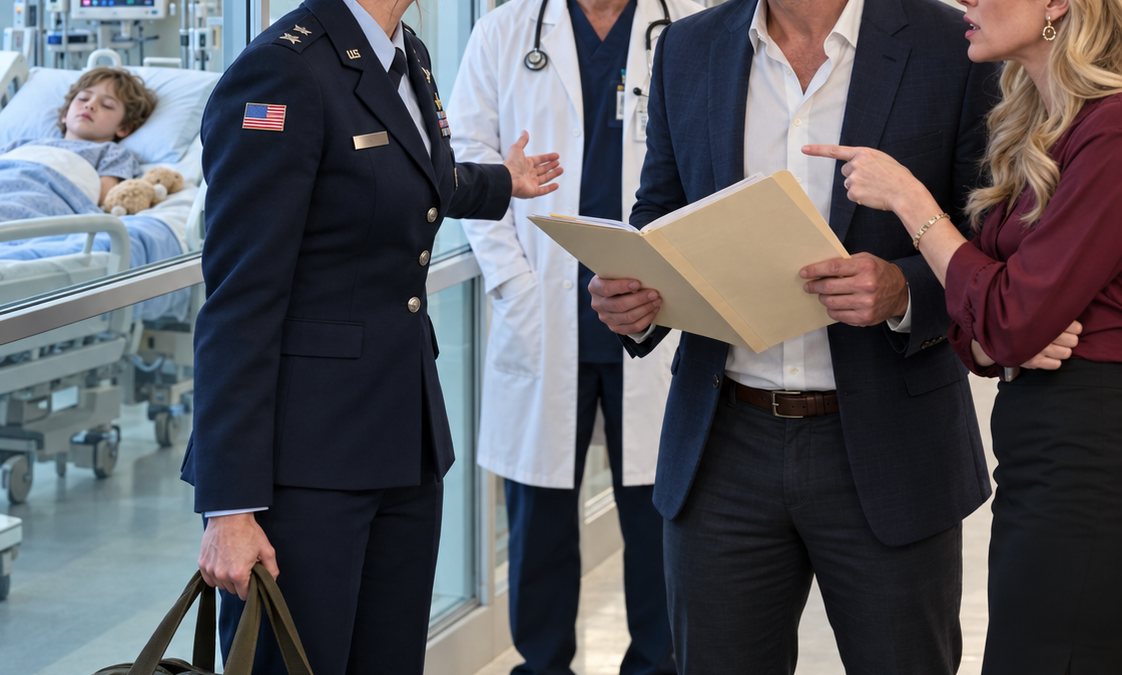
My twelve-year-old daughter had been unconscious for nine days when I reached the hospital and heard her father discussing the end of treatment; his girlfriend mocked my uniform, but then my daughter squeezed my hand twice—the signal we invented years ago, and the first clue their story was wrong.
Part 2/5: Hospital records reveal my number was wrong, my daughter had asked for help, and the night of the crash held more secrets than I knew.
The hospital social worker, Melissa, arrived Friday morning with a folder and the careful manner of someone who had learned to be gentle without sounding uncertain. She said she understood there had been communication problems.
“That’s putting it mildly,” I said.
I showed her the messages Trevor had sent during the nine days I was trying to get home. Most were brief: Still stable. No changes. Doctors say wait. One message stood out: Don’t keep calling the hospital. You’re upsetting everybody.
Melissa read it without comment. “Were you getting daily updates from the medical team?”
“No. I kept asking Trevor to arrange them.”
She checked the contact information listed in Willa’s chart, then frowned. “The number here ends in 0186. Is that still yours?”
“That hasn’t been my number in four years.”
She looked up. “Who gave the hospital this number?”
“I don’t know. Trevor knew my current number. He called it himself to tell me about the accident.”
Melissa said she would check the admission records, correct my information, and arrange a conversation with the physicians. She also asked for our custody agreement.
Trevor and I had been divorced for three years. We shared legal custody. Willa spent school weeks with me when my duty schedule allowed; during longer assignments, she stayed with her father. It wasn’t a perfect arrangement, but I believed we both understood that our daughter came first.
After Melissa left, I called my attorney, Elise Morgan, who had handled our divorce. I explained the disconnected number, the possible treatment meeting, and Trevor’s strange account of the crash.
“Tell me what you know,” Elise said, “not what you suspect.”
“I know he gave the hospital the wrong number. I know he said he was taking Willa off life support Friday. And I know he won’t tell me why she was out at ten forty-three.”
“Then get the custody order to the hospital and request the records you’re entitled to. Don’t confront him in a hallway. Let the documents do some of the talking.”
I wrote that down on the back of a cafeteria receipt. Elise reminded me that I didn’t need to win an argument that day. I needed to protect Willa and make sure the people treating her had accurate information.
Around noon, Ruth Bell arrived carrying a paper bag from a bakery near her home. Ruth was sixty-three, a retired elementary school secretary, and the closest thing Willa had to a grandmother in North Carolina. She had lived across the street from us since Willa was a toddler.
When my marriage ended, Ruth never asked whose fault it was. She brought casseroles, watched Willa when my schedule changed, and reminded me to eat. Now she stood beside the hospital bed and looked down at my daughter.
“Oh, sweetheart,” she whispered.
She set the bag on the table. “Turkey sandwich, apple. And don’t tell me you’re not hungry.”
I managed a tired smile. We sat together while the ventilator kept its steady rhythm. After a few minutes, Ruth told me Willa had called the evening before the accident.
“She asked if she could stay with me for a while,” Ruth said.
My stomach tightened. “Did she say why?”
“Only that things were uncomfortable at her father’s house. I asked whether anyone had hurt her, and she said no. She sounded upset, though.”
“Did you call Trevor?”
“I tried. He didn’t answer.” Ruth looked ashamed. “I should have called you.”
“You didn’t know what was going to happen. Neither did I.”
I remembered a message Willa had sent me two days before the crash: Mom, can we talk when you get home? It’s about Dad’s house. I’d been in the middle of an equipment inventory when it arrived. I answered that evening, telling her I’d call when I could.
Our scheduled call never happened. A communications issue delayed it, then work took over. I assumed whatever was bothering her could wait a few more days.
That assumption would haunt me.
At two, Dr. Samuel Ortiz arrived to conduct a neurological assessment. He explained each step before examining Willa. She didn’t consistently follow verbal commands, though there were movements the team wanted to monitor.
“One examination doesn’t tell us the whole story,” he said. “We’ll repeat the assessments.”
“Could she hear me?”
“We can’t know that from what we’ve observed. But speaking to her calmly is reasonable.”
I told him about the hand signal. He listened and wrote it down.
“That history may help us design repeated assessments,” he said. “We still need to distinguish an intentional response from an automatic movement.”
After he left, I leaned close to Willa. “Remember the garden you wanted behind the house? Ruth says she’ll help us plant sunflowers.”
I squeezed her hand twice. Nothing happened. I stayed anyway.
Later that afternoon, Ruth returned from the cafeteria holding her phone. A neighbor had spoken to someone who knew the officer investigating Willa’s crash.
“Trevor wasn’t driving,” she said.
I stared at her. “What?”
“The report names Paige as the driver. You need to confirm it with the police, but that’s what my neighbor heard.”
I called the investigating department and left my number. An hour later, Officer Michael Hayes called back. He confirmed that Paige had been driving the car when it left a wet stretch of Ramsey Street and hit a utility pole. Willa had been in the backseat.
“Was another car involved?” I asked.
“No other vehicle was struck.”
“Trevor told me a truck forced them off the road.”
“I can’t discuss every statement we’ve collected,” Officer Hayes said, “but I can confirm your former husband wasn’t in the vehicle when the collision happened.”
That answer settled heavily in my chest. Trevor hadn’t confused one small detail. He had allowed me to picture him in a crash that he had not been part of.
I found him in Willa’s room later that afternoon.
“Paige was driving,” I said.
His face changed. “Rebecca, I was trying to keep you calm.”
“You told me a truck ran you off the road. You weren’t there.”
He rubbed his forehead. “Paige was doing me a favor. Willa needed a ride.”
“From where?”
“A gathering at a friend’s house.”
“What gathering?”
“Just some people we know.”
“Why was our daughter out at ten forty-three on a school night?”
“Things got later than expected.”
“Why didn’t you go get her?”
“I was working.”
His answers sounded thinner each time he spoke. I kept my voice low. “Did you know Paige was driving?”
“Yes.”
“Did you know Willa was upset about staying at your house?”
“She gets upset when she doesn’t get her way.”
“She’s twelve, Trevor. She’s our daughter, not an inconvenience.”
He stood. “You’ve been home less than a day and you’re treating me like a criminal.”
“I’m asking you to tell me the truth.”
He left without answering. I went back to Willa’s bedside, where I could be angry without making her carry it.
Part 3/5: As investigators examine Paige’s phone and the crash scene, I learn that lies can keep a parent from the room where decisions matter most.
Elise called that afternoon after reviewing our custody order. Both Trevor and I shared legal authority over major medical decisions, she said, and the hospital should involve us both according to its procedures.
“Can Trevor decide to stop treatment without me?” I asked.
“Not simply because he’s been at the hospital longer. If you disagree, the medical team and legal process matter. Keep asking for clear evaluations, and keep your concerns separate from the medical evidence.”
I looked through the glass toward Willa’s room. “I don’t want anyone making assumptions about her.”
“Then keep showing up and keep asking for information.”
That evening Dr. Ortiz returned with another member of the neurology team. They examined Willa’s pupils, reflexes, and responses to simple instructions. I stood by the window and tried not to interfere with the quiet work.
Afterward, Dr. Ortiz explained that some responses remained inconsistent. The team couldn’t determine how much awareness Willa had, but he had documented our hand signal and would consider it during future assessments.
For the first time, someone had treated the signal as useful history without calling it proof. I needed that kind of careful honesty.
Ruth brought soup in a thermos that night. I told her the police had confirmed Paige was driving.
“Trevor hated admitting he’d made a mistake,” she said.
“This wasn’t a mistake.”
“No,” Ruth answered. “It was a choice.”
My phone vibrated. Elise had sent a message reminding me to preserve every text from Trevor. I opened our conversation and began saving copies. One message from the morning after the crash caught my attention: Please don’t contact Paige. She’s having a hard enough time.
I’d taken that as concern for someone who had survived a frightening accident. Now I wondered what Paige had been afraid of saying.
The next morning, Officer Hayes called again. Investigators had obtained information about communications between Trevor and Paige after the crash. They were examining whether the two had coordinated their accounts.
“I can’t share details yet,” he said. “We’re still looking at the witness statements and roadway evidence.”
I thanked him for being careful with what he said. I wanted answers, but I didn’t want to mistake a suspicion for a conclusion.
A witness had been driving behind Paige before the collision. Officer Hayes said the witness reported a vehicle matching hers braking suddenly and moving sharply toward the shoulder. Investigators were also examining phone activity around the time of the crash.
“Was Paige using her phone?” I asked.
“We’re still reviewing the available evidence. I don’t want to give you a conclusion we haven’t established.”
I went into Willa’s room and sat beside her. Her hand was warm against mine. “I’m going to find out what happened,” I whispered. “You don’t have to help me do it. You just keep resting.”
The hospital arranged a family meeting for Friday. Trevor called it “the meeting where we decide what happens next.” When I told him the doctors had not made a decision, he said I was twisting his words.
By then, the hospital had corrected my number. The chart listed both parents, and I received updates directly from the staff. The change was simple, but it clarified what the last nine days had been: Trevor had been my only source of information, and he had controlled how much I heard.
At the meeting, Dr. Whitaker reviewed Willa’s condition. Her injuries were severe, and her recovery remained uncertain. The team needed to repeat neurological assessments and continue treatment while they learned more.
No one told us there was a deadline. No one said they had decided to withdraw life support.
Trevor sat with his jaw tight. Paige waited outside the room.
I asked the doctors to explain which signs they were watching and how they would distinguish reflex from awareness. Dr. Whitaker answered each question. Dr. Ortiz said he had noted my description of the hand signal and would keep testing for repeated, consistent responses.
Trevor accused me of holding onto false hope. I told him I was asking the doctors to evaluate our daughter, not asking them to promise me a particular outcome.
After the meeting, Officer Hayes called again. Investigators had confirmed that phone activity associated with Paige’s device occurred shortly before the collision. The timing raised questions, along with the witness account and physical evidence. The case was still under review, and no charges had been filed.
I repeated that distinction to myself. There was an investigation, not a verdict. But there was also a clear contradiction in Trevor’s story, and the wrong number in Willa’s chart had kept me out of conversations where I belonged.
Elise helped me seek an emergency hearing to establish temporary safeguards while Willa remained critically ill. We weren’t asking the court to decide who caused the crash. We were asking for clear authority over medical communication and for decisions to remain guided by Willa’s needs and the doctors’ advice.
The hearing was scheduled for Monday. On Sunday night, I barely slept. I sat beside Willa and listened to the rain tap at the glass. I told her about the sunflower seeds Ruth had bought. I told her I had saved every message. I told her I was sorry I hadn’t called when she first asked.
Then I squeezed her hand twice.
She didn’t squeeze back. I waited with my fingers around hers anyway.
Part 4/5: A court order restores my place in Willa’s care, and a small, repeated response gives us a reason to keep waiting.
Elise met me at the courthouse Monday morning. She had the same steady expression she wore whenever someone else’s panic threatened to take over the room.
“Remember,” she said, “we’re here for Willa. Nothing else.”
I nodded. “I know.”
“Then let me handle the arguing.”
The judge wasn’t being asked to decide whether Paige caused the crash. That investigation was separate. The court would hear about the custody order, the communication breakdown, and the disagreement over how medical decisions should be handled while Willa remained critically ill.
Elise presented the custody agreement, the hospital’s contact records, and messages I had sent asking Trevor to make sure the hospital had my current number. She also explained my Army assignment and the delays that had kept me from reaching North Carolina sooner.
Trevor’s attorney pointed out that he had stayed at Willa’s bedside throughout the first nine days. Elise didn’t dispute it. She said his presence did not remove my right to accurate information or participation in major decisions.
The judge, Margaret Ellis, read the documents before looking at Trevor.
“Were you aware that your former wife’s contact information was incorrect?” she asked.
“I didn’t realize it was outdated,” he said.
Elise showed the court a message in which I had asked him to correct it. Trevor shifted in his chair. “I had a lot happening.”
“I’m sure this has been difficult for everyone,” Judge Ellis said. “Difficulty does not eliminate parental responsibilities.”
When the judge asked whether I wanted to speak, I stood.
“My daughter has two parents,” I said. “My Army service sometimes takes me away from home. That’s why we have a custody agreement. Being physically absent doesn’t mean I gave up my responsibility to her.”
I kept my hands together so no one would see them shake. “I need accurate information so I can help make decisions about her care. I’m asking the court to make sure those decisions are based on her needs, not on which parent happens to be closest to her hospital bed.”
The judge issued a temporary order giving me authority to coordinate Willa’s ongoing medical care and make specified decisions during the emergency period, subject to the treating team’s recommendations and further review. Trevor would continue to receive appropriate medical updates and could visit unless hospital staff identified a concern.
The order didn’t let me ignore the doctors or make decisions outside its terms. It gave the hospital and both parents clearer responsibilities while Willa remained in critical condition.
Outside the courtroom, Paige followed us into the hall. “Are you happy now?” she demanded. “You’ve made Trevor look like a monster.”
Elise turned toward her. “This isn’t the place.”
“I’m trying to protect my daughter,” I said. “I asked for a clear process while she’s in the hospital.”
“You’re ruining our lives over an accident.”
“I didn’t ruin your lives,” I said. “I stopped helping you hide what happened.”
Trevor caught up near the elevator. “Rebecca, please. I never wanted any of this.”
“Neither did Willa.”
He looked exhausted. “I was scared.”
“So was I.”
He glanced at Paige, then back at me. “I thought if you knew she was driving, you’d try to keep Willa away from us.”
“Then you should have told me the truth and let us deal with it.”
He lowered his head. I didn’t feel victorious. I felt tired.
Back at the hospital, Ruth sat beside Willa, reading aloud from a book about a girl who rescued abandoned horses. I told her the court had issued the temporary order.
“That’s good,” she said.
I looked at Willa through the glass. She still needed the ventilator. She was still surrounded by equipment, and nobody knew how much of her former life she might regain.
“No court order can change what she’s facing,” I said.
“No,” Ruth replied. “But it can make sure you’re there for it.”
That evening, while I was downstairs getting coffee, Dr. Ortiz called. Willa was stable, but the team had seen something during repeated examinations. He asked me to come upstairs.
I left the coffee on the counter.
Dr. Ortiz met me outside her room. “We’ve observed responses that appear more consistent than before,” he said. “I don’t want to discuss conclusions over the phone, but I’d like you to see what we’re seeing.”
Inside, Willa’s eyes were partly open. They didn’t follow me across the room. I sat beside her and told her I was there.
Dr. Ortiz asked Willa to move her right thumb. For several seconds, nothing happened. Then her thumb shifted.
He waited and repeated the instruction. Her thumb moved again.
I covered my mouth. “That’s my girl.”
Dr. Ortiz documented the responses and explained that the team would continue structured examinations. Willa still had a serious brain injury. No one could tell us what recovery would look like, but we had more information than we’d had the day before.
Over the following days, she opened her eyes more consistently and followed simple instructions during some examinations. As her breathing improved, the team gradually reduced her ventilator support.
I had imagined recovery as a door swinging open. Instead, it arrived as a series of small steps, each followed by another long wait.
One afternoon, after a swallowing assessment, Willa whispered, “Water.”
The nurse explained that she needed to follow the team’s instructions before drinking normally. We helped moisten her mouth while they arranged the appropriate evaluation. It was an ordinary request, but I wanted to remember every sound she made.
Part 5/5 (THE END): Willa’s recovery comes in small victories, while the truth about the crash brings consequences and forces both parents to rebuild trust.
Willa’s recovery didn’t come all at once. First, she began opening her eyes more consistently. Then she followed simple instructions during some examinations. When her breathing improved enough, the medical team reduced her support in careful stages.
She slept often. Sometimes she woke frightened; sometimes she looked at me without recognizing me, then relaxed when I spoke. Dr. Whitaker warned that confusion and agitation could be part of recovery from a serious brain injury.
“Don’t take those moments personally,” she told me. “Her brain is healing.”
I tried to remember that. The first time Willa looked straight at me and whispered “Mom,” I nearly came apart.
I leaned closer. “I’m here, sweetheart.”
“Water,” she whispered.
Her care team had to assess her swallowing before she could drink normally. We helped moisten her mouth while they arranged the next steps. Ruth arrived later with clean clothes and chicken soup. When I told her Willa had spoken, she put everything down and hugged me.
“Oh, Rebecca,” she said.
That was enough.
The rehabilitation team explained what came next. Willa had weakness on one side, trouble concentrating, and periods of exhaustion. Physical and occupational therapy would help assess her strength and daily skills. A speech-language pathologist would work with her communication and swallowing.
I took notes in the same little notebook where I had recorded Trevor’s messages. The pages had changed. I was writing exercises, appointments, and questions about recovery instead of times, phone numbers, and conflicting accounts.
One afternoon, Willa tried lifting a plastic cup with her right hand. It slipped and spilled water across the table.
“I can’t,” she whispered.
“Not yet,” I said.
“I used to.”
“I know, sweetheart.”
She turned away, and I wanted to promise everything would be fine. I couldn’t know that. So I sat beside her until she was ready to try again.
A week later, Trevor asked to visit. The temporary order allowed appropriate contact, and the hospital team agreed to a short visit. I wasn’t looking forward to it, but Willa had the right to see her father if she wanted to.
Trevor arrived alone, wearing an old gray sweater I remembered buying years earlier. He looked as though he hadn’t slept.
“Thank you for letting me come,” he said.
“Let’s keep it calm,” I replied. “Ten minutes to start.”
He nodded. Willa was sitting upright with pillows supporting her back. Trevor stopped near the doorway.
“Hey, Peanut.”
It had always been his nickname for her.
Willa looked at him. “Dad.”
His face crumpled. He approached slowly and sat beside her. “I’ve missed you.”
“Why are you crying?”
“Because I’m glad you’re talking to me.”
Willa reached with her stronger hand, and Trevor held it carefully. I stood by the window. Despite everything, I remembered the man who had taught her to ride a bicycle, running behind her down the driveway until she found her balance.
That man had not disappeared. But he had made choices I couldn’t excuse.
After the visit, Trevor asked if we could speak privately. In the family room, I asked him why he had lied.
“I was afraid,” he said.
“Afraid of what? Losing Paige? Losing time with Willa? Having people know you let her go out that night?”
“I thought I was protecting our family.”
“You were protecting yourself.”
He looked down. “I know.”
“You were so afraid of losing your life with Paige that you forgot what mattered in ours.”
He began to cry. This time, I didn’t comfort him.
“Show Willa you’re sorry,” I said. “Be honest. Follow the doctors’ recommendations. Stop making her carry the consequences of your decisions.”
He nodded. I wasn’t ready to forgive him, but I was willing to let him begin doing better.
That evening, Willa was quieter than usual. Rain tapped against the window while I sat beside her.
“Mom?”
“Yeah, sweetheart?”
“Why was Dad crying?”
“He’s been worried about you.”
She thought about that, then reached for my hand. “I remember something.”
My heart tightened. “What do you remember?”
“About the car.”
I moved closer. “You don’t have to talk about anything before you’re ready.”
“I remember Paige being angry.”
I waited. I didn’t ask her to fill in the pieces. Willa closed her eyes.
“Can you tell me what happened?” I asked gently. “Only when you want to.”
“I remember little parts,” she said. “They don’t fit together.”
“We’ll take our time.”
Three months after the crash, Willa stood in our kitchen holding a glass of water with both hands. It took her almost a minute to carry it from the counter to the table. When she set it down without spilling, she smiled at me.
“See? I didn’t even need a towel.”
I laughed, then turned toward the sink so she wouldn’t see me cry.
People talk about miracles as if they happen in a single moment. Ours came in inches: a hand reaching for a cup, a sentence spoken without stopping, a walk from the bedroom to the porch without resting halfway.
Willa still struggled with headaches, fatigue, and remembering instructions. Some mornings, getting dressed exhausted her before breakfast. Her rehabilitation team had warned us that progress wouldn’t be a straight line, and they were right.
My commander approved a temporary assignment arrangement that let me stay near home while we adjusted to Willa’s medical needs. Ruth came by most afternoons to help with reading exercises and bring food. She also insisted I take a walk sometimes.
“You can’t pour from an empty pitcher,” she told me.
I used to roll my eyes at sayings like that. Now I understood.
By January, Willa returned to school two mornings a week. Her teachers shortened assignments and built in rest breaks. On the first day, she stood near the door wearing her purple backpack.
“What if everybody stares?”
“Some people probably will,” I said. “But the people who care about you will be glad you’re there.”
“Will you pick me up?”
“I’ll be waiting before the bell.”
She squeezed my hand twice. I squeezed back.
The investigation into the crash eventually concluded that Paige had been using her phone while driving. The evidence included phone activity, witness observations, and physical evidence from the roadway. The district attorney filed charges under North Carolina law, and Paige later entered a guilty plea to a traffic offense arising from the collision.
The court imposed penalties and driving restrictions. Questions about financial responsibility remained subject to the legal process. There was no dramatic courtroom confession, no apology that erased what had happened. I wasn’t even present at the final hearing. I was taking Willa to physical therapy when Elise called with the outcome.
I listened, thanked her, and went back to the waiting room. Willa was practicing steps between parallel bars. That mattered more.
Trevor and Paige separated weeks later. I learned it from Trevor during a conversation about Willa’s rehabilitation schedule. I didn’t ask for details. Their relationship wasn’t my concern anymore.
Trevor’s relationship with Willa was different. Our attorneys helped establish a revised parenting plan with clear medical communication requirements and a gradual schedule for his involvement. He began counseling and attended rehabilitation appointments when allowed. He learned Willa’s exercises and stopped treating every difficult conversation as an accusation.
I watched him carefully. Trust wasn’t something I could restore just because he apologized. It had to be rebuilt through ordinary choices: showing up on time, telling the truth, and listening when Willa said she was tired.
One afternoon, he helped her assemble a small wooden birdhouse. He held the pieces steady while she worked the screwdriver. When she finished, she painted the roof blue.
“Like Mom’s uniform,” she said.
Trevor smiled. “That’s a good color.”
Later, he approached me on the porch. “I know I can’t undo what happened.”
“No,” I said. “You can’t.”
“But I want to be someone Willa can count on.”
“Then keep being that person.”
That was as close to reconciliation as we came that afternoon. It was enough. I didn’t need to love Trevor again or pretend I had forgotten what he’d done. I needed both of us to become adults who put our daughter before our pride.
By spring, the sunflowers Ruth had promised to plant were growing behind our house. Willa checked them every morning. One Sunday, a light rain moved across the neighborhood, and we sat together on the covered porch, watching water drip from the railing.
“Mom?”
“Yeah?”
“Do you remember our secret signal?”
“Of course.”
She reached for my hand and squeezed twice. I squeezed back.
“You knew it was me in the hospital, didn’t you?”
“I knew what our signal meant,” I said. “The doctors helped us understand what your body was doing.”
She nodded. “Were you more scared than when you were overseas?”
“Much more.”
She leaned against my shoulder. “I’m glad you came home.”
“So am I, sweetheart.”
We watched the rain for a while. Before the accident, I thought strength meant staying composed, solving problems, and never letting anyone see how frightened I was. Willa taught me that sometimes strength means admitting you’re afraid, and sometimes it means asking the right people to help.
I thought about the first night in the hospital, when her fingers squeezed mine twice. I had wanted that signal to answer every question. It couldn’t tell me how badly she was hurt or how long recovery would take. It couldn’t make Trevor tell the truth or make Paige’s choices disappear.
But it told me my daughter was still there, and it reminded me to keep showing up.
Willa squeezed my hand once more. She was still here. And so was I.
THE END