Nora Whitaker Was Told Her Rocky Hill Couldn’t Grow Anything—Then One Frosty Night Revealed Why the Valley’s Best Land Kept Destroying Every Garden Below.
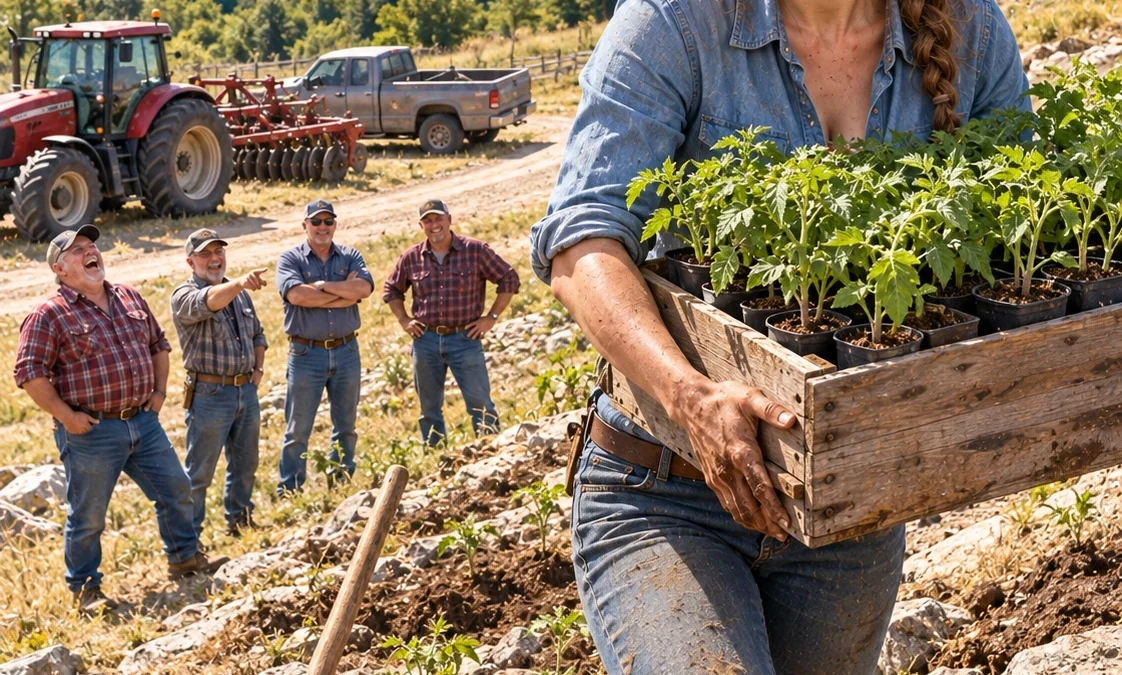
Part 2/5: Nora clears a path through the cedar line, then waits for a forecast that gives the whole valley false confidence.
Walter took his bow saw to the cedar line the next morning. He chose the lowest point where the slope met the valley and cut out three trees. Their trunks came down one after another, leaving a gap twelve feet wide.
June dragged the branches away and stacked them for kindling. Nora pulled the twelve plants that would never recover. She moved twenty-eight more, bruised but still alive, thirty feet higher into the middle of the slope. Then she spent her last six dollars on a dozen replacement plants from the feed store.
She also moved one thermometer. One post went where the old bottom rows had been; the other stayed in the middle of the slope. The next clear morning, she checked them both.
Before the cedars came out, the low spot on the hill had been nearly as cold as the valley. Now it read four degrees warmer.
The cold had somewhere to go.
Grant and Eli watched the trees come down from their truck. “Now she’s cutting trees,” Eli said.
“That’s the third crazy thing this month,” Grant replied.
“Fourth,” Eli said. “You forgot the thermometers.”
Nora heard them, but she didn’t answer. She had learned that people could laugh at a plan long before they understood what the plan was measuring.
For a week in the middle of May, the weather turned beautiful. Warm sunlight filled the afternoons, and the nights stayed in the fifties. Farmers who had held back their plants finally set them out. The older man by the bridge tried peppers again for the first time in three years. A family farther up the creek planted 200 tomato plants. Grant bought another flat of peppers and put them beside the creek.
Nora kept checking her thermometers.
On May 19, a cold front passed through. It rained a little in the afternoon, then the clouds moved east. The wind blew hard from the north until sundown. After that, it stopped.
Nora was on the porch when the air went still. The sky turned the deep, clear blue of a cold glass bottle. The first stars appeared sharp and bright.
The radio said the low would be thirty-eight. There was no frost warning.
Nora looked at June. “That’s the kind of night Martin talked about.”
At ten o’clock, Nora walked down to the bottom with a lantern. The thermometer by the creek read forty-two. The one on the hill read forty-six.
At midnight, the creek read thirty-seven and the hill forty-four.
June refused to go to bed. She sat at the kitchen table in her coat, writing the readings in Nora’s notebook as Nora called them out.
At two in the morning, the bottom thermometer read thirty-three. Nora stood beside the creek in the dark. The air around her ankles felt colder than the air at her face. She could sense it moving, slowly sliding off the slopes throughout the valley and settling around her.
She climbed the hill. Halfway up, the air against her skin changed. It felt softer, warmer. The thermometer read forty.
At four, the bottom read twenty-eight.
Twenty-eight degrees. Four below freezing.
Down in the dark along Coldwater Creek, the water inside the tomato leaves was turning to ice. Nora thought about running to the Mercers’ house, but it was too late. Three hundred plants couldn’t be covered in the dark. Nothing could stop cold air from filling the bowl.
She climbed the hill one more time.
The middle slope read thirty-six.
It was cold, but not freezing.
At dawn, Nora and June stood at the top of the pasture and looked down. The valley floor was white with frost. It followed the creek and filled every low spot, stopping at nearly the same height all the way around the valley, as if frost had settled there like water in a bathtub.
A thin mist hung over it. Above that line, the grass was green and wet. Below it, every garden was exposed to what the night had brought.
The sun rose at six. By eight, the frost had melted, and the damage could be seen plainly.
Along Coldwater Creek, eleven gardens had been hit. Grant Mercer’s 300 tomato plants were black. His new peppers were dead. Eli’s beans lay flat against the earth like wet paper. The older man’s peppers were gone again. The family up the creek had lost all 200 of its tomatoes.
One frost, one night. It had taken the whole valley.
On the hill behind the Whitaker barn, 120 tomato plants stood straight in the sun. Not one leaf was black. Even the twenty-eight plants that had been damaged two weeks before had survived, including those near the gap in the cedar line.
Nora didn’t go down to the creek to say anything.
She didn’t need to.
Part 3/5: In the morning light, the farmers see the difference between a green hillside and a valley floor covered in ruined crops.
Martin Bell arrived at nine o’clock. Grant and Eli were already standing at the Whitaker property line. Nobody had called them. They had looked up from their blackened garden and seen the green on the hill.
Martin walked the rows, then sat on the tailgate and read Nora’s notebook page by page. Every morning’s measurement since March was there, including each clear night.
“Twenty-eight in the bottom,” he said. “Thirty-six on the slope. Eight degrees.”
He looked at Grant. “That’s the difference between a dead garden and a live one. Same county. Same night. A hundred yards apart.”
Grant didn’t answer right away. He studied Nora’s plants, the gap in the cedar line, and the black field below.
“Grandpa Mercer used to say that hill was worthless ground,” he finally said.
“He wasn’t wrong about the rocks,” Nora said. “He was wrong about the tomatoes.”
Eli laughed, but this time there was no edge to it.
“I guess the bet’s off,” Grant said.
“I guess I get the bragging rights,” Nora replied.
“You earned them,” Grant said quietly.
That afternoon, Nora returned to work. She had plants to water, damaged leaves to trim, and a stand to build before her first tomatoes were ready. Nobody cheered her. Nobody suddenly offered to dig the next row. The day still held all the work it had held the day before.
But the way people looked at the hill had changed.
The following week, Grant walked up to the gap in the cedars without his brother. He stood there for a while, watching the slope. Then he asked Nora how far up she thought his own tomato rows should go.
She didn’t tell him to move everything. She handed him the notebook and showed him the measurements. He looked at the numbers longer than she expected.
“Could we borrow a thermometer?” he asked.
“Ask Martin,” Nora said. “He has the county ones.”
Grant nodded. He didn’t apologize for the jokes, and Nora didn’t ask him to. There would be time enough to decide what the moment meant. Right then, the useful thing was that he had asked.
Eli came by a few days later with a small basket of peppers that had survived on a higher patch of their property. “You can have these,” he said. “For the stand.”
Nora accepted them. “Thanks.”
He glanced at the hill. “I still think the rocks are ridiculous.”
“They are.”
“Fair enough.”
The frost had not only taken plants from the valley. It had taken the easy certainty that the lowest, richest soil was automatically the safest place to grow. People had trusted what they could see—the dark earth, the level field—and dismissed what they hadn’t bothered to measure.
Martin asked Nora if he could copy her notebook. He didn’t want to turn her into a lesson or claim her work as his. He wanted other farmers to see the readings for themselves.
Nora let him make a copy.
Then Martin asked twenty farmers to do what she had done. He lent out every thermometer he could find. Each farmer hung one in low ground and another on a slope, then recorded the numbers on clear spring mornings.
Some laughed when they were asked. Others had already seen what happened to the Whitaker garden and accepted the thermometers without comment.
That summer, Nora’s tomatoes grew steadily. The plants in the middle of the slope filled out and carried their fruit without the blackened leaves she had feared. The twelve replacements took longer to catch up, but they survived.
The first tomatoes ripened on July 2, nearly three weeks before any others in the valley. Nora set up her stand along Route 9 with a hand-painted sign and a cigar box for change.
The first Saturday, she sold out.
She had expected to feel triumphant. Instead, she felt tired and hungry and grateful that the money in the box was real. She counted it twice at the kitchen table. It wasn’t a fortune, but it meant she could buy more seed and keep going next year.
Walter sat across from her while she sorted the bills. He had helped dig every hole and sawed down the cedars. He didn’t make a speech about believing in her. He simply asked how many plants she planned to grow the next season.
“More,” Nora said.
“How many more?”
“Enough to fill the middle of the hill.”
Walter nodded. “Then we’d better start hauling compost early.”
June, who had been listening from the doorway, groaned. “I knew you were going to say that.”
“You don’t have to help,” Nora said.
“I know. But then I’d have to listen to you explain that you did it yourself.”
The three of them laughed.
At the feed store, Martin talked about the measurements without making Nora’s work sound like a magic trick. He told the farmers that the thermometer readings had mattered because they had been recorded over time. One warm morning could be a fluke. Several clear, still mornings showed a pattern.
The valley had been there all along. The cold had been moving through it every spring. What changed was that people could now point to a number, a slope, a tree line, and a place where the air had collected.
By the time the next planting season came around, Nora wasn’t the only one climbing.
Part 4/5: Martin turns Nora’s notebook into a county map, and the neighbors begin testing their own ground before choosing where to plant.
By March, Martin Bell had a map of Bracken County pinned to the wall in the back room of the feed store. The low areas were colored blue. The warmer slopes were yellow. Coldwater Creek ran down the center of a long blue stripe.
Nobody laughed at the spring meeting.
The room was the same. The chairs still folded. The coffee still sat in its dented pot. But this time, the farmers were there to see the map.
Martin had brought Nora’s original notebook along with the records from the twenty farms. He didn’t present her as someone who had guessed correctly once. He showed the readings, night after night, and explained how the air moved across the land.
A farmer near the door studied the blue stripe. “That runs straight through my garden.”
“Then test the rise behind your house,” Martin said. “You might find a warmer pocket. You might not. That’s why you measure.”
Grant Mercer moved his tomatoes to a slope at the north end of his property. He cut a gap in his own fence row so cold air wouldn’t pool behind it. He and Eli did not move every crop at once. They used what the measurements told them and left room to learn.
The older man by the bridge planted peppers on the rise behind his barn. The family up the creek moved its whole garden beside its house, above the low ground. None of them treated Nora’s hill as a guarantee that every slope would be safe. They checked their own land.
Nora expanded her garden by filling the middle of the hill. She kept a few plants lower down, not because she expected the same results, but because she wanted another year of comparisons. She put one thermometer near the gap and another farther up the slope. June helped write down the readings, though she claimed the notebook was boring.
“It’s numbers,” June said one morning.
“It’s numbers that tell us where the plants survive,” Nora replied.
“That makes it slightly less boring.”
The May frost came again. It always did.
The night before it arrived, the sky cleared after a brief rain. The wind dropped, and the air went still. Farmers checked their thermometers. Some covered seedlings in low spots. Others left their gardens alone, trusting the readings they had taken and the positions they had chosen.
This time, the cold walked down into an emptier valley.
The frost settled along Coldwater Creek, but most of the tender crops weren’t there. Grant’s tomatoes stood on the north slope. The bridge farmer’s peppers were behind his barn. The family up the creek had planted beside its house, above the lowest ground.
Not every plant escaped damage. A few low rows suffered, and one farmer learned that a slope behind a thicket could behave differently than the one Martin had mapped. But no one lost an entire garden that morning.
When the farmers came to compare results, they brought their own notebooks. The conversation wasn’t about whether cold air moved downhill. It was about where it gathered on each farm, and how to give it a path out.
Nora listened more than she spoke. She had learned that the best way to persuade people was to let them see the evidence with their own eyes.
Grant came over after the meeting. “I’m not going to say I was wrong about everything,” he said.
“I wouldn’t ask you to.”
“I was wrong about the hill.”
“Yes.”
He shook his head, smiling a little. “You could make that easier on me.”
“I could, but I’d have to lie.”
This time, Grant laughed first.
As spring work filled the valley, the old division between the creek bottom and the hillside began to feel less certain. The bottom was still rich soil. It still grew plenty of crops. It simply wasn’t the warmest place on every kind of night.
The slope still had rocks. It still took more effort to plant. But a place that had seemed useless could be valuable once the farmers understood what it offered.
Nora’s roadside stand became a familiar stop on Route 9. She sold tomatoes, then peppers and beans. People who had once slowed down to watch her dig now pulled in to buy produce and ask about the hill.
Some wanted the quick version. Cold air was heavier and ran downhill. It collected in the low places. Tender crops often did better on the middle of a slope.
Others wanted to see her notebook.
Nora showed it to them, page by page. She explained that the hill had not been warm every morning. On cloudy nights, the readings had nearly matched. A slope could also be too exposed at the top. The trick was not to believe that hills were always better. The trick was to look at what the air and the land were doing.
One afternoon, an older woman who had lost a garden two years in a row held the notebook carefully, as though the pages might be fragile.
“I thought the weather report was wrong,” she said.
“It was measuring a different place,” Nora replied.
The woman looked toward the creek. “I never thought about the air settling there.”
“Most people didn’t.”
The first season on the hill had begun with a girl carrying 120 tomato plants past the best field in the county. By the next spring, other farmers were walking their slopes with thermometers in hand.
Nora had not changed the weather. She had changed where people looked before they blamed it.
Part 5/5: One year later, the valley understands why the frost kept returning, and Nora sees that the lesson has traveled farther than her garden.
The following winter, Walter sat with Nora on the porch behind the barn. The hill was quiet under the cold. Its rocks and dormant grass were hidden beneath a thin layer of snow, and the cedar gap remained open where the trees had been cut.
Walter had brought out an old Bible that had belonged to Nora’s grandmother. He turned to a page with a verse underlined in pencil.
“She marked this one years ago,” he said. “Ecclesiastes.”
He read it aloud: “All the rivers run into the sea.”
Then he closed the book and looked toward the valley.
“Everything runs to the low place,” he said. “Cold is no different. You just looked.”
Nora thought about the mornings she had walked between the thermometer posts. At the time, the numbers had seemed small. Four degrees. Five. Seven. Nothing dramatic on its own.
But the difference between twenty-eight and thirty-six had been the difference between a blackened garden and a living one. The lesson had been sitting in the valley for generations. It only needed somebody to measure it.
By the next spring, Martin’s map had more notes on it. Farmers had added new readings, new gaps, and new places where cold air gathered or drained away. It wasn’t a perfect map, and Martin didn’t pretend it was. Every farm had its own shape, its own tree lines, and its own low spots.
That was the point.
The map didn’t tell people what to plant. It helped them ask better questions about where to plant it.
Grant and Eli kept their tomatoes on the slope. The older man by the bridge grew peppers behind his barn again. The family up the creek continued to garden near the house. They all knew that a late frost could still arrive. It always had, and it always might.
But when the forecast called for a mild night, they no longer assumed every part of their property would have the same temperature.
They watched the sky. They checked the wind. They looked at the thermometers.
Nora kept a few plants near the bottom of her hill, but she didn’t rely on that patch for her early crop. The main rows stayed in the middle of the slope, below the exposed top and above the pocket that had formed near the cedar line. The gap remained open, allowing the cold to move downhill instead of stopping against a wall of branches.
Her garden grew larger each year. June kept helping, even after she was old enough to decide that hauling compost was not an obligation.
When people asked Nora how she had known the hill could work, she didn’t say she had known. She told them about Martin’s extension meeting, the two thermometers, and three weeks of measurements. She told them about the cedars, the frost pocket, and the twelve plants she lost before she understood what she had built.
She didn’t leave out the mistake. It was part of the reason the explanation mattered.
The hill hadn’t saved her because she was fearless or naturally gifted. It had given her clues. She had made a wrong choice, looked at the evidence, and changed the plan.
That was what Walter respected most. He had watched people in the valley shrug off losses as bad luck. Nora had refused to do that without asking whether the land had been telling them something.
In early summer, the hillsides around Coldwater Creek turned green with gardens. Some rows sat higher than before. Others stayed where they were because the measurements showed they were safe enough. The valley floor wasn’t abandoned; it simply stopped carrying every tender crop in the county.
When the next frost came, it settled along the creek again. The radio forecast had not warned the farmers, but this time they were ready. A few plants near the lowest ground were damaged. Most of the gardens came through.
By sunrise, the frost had already begun to melt. From the Whitaker hill, Nora could see the thin white band near the creek and the green rows above it.
She didn’t feel like proving anyone wrong. There was no need to. The numbers, the plants, and the farmers’ notebooks had already done that work.
The rule was simple: cold air ran downhill like water. It followed slopes and ditches, then gathered in the low places. Tender crops often did better on a slope, especially in the middle, where cold could drain past instead of pooling around them.
Nora had carried 120 tomato plants up a rocky hill because she trusted what she had measured. One bad frost showed her that the hill needed a way to drain. One clear night showed the valley what the difference could mean.
A year later, the bottomland was still rich and the hill was still rocky. What changed was that the farmers knew which conditions mattered, and they had learned to check before deciding the land was useless—or safe.
THE END








