They Called Her 90 Shaggy Cows Useless—Then a Record Blizzard Buried the Valley’s Richest Ranch, and Its Owner Came Begging at the Gate She Had Rebuilt
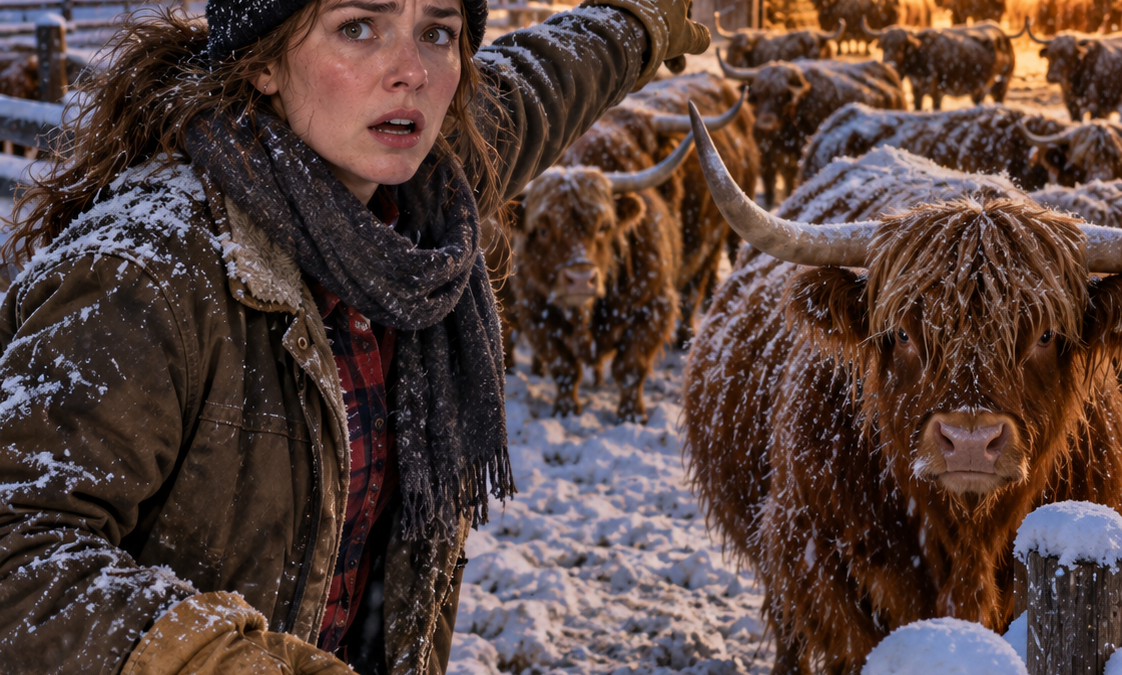
Part 2/5: Mara built her winter plan around scattered feed, dependable water, and routes that could survive a storm; the powerful ranch nearby concentrated everything in one place.
Mara did not know exactly when the storm would come. She never claimed she did. She knew that a wet autumn followed by an Arctic cold front could turn snow into packed drifts instead of letting it blow through. She knew the eastern shoulder funneled northeast winds toward the valley. Eli’s father had lost sixty head in one night in 1996, in a low pasture that looked safe on a calm afternoon.
So Mara stopped preparing for an average winter.
She split her ninety cattle into four groups according to age, health, and pregnancy. The oldest cows and heaviest bred females went to Aspen Draw, below a timber belt that had broken the wind for eighty years. The younger stock went to the willow bottom, with the creek bank behind them. She left the open hay meadow empty, though it had the best standing forage. In a ground blizzard, an open meadow could become a killing floor.
Each herd had hay within three hundred yards on high ground, tarped and strapped down. Each had its own water source: either a spring-fed trough that ran too fast to freeze or a heated tank with a spare regulator taped to the post. Mara divided fuel among three sheds instead of keeping it all in one barn.
She drove the ranch twice, once in daylight and once after midnight, memorizing fence posts and low spots. Hollis came to pregnancy-check the cows and stayed four hours longer than the appointment required.
“A double coat isn’t a miracle,” he told her. “A Highland can stand in weather that kills a black baldy, but she can still die of exhaustion if she walks all night in a drift. And dehydration will kill faster than cold. If she can’t drink, she stops eating. If she stops eating, she can’t make heat.”
Mara nodded. “I read the breed brochure. Then I read the mortality studies.”
Hollis looked toward the dispersed hay stacks. “The brochure is selling something. The studies aren’t.”
When he drove away, he was uneasy. Mara was running the most carefully planned winter operation in the valley on the smallest budget in the valley.
At Rusk Crown, the shop crew had been pulled from maintenance to finish the new hospitality building. Investors from Denver were arriving in nine days. The east barn’s backup generator powered its water heaters, feed augers, and lighting. It needed a new fuel filter, a load test, and a coolant flush.
Frank Dwyer had the work order ready. Clay deferred it until the next month. The technician’s travel from Great Falls cost money, and the generator had started every time for six years. Clay signed the postponement and never told his father.
Gideon was watching twelve camera feeds in his glass office. The cattle on the screens looked like moving marks against clean pens. He had never touched most of them.
On November 29, Ruth called Mara with the long-range forecast in front of her. The weather service had upgraded a winter storm watch to language Ruth had not heard used about Alder Ridge in thirty years.
“Get out while you can,” she said.
Mara looked through the kitchen window at the pasture. “There are ninety animals out there who can’t open a gate or break ice.”
Ruth was silent for a moment. “I thought you’d say that.”
That night, Mara walked the north boundary with a lantern and tested the gate she had rebuilt. It opened onto the old benchland track, above the creek, where wind scoured snow instead of piling it up. In fifty-one years of records, drifts there had never been deeper than a man’s knee.
She had rebuilt it as an alternate route to the highway. She had not built it for Gideon.
The storm came nine hours ahead of the forecast. At four in the afternoon on December 2, the temperature dropped nineteen degrees in forty minutes. A northeast wind rose to forty miles an hour, with gusts strong enough to rock parked equipment. The leading edge of the snow was dense and wet. As the air grew colder, it turned to fine granular ice—the kind that packed into drifts like poured concrete.
By nine, visibility had disappeared.
At Rusk Crown, snow slid off the eastern slope, struck the still air behind the shop, and dropped into the gap between two rises. By midnight, the drift across the main access lane stood eleven feet high at its crest and stretched for two hundred yards.
It covered the north doors of the central hay building. It sealed the east barn’s service entrance, where four hundred bred females stood cut off from the feed they had eaten that morning. Every system on the ranch was designed to move through the same lane.
Nothing had been designed to work without it.
The electrical grid failed at 12:40 a.m. The main generator started. The east barn generator coughed into life, ran rough for eleven minutes, surged, and died. In the dark, a night hand opened its casing and found the fuel filter so clogged it looked like felt. There was no spare. The parts had been ordered as part of the service Clay had postponed.
The water heaters stopped. The tanks developed a skin of ice within three hours and froze solid within six. Four hundred animals stood in front of frozen water, with no one able to reach them.
At two in the morning, Clay sent two snow machines toward the lane. One slid off the buried shoulder into a ditch and vanished up to its chassis. The other fought forward for a hundred and sixty yards before its operator called over the radio.
“We’re pushing a river uphill.”
Clay ordered him to keep going. Frank Dwyer said the man would die for nothing. For the first time in his career, he said it on an open channel with everyone listening.
The machine came back.
Clay told the assembled crew he would review who had been where when the storm hit. Gideon spent an hour on the phone offering a feed hauler triple his usual rate, then quadruple. It made no difference. The county had closed both highways. A grader went into a ditch; the state pulled its plows. Money could not put a truck onto a road the state had abandoned.
Gideon stood at the glass wall of his office and watched eleven camera feeds dissolve into static. The one remaining image showed his best bred heifers standing nose-down against a fence line that was disappearing.
Juniper Draw was not spared. A cottonwood limb crushed forty feet of fence in the willow bottom. Mara spent two hours in the dark with wire pliers and a flashlight clenched between her teeth, splicing the line before eighteen cattle could wander onto the county road.
A seven-year-old red cow went down in a creek cut. Mara strapped her to a winch and dragged her out at an angle that nearly rolled the four-wheeler. The cow gashed a hock and limped, but she lived.
Mara ran the generator in ninety-minute cycles to stretch her fuel. The house fell to forty-six degrees between runs, and she slept on the kitchen floor in her coat, waking every forty minutes.
Her cattle ate. They drank. That was the whole point.
The four groups were sheltered among timber, willows, and the lee of the ridge. The same wind that built eleven-foot drifts on the eastern shoulder scoured parts of the north bench down to bare grass. Hay lay three hundred yards away, not a mile behind a sealed door. The spring-fed trough at Aspen Draw never froze.
Twice a day, Mara walked from group to group with an ice spud and a sled, following the fence posts she had counted eleven days earlier. She returned with frozen eyelashes and the right number of animals. The Highland cattle stood with snow resting across their backs, steaming at the nostrils, alive and almost boringly calm.
At three the next morning, Hollis’s phone rang. The caller was Sam Kincaid, a Rusk Crown hand trapped in a feed truck. The east barn had no water or feed access. Four hundred bred females were inside, and the main shop had given him a lecture instead of an answer.
Hollis called county emergency management, then the volunteer fire district. He learned that the approach to Rusk Crown ran through the same drifted gap. A county rotary plow and the district’s tracked machines would need fourteen to twenty hours to cut a path from the far side. Conditions were still worsening.
The animals did not have twenty hours.
At four, Frank spread a map across a workbench in the Crown’s shop. The old benchland route had been there since before any of them were born. It followed the north ridge, left the highway at a gravel pullout, and dropped to the east pens through a back gate. It was the only ground within ten miles where a tracked machine could work.
Gideon traced it west. Frank gave him the last fact aloud.
“It runs through Mara Ellison’s place. Through her north gate.”
Part 3/5: Gideon reached the gate he had tried to close, while Mara faced a choice about access, command, and the cattle waiting on the other side.
Between 4:20 and 5:40 a.m., Gideon left four messages on Mara’s phone. Each one sounded less composed than the last.
Clay suggested sending the family attorney. Gideon refused. Nothing would be settled in court before the cattle died.
At six, he and Frank drove a tracked utility vehicle along the highway shoulder to the gravel pullout. They climbed onto the benchland route and found what Frank had promised: hard, wind-scoured ground with drifts no higher than a boot. The ridge shielded the old track.
They stopped six hundred yards short of Mara’s fence, where a washout had opened beneath the snow. The rest of the way, they walked.
By the time Gideon reached the north gate, snow had packed his shearling coat white. His hat was gone. His raised hand shook as he tried to knock against the gatepost.
Mara stood on the other side with a lantern and a radio. Ten minutes earlier, the fire district duty officer had called to say a rescue operation was staging and asked whether the district could cross her boundary.
For a moment, she and Gideon said nothing.
He spoke first. “We need the north route opened. My crews can be through in an hour. You’ll be compensated at whatever figure you name.”
He reached into his coat as if a checkbook could settle the matter.
“Put it away,” Mara said. “I’m not turning four hundred animals freezing in a pen into a negotiation.”
Gideon misunderstood her, as he had from the first day. He heard refusal where there was none. Fear came through his exhaustion and emerged as the only language he trusted.
“You’re a failing operator on four hundred acres, with your dead husband’s debt and a yard full of novelty animals,” he said. “You have no idea what it means to stand against my family. You’ll regret playing at power on the one night it matters.”
The wind took some of his words. Mara heard all of them.
She let the silence hold for three seconds. “The route cannot be opened on your say-so, and your men won’t open it. The washout has to be flagged and bridged.”
Under the county declaration, the fire district held command. Hollis confirmed over the radio that the road was suitable only for specialized equipment, under escort, in daylight, once the gusts dropped below fifty miles an hour.
Gideon opened his mouth.
“Put a loaded feed truck on that bench in the dark,” Mara said, “and you lose the truck, the driver, and the route. Then nobody reaches your cattle.”
She gave him one condition. On-scene command would belong to the fire district incident commander. Animal triage would be based on condition. Clay would issue no operational orders on her land—or anywhere else on the rescue route.
Mara had watched Clay defer maintenance, overrule his foreman, and order a man back into a drift that had already beaten him. She would not open her boundary so he could put more people in danger.
Snow ran from Gideon’s shoulders. Every instinct shaped by three generations of ownership resisted what he had to say. Behind him, four hundred animals stood in a barn with frozen water.
“All right,” he said. “It’s yours to run.”
Twenty minutes later, Clay’s voice crackled across the open channel. He called the Highland cattle useless lawn ornaments.
Mara pressed the radio button. “Can any machine on your property pull a cow out of a drift?”
Frank answered before Clay could. “It cannot.”
The gate was open, but the problem was not solved. Once the daylight grew strong enough to read the ground, Mara spread her topographic map across the hood of the tracked vehicle. The last quarter-mile of the route dropped from the bench toward the Crown’s East Gate through a cut buried to the fence tops.
Cattle could not be walked through it. No machine would clear it before dark.
The animals would need somewhere with wind protection, standing water, and feed already on the ground—within a mile, immediately. Only one place in the valley met all three requirements: the sheltered bench above Juniper Draw’s Aspen Draw.
The wind fell below fifty just after eight. Alder Ridge began to move.
The fire district’s tracked machine went first, with Frank walking ahead on a flagged line. A county rotary plow followed, then two ranch loaders, a volunteer water truck, and eleven pickups carrying men and women from eight different outfits. Some of them had laughed at Mara at the sale barn.
Ruth Calder ran the staging point from the back of her feed-store truck. She had a coffee urn, a notebook, and a radio. She matched drivers to vehicles and loads with the focus of someone who had organized other people’s emergencies for thirty years.
Mara opened the north gate at 8:20 a.m. She would not close it again for nine days.
Her part was not the kind of heroics people later tried to add to the story. She did not ride a Highland cow through a snowbank or hitch the animals to a rescue sled. Anyone who told that version was corrected by someone who had been there.
She opened Aspen Draw as a holding ground and took in sixty-one displaced Rusk Crown cattle from the two worst pens. The timber belt broke the wind. Hay was already spread on the ground, and the spring-fed trough still ran.
To make room, Mara moved her ninety Highlands down into the willow bottom. They went without fuss and spent the day eating.
That was what the famous herd did. It was also exactly what Mara needed them to do.
Hollis worked until he could barely close his hands. He treated nine young animals with severe hypothermia, including two calves born three weeks early. He slowly warmed twenty-two exhausted bred females through a protocol that took most of the day.
The count was not a happy one. Thirty-four Crown animals had died before the first machine reached the east pens, most of them in the far north pen where the drift had swallowed the windbreak panels. Eleven more would die over the following week. At Juniper Draw, one bred cow lost her calf, and a Highland bull tore his shoulder badly enough to heal with a permanent limp.
Mara never used those numbers in public. It was one reason the valley eventually learned to trust her.
The confrontation people remembered came at noon in the east barn’s alley. Clay was telling a loader operator to pull out the imported bred heifers first. Their genetics represented more than four hundred thousand dollars in projected value. The commercial cows, he said, could wait.
Sam Kincaid stood across the alley. “The commercial pen’s gone nineteen hours without water. Two are down.”
“Those heifers are the priority,” Clay repeated.
The loader operator looked at the fire district commander. The commander looked at Mara.
“By condition,” Mara said, loud enough to carry the length of the barn. “Not by invoice. The down animals go first.”
The loader moved toward the commercial cows.
Gideon stood twelve feet away with a shovel he clearly did not know how to hold. He watched Mara make the call his son had failed to make. Sometime that afternoon, he stopped supervising and started carrying buckets.
On December 4, the sun came up beneath a clear sky that felt like an insult. For years afterward, people described the view the same way: Rusk Crown lay under a white tide. The hospitality building was buried to its window line. A drift rose against the central hay barn like the hull of a ship. The paved roads had disappeared.
On the western hills above Juniper Draw, ninety long-haired cattle stood scattered around feeders Mara had placed in October. Sixty-one borrowed Crown cows ate among them.
People saw the picture and thought the Highlands had saved the day. They hadn’t broken trail, hauled supplies, or shielded another animal with their bodies.
What had carried Juniper Draw through the storm was a system that did not require the world to cooperate: four wintering grounds, five hay stacks, water in several places, fuel in three sheds, and two routes to the highway.
Part 4/5: The storm’s aftermath exposed the Crown’s preventable failures—and revealed why Gideon had pursued Mara’s land for years.
Warren Pike arrived on December 9. The insurance carrier had sent him to document losses that could reach into the millions. He spent four days reviewing maintenance logs, service orders, and internal risk reports. Warren had no authority over Gideon and solved nothing by showing up. He simply wrote down what the paperwork said.
The paperwork was worse than the rumors.
Clay had deferred the east barn generator’s service twice, once in October and again in November. A consulting firm in Bozeman had warned the previous spring that the central hay supply and the single interior access road were the Crown’s two largest risks. It had recommended a secondary feed cache on the east side and a graded alternate approach from the north.
Both recommendations had been priced at about eighty-one thousand dollars and marked “deferred, non-urgent.” Frank had also submitted three memoranda over two years describing how drifting snow filled the gap. Clay had read them. He had initialed one.
Warren stayed careful. He did not announce that the insurance claim would be denied; its coverage depended on contract language and documented compliance. The eventual settlement took eight months, came in substantially reduced, and included a restructured premium with conditions.
But Warren did state that much of the loss had been foreseeable and could have been reduced. The risks had been identified in advance. The ranch had chosen not to pay for the recommended fixes.
It was a bloodless sentence on a report. In Alder Ridge, it landed like an anvil.
Warren visited Juniper Draw because the fire district’s report referenced the rescue. Mara made coffee and set out her binders when he asked to see them.
He found three years of daily weather logs, a hand-drawn grazing map showing rest intervals and stocking rates, a winter dispersal plan dated November 14, a feed inventory listing location and tonnage, a water redundancy sheet, and a one-page contingency plan for four levels of storm severity.
Warren had assessed operations with fifteen-million-dollar budgets that kept nothing comparable.
“Where did you learn to do all this?” he asked.
Hollis was standing by the door, hat in his hands. “Mara spent six years as a pasture management technician,” he said. “Four years contributing to a multi-state research project on cold adaptation and winter resilience in beef systems. She co-authored two sections of the final report.”
Mara had married a rancher and put the work aside for eleven years while she and Eli ran a conventional herd in the conventional way. Then Eli became ill, and their cattle went to pay the medical bills. When he died, Mara was left with four hundred and twenty acres, a bank note, and what she knew.
She had rebuilt Juniper Draw according to the research, using the hardiest genetics she could afford and a plan that assumed equipment might fail.
Gideon, who had come to the kitchen at Warren’s request, finally understood. For six weeks, he had mocked the only person in the valley who had actually read the literature.
The second revelation surfaced by accident. While documenting the route used in the rescue, Warren pulled the county records for the benchland corridor. The file contained the 1951 survey, the two denied petitions to close the route, and a third filing from four years earlier.
That petition, requesting removal of the corridor from the county’s long-range agricultural access plan, had been submitted by Rusk Crown Ranch Holdings.
The route carried a historical stock-access designation connected to the Juniper Draw parcel. Its use was limited by vehicle class and purpose, but it was the only legal connection between the eastern range and the old loading grounds that did not cross four other landowners’ properties.
For anyone planning to expand eastward, the route was worth far more than the grass it crossed.
The community meeting took place January 11 in the Grange Hall. Snow still banked the parking lot, gray from tires and road grit. Two hundred and six people came.
Warren presented the findings he was permitted to share, plainly and in nine minutes. Frank stood and read the dates on his own memoranda. Sam described nineteen hours without water in the north pen.
Gideon rose to speak about the storm’s unprecedented severity. A hay broker in the fourth row asked him to explain the deferred generator service order.
The room went quiet. Gideon could not blame the weather. The same storm had hit both ends of the valley, but only one ranch had been buried by the choices it had made.
Mara spoke last. She kept it to ninety seconds.
“I didn’t win anything,” she said. “Thirty-four animals died before help arrived. Nobody in this room should be enjoying that.”
She said Gideon had tried to pay her at the gate. She had refused because help offered at a price was a transaction, not help.
Then she gave them the line Ruth would later paint on a board for the feed store.
“I didn’t get through this because my cattle are worth more than his cattle. They aren’t. I got through it because I didn’t put their whole future inside one machine.”
She sat down. Nobody laughed.
Gideon stood and asked if she would speak with him afterward about a proposal. The room understood that something in Alder Ridge had changed shape.
Outside, in the cold parking lot, he made two offers. First, the Crown would pay the documented costs of the sixty-one cattle’s stay: feed, fuel, fence damage, veterinary work, and a fair use fee for the corridor. Second, he wanted Mara to accept a three-year consulting retainer to help reorganize the Crown. The contract included exclusivity.
Mara accepted the first offer, down to the receipts. She itemized the bill so carefully that Gideon called twice to ask if it was complete.
She declined the second.
For two years, she had learned what happened when a person depended on one thing for everything. She would not make Gideon’s family that one thing.
The reorganization went ahead anyway. Clay lost operational authority during a management review and was moved permanently to investor relations. Frank became yard superintendent, with a maintenance budget no one could overrule.
That spring, the Crown funded the deferred recommendations and spent roughly three hundred thousand dollars more on a secondary feed cache, a graded alternate approach, and a formal emergency-use easement with Juniper Draw. Mara’s attorney wrote the limits.
In April, Gideon stood at the Cattlemen’s Association meeting and admitted he had been wrong about Mara, her cattle, and his own ranch. He said his family’s losses were his responsibility, not the weather’s.
It cost him more to save face than it had ever cost him to buy land.
Part 5/5: Mara kept her ranch and her independence, while the valley learned the true value of the road Gideon had once tried to erase.
In March, a regional producers’ cooperative invited Juniper Draw into a climate-resilience demonstration program. The stipend and consulting day rate came to eleven thousand dollars in the first year, then nearly twice that the next. Combined with Mara’s calf crop, the income pushed the bank deadline out by three years and let her sleep.
She did not become rich. She did not get even. Rusk Crown remained the valley’s largest operation, its losses absorbed and its reputation bruised rather than destroyed.
Mara never tried to damage the ranch. She had figured out early that the consequences of Gideon’s own decisions made a stronger argument than anything she could add.
She still repaired her fences herself in a coat that did not fit. Her hands still cracked every January. But she had her land, her name, and a valley that had stopped telling her what she could not do.
The deeper change came when the county reviewed the old benchland route. The rescue had proved the corridor was more than a faded notation on a 1951 map. It was a working lifeline during the exact kind of emergency that conventional planning had overlooked.
The county kept the stock-access designation in place. The Crown negotiated an easement with Juniper Draw, but the agreement followed the restrictions Mara’s attorney had written: emergency use under county command, clear limits on vehicle size, and no right to turn the route into a private shortcut.
That was the part Gideon had never put in his offers. He had spent years trying to acquire the land, and even longer trying to erase the route from the county’s plans. In the end, the storm made its value impossible to hide.
The north gate he had once wanted closed now stood as the Crown’s only reliable second path to the highway. It belonged to Mara, and everyone who used it had to acknowledge that.
Spring came late and then arrived all at once. Gray patches of snow shrank into the folds on the north-facing hills. The creek ran loud and brown through the thaw.
Mara stood on the bench above Aspen Draw during the first warm week. Below her, the ninety Highlands shed great hanging sheets of winter hair. Forty-one calves, coats still curled tight, stayed close to their mothers.
A truck moved slowly along the old north road—the one that ran through the gate Mara had rebuilt in October. It stopped short of the rise.
Gideon got out and climbed the slope on his own feet. He held out his hand first.
Mara shook it.
Neither said much. There was nothing left either had to prove.
All autumn, people had laughed at ninety long-haired cattle because they did not look like what a prosperous ranch was supposed to own. Then winter came, indifferent to reputation, money, and the loudest man at the sale barn.
The Highlands had not been magic. They had not rescued the Crown’s cattle by themselves. They had been part of a plan that left no single machine, road, barn, or source of water responsible for every animal’s survival.
The real surprise was that the woman everyone had dismissed had understood the land better than the richest rancher in the valley—and that the road he tried to take from her became the route that saved his cattle.
THE END
Kết thúc/cú lật: Gideon theo đuổi Juniper Draw không chỉ vì đất chăn thả; ông muốn kiểm soát hoặc xóa bỏ hành lang đường chăn thả lịch sử. Cuối cùng, con đường đó cứu đàn bò của ông nhưng vẫn thuộc quyền kiểm soát của Mara.








