They Called Her Sheep-Wool Fence a Joke—Until a Blizzard Buried Every Road Except the One a Thirteen-Year-Old Farm Girl Had Quietly Rebuilt That Winter.
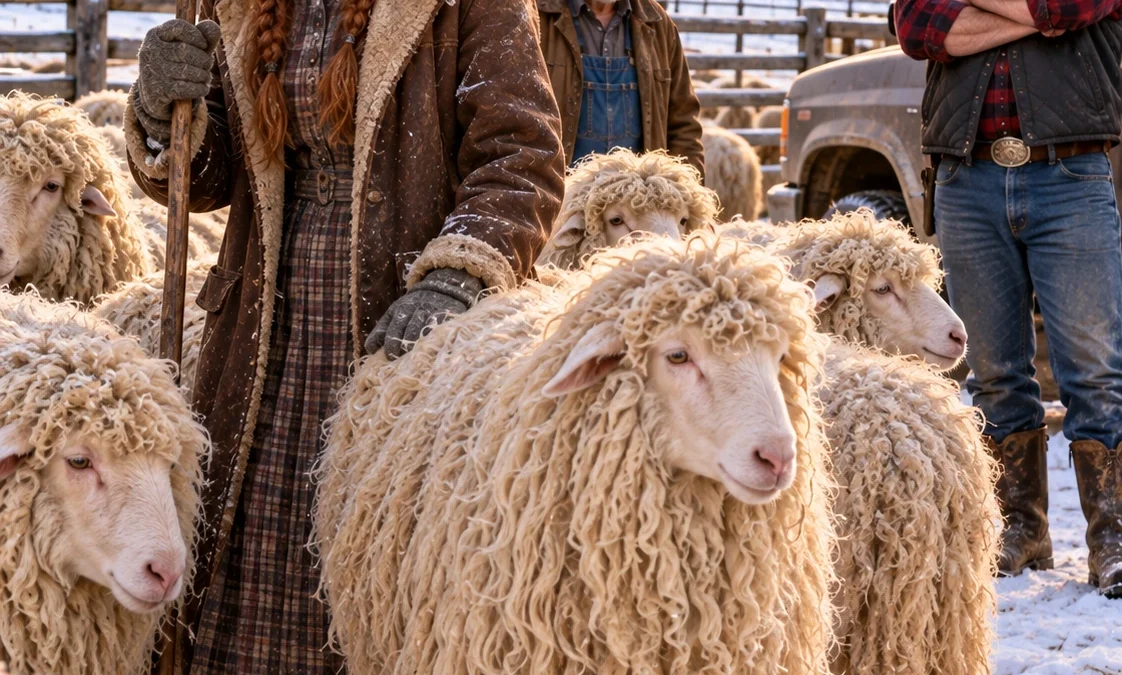
Part 2/5: After the first storm exposes her mistake, Nora rebuilds the fence to slow the wind gradually and give drifting snow room to settle.
Nora opened her red notebook again. She had written down the depth of the snow on the road, the height of the drift behind the fence, and the places where the posts had leaned. The numbers told a story she hadn’t wanted to hear.
“I worked so hard to close those holes,” she said.
Eli pulled a chair out from beneath the table. “You did.”
Nora looked up, expecting him to defend her. Instead, he pointed to the notebook.
“Now you know what to change.”
A solid wall didn’t create the broad, calmer airflow Nora needed. Wind forced over the wall could grow turbulent, speed up again beyond it, and carry snow farther downwind. A porous barrier, with openings through which some air could pass, could slow the wind more gradually. The snow would settle across a longer stretch instead of piling up in one steep mound.
Eli remembered the way his father had built the old willow panels. They had been rough and uneven, but they had never been solid. His father had made them to interrupt the wind without stopping it.
The distance from the road mattered, too. Their fence stood 180 feet away, enough room for a deep drift to form in the field. If the barrier sat too close, the drift it created might reach the pavement it was meant to protect.
“We got the distance right,” Nora said.
“Looks like it.”
“And the rest wrong.”
“Some of it.”
She smiled a little. “You’re being kind.”
“I’m being old. It’s different.”
For four days, Nora and June took the fence apart. They left the cedar posts in place, saved most of the willow, and kept every usable length of wool cord. Then they pulled out the bundles that filled the gaps.
They replaced the five leaning posts and tied the panels so they had a little give. Where the branches sat too close together, they spread them apart. Where the wool cord had been packed into a thick mass, they loosened it until it held the willow without sealing the openings.
At the end, they stood side by side and looked through the fence. The far side of the field was visible between the branches.
June turned to Nora. “It looks unfinished.”
“That’s the idea.”
Nora didn’t call it a snow catcher anymore. She thought of it as a way to change the wind. The fence was about half open, six feet high, and 240 feet long. It stood 180 feet from the road, with open field behind it for the drift to settle.
The long, coarse wool had made it possible to build the ties from materials already on the farm. The Lincoln fleece was flexible, and its long fibers held together when twisted. Nora didn’t imagine it could replace steel or wire everywhere. She only needed it to hold willow panels in place through the winter.
On December 6, Grady Pike drove past again. He slowed when he saw the spaces between the branches.
“Taking it down already?” he asked.
“No,” Nora answered.
“Then why’d you pull half of it out?”
Nora finished tying a knot. “Because it was working too hard.”
Grady studied her for a moment, then shook his head and drove away.
The rest of December brought cold weather but no major test. A few light snowfalls dusted the fence. Nora went out after each one to measure drifts and record wind direction. Sometimes the snow behind the willow stood an inch deeper than elsewhere. Sometimes the difference was barely visible.
She wrote it all down.
She began to notice the way powdery snow moved differently from wet snow. A dry, loose snowfall drifted whenever the northwest wind rose. Heavy, damp snow stayed where it landed. The fence couldn’t control every storm, but it could affect the snow the wind carried across the field.
On January 17, 1963, the radio announced a major winter storm. Sixteen inches of snow were possible, with northwest winds expected to reach thirty-eight miles per hour. Gusts could be stronger, and temperatures were predicted to fall to eight degrees below zero by morning.
The county urged residents to stay off open roads. Farmers were told to secure loose equipment and shelter vulnerable animals.
Eli moved the Lincoln Longwools into the main sheep barn. He spread dry bedding, stacked hay, and checked the water trough. Nora helped count every ewe.
“Thirty-four,” she said.
“All accounted for,” Eli replied.
Martha, the oldest ewe, nudged Nora’s sleeve. Nora scratched her forehead and watched the animals settle into the straw. Their heavy fleeces could keep them warm, but shelter, food, and water still mattered. Eli made sure they had all three.
Then Nora turned toward the west field. Their fence stood alone across the open land, six feet high and nearly half open, with the road beyond it.
The first snow came shortly after noon. Large flakes drifted straight down and clung to the rails of the pasture gate. By three o’clock, the northwest wind arrived. The flakes turned sideways, and the far end of the barn disappeared behind blowing white.
By evening, the windows shook. Wind howled around the chimney and pushed loose snow under the porch door. Eli made one last trip to check the sheep. They were settled in the bedding, chewing quietly.
Nora kept thinking about the fence.
At nine that night, a sharp crack sounded outside, followed by another. She sat upright in bed. She knew the sound of wood snapping and imagined the cedar posts leaning, the willow panels flat beneath the snow, the wool ties broken.
She pulled back the curtain but saw only white moving through darkness.
The storm carried on through the night and most of the next day. Snow gathered against the barn doors. Drifts filled the space between the milk house and the machinery shed. The county plow didn’t come; the northern routes were buried, and Carl Benson had been sent to clear the main highway.
Eli said they would have to wait.
Nora hated waiting, but there was no sense walking into the blizzard to check the fence. So she listened to the wind and waited for it to weaken.
By late Wednesday night, the gusts began to fade. Thursday morning broke clear and bitterly cold. Pale blue sky stretched above the farm, and the thermometer outside the kitchen read six degrees below zero.
Nora pulled on two pairs of socks, buttoned her heaviest coat, and went outside with June. Snow reached their knees near the porch and came almost to their waists beside the barn.
The cracking noise had come from an old maple limb by the driveway. It lay across the fence line, half buried in white.
Nora looked west and stopped.
The willow fence still stood. Every section remained upright, though a few panels leaned slightly. Their brown branches rose out of the snow like the ribs of an enormous basket.
Behind them, a long, smooth ridge stretched across the field.
It wasn’t a short, steep pile, like the drift created by Nora’s first fence. This ridge rose gradually, reached its highest point well behind the panels, then sloped gently toward the road. It looked like a frozen wave.
June grabbed Nora’s sleeve. “Look at that.”
Nora was already climbing the pasture gate.
Part 3/5: A clear morning reveals a deep, gently sloping drift behind the fence and a startling stretch of pavement where the road usually disappears.
Nora walked along the ridge with her measuring stick. Near the middle, the snow came almost to six feet. Farther downwind, it grew shallower until it blended with the surrounding field.
She followed the ridge to its end. The drift extended about 125 feet beyond the fence, then stopped well short of the roadside ditch.
Nora turned toward the road.
County Road 14 was visible.
Not every inch of it was clear. Patches of packed snow and scattered powder covered parts of the pavement, but the deep wall that usually buried Whitcomb Bottom wasn’t there.
Nora walked to the worst spot and pushed her measuring stick into the snow. Four inches. She checked again a few feet away. Three inches.
Near the southern curve, she measured five inches.
Five inches after a major blizzard.
During the smaller November storm, the same stretch had been buried under more than two feet. Farther up the road, beyond the fence’s protection, the drifts remained deep. But across Whitcomb Bottom, the pavement showed through.
June began to laugh. Nora did too—not because anything was funny, but because the answer was standing in front of them.
It had worked.
A little after eleven, a diesel engine came from the south. Carl Benson’s county plow appeared over the rise, moving slowly. He expected to meet the familiar wall of hard-packed snow.
As he reached Whitcomb Bottom, he eased off the throttle and stopped. Nora saw him look from the road to the fence, then to the long ridge of snow behind it. He leaned toward the windshield as if he couldn’t trust what he was seeing.
At last, Carl lowered the blade and drove forward. The protected stretch took less than fifteen minutes to clear. The previous winter, he had spent most of a day fighting the drifts there.
He parked near the Whitcomb driveway and climbed down.
“What in the world did you put out there?” he asked.
Eli stepped out of the barn. “Ask Nora.”
Carl looked at the girl in oversized boots, holding a wooden measuring stick and a red notebook.
“It’s a snow fence,” Nora said.
“Made out of what?”
“Willow branches, cedar posts, and sheep wool.”
“Sheep wool?”
“From our Lincoln Longwools.”
Carl looked at her, then at the visible pavement. “Well, I’ll be darned.”
He climbed back into the plow and drove north to the next stretch of road. There were still miles to clear, but Whitcomb Bottom was no longer the hardest part of his day.
Nora measured everything again. The deepest drift behind the fence came to five feet and eleven inches. It ran about 125 feet downwind. The deepest remaining snow on the protected pavement measured five inches.
At Pike Bend, half a mile north, the drifts exceeded four and a half feet. Grady’s driveway was buried nearly to the top of his truck’s rear wheels.
Nora wrote each measurement in her red notebook. She didn’t call the fence a miracle. She wanted to know why it had worked.
Three days later, Thomas Mercer arrived from the county agricultural extension office. Carl had told him about the fence made with sheep wool. Thomas had spent years advising farmers about winter erosion, shelter belts, and blowing snow, but he had never seen a barrier quite like Nora’s.
He walked the full length of the panels and examined the knots. Then he pulled gently on a strand of wool cord.
“Lincoln Longwool?” he asked.
Nora nodded. “Thirty-four ewes.”
Thomas smiled. “That’s some long fiber.”
He explained that longwool breeds had been valued for generations. Their fleeces could be used for strong yarn, weaving, cord, and other products that didn’t require fine softness. The wool buyers might reject rough scraps for one purpose, but Nora had found another.
Then Thomas turned his attention to the snow. He measured the height of the panels, the spaces between branches, and the distance to the road. He spent nearly two hours making notes.
At last, he closed the book.
“You got two big things right,” he said. “You let air pass through, and you set the fence far enough back.”
Nora waited.
“A barrier that’s about half open can slow the wind over a longer distance than a solid wall. The snow settles gradually instead of piling right behind it. Your drift reaches a little over twenty times the fence’s height. That’s a substantial storage area.”
Thomas pointed toward the ditch. “You put the fence 180 feet from the road. That leaves enough room for the drift to form without reaching the pavement.”
“What if I’d put it fifty feet closer?” Nora asked.
“You might have put the drift where you were trying to keep the road open.”
Nora thought of the November storm. “I made it solid the first time.”
Thomas raised an eyebrow. “So I heard.”
“The wind went over it and around the ends.”
“That can happen. Sometimes the strongest thing is the one that knows what to let through.”
Nora looked at the panels. They still seemed rough and odd against the open field, but now she saw what the gaps did. The branches didn’t need to block the wind. They needed to slow it down.
That evening, Grady walked over from his farm. He didn’t bring his truck because his driveway was still too deep to drive out. Owen came with him.
The two of them stopped at the gate and studied the fence. Grady looked at the drift, then the road, then Nora.
“How far back is it?”
“180 feet.”
“And you left those openings on purpose?”
“About half open.”
He peered through the branches. “What keeps the whole thing together?”
“The wool cord.”
“From those big sheep?”
“Yes, sir.”
Grady rubbed his chin. A few months earlier, he had told Eli to sell the entire flock. Now he looked almost embarrassed.
Owen broke the silence. “I told you that wool wasn’t worthless.”
Grady didn’t answer right away. Then he looked at Nora.
“Think it would work up by my bend?”
“If you’ve got room on the windward side.”
Grady nodded slowly. For once, he didn’t laugh.
County Road 14 stayed open across Whitcomb Bottom for the rest of the winter. Two more major storms arrived in February, and each time the drift behind the fence grew wider and deeper.
The county still had to plow loose snow from the pavement. Ice could still form, and wind from a different direction could create drifts elsewhere. But the immense wind-packed blockage that had closed Whitcomb Bottom for days never returned that season.
The milk truck made every scheduled trip. Eli didn’t lose a single can of milk because the road was closed. Three dairies farther north kept their deliveries, too.
During the second February storm, a young boy in Mill Creek developed a high fever. After Carl cleared the ordinary snowfall, the boy’s father drove him to the doctor without making the six-mile detour around the southern ridge.
The fence didn’t make winter disappear. It kept one dangerous road from being swallowed by the wind.
Part 4/5: Neighbors begin copying Nora’s design, while a county report clarifies that the fence’s shape—not wool itself—controlled where the snow settled.
In March, Thomas Mercer prepared a short report for local farmers. He recorded the fence’s six-foot height, its approximate fifty-percent openness, the 180-foot setback, and the drift that stretched about 125 feet behind it.
He was careful about what the measurements meant. The sheep wool hadn’t made snow settle by itself. The fence’s shape, openness, and position had changed the wind. The wool had helped the Whitcombs build a sturdy, flexible barrier from materials already on their farm.
That difference mattered. The idea could work with willow, slats, or commercial snow fencing. The wool was one practical material, not a secret ingredient.
The following fall, six farms along County Road 14 installed porous snow fences. Some used willow. Others used wooden slats or bought commercial panels. Two families twisted coarse sheep wool into cord to tie their homemade barriers together.
Each farmer placed the fence upwind of the road and left enough space for drifting snow to settle in the field. Thomas visited the farms, answered questions, and reminded them not to build solid walls.
Grady Pike built his own fence northwest of the bend near his driveway. He measured the setback twice before digging the first post hole.
Owen helped him leave openings between the slats. When Grady started adding too many branches, Owen stopped him.
“Dad,” he said, “you’re building a wall again.”
Grady looked at the branches in his hand, then pulled two back out. Neither of them said another word about Nora’s sheep being useless.
The winter of 1963–64 brought cold, snow, and days of strong northwest wind. The new fences didn’t solve every problem. Wet snow piled up where it fell, ice formed on the roads, and a few storms came from unexpected directions.
But along the exposed northwest approaches, the difference was hard to miss. The county plow spent fewer hours clearing those protected stretches than it had in several previous winters.
Farmers began asking how to build their own.
Eli kept the thirty-four Lincoln Longwools. He still sold the cleanest fleece to wool buyers, but after the next shearing, he told Nora to separate the long, rough scraps into their own pile.
“Don’t toss those in with the rest,” he said.
Nora glanced at him. “You think we’ll need them?”
“I think we should find out what they’re good for.”
Some of the wool became repair cord for the fence. Some became heavy yarn for use around the farm. The rest stayed in burlap sacks in the barn, waiting for Nora’s next idea.
Martha grew another thick fleece. Nobody asked why Eli kept feeding her.
Nora still walked out to the west field in summer. The fence looked strange against the green grass: a line of willow branches and wool cords facing an empty field. There was no snow to catch and no storm to test it.
But she knew what would happen when the northwest wind returned.
She also understood that the work hadn’t been hers alone. Eli’s memory had pointed her toward the old fence. June had helped twist the cord, cut willow, and change the design after the first failure. Thomas had explained what the measurements showed. Carl’s report had brought him to the farm, and his discovery had brought the idea to other people.
Nora hadn’t stopped the wind. She had learned to leave room for it.
In late April, Eli asked her to help him clean out a small chest in the barn office. Its hinges squealed when he lifted the lid. Inside were old farm papers, a broken watch, and a leather ledger with a cracked spine.
Eli brushed dust from the cover.
“My father kept this,” he said. “I haven’t looked at it in years.”
Nora opened the ledger carefully. The pages held feed accounts, weather notes, and old measurements in a careful hand. Near the back, she found a short entry dated January 1903.
The handwriting was stiff and faded, but the words were clear enough: “Willow panels set north of the wagon track. Snow drifted west of fence. Road open through first storm. Eli says it looks foolish. Must keep panels open.”
Nora looked up. “He wrote about the fence.”
“He wrote about everything,” Eli said.
She turned the page. There was another entry, dated a week later: “Second storm brought heavier wind. East gate buried. Road remained passable below the bottom. Delivered milk to Mill Creek before dark.”
Eli leaned closer. “I’d forgotten he kept those notes.”
Nora found a third entry, written in the margin. “Eli says holes are waste. Told him wind must have room to slow. Boy will learn.”
Nora laughed, and Eli did too.
The ledger didn’t prove that their fence had been identical to the one his father built. It showed something more personal: the lesson had been there all along, written down by a man whose son had once thought the gaps were mistakes.
Eli turned the pages, remembering pieces of the winter: the willow cutting, the hard wind, his father’s insistence that the snow needed room. As a boy, Eli had been embarrassed by the rough fence and certain his father was wasting time.
“Why didn’t you tell me you remembered so much?” Nora asked.
“I remembered the fence,” he said. “I didn’t remember the pages.”
He tapped the ledger gently. “Your great-grandfather was better at keeping records than I was.”
The discovery changed nothing about the measurements or the way the fence worked. But it gave the project a deeper history. Nora hadn’t invented the old knowledge. She had found it again, tested it, corrected her mistakes, and made it useful for her own neighbors.
At the county fair that summer, Thomas displayed a small model of the fence beside his report. Nora stood near it while farmers asked questions. A few visitors wanted to know whether the wool would rot in the rain. Others wondered if sheep cord could replace wire everywhere.
She answered honestly. The wool needed protection from prolonged moisture, and it was best used for tying willow panels rather than carrying heavy loads. Its long fibers made a practical cord for their purpose, but it wasn’t stronger than steel.
“What made it work, then?” one farmer asked.
Nora pointed to the miniature branches. “The openings. And putting it far enough from the road.”
The man nodded as if he expected a more complicated answer. Nora understood that feeling. At first, she had assumed the fence needed to be strong enough to stop everything. She had been wrong.
In the fall, the county added a small note to its winter road bulletin: farmers with exposed fields could ask Thomas Mercer about porous barriers and safe setbacks. No one called it a miracle or promised that every drift would vanish.
The county had learned to be specific. The fences could reduce drifting in the right conditions, especially along roads exposed to prevailing winds. They couldn’t prevent ice, stop every storm, or help a road when the wind came from the wrong direction.
That careful explanation made people trust the idea more, not less.
Grady Pike stopped at the Whitcomb farm one afternoon as the leaves began to turn. His own fence was already standing beside Pike Bend.
“I measured it the way Thomas suggested,” he told Nora. “Left the openings, too.”
“Good.”
“I don’t suppose the sheep would like to donate any more wool.”
Nora smiled. “They don’t know what donate means.”
“I’ll trade you a sack of oats.”
“That sounds fair.”
Grady glanced at the barn, where the Lincoln flock moved through the straw. “You were right to keep them.”
Nora looked at the animals and thought of all the reasons he could have meant. The sheep had supplied the wool, but keeping them had taken more than one good idea. It had taken feed, care, shelter, and a grandfather willing to let his granddaughter try something uncertain.
“They’re useful,” she said. “Just not always in the way people expect.”
Part 5/5: Years later, the old ledger reveals that Nora’s great-grandfather recorded the same lesson, turning a clever experiment into a family legacy.
When winter returned, the fences stood across the fields like quiet promises. Nora’s panels remained in place, their willow branches tied with cord made from long Lincoln fleece. The sheep were sheltered at night, fed well, and counted each morning when storms threatened.
The county roads still needed plows. Carl Benson still drove through the cold, clearing snow and checking drifts. Some mornings were easy. Others were not.
But Whitcomb Bottom no longer swallowed the road each time the northwest wind swept across the open fields.
Nora kept her red notebook. She added each storm’s direction, the snow depth, and the condition of the fence. She compared the protected stretch with open sections nearby. She noted when the snow was dry enough to drift and when it was heavy enough to stay put.
The notes became a record of their own—not an official report, but a farm girl’s careful account of what worked and when.
Eli began asking to see the measurements. He would sit with the notebook at the kitchen table and follow Nora’s entries with one finger.
“You’ve got more patience for numbers than I did at your age,” he said.
“You had to milk cows.”
“So do you.”
“Then I guess I have fewer excuses.”
He chuckled and handed the notebook back.
The following spring, Nora and June repaired the panels. They replaced a cracked cedar post and retied two sections where the wool cord had loosened. Eli helped them cut new willow by the creek, though he moved more slowly than he once had.
Martha followed Nora along the pasture fence, her spring fleece beginning to loosen. The ewe still nudged Nora’s sleeve whenever she came near.
“You’re the reason we kept them,” June said one afternoon.
“No,” Nora replied. “Grandpa kept them.”
“Because you asked.”
Nora considered that. “Because he let me try.”
She looked at the repaired fence, then beyond it to the road. The problem had seemed so large when she first noticed it: a half-mile stretch, years of closures, lost milk, stranded families. The solution had not been one dramatic act. It had come from watching, testing, failing, measuring, listening, and trying again.
At the county fair that year, Thomas placed Nora’s red notebook beside the small model. He showed farmers the measurements from both storms: the first fence, too solid, and the second, open and set back from the road.
A visitor pointed at the rough wool cord wound around a model post. “So the sheep saved the road?”
Nora smiled. “The fence helped save it. The sheep gave us a way to tie it together.”
The visitor looked surprised, but Thomas nodded. “That’s the distinction.”
Nora didn’t mind correcting people. She knew how quickly a useful story could turn into a false one if people made it simpler than it was. The wool hadn’t magically repelled snow. The fence had slowed the wind, and the open field behind it had given the drifting snow a place to settle.
The Lincoln Longwools mattered because their coarse, long fibers made sturdy cord from wool buyers had rejected. Their fleece fit a job that fine wool would not have done as easily.
That was enough.
At the end of the fair, Nora took the old ledger from the display table and carried it back to Eli. He had brought it in a small wooden box wrapped in a cloth to keep the brittle pages safe.
“Do you want me to make a copy of that entry?” she asked.
“Thomas already did.”
“He did?”
“Made a careful copy for the county record.”
Eli tapped the ledger cover. “Your great-grandfather’s notes will stay here. The county can keep the copy.”
Nora thought about the words in the margin: “Boy will learn.”
“He probably knew you’d remember the fence someday,” she said.
Eli shook his head. “He knew I’d forget the reason. That’s why he wrote it down.”
The thought stayed with Nora. Knowledge wasn’t always lost because it failed. Sometimes it disappeared because people stopped needing it for a while. Roads changed, machines improved, old fences rotted away. Then a familiar problem returned, and someone had to look back.
That fall, Nora copied the most useful pages from the notebook and placed them inside the ledger’s wooden box. She included the flour experiment, the dates of the storms, the measured drift, and the mistake she had made by filling the fence solid.
She didn’t leave out the failure.
Especially not the failure.
If somebody read only about the second fence, they might think she had known the answer from the beginning. She wanted them to see that she had learned by getting it wrong first.
The next major blizzard arrived in February. The wind came from the northwest, as expected. Snow crossed the open ground and settled behind the fences. Carl’s plow cleared the roads after the storm, but the protected approaches took less time than the exposed sections.
A farmer near Pike Bend called the Whitcombs to say his road was still passable. Grady sent Owen over with a note thanking them for the advice.
The note was short: “The openings made the difference. You were right.”
Nora folded it and slipped it into the box with the copied ledger pages.
The winter after that brought a thaw, then a hard freeze. Ice coated parts of County Road 14, and the fences couldn’t help with that. Carl spread grit where he could and warned drivers to slow down. Nora understood that the fence had limits.
It was useful precisely because she understood those limits.
Years later, after Nora was grown, she still remembered the first time she had stepped behind the sheep and felt the wind soften. She remembered how the old ewes stood shoulder to shoulder, their wool holding the air quiet around them. She remembered Grady’s joke, the failed wall, and the shock of seeing the road after the blizzard.
Most of all, she remembered the space between the willow branches.
At thirteen, she had thought every opening was a weakness. She had packed the fence tight because she believed strength meant blocking everything. The storm had shown her that a barrier could be stronger by letting some things pass through.
The lesson belonged to more than one road or one flock. It applied to problems that looked impossible when people assumed the only answer was to push harder. Sometimes the better answer was to change the conditions around the problem—to slow what was moving, give it room, and let it settle somewhere safe.
The Lincoln Longwools continued grazing on the Whitcomb farm. Their fleeces weren’t the finest in Minnesota, and they never became popular with every buyer. But no one on the farm called their wool useless again.
Eli kept the flock through many winters. Nora kept her red notebook and the copied ledger pages. The county kept Thomas’s report and the record of the fence’s dimensions.
The old road was still there, crossing Whitcomb Bottom between the ditches. The northwest wind still swept across the fields. Snow still fell, and some storms still made travel difficult.
But the road no longer had to take the full force of every drift.
A girl had watched the sheep, listened to an old story, and built something from what other people had dismissed. Her first attempt failed. Her second worked because she learned to leave the openings.
By the time Nora’s story reached the county fair, people sometimes asked whether she had been certain the fence would succeed.
She always gave the same answer.
“No,” she said. “I just knew the road needed help, and we had something worth trying.”
Changed names and setting: The story’s names were kept as provided—Nora Whitcomb, Eli Whitcomb, June, Grady Pike, Owen, Carl Benson, and Thomas Mercer—and the setting remains rural Minnesota, USA. No currency conversion was needed.
Ending summary: Nora’s experiment succeeds, the neighbors adopt the fence design, and Eli’s old ledger reveals that his father had recorded the same lesson generations earlier.
THE END