They Laughed at Her $200 Rusty Combine — Then Three $600,000 Harvesters Suddenly Stopped, and a Technician Asked About the Mysterious Switch Hidden Beneath Her Dashboard.
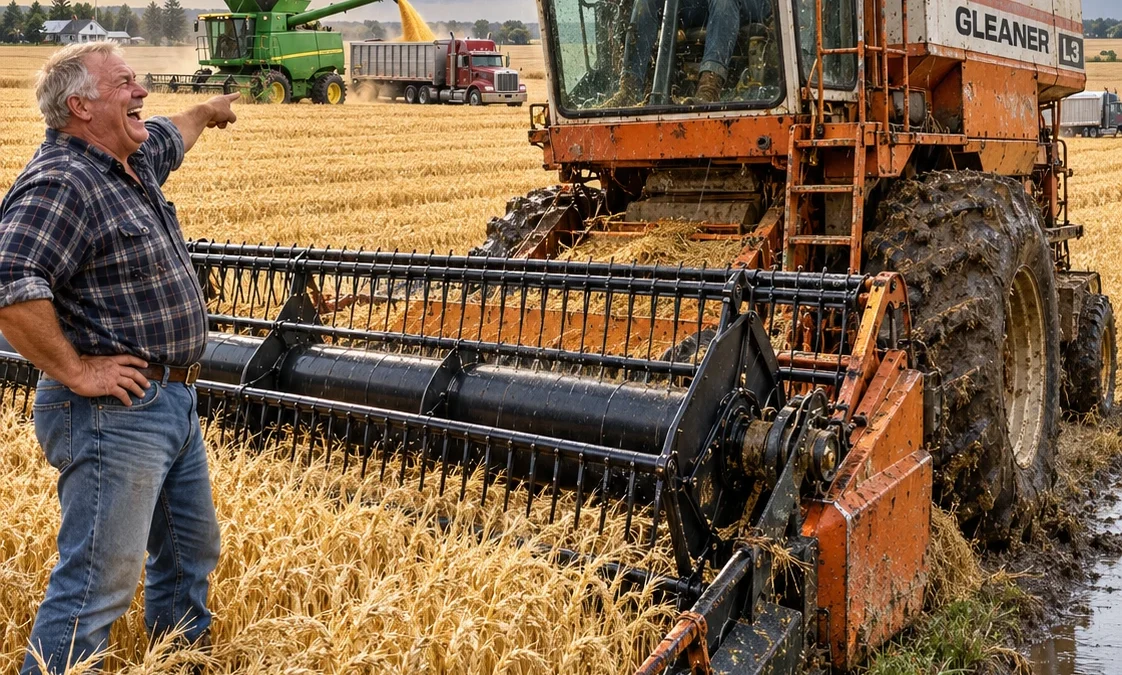
Part 2/5: Maren learns the old combine’s rhythm while Gordon’s new machines show off across the road, and a sudden lockout changes the county’s harvest.
On the morning of August 19, Maren drove the Gleaner out of the shed and lowered the header into the first standing row.
The first hour was harder than she had prepared for. The cab trapped the morning heat, and the engine at full speed was loud enough that she felt it in her chest. She pushed too quickly through the heavier stand. The cleaning shoe couldn’t process the volume, and the grain sample soon came back full of cracked kernels with too much crop blowing out behind her.
She shut the machine down, opened the lower sieve, adjusted the fan, and reduced her ground speed. The correction cost nearly forty minutes. The next sample was clean.
Just before noon, a friction squeal developed near the straw chopper housing. Maren pulled to the end of the row and called Harlan before moving another foot.
He walked her through a temperature check and a grease application on the housing shaft. She was moving again in less than an hour.
The delay irritated her, but not because it had cost time. It reminded her how much there was still to learn. Eli would have heard the squeal and known what it meant almost immediately. She wrote the location and symptom in the cab notebook and kept going.
By mid-afternoon, she had begun to find the machine’s rhythm. She was no longer just reacting to each noise and adjustment. She was learning to read the combine: how the crop moved through it, how a change in speed altered the sample, and what normal vibration felt like under her hands.
Across the road, Gordon’s three harvesters were cutting broad, confident passes through the wheat. They were ahead on acreage. Maren watched them long enough to remind herself that watching wouldn’t get her own field done, then turned back to her rows.
She used every hour the day would give her. The next morning, she was in the cab before the sky had fully lightened and kept working until the dew made the straw too wet to chop cleanly. A machine running at roughly half the speed of the equipment across the road meant she had to use as much of the day as she could.
Just before sundown, the three modern machines stopped.
They hadn’t shut down. Maren could still hear their engines idling from her seat. But their separators had stopped turning, leaving all three harvesters motionless in the field with their cab lights on.
Travis was at the first machine within minutes, phone to his ear. Gordon’s truck arrived shortly afterward. Maren kept her header in the wheat and finished her row.
The knock at her field gate came just after dark.
The man who stepped out of the service truck introduced himself as Luis Ortega. The name Harlan had given her came back immediately.
Luis had been tracking a failure pattern across multiple machines in the county that afternoon. When he called Harlan to ask which nearby machines still had monitoring hardware from the old pilot program, Harlan had given him one answer and one address: the Gleaner at Red Willow Farm.
Luis asked to inspect the monitoring unit. Maren walked him to the combine.
It took him about fifteen minutes to establish how Harlan had wired it. The unit was an independent accessory, with no connection to the separator controls or any other system needed to harvest. The toggle under the dashboard powered the monitoring unit and nothing else.
It could not stop the combine. It could not control any other machine.
Gordon’s equipment was connected differently. Its third-party fleet-management controller could place a machine into a restricted operating mode if the regional platform returned an authentication error. A configuration update had been pushed to the platform earlier that afternoon. The update had caused authentication to fail silently across all enrolled machines.
Gordon’s harvesters had responded as they were designed to respond: their separator controls had locked, and the machines were waiting for a technician to clear the error in person. Their engines kept running because the system had not restricted the engines. It had restricted the authorization to harvest.
Maren listened, then looked back at the small switch in the Gleaner’s cab.
“So this can’t unlock their machines?”
“No,” Luis said. “Your machine has no credentials on the regional platform and no communication channel to theirs. This switch is a record of a design decision. It doesn’t reach beyond the machine it’s in.”
Harlan had left the development project because he refused to put a remote authorization step inside the harvest control chain. When he removed the monitoring unit from that chain, he made sure it had no route back into a functional system.
Luis thanked Maren and drove on to the next property on his list.
By the next morning, the lockout had spread across the county. Other operations using the platform had reported the same failure overnight. The technicians qualified to clear the errors were stretched across a full county’s worth of grounded equipment, and no one could say when full access would return.
The farmers’ group had changed its focus. The day before, people had been sharing jokes about Maren’s $200 combine. Now the joke had lost its audience.
Around mid-morning, a farmer named Doris Avery arrived at Maren’s field edge. Doris was sixty-four and farmed north of town. Her harvest crew was stranded because its equipment had been caught in the same lockout.
She had fifty-two acres of ripe wheat and no crew coming. She did not try to make Maren feel responsible or tell her what she ought to do. She laid out the facts and waited for an answer.
Maren had more than a hundred acres left. Rain was forecast for August 22, and the bank deadline was six days away. If she split her time, she might not finish Red Willow Farm in time.
“I’m sorry,” she said. “I can’t take on your field right now.”
Doris nodded once. “I understand.”
Then she walked back to her truck without another word.
That quiet acceptance was harder for Maren to carry than an argument would have been. Doris had not begged or blamed her. She had simply heard the answer and gone back to face the same problem alone.
Maren called the elevator manager to confirm the delivery terms. Above-moisture delivery would not be accepted past August 22. She ran her own days as long as daylight and the dew point allowed, checking bearing temperatures every few hours and keeping notes in the cab.
That evening, she called Harlan before anything went wrong. It was the first time all season she had reached him without a failure already underway.
“The straw chopper housing is holding,” she said. “I’m keeping an eye on it.”
“I have the bearing set on the bench,” he replied. “It’ll stay there.”
Maren thanked him, then returned to the field early the next morning. There were still too many acres left and too little time to waste.
Part 3/5: A seized bearing leaves Maren twenty-six acres short, forcing her to decide whether she can finish the harvest without surrendering the farm.
By the morning of August 21, Maren had reduced the unfinished crop to twenty-six acres.
She was working through a heavy stand near the north fence line when the sound changed. It wasn’t the faint friction she had been watching. This was a hard metallic grind that shifted almost immediately into a screech she felt through the floorboards.
She cut the separator before she reached the end of the row and climbed down. The straw chopper bearing had seized. The rotor shaft had stopped, and no adjustment in the field was going to make it turn again.
The machine was down. Twenty-six acres still stood.
Maren sat on the bottom step of the cab ladder and looked at the uncut wheat between her and the fence. The rain was two days away. The bank deadline was six days away. She had no crew, no backup machine, and no reliable way to know when Gordon’s equipment would be fully available.
For the first time since Gordon had made his offer, she considered the $42,000 without anger. The money would solve the immediate problem. It would also hand over the land and the decisions for six years.
She let herself think through the whole choice instead of flinching from it. A sale of control could look like survival on paper and still be a loss she would feel every day. But the wheat wouldn’t wait for her to sort out what she wanted.
Maren took out her phone and called Harlan.
“I can’t handle this one by myself,” she told him.
“The bearing set is already in the truck,” he said. “I’ll be at your gate within the hour.”
Harlan arrived shortly after nine with his service truck, a floor jack, and the bearing set he had promised to keep ready. Ray pulled in behind him minutes later. Harlan had reached him on the road, and Ray had come without being asked.
Before anyone picked up a tool, Harlan talked them through the repair. The chopper housing had to come off first, then the shaft assembly. The old bearing had to be pressed completely out before the new one went near the machine.
Maren didn’t stand back to watch. She handed over tools, studied the parts, and helped Ray lower the housing without letting it press against the frame.
Two hours into the repair, Harlan asked her to position the bearing press. She set it slightly off-center. He caught the mistake before any pressure went through it.
He moved her hands a fraction and asked if she could feel the difference between the two positions.
“Yes,” she said.
“Then you run it.”
Maren operated the press while Harlan watched. She didn’t feel embarrassed about being corrected. She felt like someone was teaching her a skill she would need again, and she understood that was different from being kept away from the work.
They finished reinstalling the housing before midnight. Maren started the machine and ran it light for ten minutes. She walked every access point, checked the new bearing, and listened until she was satisfied. The separator ran smoothly. The chopper turned cleanly. The temperature stayed in the normal range.
She took the Gleaner back to the unfinished row and worked through the cooler night hours until the dew grew too heavy. Then she shut it down and went to the house.
Before sunrise on August 22, she was back in the cab. The air already had the heavy, still quality that comes before a storm. The forecast had shifted the rain forward to late afternoon, possibly earlier.
She worked steadily through the remaining acres, slowing down in thicker stands and checking the grain sample at every fill. By mid-morning, the wheat at Red Willow Farm was harvested.
Maren watched the last load transfer to the waiting truck and checked the moisture reading against the contract specification. For a moment, she sat without moving and let the fact of it settle.
What came to mind wasn’t the bank payment or the rain. It wasn’t Gordon’s three machines, either. It was Doris Avery nodding once and walking back to her truck.
Maren had been carrying that image since she had said no. Now that her own crop was in, she knew she couldn’t set the thought aside without trying to help.
She started the engine and drove north.
Doris was in the driveway when the Gleaner turned in off the road. She stood watching the machine come up the lane as if she had stopped expecting it to appear.
“I can’t promise I’ll finish all fifty-two acres,” Maren told her. “But I can run until the rain gets here or this machine reaches its limit.”
Doris pointed out where the fuel was staged and called to get a grain truck into position.
Travis Voss arrived twenty minutes later. Two of Gordon’s three harvesters had been cleared by technicians that morning, and he had been running custom jobs since first light. He walked the field, checked a radar loop on his phone, and returned with a practical assessment.
The open sections would go quickly with his large header. The narrow strips along the east drainage ditch were another matter. The angles were tight, and the ground dropped away. A machine his size could not cut those rows cleanly without risking the bank.
“That needs a smaller combine,” he said.
Maren looked at him. She remembered the video he had posted of the Gleaner and the comments beneath it. But Travis was watching the radar, calculating how much work could still be done before the weather decided for everyone.
“I’ll take the ditch sections,” she said, “if we keep the acreage, hours, and fuel costs separate for each machine. We settle it at the published custom rate per acre.”
“Fair,” Travis said.
Both machines went to work. Gordon’s harvester took the wide-open blocks. Maren followed the contours of the drainage ditch, cutting the narrow strips a larger header could not reach safely.
The first drops came while she was in the second ditch section. Then the rain became steady enough that no one could pretend it was passing through.
Travis was finishing the last wide block. Maren held her line close to the ditch edge and cleared the final strip with little time to spare. She reached the headland, transferred the grain in time, and raised the header before the ground softened.
The trucks moved off the field in the rain. The wheat they had reached was already on its way to the elevator.
When Maren stepped down from the combine, Gordon was waiting at the gate.
Part 4/5: With Doris’s wheat nearly secured and rain falling, Gordon faces Maren with an apology and an offer to pay for the work she did.
Gordon stood in the light rain and spoke without trying to soften what he had to say.
“I underestimated you,” he said. “And I underestimated what it meant to run three machines on one management platform without an independent fallback.”
Maren wiped rain from her face. She could hear the water pattering against the cab roof behind her and the grain trucks moving away down the road.
Gordon offered to pay her at the standard custom rate for the work she had done on Doris’s field. Maren told him she would send a written accounting of the acreage and hours before the end of the week. She expected payment based on the documented work, no more and no less.
He asked whether she was still angry about the video Travis had posted.
“I’m not interested in keeping that kind of score,” she said. “But small operations in this county deserve to be treated seriously. Not as a courtesy. As a matter of course.”
Gordon didn’t argue. He was not suddenly a different man, and Maren had no reason to expect him to be. But it was the first conversation they had in which he spoke to her as though her judgment carried weight.
Doris’s field had not all been harvested before the rain, but the part Maren and Travis reached was safely delivered. Maren had not promised more than she could give. She had shown up when she was able and worked until the weather closed the window.
That mattered to Doris, who thanked her with a firm handshake and no grand speech. Maren felt better about the help she had offered than she had expected. The decision had cost her time and fuel, but she had protected her own crop before taking on someone else’s risk.
The bank payment cleared on August 27, one day before the deadline.
Maren sat at the kitchen table with the elevator statement, Gordon’s payment, and the bills for fuel and parts. She added the figures twice, then a third time. After the bearing set and the $200 combine rental, there wasn’t much left over.
But enough remained to carry Red Willow Farm into the next season without borrowing against the land.
That was the number that had mattered since the crew boss called on August 15. She had met the deadline. The wheat had been delivered. The farm was still hers.
Harlan came for the Gleaner in the first week of September. Before the flatbed arrived, Maren had cleaned the machine, serviced every fitting on his checklist, and compiled a complete log of every adjustment, repair, and problem from August 19 through the final operating day.
Harlan read the log carefully and checked the new bearing by hand.
“Want it again next year?” he asked.
“I do,” she said. “And I want to spend part of the winter in your shop learning how it comes apart and goes back together.”
“Just learning to patch it?”
“No. I want to understand the systems well enough to recognize trouble before it turns into a breakdown.”
Harlan considered the request, then nodded. “That’s reasonable.”
Maren had expected him to agree to let her observe. She had not expected him to make space for her to learn the work properly. That small difference mattered. She had spent too many years assuming that the best she could do was call someone who knew more and hope she reached him in time.
Before the flatbed left the yard, she climbed into the Gleaner’s cab one final time.
The toggle switch sat where it had always been, just below the right edge of the dashboard. It was still off, where Harlan had left it when she first inspected the machine.
She understood what the switch was now, and what it wasn’t. It had not rescued anyone. It was not an argument against all modern equipment. It was the trace of a choice Harlan had made years earlier: one piece of the combine would remain outside any system someone else could control.
That choice had been invisible and unremarkable until the evening of August 19, when his machine kept harvesting and three far more expensive harvesters could not.
Maren had thought of the switch as a strange leftover from an old project. Now she saw it as a boundary that Harlan had drawn between information and authority. The monitoring unit could report. It could not command. Nothing outside the Gleaner could reach its separator and tell it when it was permitted to run.
The difference was not obvious from the county road. A passing driver might have seen a rusty machine and three new ones and assumed the modern equipment had every advantage. The machines across the road looked stronger, faster, and more reliable. In ordinary conditions, they were.
But harvest didn’t happen in ordinary conditions every year. The window was narrow. Weather did not care about software schedules or how impressive a machine looked in a field. A farmer needed equipment that could work when the crop was ready and the ground would allow it.
The Gleaner had given Maren no easy path. It was slow, loud, and old enough to demand her attention at every turn. She had to inspect it, adjust it, stop when it made a sound she could not explain, and keep a notebook of what she saw. She had to call Harlan when she reached the limits of her knowledge and take responsibility for the decisions she could make herself.
It never pretended to be effortless.
In the weeks that followed, people around Larkspur talked about the platform update and the harvest it had disrupted. Some farmers began asking more questions about their own equipment systems. Others focused on how quickly qualified technicians had been overwhelmed. Gordon’s operation recovered after the flags were cleared, but the lost hours did not come back.
Maren did not turn the experience into a crusade against connected machinery. She knew the newer machines could do more work in less time when everything was running as intended. She also knew how much one interruption could matter when the crop was ready and the calendar was nearly out of room.
Her concern was simpler: she wanted to know what her equipment could do, what it could not do, and who held the authority to stop it.
Part 5/5: Maren’s harvest ends with the farm intact, a new skill to learn, and a reminder that understanding the tools matters as much as owning them.
The summer had not made Maren fearless. It had made her more specific about what she needed to understand.
The next time she looked at a machine, she would ask what each system controlled and what happened if that system lost a connection. She would learn where its limits were before a season depended on finding them under pressure.
She would also keep the cab notebook. The notes she had taken about the squeal, the bearing temperature, and the changes to the cleaning shoe had helped her make decisions when there was no time to wait for someone else to arrive. They did not replace Harlan’s experience or Eli’s instincts. They gave her a record she could use to build her own.
For years, Maren had treated the part of farming she didn’t know as a gap she could only work around. She had believed she could keep the land alive by being good at the parts Eli had left to her and by calling for help whenever a machine failed.
That approach had carried her through four seasons. It had also left her dependent on someone else’s schedule, just as the harvest crew’s cancellation had made clear.
Asking Harlan to teach her was a different kind of decision. She was not trying to become a mechanic in a winter. She was choosing to learn enough to notice when something was wrong, understand how a repair worked, and be a better partner in the work of keeping the farm running.
That mattered more to her than knowing the perfect answer to every problem. She had no expectation that she would suddenly hear every failing bearing from across the shed. But she could learn what questions to ask, what parts to inspect, and when a sound meant she needed to stop before a small issue became a ruined machine.
The $200 rental had not been a lucky charm. It had been a chance. The Gleaner still required fuel, parts, time, and patience. Its old cab was hot. Its pace was slow. And when the straw chopper bearing seized, it stopped just as surely as a newer machine would have.
What made the difference was not that the old combine could never break down. It was that Maren had a direct line to someone who knew its systems, that Harlan had prepared the bearing set, and that she and Ray could help him complete the repair. The independent wiring mattered because it kept the platform from reaching into the machine’s operating controls. The human work mattered because the switch alone could not harvest a single acre.
Maren thought about Gordon’s offer now and then. She didn’t regret turning it down. She also didn’t pretend she had been certain, sitting beside the stalled combine with twenty-six acres left and the storm approaching.
At that moment, the lease would have felt like relief. A guaranteed payment could have taken the pressure off the bank deadline and given her room to breathe. It also would have meant giving up six years of decisions about land she wanted to continue farming.
She had chosen the harder path because she wanted the farm’s future to remain hers. The choice did not make her brave or prove that accepting help was weakness. It meant only that she had found a way through that particular season without signing away control.
When the flatbed carried the Gleaner off the property, Maren watched until it turned onto the county road. Then she went back to the shed and looked over the equipment she had kept.
The wheat harvest was finished. The bank had been paid. The fall seeding was still ahead, and there would be decisions about fuel, weather, and the next season’s financing. Nothing had become effortless. The work was still there.
But the farm was still hers, and she had learned something she could carry into the next harvest.
Machines were not dependable simply because they were expensive or new. They were dependable when the people using them understood their limits, maintained them carefully, and knew what to do when something went wrong. A modern platform could be useful, but it should not become the only authority standing between a farmer and the work that needed to be done.
Harlan’s switch did not save Maren’s crop. It showed her where one machine’s controls ended and someone else’s system began. She had saved the crop by paying attention, asking for help, taking part in the repair, and working through the hours the harvest allowed.
Across the road, Gordon had spent nearly two million dollars on equipment that a software update could stop at the worst possible time. Maren had spent $200 on a machine she had to learn before she could trust it.
By the time the season ended, she trusted it—not because it was old, and not because it had never failed, but because she understood more of what it could do and had begun learning what it could not.
The next winter, she would spend time in Harlan’s shop. She would ask questions, handle the tools, and learn how the systems fit together. The following harvest, she would climb into the Gleaner with a better notebook and a clearer idea of what she was listening for.
The farm would still ask more of her than she knew how to give. That was part of farming. The difference was that she no longer mistook what she had yet to learn for proof that she could not do the work.
When the combine left the yard, the toggle remained in its off position. It was a small detail on a battered dashboard, easy to miss and impossible to understand without knowing why Harlan had put it there.
Maren knew now. It marked the line between a tool that could report and a system that could command. On the evening the three harvesters stopped, that line had mattered.
The season had started with a canceled crew, a rejected lease, and a field of wheat that had to be harvested before the weather changed. It ended with the bank paid, the crop delivered, and Red Willow Farm still under Maren’s control.
That was enough. It was also the beginning of what she would learn next.
THE END








