They Mocked Her Eight-Dollar Scrap Mill—Until a Missouri Widow Turned It Into the County’s Only Source of Sweetness and Paid Off the Debt That Could Take Her Farm
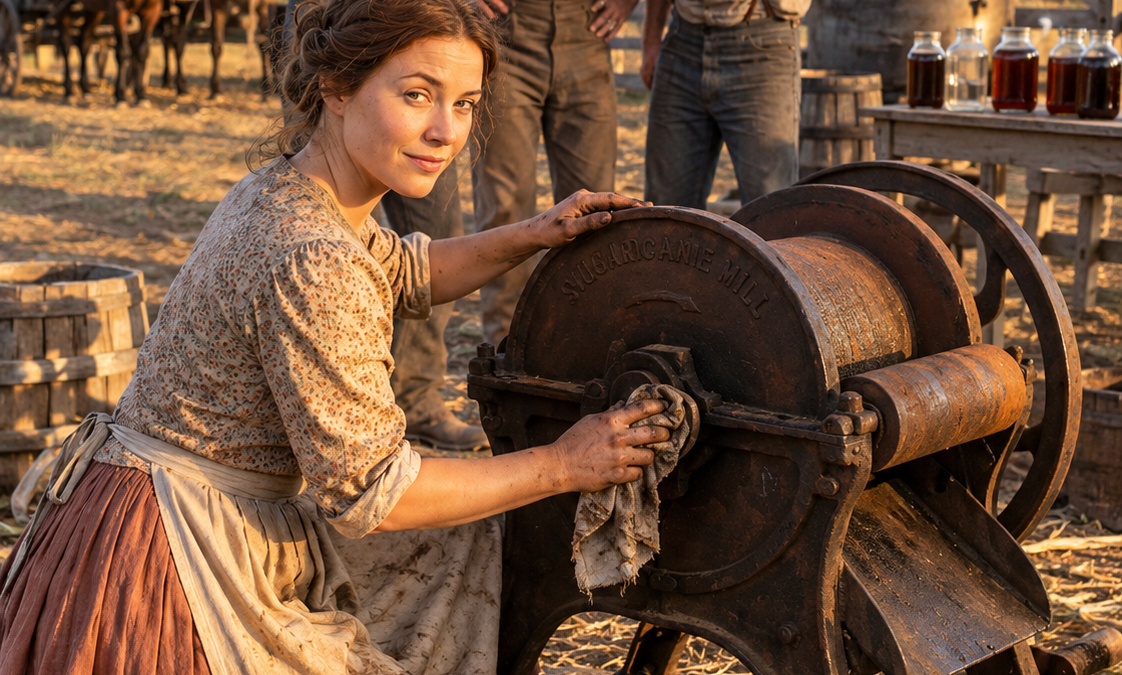
Part 2/5: The seed takes root as neighbors doubt her plan, and Mara prepares a farm, a mill, and a boiling operation from almost nothing
On the first Saturday in June, Mara went to Nathan Bell’s store to buy early amber seed. Bell found the listing in an old agricultural pamphlet and weighed out the amount she needed.
“You know your note comes due on the first of December?” he asked as he entered the purchase.
“I know,” Mara replied. “I mean to settle it before you have to remind me.”
He studied her a moment, then closed his ledger. Behind her, two farmers who had seen the auction murmured about the widow and her eight-dollar mill. Word had already spread that Mara intended to grow sorghum and make molasses.
Ruth Calder, who farmed down the creek road, stopped her on the store porch.
“People say it’s foolish,” Ruth remarked.
“I expect they do,” Mara replied, shifting the seed sack onto her other arm.
Ruth didn’t offer praise, but neither did she laugh. Silas Crowe, on the other hand, stopped his wagon outside the store two weeks later and crossed the road to confront Mara as she loaded her things.
“Milling cane is harder than growing it,” he warned. “And boiling is harder than milling. I’ve run a mill nine years and still scorch a pan most seasons.”
Mara kept loading her wagon. “I’ll remember that.”
His warning was meant to discourage her, but there was a truth inside it. She had no intention of ignoring useful information simply because it came from a man who had laughed at her.
The first week of June, she borrowed a breaking plow from Gideon Shaw and turned an acre and a half of bottomland. She planted the early amber in straight rows wide enough for a hoe to pass between them. In return for the plow, she promised half a day of fence work at Shaw’s farm in the fall.
The seed came up in ten days. By the middle of June, the young plants looked much like ordinary corn. Mara checked the rows every evening after her chores, watching the small green blades rise through the soil.
The summer demanded steady work. She hoed out weeds, thinned crowded stalks, and watched the sky through three dry weeks in July. When she found chinch bugs feeding along the field’s southern edge, she spent two days on her knees treating the affected rows and burning the stalks too far gone to save.
Only seven stalks were lost, but the fear stayed with her longer. She had planted a crop she’d never grown before, and she was learning every lesson by risking the harvest itself.
The solitude of the work settled around her. Since Jonah’s death, she had grown accustomed to rising before dawn and doing what needed to be done without anyone beside her. Still, some evenings she sat at the kitchen table and felt the empty place across from her as sharply as ever.
The cane gave her something to watch over. She sometimes spoke to it as she walked the rows, not because she thought it could hear, but because the words needed somewhere to go.
By mid-August, the stalks stood above her shoulders, their joints thickening and their color darkening toward purple. Mara had no proof the crop would make a profit, but at least there was no longer an obvious reason for the neighbors to laugh at a bare patch of ground.
She had spent the latter half of August building a boiling arch from creek stones and clay. It was a low fieldstone furnace, shaped to hold the long, shallow pan Shaw had repaired. A shallow pan would heat juice evenly and let it boil down quickly without scorching the bottom, Elias Mercer had explained.
At his suggestion, Mara divided the pan into three sections. The raw juice would begin near the firebox, where it was thinnest. As it thickened, she would move it toward the cooler end, never mixing new juice back into syrup already nearing its finish.
“Keep the pan honest,” Elias told her when he visited to inspect her work.
She wrote every instruction in her ledger. The pages filled with details about the mill, the fire, the crop, and the costs. In the margins, she recorded the names of anyone who had offered advice or help.
By the second week of September, the cane had grown taller than Mara. Its seed heads had changed from milky to firm, and the stalks held the deep green-purple hue of ripe sorghum.
Elias came out to inspect the field as promised. He walked every row, split a stalk, and tested the juice with his thumbnail.
“Ready enough,” he decided. “Cut it before the first hard frost. And mill each day’s cutting before night is gone. Juice left standing in this heat will sour.”
Mara began with the first acre. For three long days she cut, stripped, and topped the stalks with the curved knife Shaw had made. The dry blades went into a pile for the cow. The seed heads were set aside for planting and for the hens.
The work bent her back and blistered her palms. She counted stalks and armloads to keep her mind moving through the pain. Each stalk needed a low angled cut, a quick stripping of its coarse leaves, and a final cut to remove the seed head.
On the first day of milling, she harnessed a broad-backed gelding she had borrowed from a neighbor in exchange for two seasons of fence-mending labor. The horse balked twice at the long circle, then settled into a steady walk.
Mara fed the first stalk between the rollers. The iron caught it with a sound like a green branch snapping, and bright juice flowed through the trough into a barrel.
For a long moment she stood watching. The mill everyone had called scrap iron was doing precisely what she had believed it could do.
She pressed the cane twice, as Shaw had taught her. By the end of the day, she could judge the quality of the pressing by the color and dryness of the spent stalk. The second pass yielded about a fifth more juice, just as he had promised.
She also learned how quickly a mill could hurt her. On the second afternoon, her sleeve caught against a stalk just before the rollers pulled it inward. Mara yanked herself back hard enough to tear the cuff and bruise her arm.
Afterward, she kept her hands farther from the iron and never let fatigue excuse careless work.
By sundown on the second day, she had pressed nearly all her cane. A dozen barrels held about 430 gallons of raw green juice, sweet-smelling and faintly grassy. None of it was molasses yet.
All of it would sour by morning unless she boiled it down.
Part 3/5: A scorching fire destroys her first batch, but an old farmer teaches Mara the signs that can save the next pan
The first evening of boiling began after dark. Mara strained the juice through clean muslin, then ladled it into the shallow pan and built a small, steady fire beneath it.
She had built the furnace carefully, testing the draft with kindling before trusting it with a full batch. A fire that smoked instead of drawing clean would waste wood and heat the pan unevenly.
Juice came to a boil within half an hour. Pale green scum rose to the surface, carrying plant wax and fine bits of cane that had passed through the first straining. Mara drew it off with the skimmer, taking care not to let it boil back into the juice.
She worked through the night, feeding the fire in small sticks and moving the thickening liquid toward the pan’s cooler end. By dawn, the steam carried a warm sweetness that smelled unmistakably like molasses.
She had turned roughly eight gallons of raw juice into one gallon of finished syrup. Her back ached, her hands were raw, and her eyes stung from the smoke, but the result gave her more confidence than any promise had.
The process became a routine over the next weeks. Mara rose before four to press cane, worked through the afternoon, then boiled at night. Some batches finished by ten; others held her at the pan until two in the morning.
She kept a cot in the shed so she wouldn’t lose time walking back to the house between batches. Every pan’s yield and every hour went into the ledger.
On the third morning, exhaustion cost her dearly. She turned away for a few minutes to deal with a fence rail the gelding had loosened, and when she returned, the thickening syrup at the finishing end had scorched.
The smell reached her too late. She pulled the pan from the fire, but the damage was done. Nine gallons of bitter, blackened syrup would be fit only for the hog trough.
Mara wrote down the loss: one pan, nine gallons, nearly five dollars in value. Then she sat beside the cooled furnace and stared at the blackened surface.
She had cut and hauled the crop, repaired the mill, built the arch, and risked the money she needed to keep the farm. Now the moment she had dreaded had arrived: a failure that might undo the entire season.
For the first time, she wondered whether Silas Crowe had been right. The note still waited. The timber remained unsold. The winter would come whether she had succeeded or not.
She scrubbed the pan with sand and creek water until her arms hurt. She didn’t decide to quit; she only decided she would wait until morning to judge what the failure meant.
By Saturday, the story had reached Ashford Crossing. One version said she had ruined her whole crop; another claimed the scorched syrup had eaten through the pan.
Ruth Calder told her she had heard Silas say, “I told her I’d have hauled it away for free.”
Nathan Bell didn’t repeat the gossip, but he did ask whether Mara still expected to settle her debt in December. His question carried more doubt than it had in June.
That evening, Mara sat beside the cold arch, trying to understand what she had missed. Then Elias Mercer arrived with his own worn skimmer tucked under one arm.
“You’re watching the fire,” he said as he settled on a barrel beside the pan. “You ought to be watching the ladle.”
He dipped the skimmer into the syrup near the finishing end and lifted it above the surface. The liquid fell in separate drops.
“Not done,” he said.
He fed the fire in small, even sticks and waited. A quarter hour later, he dipped the skimmer again. This time the syrup fell in a single, unbroken sheet and clung to the edge before letting go.
“That’s the sheet,” Elias explained. “Some call it aproning. When it hangs that way, pull the pan. Not when the clock says. Not when you’re tired of standing. When the syrup tells you.”
The fire could lie, he added, but the ladle never did. He taught her to listen to the boil, too. Thin juice rolled in large, loose bubbles. As it thickened, the bubbles drew together, stood taller, and broke with a different sound.
The pan had scorched because the syrup was already thick when the heat remained too strong. The final quarter hour required the closest attention of all.
Elias also explained that a batch pulled at the first sheet would be lighter and thinner, suitable for pouring over bread. A few minutes longer would make it darker and thicker, better for cooking and longer storage.
Mara began marking the jugs with chalk. “S” for lighter syrup, “M” for true molasses.
With Elias beside her, she boiled three more pans. None scorched. By the fourth, she could feel the syrup’s changing weight against the skimmer and hear the moment approaching in the sound of the bubbles.
Her confidence returned, but it was no longer the confidence of someone hoping the plan would work. It came from learning exactly what the work required.
By the last week of September, she was pulling clean, dark molasses from the pan, straining it again, and pouring it into stoneware jugs. The color glowed red-gold in the afternoon light.
Her first taste surprised her. Sorghum molasses was sweeter at first than the plantation syrup she remembered, with a grassy note underneath and a clean finish.
She carried one jug to Gideon Shaw, the first payment toward the ten gallons she owed. He tasted it carefully.
“My wife can stop asking for something sweeter than cornbread,” he said, corking the jug and setting it safely on a shelf.
Mara carried another jug to Elias Mercer with a note: “The sheet found me. Thank you.” He never mentioned the gift, but when she visited the following spring, she saw its cork on his mantle.
Part 4/5: The county’s first customers arrive, and Mara turns her struggling mill into a fair business that begins to feed its neighbors
News of Mara’s molasses traveled faster than the story of her scorched pan. By the second week of October, her first customer stood in the yard before breakfast.
Caleb Voss, a widower from three farms down the creek road, had grown sorghum on a hunch but had no mill. He asked whether she would press and boil his cane the way grain mills charged for corn and wheat.
Mara offered the usual toll: one gallon out of every four for the mill, with the other three going back to the farmer. It was fair, she believed, and fair mattered more than taking the most she could.
Caleb agreed. Mara weighed his cane, worked it alongside her own, and entered the amount in her ledger. Soon the word spread that her mill was open to neighbors.
The first few came cautiously. Ruth Calder brought a small load and watched as Mara measured the toll. Then she came back with more.
An older farmer, Harlan Fitch, who had once said he wouldn’t feed sorghum molasses to a hog, arrived with a wagon full of cane. He paid his toll without comment and took his three gallons home.
Mara took every customer on the same terms. She kept the accounts carefully, recording the amount each farmer brought and the share each received. By late October, eleven farms had brought cane to the mill, and Mara’s toll share amounted to more than 130 gallons.
The arrangement expanded the business without requiring her to buy more seed or plant more ground. Her neighbors supplied the crop; she supplied the mill, the pan, and the long hours of boiling.
She sold her own molasses at a price she set in the ledger rather than changing it whenever someone offered more. Forty cents a gallon early in October, then five-cent increases as the shortage worsened, with a ceiling of seventy-five cents.
Two farmers offered more during the second week of November. Mara refused. A mill that gouged its neighbors in a hard year would not be worth much when the hard year passed.
At the store, she watched a woman ask Nathan Bell for sugar to make pear preserves. Bell had none to sell and said the nearest supply was a day’s ride away, with no promise of a fair price.
After the woman left, Bell gestured toward the jugs of Mara’s molasses on a shelf behind the counter.
“A body could do worse this year than buy one of these,” he said.
He offered to sell the jugs at a dollar a gallon, keeping none of the price for himself. Freight had become so expensive that even ordinary goods cost him nearly twice what they had before the war.
The demand stretched Mara’s time beyond what she could manage alone. By the last week of October, she was boiling before dawn and after dark, and the mill still had cane waiting.
For the first time since Jonah’s death, she hired help. Everett Cole, a fourteen-year-old boy from the next farm, earned fifty cents a day tending the firewood and feeding the mill.
Everett learned quickly, but in his second week he nearly reached toward the rollers before they had stopped. Mara shouted. He snatched his hand away in time.
She made him repeat the safety rule until he could say it without hesitation: hands clear until the roller’s turn was finished, every time. The close call frightened them both, and Everett never made the mistake again.
The first hard frost arrived on the last night of October. The following morning, four wagons were already lined along Mara’s fence.
By the second week of November, three or four waited most mornings, sometimes six on a Saturday. Mara kept a tally of every wagon in the margin of her ledger.
One cold Tuesday, Silas Crowe stood beside his own wagon in the line. His mill, four miles away at Bitter Creek Crossing, had fallen weeks behind on orders.
“I’ve eight bushels of cane waiting to be pressed,” he said. “I hear you’re running the fairest toll in the county, and keeping your weights straight.”
He didn’t apologize for laughing at the auction. Mara didn’t ask him to. She weighed his cane, quoted the same one-in-four toll she gave everyone, and recorded his name in the ledger.
That was all the answer she needed to give him.
Part 5/5 (THE END): Mara pays her debt early, earns the county’s respect, and sees the derided mill become the foundation of her future
By the last Saturday in November, Mara had filled eleven jugs with her best molasses and loaded them onto the ox cart that had once carried the rusted mill home. She brought them to Nathan Bell’s store three days before her debt came due.
The county’s shelves held no cane sugar, and plantation molasses had nearly vanished. Bell weighed and tasted each jug with care. Even after accounting for the lower prices her earliest syrup had brought, Mara’s season’s sales amounted to $194.30.
She counted out $34.60 for Jonah’s note. Bell marked the balance paid in his ledger, then set the stamp aside.
“I didn’t expect to close this account early on the strength of a mill I thought you’d overpaid for,” he admitted.
“You weren’t alone,” Mara said.
There was no boast in her voice, only the satisfaction of a number finally coming out right. She still had $159.70 to her name after the debt was cleared.
Silas Crowe stood behind her with a jug of molasses and his payment already counted. He watched Bell close the account and said, “Well, I’ll be.”
Ruth Calder bought two more jugs. Mara took the cart home with money in her pocket and a future that no longer depended on one December deadline.
She planned to visit Elias Mercer with a proper share of the season’s best molasses, not merely a single thank-you jug. He would likely refuse to hear it called payment for his time, but she intended to bring it anyway.
By the second week of December, the mill stood at the center of a modest, steady operation. A second lean-to had been built beside the shed for storage, and Mara had paid for the lumber outright.
Gideon Shaw was forging a second pan for the next season. This time she could pay him in cash rather than promise a share of what she had not yet made.
Silas Crowe visited twice more before Christmas. Once to press a small cutting of his own, and once to ask where he might find seasoned white oak for a new sweep arm.
His old arm had finally given out after nine years. He had decided there was no shame in copying a design that worked better.
Mara told him where to find the oak and which blacksmith to ask. She charged him nothing for the advice.
Before the ground froze, she staked out three acres of bottomland for the next year’s cane. She spoke to Ruth Calder and Caleb Voss about sharing the seed costs in exchange for bringing more cane to the mill.
Everett Cole asked whether she would need him again the following autumn. Mara told him she expected to need him for more than one season.
One clear evening near the solstice, the last sunlight fell across the staked field. Under the shed, the mill’s rollers gleamed faintly where the day’s cane had passed through them.
Mara walked the yard, checking the shelves of filled jugs and the furnace where the coals still glowed beneath a thin veil of ash. The gelding grazed by the fence, no longer borrowed but hers outright, bought with the season’s first surplus.
That night, she opened the ledger at the kitchen table. The pages held eight months of work: eight dollars for the mill, a dollar and a half for the pan, $2.75 for seed, and the blacksmith’s repair paid in molasses and cash.
She read the record of the scorched batch, the nine gallons lost, and the lesson that had saved the seasons that followed. She saw the names of the eleven farms whose cane had brought more than 130 gallons to her storehouse.
None of it, she understood, had come from luck alone. The mill had needed ironwork and care. The boiling had needed patience and judgment. The business had grown because neighbors were treated fairly and every figure was written down.
Beside the ledger sat a few jugs of syrup, dark red-gold in the lamplight, and a stripped cane stalk she had saved from the final cutting. She was thirty-three years old, a widow with a farm, a paid note, and a mill the county had once called scrap iron.
She sketched plans for a second boiling shed on a scrap of paper tucked into the ledger. She had spoken to Ruth about whether her eldest daughter might want steady work the following autumn.
It was only arithmetic so far, the same kind of arithmetic that had first seemed like a shape a plan might take. But Mara had learned to trust numbers that began honestly and stayed honest.
She banked the kitchen fire and carried the lantern out into the cold. The mill stood quiet beneath its roof, its three rollers oiled and ready for whatever the next season asked of them.
Mara rested a hand on the nearest roller as she had in the auction yard, when the iron was cold and the laughter was loud behind her. Now the touch held no gamble.
It felt like home.
THE END








