When I woke in a hospital bed with a stranger’s hand around my wrist, I couldn’t remember the date or how I’d gotten there. I only knew my husband was somewhere nearby, and that the doctor would soon say something that made him go utterly still. I was sixty-two, and I had spent years believing I was too capable to be trapped.
Part 2/5: A nurse gives me privacy, and the truth finally enters the medical record
I returned to awareness in pieces. First came movement and the vibration of a car. Then I heard a voice I recognized, but it sounded unlike Malcolm’s usual controlled tone. He was driving and talking to himself.
“She slipped on the ice by the back steps,” he said. “She hit her head. I found her there. That’s what happened. She slipped on the ice.”
He repeated it as if practicing for an audience.
My eyes stayed closed. I was lying across the back seat, and each breath sent pain through my left side. My ribs hurt. My head felt thick and wrong. Through the fog, one thought surfaced: he was scared.
He was scared enough to take me to a hospital, where there would be other people. Other people meant eyes, and eyes meant a chance. I couldn’t sit upright. I had no plan. But I held on to that possibility like a thread in a dark room.
The emergency department at Corewell Health Butterworth Hospital was bright and busy. Malcolm stayed beside me while they wheeled me through the doors. He performed his role perfectly.
“My wife,” he said, his voice breaking. “I came home and found her at the bottom of the back steps. She must have slipped on the ice. Please help her.”
He held my hand and stroked my hair. Somewhere in the haze, I felt the warmth of his hand and remembered what it had done less than an hour before. The tenderness felt wrong in a way I couldn’t explain.
A young nurse took my vital signs and used my name without asking. She had read it on my intake form. That small fact steadied me: my name was written down; I was here; this was real.
When the staff drew a curtain to examine me, a female nurse helped me change into a gown. She saw my torso and went still for a moment. I knew what she was looking at. I had seen the bruises in the bathroom mirror, each one a different shade from a different week, some fading while others were still fresh.
“Some of these look quite old,” she said gently.
Malcolm was just beyond the curtain.
“She bruises easily,” he said. “She’s clumsy, too. This isn’t her first slip.”
He gave a small, apologetic laugh, as if we shared a private joke about my incompetence. The nurse looked at me. Her expression was careful and quiet. She didn’t challenge him in front of me, but I could feel that she had noticed.
They took me for scans. Malcolm protested when he was told he could not come, but a staff member calmly explained that it was standard procedure and sent him to the family waiting area.
When he was gone, something in my chest loosened.
In the radiology hallway, I began to cry. I hadn’t decided to. The tears simply came, a release of pressure I could no longer hold back. The nurse squeezed my hand and leaned close so Malcolm couldn’t hear her.
“You’re safe right now,” she whispered. “Can you tell me what actually happened tonight?”
I stared at the ceiling. I thought about the forgotten prescription, the kitchen floor, the grocery receipts, and my daughter crying at my wedding because she believed I had finally found happiness.
“He did it,” I said. “He’s been doing it for almost three years.”
The nurse didn’t look surprised. She looked sad and certain.
“Okay,” she said. “You did the right thing. We’re going to take care of you.”
The scans showed two fractured ribs and a mild concussion. The doctor also found signs that I had fractured ribs before and that they had healed without treatment. I had not fallen on an icy step that night. My injuries told a longer story.
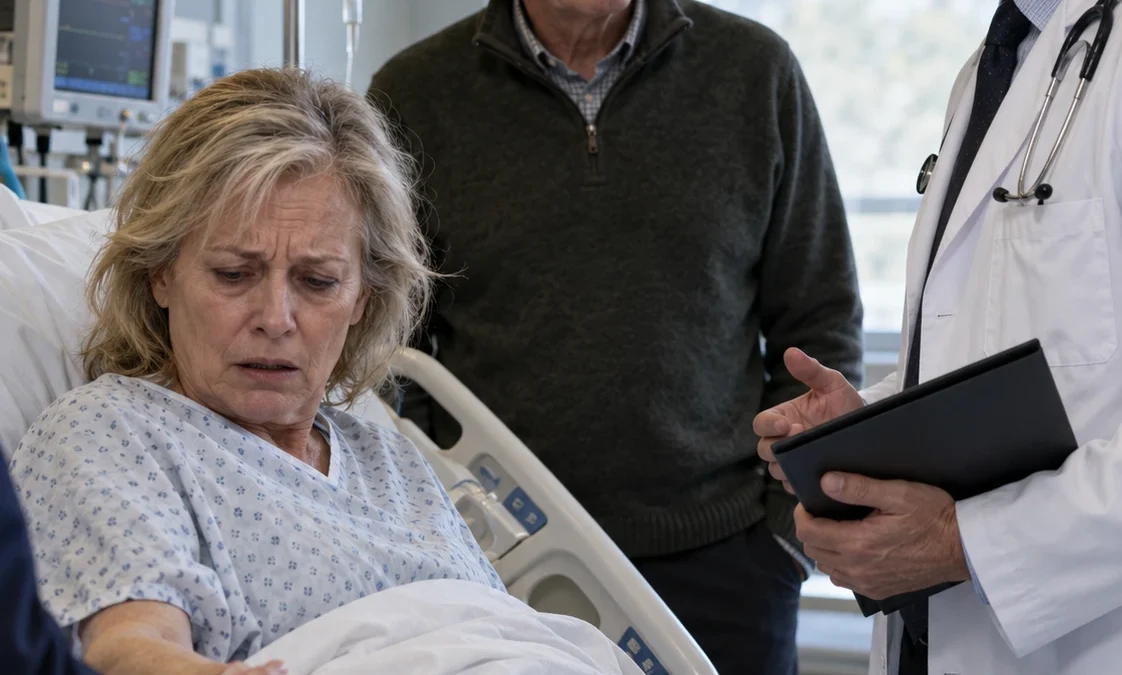
The doctor asked to speak with me privately. He was young, maybe thirty-five, and spoke in a careful, unhurried way despite the commotion outside my room. Instead of standing over me, he pulled a chair close and sat down.
“I need to ask you directly,” he said. “The injuries we’re seeing aren’t consistent with a fall. The different ages of the fractures and the bruising on your torso suggest repeated physical trauma over time. Has someone been hurting you?”
I nodded before I had fully decided to. It was small, but it was an answer.
He stepped outside and spoke to someone in a low voice. When he came back, he told me Malcolm was being moved to another waiting area. A victim-services worker was on her way. He also explained that he was required to document what he had found and contact the appropriate services.
“You have the right to protection,” he said.
The next person through the curtain was not Malcolm. She was a woman in her fifties with short gray hair and an ID lanyard. She introduced herself as Sharon, a victim-services advocate. Her voice was direct and kind. She explained what my options were and told me I did not have to return home.
“Is there someone we can call for you?” she asked.
I gave her Meredith’s name. Then I began to cry again, harder this time. It was the kind of crying that comes from a place you have kept rigid for years, not just from pain or fear, but from the shock of finally letting another person see you.
Sharon called my daughter from the hallway. I heard her measured voice explaining what had happened. Then I heard Meredith make a sound I had never heard from her before.
She arrived within forty minutes, still wearing her coat, her hair mussed from running across the parking lot. She took my hand and pressed it against her cheek.
“Mom,” she said. “Why didn’t you tell me?”
I had no good answer. I still don’t have one that explains all of it. I was ashamed. I was afraid of being judged. I had convinced myself that keeping quiet was protecting my family from a painful truth, when really it was keeping Malcolm’s secret for him.
By the time Meredith arrived, the Grand Rapids Police Department had been called. An officer took my statement. Two others went to the family waiting area to speak with Malcolm. Later, I learned he tried to redirect them to the icy-step story. When they told him what the medical team had found, his composure began to break down.
He was taken into custody that night.
I stayed in the hospital overnight for observation. Meredith slept in the chair beside my bed, still in her coat because no one had thought to bring her anything else. I watched her sleep in the dim light and felt guilt, but also something I couldn’t name. It felt like the first breath after being underwater for a very long time.
Part 3/5: My family stands beside me as I leave the house and face the court
The weeks that followed moved faster than I could absorb. The divorce proceedings began. Meredith stayed close, but it was my daughter-in-law, Tessa, who helped me understand the paperwork and legal steps from Denver. She was a lawyer, and she never made me feel foolish for not knowing what came next.
My son flew in as soon as he could arrange it. He met me at a Tim Hortons near the shelter where I was staying temporarily and held both my hands across the table.
“You are the strongest person I have ever known,” he said.
“I don’t feel strong,” I replied.
“That’s okay,” he said. “I’ll feel it for you until you can.”
I had driven past that Grand Rapids shelter many times without really seeing it. I never thought it would become part of my life. Inside, it was warm and practical. The staff and residents had a quiet, battle-tested decency that comforted me more than I expected.
No one asked why I had stayed. They knew. They had lived their own versions of that question.
The first nights were difficult. I was in a safe place, but my body didn’t yet understand that. I woke at small sounds. I found myself listening for Malcolm’s footsteps even though he was nowhere near the shelter. When someone entered the room, I tensed before I could stop myself.
I also kept replaying the choices I had made. I wondered why I hadn’t called Meredith sooner, why I had accepted the allowance, why I had explained away the bruises. It took time to understand that those questions were another way of blaming myself for someone else’s behavior.
Malcolm had been charged with assault causing bodily harm, criminal harassment, and making threats. My hospital records were evidence. So were the photographs taken in the emergency department and the messages he had sent me: cold, controlling texts I had never deleted.
I couldn’t explain why I had kept them. Maybe some part of me had known that one day I would need a record of what was happening. Maybe I had simply not wanted to erase them. Either way, they became part of the case.
Malcolm pleaded not guilty. That meant I would have to testify.
I had never imagined describing our marriage in a courtroom. Yet there I was at sixty-two, sitting in front of a judge and explaining in specific, clinical detail what Malcolm had done over nearly three years. I talked about the first time he grabbed me, about the bruises he hid, the money he controlled, and the prescription I forgot.
I had to speak about the night of the hospital visit and his story about the icy steps. I had to explain that the bruises did not come from clumsiness, and that the earlier fractures in my ribs could not be explained by a single fall.
His lawyer wore an expensive suit and spoke in a way designed to make me feel foolish. He suggested that I was a woman of a certain age dealing with confusion, that perhaps I had misremembered things, that I was not entirely reliable when describing my own experience.
The implication settled over the courtroom: I might be mistaken about what had happened to me.
I sat up straight in the witness box and looked directly at him.
“I am sixty-two years old,” I said in my clearest voice. “I raised three children, ran a household, and managed my family’s finances for thirty years before this man entered my life. I know precisely what happened to me.”
The room fell quiet. Even the judge seemed to lean back slightly.
I had spent years treating my age as another reason to feel ashamed. I thought I should have known better, that experience ought to have protected me. But that day, my age became evidence of the life I had lived before Malcolm. I knew how I had handled money and raised my children. I knew how I had treated people I loved. I knew the difference between falling and being hurt.
After I finished testifying, I sat beside my advocate and waited. Meredith was there. My family was there. It was painful to have my private life examined, but I was no longer facing it alone.
There were moments when I wanted to disappear from the room. I thought of the kitchen, the red marks on my arm, and all the times I had changed my story to make the truth easier for everyone else. Then I remembered the nurse in the hallway, leaning close and telling me I was safe.
That wasn’t the whole truth yet. I was still frightened. But in that courtroom, I had a choice I hadn’t had in Malcolm’s house: I could say what happened without changing the words to protect him.
Part 4/5: The verdict brings consequences, but freedom arrives quietly
When the verdict was read, Malcolm was found guilty on all counts. He was sentenced to four years in prison. The judge also issued a lifetime no-contact order, barring him from contacting me or coming near my home, my children’s homes, or my grandchildren’s schools.
The court considered the sustained abuse, the way Malcolm had concealed it, and his attempt to mislead hospital staff. The sentence was significant. I understood the decision, but the word “guilty” did not erase what had happened or make me feel like the person I had been before I met him.
I thought I would cry when I heard the verdict. I didn’t. Instead, I felt something physical and quiet: the sense of a knot that had been pulled tight for years finally beginning to loosen.
Meredith squeezed my hand. I looked at the papers spread across the table beside my legal advocate and thought of the people who had helped me reach that moment. The nurse who noticed the bruises. The doctor who sat down instead of towering over me. Sharon, who called my daughter when I could barely speak. Each of them had done one small thing. Together, those things had become a way out.
After the court proceedings, I stayed focused on practical steps. The divorce moved forward. I worked with my family to make sure Malcolm could not reach me. The no-contact order gave me a measure of safety, though it did not instantly make my nerves settle.
I learned that safety and peace were not the same thing. Safety meant there was a legal order, a place to sleep, and people who knew where I was. Peace took longer. It came in small pieces, often too ordinary to notice until I looked back.
I had to get used to making decisions without guessing how Malcolm would react. Even choosing what to buy at the grocery store could bring back the old habit of calculating the cost, checking the list, and imagining the lecture I would receive. I had been trained to treat ordinary choices as risks.
For a while, I heard his criticism in my head. I would stand in a store aisle and think, “Is this too much? Will he say I’m wasting money?” Then I would remember: I was not in his house. No one was waiting to inspect my receipt.
I returned to the things I had stopped doing. I spoke with my book-club friends again, though it took time to explain why I had disappeared. I did not need to tell them every detail. I only needed to let them know that I had been isolated and was trying to reconnect.
My son continued checking in. Tessa helped me through the legal documents without turning every conversation into a reminder of what I had endured. Meredith made sure I knew she was there, but she also gave me space to decide what I could handle.
I began to see the ways Malcolm had made me feel responsible for his moods. If he was angry, I looked for what I had done wrong. If he was gentle, I treated it as proof that I should forget the anger. The pattern had made me question my own judgment until I could no longer tell the difference between compromise and surrender.
That understanding did not make the past disappear. It did make it possible to stop using the past as evidence against myself.
I had not caused Malcolm’s behavior by forgetting a prescription, rearranging a closet, or wanting to visit my daughter. I had not made him hurt me by being too trusting or too old or too slow to leave. The responsibility belonged to the person who chose to do it.
The day the final order was explained to me, I heard the terms and tried to imagine what they meant in the ordinary hours ahead. It would be easier to understand later, when I could open my door without wondering whether he would be standing outside, when I could make plans without preparing for the argument that followed.
Freedom did not arrive as a grand feeling. It arrived through a series of moments in which Malcolm’s permission was no longer required. I could talk to my children. I could see my friends. I could spend money without showing proof. I could decide what kind of life I wanted to build next.
I still had a long way to go. But for the first time in years, the next step belonged to me.
Part 5/5: Two years later, I begin to trust the ordinary quiet of my own home
I have lived in my two-bedroom apartment in Grand Rapids for two years now. Meredith helped me find it. It has a kitchen table by the window, and in the mornings I sit there with tea and listen to birds outside.
My grandchildren, now nine and eleven, come during school holidays. They know my apartment as a place where Saturday means chocolate-chip pancakes, bedtime can run a little late, and there is room to draw at the kitchen table.
They do not know the whole story yet. I will tell them when they are older. I will not pretend this never happened, and I will not teach them that silence is a virtue when someone is hurting you.
Every other week, I see a therapist who specializes in trauma. She has helped me understand how control can be built slowly, how shame can hold it in place, and how capable, intelligent people can still find themselves trapped. Understanding the pattern has not erased what I lived through, but it has helped me stop blaming myself for it.
Some things still happen. I startle when someone comes up behind me unexpectedly. Enclosed spaces can make me uneasy. Sometimes I still scan the emotional temperature of a room before deciding how to behave.
When I catch myself doing that, I remind myself I no longer live in Malcolm’s house. I do not have to adjust my whole day to someone else’s mood. I am sixty-three, and I have paid for my own groceries for two years without giving anyone a single receipt.
That may sound small. It isn’t.
I want people my age to understand that experience does not make anyone immune. I had raised children, managed a household, and survived grief. I believed that life experience would help me recognize danger. Malcolm was patient. The control came gradually, and each step felt manageable beside the one before it.
I was ashamed because I thought I should have known better. That shame nearly kept me in that house until something irreversible happened.
If someone in your life seems smaller since entering a relationship, if they keep canceling plans or making excuses, ask them the hard questions. Ask kindly. Ask more than once. Leave the door open. They may be waiting for proof that someone outside still sees them and still cares.
In the United States, the National Domestic Violence Hotline can be reached at 1-800-799-SAFE (7233), or by texting START to 88788. If you are in immediate danger, call 911.
I am alive. I am in my own apartment, with birds outside my window and my grandchildren coming next weekend. I have already bought the chocolate chips.
The doctor in the emergency room refused to look away. He named what he saw and documented it, even though doing so meant consequences for the man waiting outside my curtain. That decision helped give me my life back.
I used to think strength meant being able to handle everything alone. Now I know it can also mean saying the truth out loud, accepting a hand when it is offered, and letting other people help you find the way out.
THE END
Tên và địa điểm đã đổi: người kể chuyện thành Joanne Whitaker; người chồng thành Malcolm Voss; con gái thành Meredith; con trai thành Aaron; con dâu thành Tessa; chuyển bối cảnh từ Ontario, Canada sang Grand Rapids và Ada, Michigan, Hoa Kỳ. Không có đơn vị tiền tệ cần đổi.
Kết thúc: Câu chuyện gốc đã có kết thúc rõ ràng, nên mình giữ nguyên hướng kết thay vì thêm cú twist mới: Malcolm bị kết án, Joanne ly hôn và xây dựng lại cuộc sống an toàn bên gia đình.








