A Woman Paid Five Dollars for a Condemned Store, Then Found Five Hidden Crates That Could Change Her Life—and the Future of a Town Everyone Had Abandoned…
Part 2/5: Mara guards the crates, contacts experts, and learns the hidden denim may be worth far more than the store.
Mara didn’t sleep that night.
She spent the last of the daylight hauling sheets of plywood across the front of the store and securing them over the cracked windows. She drove construction screws through the oak frames until her drill battery died, then finished the job with a hand screwdriver until her palm blistered.
By nightfall, the Harlow General Store felt less like a condemned building and more like a fortress.
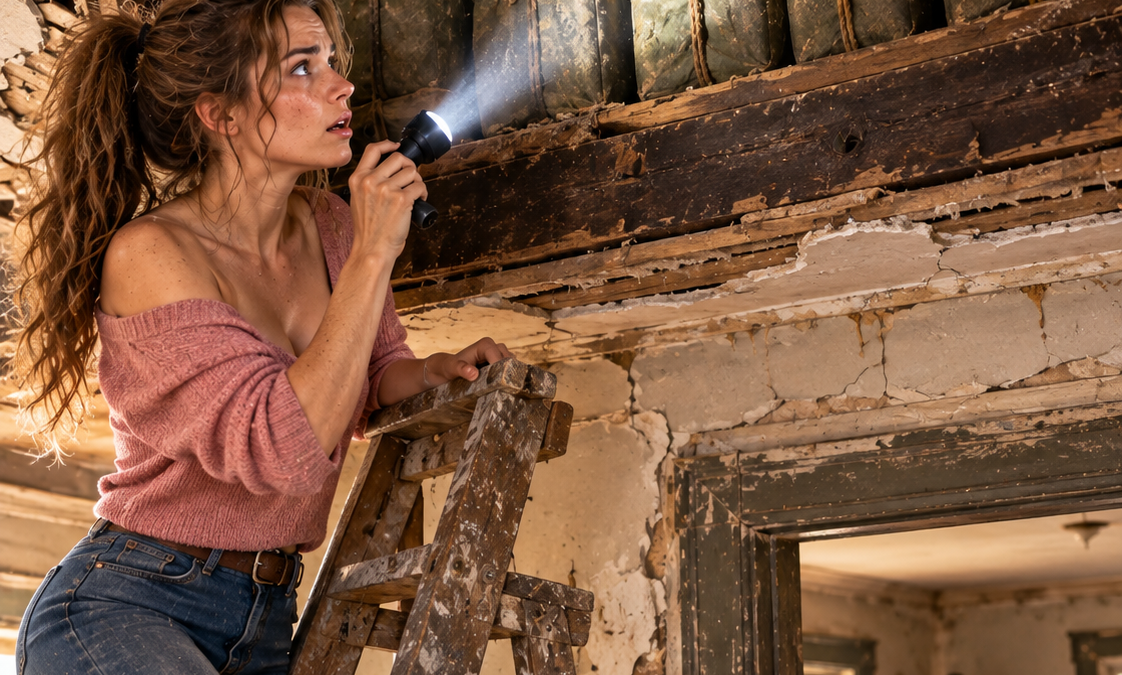
Mara sat cross-legged on the floor beneath a battery-powered camping lantern. The five crates surrounded her, their lids open. The smell of indigo and cedar masked the store’s old dampness, but it did nothing to calm her thoughts.
If word got out in Bellwether, people would talk. In a town where many storefronts were boarded up and the median income hovered just above the poverty line, talk could turn into curiosity. Curiosity might lead someone to decide that a crowbar and a dark night were all it took to claim what she had found.
The deed was hers, but it didn’t make the back door any stronger or the broken windows any less exposed.
At dawn, she chose one pair of jeans from the smallest crate and folded it carefully into a black plastic bag. She locked the store, drove thirty miles east to a chain motel near the interstate, and paid for a room for the day.
From the room, she connected to the motel’s Wi-Fi and searched for vintage workwear experts. She found three dealers who appeared to specialize in old denim and sent each of them a short email with four photographs: the leather patch, the copper rivets, the lettering on the crate, and the full pair of jeans.
She expected to wait days.
Her phone rang twenty minutes later.
The caller ID showed a Los Angeles area code. Mara stared at the screen before answering.
“My name is Arthur,” the man said without a greeting. His voice sounded breathless. “The photographs you sent. Where are the garments right now?”
“They’re safe.”
“Have you washed them?”
“No.”
“Please tell me you didn’t put them in a machine.”
“I haven’t touched them beyond opening the crates. They’re stiff, unworn, still packed in the wood.”
Arthur exhaled sharply. “Listen carefully. Don’t handle them without clean, dry hands. Don’t expose them to direct sunlight. If those are authentic 1930s Levi’s 501s in dead-stock condition, you may have museum artifacts, not a pile of old clothes.”
Mara sat on the edge of the motel bed. “What does that mean?”
“A single pair in that condition sold in Tokyo last year for eighty-five thousand dollars. I can be in Chicago by tomorrow morning, then drive to you. I need to inspect them.”
“I haven’t agreed to sell you anything.”
“I know,” Arthur said. “You should have them appraised. How many pieces did you find?”
Mara looked at the black bag resting beside her on the bed. “One hundred and twenty, I think.”
Silence followed.
Then Arthur said, “Don’t talk to anyone else about them. I’ll text you my flight information.”
The call ended.
Mara went back to the store and spent the next twenty-four hours sitting in the dim space with a crowbar across her lap. Every groan of the floorboards made her look up. She listened to the distant rumble of pickup trucks on Main Street and the wind pushing against the plywood.
The next morning, a black rental SUV pulled up outside.
Arthur was a wiry man in his late forties, with thick-rimmed glasses and a tailored linen jacket that looked wildly out of place on Bellwether’s dead-end street. He carried a heavy aluminum briefcase.
Mara let him in through a side door and locked it behind him.
Arthur ignored the peeling wallpaper, the water stains, and the debris on the floor. His gaze went straight to the five crates. He approached them slowly, like a man nearing a wild animal.
He opened his briefcase and took out white cotton archival gloves. After slipping them on, he knelt beside the first crate and lifted a denim jacket. He checked the pleats, the single pocket, the shape of the buttons, then turned it over and studied the stitching.
“My God,” he whispered.
For a moment, the polished confidence of a city dealer disappeared. Arthur looked like someone standing in front of a miracle.
“The stitching is right. The dye hasn’t oxidized. This is a time capsule.”
He spent two hours moving from crate to crate, counting and inspecting each piece. He photographed details and took careful notes. Mara sat on an overturned bucket, watching him work.
At last he sat back on his heels and removed his gloves. His hands were trembling.
“You found the mother lode,” he said.
“What are they worth?”
“The market for dead-stock denim is specialized. If one hundred and twenty pieces go up for sale at once, the individual prices could fall. But I represent a consortium of private collectors and two textile museums, one in Japan and one in London.”
He explained that he could arrange a private sale of the entire collection. No auction. No public spectacle. No months of waiting for buyers.
“I can write you a cashier’s check today,” he said. “Two-point-four million dollars, from a corporate escrow account. We load the crates into my vehicle, and you never have to worry about this building or this town again.”
Mara looked at him, then at the checkbook in his hand.
Two-point-four million dollars was enough to change everything. She could go back to Chicago, buy a condo near the lake, and stop worrying about rent, eviction notices, and the next unexpected bill. She could leave Bellwether and never haul another bag of rot to the alley.
She also looked at the pry bar lying on the floor beside her. Then she looked up at the open ceiling, where the hidden crates had rested. The original timber joists were still there beneath the cheap beadboard.
“Two-point-four,” she repeated.
“Cash in hand,” Arthur said.
Mara stood and walked to the crate that held the jackets. She gently lowered the lid and fastened the rusted latches.
“I’ll take the deal,” she said. “On one condition.”
Arthur watched her closely. “What condition?”
“I need time to decide how I want to use the money. And I’m not selling because I’m desperate enough to sign anything you put in front of me.” She wanted every term reviewed, every promise made official. The hidden clothes had survived decades by staying protected; she wouldn’t let a rushed decision strip her of control now.
Arthur nodded. He gave her the names of the people who would handle the escrow and the sale documents, and they agreed that nothing would leave until the paperwork was complete.
The SUV departed Bellwether quietly three days later, carrying the crates and the last physical evidence of what had been hidden above the store. The funds cleared into a newly opened commercial bank account.
Mara sat in her rusted Subaru in the bank parking lot and stared at the balance on her phone. The zeros seemed unreal. She turned off the engine, stepped out, and walked two blocks down Main Street to Bellwether Feed & Seed.
The bell above the door jingled. The store smelled of fertilizer, cut pine, and oiled leather. Walt Gibson sat behind the counter with a newspaper. He looked up and narrowed his eyes.
“Thought you’d be gone by now,” he grunted, folding the paper. “Haven’t seen you dragging trash to the alley in a few days. Figured the roof finally caved in.”
Mara reached into her pocket and set his forged-steel pry bar on the glass counter.
“I came to return this,” she said, “and place an order.”
“An order?”
“I need lumber. A lot of it. Twenty squares of architectural shingles, three rolls of roofing underlayment, drywall for three thousand square feet, plumbing fixtures, commercial electrical wire, and a dozen gallons of copper ceiling paint.”
Gibson stared at her.
“You’re out of your mind,” he said at last. “You can’t afford that. Even if you could, it’s throwing good money after bad. The Harlow place is dead.”
“It isn’t dead,” Mara said. “It needed someone to clear out the rot.”
“I have the money, Mr. Gibson. All of it.”
She slid a printed bank statement across the counter, with the account information blacked out and the balance visible. Gibson leaned over it, read the number, and went still.
He looked at Mara, then back at the statement.
He didn’t ask where the money came from. In Bellwether, people knew when not to press a question.
“You’re staying,” he said quietly.
“I’m staying.”
“I’ll get you a crew.”
“I want to hire local. There are contractors in town who need work. Prevailing wage plus twenty percent. I want the roof finished by the end of the month.”
A faint, grudging smile touched Gibson’s mouth.
“All right, kid,” he said. “Let’s build a hardware order.”
Part 3/5: Mara turns her fortune into a local rebuilding effort, while the town watches the condemned store come back to life.
The transformation of the Harlow General Store didn’t happen overnight.
It was noisy, messy, and harder than Mara had expected. This time, though, she wasn’t working alone. The first crew included six local men, led by Gibson’s nephew. They arrived with ladders, tool belts, and a long list of opinions about what the building needed.
By mid-October, the sagging beadboard ceiling in the back had been demolished and hauled to the dump. The original twelve-foot clearance was back, and the heavy timber beams had been exposed and treated.
The roof crew stripped away the damaged shingles and replaced them with weatherproof ones. They worked through cold mornings and afternoons when the wind sent scraps of old roofing skittering across the lot.
Mara paid them on time. She paid the rates she had promised.
At first, the people in town watched from across Main Street. The old men at the diner no longer placed bets on how long before the city woman gave up. Instead, they began walking over with thermoses of coffee and advice about how to treat original oak floors.
Some of the advice was useful. Some of it came from people who had last done repair work in the seventies. Mara listened either way.
She knew what it felt like to have people look at you and decide that you were about to fail. She had heard it in the auctioneer’s silence, seen it in the diner men’s faces, and felt it every time someone called the building a lost cause.
She didn’t need them to believe in the store. She needed the roof to stop leaking.
As the work progressed, Mara hired local electricians, plumbers, painters, and finish carpenters. The money from the dead-stock denim gave her the means to pay for materials, but the project still required patience and care. The building had been neglected for decades. Every repair seemed to reveal another one.
A section of floor near the rear entrance had to be reinforced. Several walls needed new plaster. The old wiring wasn’t safe to keep, and the plumbing fixtures had long since become unusable.
Mara had to make decisions without letting the size of her bank balance make her careless. She learned to ask questions, compare estimates, and listen when a contractor explained why the cheapest option would cost more later.
Gibson became her most frequent visitor. He rarely praised her, but he began showing up before she called. He brought advice, helped coordinate deliveries, and introduced her to people who knew the building’s history.
When Mara worried aloud that she was moving too slowly, he shrugged.
“Old buildings have their own pace,” he told her. “You can fight it, or you can learn where it’s been holding its breath.”
She thought of the hidden crates and the ceiling that had been built to conceal them. “I’m learning.”
Six months after she had bought the property for five dollars, Mara stood at the front doors and turned a new key in the lock.
She had spent months picturing that moment. The reality still caught her off guard.
The oak floors shone with a warm finish. The original stamped tin ceiling had been carefully restored and painted copper, its details reflecting the afternoon light. The back ceiling stood high and solid, with the old beams visible and secure.
The Harlow General Store had become something new: part market for local artisans, part café, and part community gathering place. It smelled of fresh coffee and new lumber rather than dust and decay.
Mara stood behind the counter in an apron, rubbing her hands against the fabric as she took in the room. The shadows in the rafters were gone. The crates that had once rested there were now somewhere far from Bellwether, carefully preserved in the hands of collectors and museums.
She had found a fortune in the dark. But the treasure she thought about most wasn’t the canvas-wrapped crates or the indigo dye.
It was the work.
It was the calluses on her hands, the sore muscles that had earned their rest, and the deep, heavy sleep she had begun to get each night. It was the steady knowledge that she had built something that could last.
For years, Mara had thought of herself as a person who had run out of options. The eviction notice, the empty account, and the end of her relationship had narrowed her view until every future seemed to lead back to the same dead end.
The store hadn’t erased the life she had lived before. It hadn’t made her past disappear. But it gave her a reason to stop measuring her worth by how much she had lost.
She had bought a nightmare for five dollars. She had uncovered a secret that changed her circumstances. Then she had chosen to use that good fortune to build a place where other people could work.
The first customers came in slowly. Some were curious neighbors who wanted to see what had become of the old store. Others came for coffee or to look at the goods made by people they knew.
A woman from the diner brought her sister. A contractor who had worked on the roof stopped by with his wife. One of Gibson’s regular customers bought a mug from a local potter and stayed long enough to finish a cup of coffee.
The doors stayed open.
Mara didn’t mistake a busy opening day for a guarantee of success. She knew a building could be beautiful and still fail as a business. She also knew that one good season couldn’t fix every problem a town had faced over decades.
But when she looked around, she could see people using the place. They talked at the tables. They made plans. They asked who had made the pottery and whether the shop would have fresh bread next week.
The store had a purpose beyond being a repaired building.
Near closing time, Gibson came through the front doors. The bell jingled above him. He removed his trucker hat and looked around the room, taking in the copper ceiling and the restored oak counter.
He laid a heavy hand on the counter.
“Not bad, kid,” he said, his gravelly voice carrying through the bright space. “Not bad at all.”
Mara smiled. It was the first smile in a long time that reached her eyes.
“Thanks, Gibson. Want a coffee?”
“Black,” he said. “And make it strong. We’ve got work to do.”
Part 4/5: The store opens as a market and café, giving Bellwether a gathering place and Mara a life built on her own choices.
Mara poured Gibson a black coffee and set it on the counter. He took a sip, nodded once, and looked toward the open floor where a few customers were still talking.
The exchange was ordinary. That was what made it matter.
For months, every day at the store had been an emergency: a leak to stop, a floor to shore up, a delivery to arrange, another decision to make with too little information. Now the room held the sounds of people choosing to stay a little longer.
The five-dollar deed was framed behind the counter. Mara had put it there as a reminder of what the town had thought it was selling: a liability, a dead building, one more problem removed from the county’s ledger.
She didn’t frame the bank statement. She didn’t need to. The number had changed her choices, but it hadn’t done the work for her.
When Arthur first offered the money, he had said she could leave Bellwether and never worry about the store again. At the time, she had considered that a gift. The possibility of never worrying seemed almost as valuable as the money itself.
Yet when the crates were gone and the funds cleared, she hadn’t felt the urge to return to Chicago. She had thought about the ruined roof, the hidden beams, and the people who had watched her haul debris out of the building.
The money gave her a way to stay without being trapped by the cost. She could hire people. She could buy materials that would last. She could take the time the building needed instead of choosing the quickest patch.
That distinction mattered to her. She had spent too much of her life feeling that circumstances were making every choice on her behalf. This time she had been able to decide what came next.
Gibson took another sip of coffee. “You know, folks are already asking if you’re going to have a winter market.”
“I’ve been thinking about it.”
“Don’t think too long. People need something to look forward to.”
Mara glanced toward the artisans’ shelves. The work on display came from neighbors, craftspeople, and small businesses in the area. A winter market could give them a reason to bring more of it into the store.
“I’ll talk to them,” she said.
“You should. They’ve been talking about it since the place opened.”
He set down the cup and took his hat off the counter. Before leaving, he looked toward the back of the store, where the new ceiling met the old beams.
“You did good work back there,” he said.
Mara knew he meant more than the carpentry. “We did.”
He nodded and left.
The months after opening were not effortless. There were slow afternoons and bills that came due sooner than expected. A coffee machine needed repair. One of the new fixtures leaked. The first batch of locally made goods sold more slowly than Mara had hoped.
But customers came back.
The café became a place where people could meet without needing to buy a full meal. Local makers rotated their work on the shelves. Contractors who had been hired for the renovation returned to bring friends or family through the doors.
Mara learned which days needed more staff and which hours were quiet enough for her to handle the counter alone. She learned the names of regular customers and which ones wanted to talk before they ordered.
The store had changed the way she saw the town, too. Bellwether wasn’t merely a place where the highway had bypassed the people who lived there. It was a place full of people who had learned to get by without expecting anyone to come help.
Some had lost jobs when businesses closed. Some had stayed because their families were there. Some had watched the old store stand empty for so long they had stopped seeing its windows as windows at all.
They hadn’t been waiting for Mara to save them. She understood that. They had been living their lives in a town that had given them too few reasons to expect anything new.
The store could not fix every hardship. It could put work into people’s hands. It could give local makers a place to sell what they made. It could provide a warm room, a cup of coffee, and a reason to cross Main Street.
That was enough to begin with.
When Mara thought back to the day she opened the ceiling, she remembered the first sudden fall of dust and the thud of debris hitting the floor. She remembered seeing the bundles above her, then feeling fear before she had any idea what they held.
She could still picture the first pair of jeans in her hands: stiff, dark, and strange, with its old-fashioned cinch-back strap. Back then she had seen only a possible fortune and a possible threat.
The crates were gone now, but the discovery had not left her. It had changed the direction of her life. It had also revealed what she wanted to do with the chance she’d been given.
She didn’t need to pretend that the past had been easy. Chicago had not been a mistake just because she left. The end of her relationship had hurt, and the eviction notice had been frightening. Those things had been real.
So was the life she had built afterward.
Some evenings, after locking up, Mara walked through the quiet store without turning on every light. She would run a hand over the restored oak counter, check the doors, and pause beneath the repaired back ceiling.
The building had once held its breath behind a false wall of beadboard. Now the old beams were visible, strong enough to bear their own weight.
Mara knew the comparison wasn’t perfect. People weren’t buildings, and fixing a store hadn’t magically made her whole. But she understood why the work had mattered. She had stood in a place that looked beyond repair and found a reason to begin.
The crates had provided the money. Her choices afterward had made the store.
Part 5/5: Mara’s discovery becomes a beginning for the town, as she realizes the lasting treasure was the life she chose to build.
As winter approached, the store’s front windows glowed against the early darkness. Customers came in from the cold, stamped snow from their boots, and found seats near the café counter.
Mara added local products when she could. She spoke with makers about what they wanted to sell and what support they needed. The store’s calendar filled with small gatherings and market days.
None of it made Bellwether prosperous overnight. The town still had boarded-up buildings. People still worried about jobs and bills. But the Harlow General Store had become one place where people could see the work of their neighbors, buy it, and talk about what might come next.
Mara didn’t make speeches about the future. She knew that promises could be as fragile as the hope she had once tried not to feel. Instead, she kept the doors open, paid the people she hired, and repaired what broke.
She had arrived in town with a car full of belongings and no plan beyond finding something she could afford. The five-dollar bid had felt almost absurd. She had expected a burden, and she got one: a leaking roof, soft floorboards, and a false ceiling heavy enough to threaten the people below it.
But the store also gave her something to do with her hands when her thoughts kept circling the same old losses. The work was real and immediate. Every bag removed, every beam exposed, and every repair completed offered proof that something could change.
When the hidden crates appeared, she could have treated the discovery as an exit. Two-point-four million dollars was enough to walk away from the town and never look back.
For a while, she thought that might be the obvious thing to do.
Instead, she stayed. Not because Bellwether owed her anything, and not because she could single-handedly rescue it. She stayed because the building had become hers, because the people who helped rebuild it deserved to be paid, and because she wanted to see what the place could become.
The answer took shape slowly. It came in fresh coffee, handmade goods, repaired floors, and the bell above the door ringing through the room. It came in customers who began to recognize each other and workers who had new jobs.
It came in the simple fact that the old store was no longer empty.
Mara no longer needed to convince herself that she was fixed. That word had seemed like a goal when she first arrived, as if one solid project could repair every damaged part of her life. She understood now that a person didn’t become whole all at once.
She was building a life, one decision at a time. The store was part of it.
One morning, she unlocked the front door and let the cold air move through the entryway. A few customers were already waiting outside. The first one greeted her by name, and the second held the door for someone coming behind him.
Mara stepped back from the entrance and watched them come in.
The building had begun as a condemned property that nobody wanted. It had become a market, a café, and a place where Bellwether could gather. The money from the crates had made the renovation possible, but the people who filled the store gave it a reason to remain open.
Mara had bought a nightmare for five dollars. She had opened a ceiling and found a fortune wrapped in canvas. Then she had used that good luck to make something that belonged to the town as much as it belonged to her.
The old building had been a monument to everything Bellwether had lost. Now it held the signs of what the town could still make.
When Gibson came through the door, the bell rang brightly above him. He removed his trucker hat and took in the room again, as he had on opening day.
“Still not bad,” he said.
Mara smiled. “You say that like you’re surprised.”
“I’m saying it like I’m right.”
He took his usual place by the counter. Mara poured him a strong black coffee, and he nodded toward the day’s work waiting for them.
There was still more to do.
The roof had to be checked before the next storm. A new batch of goods was due from a local maker. The winter market needed signs and tables arranged. The store’s future, like the town’s, would depend on people returning and choosing to keep it alive.
Mara didn’t mind. Work no longer felt like a punishment or a way to outrun her past. It felt like something she had chosen, and something she could continue choosing.
For the first time in years, she could look ahead without expecting to find only another closed door.
THE END








