He Offered Her $2 Million for Her Texas Ranch, but She Insisted on Staying—Then a Missing Courthouse Page Exposed a Plot Against Her Father’s Legacy.
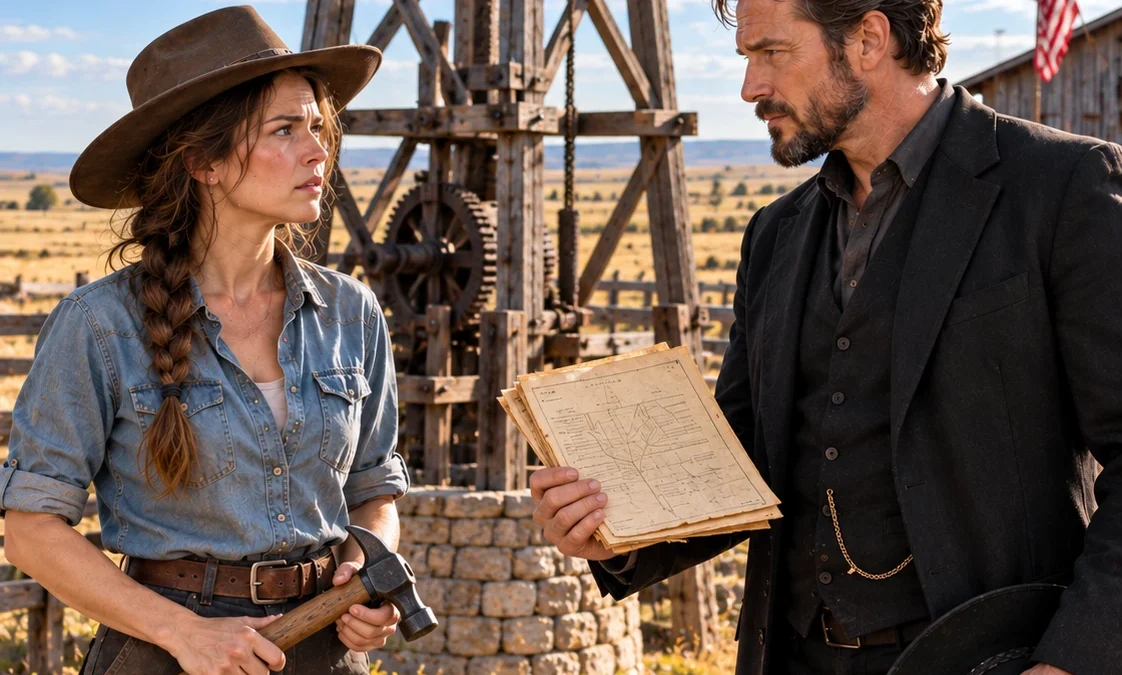
Part 2/5: A missing courthouse page threatens the sale, while a dangerous cattle rescue proves that the ranch’s future depends on experience, courage, and earned trust.
Mobeetie was little more than a dusty collection of wooden buildings near Fort Elliott, but its courthouse held records that could make families rich or leave them with nothing.
Willa arrived shortly before noon, with Barrett riding behind her. He had offered to handle the legal questions, but she had declined before they left the ranch.
“This is my father’s land,” she reminded him. “I need to be the one asking.”
Inside the courthouse, an elderly clerk named Abram Fletcher greeted her with genuine sadness.
“Your father was a good man, Miss Hartwell. Paid his fees on time and never let me forget if I made a mistake.”
“Then you’ll remember his deed.”
“I certainly should.”
Fletcher carried a heavy ledger to the counter and opened it to the records from November 1881.
His finger moved down the entries.
Then he stopped.
He turned backward, checked the numbers, and examined the binding.
“That isn’t right.”
Willa leaned closer.
“What isn’t?”
“There’s a page missing.”
The clerk held the book toward the window. Pages 141 and 142 were gone, leaving a narrow strip of paper along the stitching where someone had cut them away.
For several seconds, nobody spoke.
Fletcher looked physically ill.
“I saw that page in March,” he said. “I remember your father’s filing clearly.”
“Who has examined this book since then?”
The clerk began recalling names, including several lawyers, land agents, and Edmund Vale.
At a nearby desk, a young copying assistant named Nolan Pierce suddenly dropped his pen.
Willa noticed.
So did Barrett.
Barrett wanted to demand that the sheriff question everyone who had handled the book, but Willa spoke before he could interrupt.
“Mr. Fletcher, I need an official statement describing the missing page. Include the last date you saw it and everyone you can remember handling the records.”
Fletcher nodded.
Then he told her something important.
“The state keeps separate land-purchase records in Austin. Write to Adelaide Shaw at the General Land Office. She’s careful with her books, and she won’t accept a claim just because someone has a fancy lawyer.”
Willa left with a sealed statement and mailed her request that afternoon.
On the courthouse steps, Barrett admitted that remaining quiet had nearly broken his patience.
“Accusations won’t restore a missing deed,” Willa told him. “Evidence might.”
She climbed into her saddle.
“And that boy who dropped his pen knows something.”
The spring roundup began on May 1.
Fourteen Copper Mesa riders joined six experienced hands from neighboring rancher Cyrus Bell. A remuda of 120 horses moved across the flats, and a green chuck wagon followed the outfit from camp to camp.
Everyone knew about the sale.
More importantly, everyone had heard that Willa intended to remain after the money changed hands.
The rumors grew so ridiculous that Rafael threatened to make the next man who repeated one clean the livestock pens.
Willa ignored the gossip.
Before counting began, she invited Barrett, Rafael, and Cyrus to a high sandstone ledge overlooking the canyon.
There, she produced a more detailed management agreement.
She would retain the stone house, twelve personal horses, and authority over water, grazing, and cattle movements. The Hartwell ladder brand would remain registered in her father’s name, and she could leave whenever she chose without surrendering her earned wages.
Barrett read every condition.
“There’s something I’d like added.”
Willa looked immediately suspicious.
“What?”
“If I make a foolish decision, I want you to correct me in front of the men instead of allowing it to stand because I’m the owner.”
Cyrus laughed.
“Boy, most ranchers would rather swallow a horseshoe.”
“Then most ranchers haven’t met Miss Hartwell.”
Willa studied Barrett before adding the sentence in her own handwriting.
All four signed the agreement, with Rafael and Cyrus serving as witnesses.
The following morning, the work began.
The men gathered cattle across the open range, pushing them toward temporary corrals where every animal passed between two counting gates.
Rafael and Cyrus kept independent tallies using cedar sticks. If their figures differed by even one animal, that group went through again.
Barrett stayed away from the tally gates to avoid influencing the count.
Instead, Willa took him across the ranch, teaching him the country he intended to own.
There were eleven springs, but they weren’t equally dependable. Three weakened during August, two became dangerous after heavy rainfall, and one remained concealed beneath a rock ledge where unfamiliar riders would never think to look.
At Cedar Spring, she showed him water flowing steadily beneath the roots of a twisted cedar.
“This one kept our cattle alive during the worst drought,” she said.
Barrett watched the clear current.
“And Vale claims it belongs to his company.”
“He claims whatever he thinks somebody will be too frightened to defend.”
She explained how her father had traveled to Austin with thousands of dollars in gold to secure three essential sections. She remembered him returning home convinced that no outside corporation could ever control their water.
Now someone had removed the very record that supported his confidence.
Five days into the roundup, disaster struck at the Canadian River.
Two hundred cattle had been driven down toward the shallow water when a dozen wandered onto a sandbar that appeared solid.
It wasn’t.
Within moments, the animals were trapped belly-deep in shifting sand. Two young riders attempted to reach them, and one horse began sinking as well.
Willa arrived at a gallop.
“Get off that horse!” she shouted. “Keep your body flat and crawl!”
The frightened rider obeyed, and the relieved horse managed to struggle back onto firm ground.
Willa ordered ropes, strong horses, and the heavy canvas cover from the chuck wagon.
Barrett volunteered immediately.
“You do exactly what I say,” she warned. “Nobody gets to play hero.”
“Understood.”
They spread the doubled canvas across the unstable sand, using it to distribute their weight.
Barrett crawled toward the first trapped cow while Willa directed the men from the bank.
He secured a rope behind the animal’s foreleg, then dug into the wet sand to loosen the suction holding her down.
“Not yet!” Willa called when the waiting horses shifted. “Pull too soon and you’ll injure her!”
Only after Barrett freed enough sand around the legs did Willa signal the riders.
The ropes tightened.
The cow struggled, lunged forward, and finally dragged herself onto the canvas.
Eleven animals were rescued before nightfall.
The twelfth had sunk beyond reach.
Willa remained beside that cow longer than Barrett expected, her hand resting against the animal’s neck.
Later, while the exhausted crew gathered around a fire, Barrett sat holding a tin cup he was too tired to drink from.
Willa lowered herself onto the rock beside him.
“You listened,” she said.
“You knew what would work.”
“Knowing doesn’t help when people refuse to listen.”
Barrett looked across the river toward the place where they had lost the final animal.
“Eleven saved. That’s something.”
“It is,” Willa answered. “But we’ll record the one we lost, too.”
For the first time, Barrett fully understood why she had insisted on counting cattle instead of trusting a number written in an old book.
Honesty on the Copper Mesa wasn’t something practiced only when it produced a profit.
It applied when the truth cost money, when the work was unpleasant, and when someone had to admit that even doing everything right couldn’t save every animal.
The roundup continued for another six weeks.
And when the final tally sticks were brought to the chuck wagon, Willa discovered that her father had left behind a surprise neither she nor Barrett had anticipated.
Part 3/5: The final cattle count reveals an unexpected financial truth, while a powerful company offers Barrett an enormous reward for abandoning Willa and her father’s ranch.
The roundup lasted forty-four days.
By the middle of June, the Copper Mesa riders had pushed cattle through every accessible counting gate, searched the distant draws, and recorded every loss they could verify.
On the final evening, the men gathered around the chuck wagon while Rafael and Cyrus emptied their cedar tally sticks onto a saddle blanket.
Willa sat with her father’s ledger open.
Barrett stood nearby, saying nothing.
The two counters checked their figures separately, then compared them while the crew watched.
When the last stick had been counted, Rafael handed the result to Willa.
She looked at it once.
Then she checked it again.
Her father’s book listed 30,106 cattle.
The range count showed 30,320.
Two hundred and fourteen more animals than the old ledger recorded.
A low murmur passed around the wagon.
Rafael removed his hat.
“Your father used to say he’d rather count a cow twice in the pasture than sell one he wasn’t certain existed.”
Willa stared at the numbers.
For months, she had feared that the financial pressure facing her father might have led him to overestimate the ranch’s livestock. Instead, he had consistently reported fewer cattle than his outfit could establish.
Barrett took out his pencil and calculated the value of the additional animals at the agreed price per head.
Then he prepared another bank draft.
Willa looked at it in disbelief.
“You’re adding that to the payment?”
“We agreed on what was actually here.”
“But the difference benefits me.”
“Then your father should have counted less carefully,” Barrett answered with a small smile.
She accepted the draft without speaking.
That evening, while the crew celebrated, Willa remained near the corrals with her father’s book resting in her lap.
The numbers hadn’t simply increased her inheritance.
They had answered a question she had been too frightened to ask while Amos was alive.
He had not been disguising a failing cattle operation with false records.
He had been protecting his reputation long after the consequences could benefit him.
In July, a letter arrived from Austin.
Adelaide Shaw confirmed that the General Land Office possessed records of Amos Hartwell’s purchase, but the Continental company had filed a formal challenge.
Its lawyers claimed their railroad certificates had secured the three disputed sections in August 1881, before the Hartwell family’s rights were perfected.
Until both claims could be examined, the state would not approve a clear transfer of title.
A hearing was scheduled for the following spring.
Willa read the letter twice.
“Another eight months of waiting.”
Barrett folded his hands.
“And the final payment stays in the bank until the title is cleared. That’s the agreement.”
“I know. I wrote it.”
There was no anger between them, only disappointment.
Willa knew her father had kept a receipt from Austin showing exactly when he had paid the state. She remembered seeing the document years earlier, but after his death it had vanished from the papers in his desk.
They had the state office’s general confirmation, but the original dated receipt could settle the dispute far more decisively.
Meanwhile, Edmund Vale decided to approach Barrett without Willa present.
One brutally hot afternoon near the end of July, a covered buggy rolled into a remote line camp forty miles from ranch headquarters.
Barrett was supervising a thousand heifers with three riders when Vale stepped down wearing a tailored brown coat, polished gloves, and an expression of professional courtesy.
“I hope we can discuss an opportunity without unnecessary unpleasantness,” Vale began.
Barrett remained in the doorway.
“You have ten minutes.”
Vale smiled and unfolded a document.
His company would purchase Barrett’s interest in the Copper Mesa, return every dollar he had advanced, cover the relevant expenses, and pay an additional $200,000.
“You could leave Texas wealthier than you arrived,” Vale said. “No hearings, no disputes, no responsibility for someone else’s stubbornness.”
Barrett examined the man’s carefully arranged papers.
“And Miss Hartwell?”
“She can remain in the stone house for the rest of her life. We’ll make certain she’s comfortable.”
“She runs the ranch.”
“She’s a young woman carrying sentimental expectations about her late father’s business. That is hardly a reason for you to endanger two million dollars.”
Barrett’s expression hardened.
Vale leaned forward.
“Surely you understand the situation. You came here to purchase land, not bind yourself to a woman who insists she must accompany it.”
Barrett looked toward the distant cattle.
Only a few months earlier, he might have considered such an offer the sensible conclusion to an expensive problem.
The profit was substantial.
The escape would be easy.
Nobody on the coast would question why he had returned with more money than he took north.
But he remembered Willa struggling through the river mud, refusing to abandon trapped livestock until the final rescue became impossible.
He remembered her demanding accurate accounts when inflated numbers might have made her richer.
And he remembered being corrected beside the windmill before he had earned even the smallest right to interfere.
“She’s not part of a purchase price,” Barrett said. “She’s the finest range manager I’ve ever met.”
Vale’s smile weakened.
“You haven’t read my full proposal.”
“I’ve heard enough.”
“An extra two hundred thousand dollars is not a small consideration.”
“Neither is a man’s word.”
Vale stood.
“People reconsider when winter arrives.”
“Perhaps. But I’m not reconsidering today.”
Barrett refused the offer and left Vale’s paperwork untouched on the bench.
That night, instead of sleeping at the line camp, he saddled a fresh horse and rode toward the ranch house.
He reached headquarters shortly after sunrise, dusty and exhausted.
Willa was preparing to ride out when she saw him.
“Something happened.”
He nodded.
“Water your horse first,” she said.
Only when the animal had been cared for did they sit at the kitchen table.
Barrett placed Vale’s written offer before her.
Willa read every paragraph.
When she reached the additional $200,000, she stopped.
“You could have taken this,” she said quietly.
“Yes.”
“You could have agreed without telling me.”
“Yes.”
“Then why bring it here?”
“Because a decision concerning your father’s ranch shouldn’t be hidden from the woman who knows it best.”
She looked down at the document.
“Even though you were the one being paid?”
“Especially then.”
For several moments, the kitchen was silent.
Finally Willa asked, “What did you tell him, Barrett?”
It was the first time she had used his given name.
“I told him no, Willa.”
Neither mentioned that he had used hers, too.
She folded the offer and placed it inside the brand book.
“Then we’ll find my father’s receipt.”
They searched throughout August and September.
Rafael dismantled the tack-room flooring. The riders examined abandoned line camps, old storage trunks, and the dugout Amos had occupied before building the stone house.
Lucia searched the chuck wagon with tremendous enthusiasm and produced seventeen missing spoons, two horseshoes, and a broken pocket watch.
No receipt.
Barrett read the brand book from beginning to end, searching for clues in its margins.
Nothing.
By October, the cottonwoods along the Canadian had turned yellow, and cold mornings were settling over the open range.
One evening, Willa stood on the porch studying the northern sky.
“There’s a norther coming.”
Barrett joined her.
The sky looked clear.
“How can you tell?”
She pointed toward the horse pasture.
Every animal had gathered beneath the protected side of the ridge, with its tail turned north. Not one was grazing.
“Give it two days,” she said. “Maybe three.”
Barrett studied the horses.
The receipt remained missing.
The company’s challenge remained unresolved.
And although both had begun looking forward to their evenings at the kitchen table, neither had said anything about what might happen when the ranch was finally sold.
Two days later, a black wall appeared across the northern horizon.
The temperature fell without warning.
The cattle began moving toward the canyon.
And the windmill at the Seep started making a sound neither rancher had ever heard before.
Part 4/5: A violent winter storm nearly destroys the ranch’s most important windmill, but its damaged platform reveals a secret Amos Hartwell left for his daughter.
The norther reached the Copper Mesa in November 1883.
Barrett and Willa were inspecting the northern grazing boundary when the afternoon sky turned dark blue, almost black.
The wind struck so suddenly that Barrett’s horse staggered sideways.
Within minutes, blowing ice and sand reduced visibility to less than a hundred yards. The temperature dropped sharply, and the cattle began drifting south with the storm.
Willa understood the danger immediately.
“They’ll follow the wind until something stops them. If they reach the canyon rim, we’ll lose hundreds!”
Rafael and six men were working the eastern drift fence, leaving the western boundary dangerously exposed.
Willa turned her horse west.
Barrett followed.
For three hours, they rode through freezing wind, finding scattered cattle by their calls and driving them toward protected draws.
Barrett’s hands went numb inside his gloves. He could barely feel the reins, and ice covered his coat.
Whenever he lost sight of Willa, he followed her voice.
She knew every slope, every opening in the rim, and every sheltered passage where frightened animals could be directed away from danger.
Near sunset, they reached the main draw below the Seep.
A terrible metallic shriek rose through the storm.
The windmill was spinning out of control.
Its wooden tower shook under the force, and the pump rod slammed violently inside its housing.
The mechanism that normally turned the wheel away from excessive wind had failed.
Willa jumped from her horse and examined the chain hanging from the tower.
“Broken,” she said.
Barrett looked upward.
“Can we stop it from here?”
“Not without repairing the connection above.”
She began climbing.
“You’re not going up there in this wind!”
“If the wheel breaks loose, it’ll destroy the tank. We can’t afford to lose this water.”
He moved toward the ladder.
“Then I’ll go.”
“You don’t know the mechanism.”
That ended the argument.
Willa pointed toward an iron lever at the base.
“When I call, pull that down and keep it there. Whatever happens, don’t release it until I’m back.”
Barrett positioned himself beneath the tower.
Above him, Willa disappeared into the darkness.
For several terrible minutes, he heard metal striking metal, the violent turning of the wheel, and her boots against the wooden platform.
Then her voice came through the wind.
“Now!”
Barrett pulled the lever.
The mechanism fought him.
His boots slid across the frozen ground as he leaned his entire weight against the iron handle.
Slowly, the shrieking wheel began losing speed.
A final grinding noise echoed from above.
Then the windmill stopped.
When Willa descended, she carried something Barrett had never seen before.
A small green tin box.
Its corners were rusted, and broken nails protruded from the lid.
“I found it attached beneath the platform,” she said. “The storm tore it partly loose.”
They hurried into the stone pump house and lit a lantern.
Willa placed the box on a bench.
Inside was a packet wrapped in oilcloth.
She unfolded the covering carefully.
The first document bore the official seal of the Texas General Land Office.
Barrett held the lantern closer.
It was a receipt issued to Amos Hartwell for $9,120 in gold, covering sections 41, 43, and 47.
The date was July 11, 1881.
Willa read it three times.
“July,” she whispered. “He paid in July.”
Vale’s company claimed its certificates had secured the same land in August 1881.
Her father’s receipt showed that he had completed the purchase a month earlier.
Beneath it lay a confirming letter from Austin and a hand-drawn survey showing the disputed springs.
At the bottom of the packet was a note written on paper torn from the old brand book.
Willa recognized her father’s handwriting immediately.
The note explained that if she had discovered the box, he was probably gone and somebody was trying to take the water.
He had hidden the papers where a dishonest visitor would never think to search, trusting that his daughter would eventually find them while caring for the machinery.
His final instruction was simple.
Never allow anyone to separate the grass from the water that kept it alive.
Willa sat motionless.
“He knew,” she whispered.
Barrett lowered the lantern.
“He knew somebody might challenge the purchase.”
“No. He knew I’d be the one repairing that windmill.”
Her eyes filled.
“He was getting old. His knee hurt every morning. But he still climbed up there to leave this for me.”
Barrett took a feed sack from a shelf and placed it around her trembling shoulders.
Outside, the wind gradually weakened.
They remained in the pump house until the lantern burned low.
For the first time since her father’s death, Willa had proof that his careful planning had extended beyond his lifetime.
And for the first time since arriving in Texas, Barrett understood that the Copper Mesa was becoming something more than an investment.
He didn’t tell her that night.
There were cattle to check, fences to repair, and a document far too important to risk losing.
Willa refused to send the original receipt through the mail.
Adelaide Shaw would come to Mobeetie in March, and she intended to place it directly into the woman’s hands.
Winter settled over the ranch.
The cattle sheltered in the canyons, the springs remained open, and the storm-damaged windmill was repaired.
Barrett continued living in the small line house below the ridge, leaving Willa the family home as their agreement required.
After the norther, he replaced the mourning band on his hat with Lucia’s braided horsehair gift.
He kept the old black ribbon carefully folded inside his trunk.
Near Christmas, Willa invited him to supper.
Snow fell beyond the kitchen window while they shared beef stew and the last preserved peaches from summer.
During a quiet moment, she noticed him turning Rosalie’s ring.
“What was she like?” Willa asked.
Barrett looked surprised.
“Rosalie?”
“You’ve told me where she grew up. You’ve told me what she wanted to see. But you never told me what made her laugh.”
He smiled faintly.
“She sang whenever she worked. Couldn’t keep a tune straight, but she never cared. I’d hear her in the kitchen, out near the barn, sometimes halfway across the yard.”
His smile faded.
“After she died, the house became so quiet that I started sleeping in the barn.”
Willa watched him across the table.
“When Father died, I was afraid to move anything. His hat is still hanging beside the door.”
Barrett glanced toward the familiar peg.
“I understand.”
“I thought you might.”
She reached for the stew pot, then stopped.
“Barrett, whatever happens between now and the sale, don’t think you have to stop remembering her.”
He met her eyes.
“There’s room for the people we loved before we got here,” she continued.
He couldn’t think of an answer that would express what those words meant to him.
Instead, he thanked her quietly.
Later, when he stepped outside, he looked again at the cedar porch post.
Its last rainfall notch belonged to the winter Amos Hartwell had died.
Willa came to the doorway.
“Still no new mark,” he said.
“Snow doesn’t count. Father’s rule.”
“Then I hope we get enough rain next spring.”
“So do I.”
Neither knew that the next spring would bring a legal victory, a change of ownership, and a decision that would surprise everyone who worked on the Copper Mesa.
But first, Willa had to stand before the state’s representative and prove that her father had been telling the truth all along.
Part 5/5 (THE END): A hidden receipt defeats the company’s land claim, but after the ranch changes hands, Willa reveals what she truly wanted to keep.
Adelaide Shaw arrived in Mobeetie during the third week of March 1884.
She was sixty years old, plainly dressed, and carried a leather document case containing official records from Austin.
For twenty years, she had traveled through remote Texas counties reviewing disputed land purchases. She preferred hearing both sides in person rather than trusting letters written by attorneys.
The courthouse was crowded when the hearing began.
Edmund Vale sat with a lawyer from Fort Worth.
Willa sat across from them with her father’s brand book.
Barrett remained on a bench at the back.
He had offered to sit beside her, but Willa insisted on presenting the evidence herself.
“If you’re next to me, they’ll think I need you to speak for me.”
“You don’t.”
“Then let them see that.”
The company’s lawyer presented his certificates first.
He claimed that the Continental Land and Cattle Company had secured sections 41, 43, and 47 in August 1881, before Amos Hartwell’s purchase had been properly recorded.
He emphasized that the county ledger contained no surviving deed page establishing the earlier transaction.
Adelaide listened patiently.
Then she turned toward Willa.
“Miss Hartwell, what evidence have you brought?”
Willa opened the brand book.
She removed the oilcloth packet and laid the original receipt on the table.
“Nine thousand, one hundred and twenty dollars in gold,” she said. “Paid by Amos Hartwell on July 11, 1881.”
Adelaide examined the document.
Then she opened the register she had brought from Austin.
The receipt number matched the state’s official record.
The date matched.
The three land sections matched.
Willa felt her hands trembling beneath the table.
Adelaide turned another page.
“Now, concerning the Continental company’s certificates.”
Vale leaned forward.
“The company claims an August 1881 filing,” Adelaide continued. “But the General Land Office received these certificates on February 3, 1883.”
The courtroom fell silent.
Willa slowly stood.
“That’s after my father died.”
“Yes,” Adelaide answered.
The company’s papers had been filed long after Amos bought the disputed land. The earlier dates presented by Vale’s lawyer did not agree with the official state register.
Adelaide asked Abram Fletcher to read his statement concerning the missing courthouse page.
The elderly clerk described the cut binding, the disappearance of pages 141 and 142, and the names of those who had examined the ledger.
When Vale’s name was mentioned, he turned toward the window.
Willa looked across the room.
Nolan Pierce, the young copying assistant, sat near the wall.
“Mr. Pierce,” she said, “when I came here last April, you dropped your pen after Mr. Fletcher discovered the missing page.”
Nolan looked frightened.
“Is there something you need to tell us?”
For several seconds, he remained seated.
Then he stood.
“Vernon Slade paid me fifty dollars.”
Nobody moved.
“He told me the page wasn’t important. He promised the company would give me a better job if I removed it.”
Willa stared at him.
“You cut it out?”
Nolan nodded.
“With my pocketknife. I burned it afterward.”
The sheriff stepped forward as Nolan began explaining what had happened.
He hadn’t understood the full importance of the document, he claimed, but he knew he had done something dishonest.
Adelaide instructed him to write and sign a formal statement.
Then she turned toward Vale.
“The state records establish that Amos Hartwell purchased these sections before your company’s claim was filed. The contest is denied.”
Vale’s attorney began to protest.
Adelaide raised one hand.
“This hearing determines the land claim. Any criminal matters belong before the appropriate court.”
She offered Vale a choice: withdraw the challenge or appeal to the commissioner in Austin, where the official registers and Nolan’s confession would accompany the case.
Vale took the pen.
He signed the withdrawal.
The contest was finished.
Vernon Slade had already left the county, and no criminal conviction against Vale followed. But several weeks later, a letter from London announced that Vale had been recalled and the company intended to sell its Texas holdings.
Abram Fletcher restored the missing county entry using the verified state records, including the original purchase date of July 11, 1881, and the county filing of November 9 that year.
At last, the Copper Mesa had clear title.
In April, Barrett and Willa returned to Mobeetie to complete the sale.
The banker, Mr. Finch, examined the documents and counted the enormous final draft several times.
Then he placed the deed between them.
It described approximately 240,000 acres, the ranch improvements, the water rights, and the cattle bearing the Hartwell ladder brand.
Willa read every line.
Barrett never hurried her.
When she finished, she signed her name as seller.
He signed as buyer.
The banker congratulated them.
“I imagine you’ll enjoy your retirement, Miss Hartwell.”
Willa smiled.
“I’m reporting for work on Monday.”
She rode home alone the following morning.
She wanted the sale understood for exactly what it was: a legal transfer of property, not an arrangement that gave Barrett ownership of her future.
The following May, the spring branding brought the entire outfit together again.
Thirty men gathered around the fire while Lucia watched from the chuck wagon.
Willa lifted the first heated branding iron.
Then she turned toward Barrett.
“Before we begin, there’s something everybody needs to hear.”
The riders fell quiet.
“A year ago, Barrett Calloway offered two million dollars for this ranch. I told him I’d sell, but the land and I came together.”
Several men exchanged glances.
“Some people misunderstood that. They thought I was asking a rich man to take care of me.”
She looked directly at Barrett.
“But I wasn’t asking to be taken care of. I was asking for the chance to keep doing the work I loved.”
Her voice softened.
“The deed is signed. The ranch belongs to Barrett now. I’m his manager because that’s the arrangement we made.”
She lowered the branding iron.
“And now that nobody can mistake my meaning, I have another question for him.”
Barrett stood motionless.
Willa smiled through gathering tears.
“Barrett, would you like to stay here with me? Not because we signed a contract. Not because you paid for this land. Because we’ve made a life here that I’d like us to share.”
For a moment, he couldn’t speak.
Then he walked around the fire, gently took the iron from her hand, and passed it to Rafael.
“Yes,” he said. “More than anything.”
He kissed her while the men cheered.
Lucia shouted excitedly that she had seen the whole thing before anyone else.
Willa laughed, wiped her eyes, and took back the iron.
“All right,” she told the crew. “We’ve still got cattle to brand.”
They married in October after the fall cattle work was finished.
The ceremony took place beside the windmill where they had first met.
A traveling preacher came from Mobeetie. Rafael stood beside Barrett, Cyrus brought food for the celebration, and Lucia was allowed to watch from the stone tank’s edge while her father kept a firm hold on her dress.
Barrett wore his gray hat with Lucia’s braided band.
Before the vows, he removed Rosalie’s wedding ring from his little finger.
“I don’t know what I should do with this,” he told Willa quietly. “I won’t pretend she wasn’t part of my life.”
Willa reached into her pocket.
She took out a thin gold chain that had belonged to her mother and threaded Rosalie’s ring onto it.
Then she placed the chain around Barrett’s neck.
“She helped bring you to this place,” Willa whispered. “You never have to forget her.”
They exchanged their vows as the autumn wind moved gently through the windmill.
That night, rain began falling during the wedding supper.
It poured across the valley, filled the draws, and drummed against the stone house until nearly dawn.
The next morning, Barrett and Willa walked down to the Seep.
The stone tank was overflowing.
When they returned to the porch, Willa brought out her father’s old horn-handled knife.
She stood beside the cedar post where twenty-two years of rainfall had been recorded.
There had been no new mark since her father’s final winter.
She offered the knife to Barrett.
“It’s your house now,” she said. “And your tank.”
Barrett shook his head.
“That record belongs to your father. I wouldn’t change it without you.”
Willa placed her hand over his.
“Then we’ll make this one together.”
They pressed the blade into the cedar beneath the final row of old marks.
One new notch.
Not for the sale.
Not for the fortune Barrett had spent.
Not even for the marriage that had surprised everyone along the Canadian River.
It marked the first rain of the life they had chosen to build together.
THE END








