I bought three crates of forgotten seeds for fifty dollars while a farm auction laughed at me; months later, when drought erased the county’s crops, my father’s old notebooks revealed why a few narrow rows behind my house were still alive—and the most powerful man in town arrived with a photograph that changed everything.
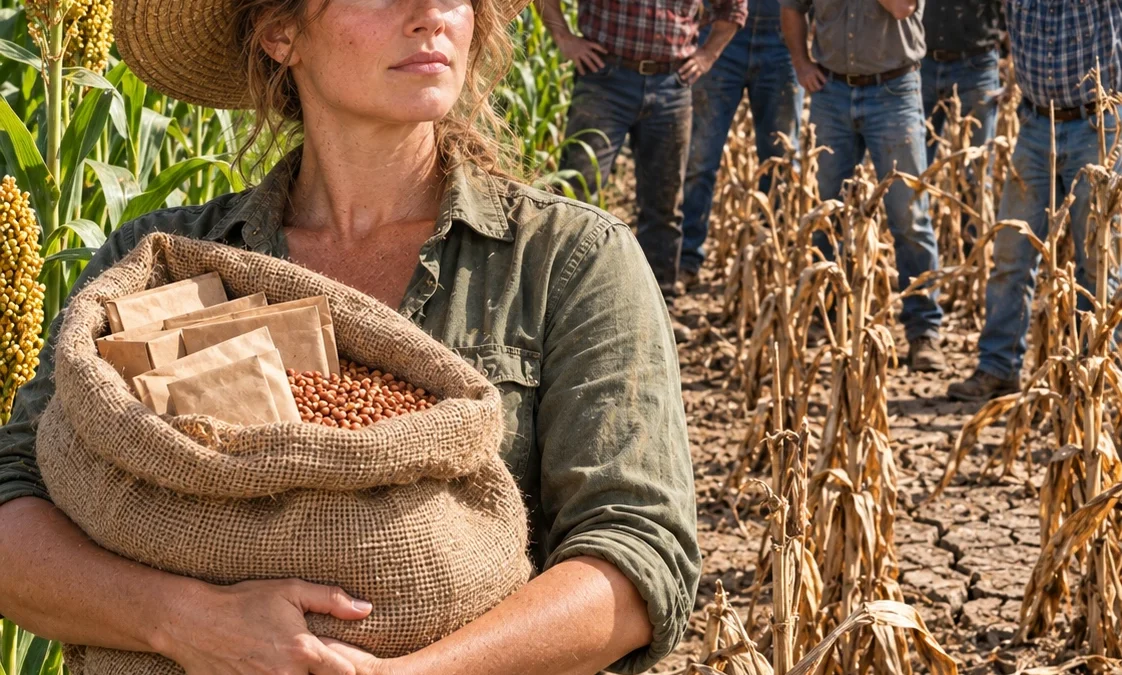
Part 2/5: When drought kills the county’s crops, my surviving rows draw attention, but the seeds’ promise remains uncertain.
Nora Bell, an extension agronomist for three counties, came out on a Thursday with a soil probe and a camera. She was forty-one, sunburned across the nose, and the kind of person who asked four questions before offering one opinion.
She walked all eleven strips, even the dead ones. Then she read my notebook, stopping at the germination page.
“You tested every lot before planting,” she said. “That’s what makes this useful. If you’d thrown old seed at the ground and something survived, it would be a story. This is data.”
She put the notebook against her chest and looked toward the flags. “But one site, one year, no replication. I can’t tell you these varieties are tougher than what’s in the dealer’s bag. I can tell you this ground held water.”
“I know.”
“You know. I know. In a week, nobody else will.”
That night, I couldn’t sleep. The crates in my mudroom held perhaps fifty pounds of viable seed. If the plants proved useful, people would want more than I had. I had twenty-four acres, no insurance, a failing pump, and a payment due.
I was still deciding what to do when the weather made the decision for me.
On the twenty-fourth, a dry south wind came up at thirty-five miles an hour and blew for eleven straight hours. It hit Kingsley Agricultural’s four-hundred-acre demonstration field along the highway. The field was planted with a new drought-tolerant hybrid, advertised on a sign at its entrance.
The wind struck during pollination. Four days later, the sign was still standing, but the crop behind it wasn’t worth cutting.
That week, someone photographed my surviving strips and posted the image to the Briar Creek community page with three words: Explain this one.
By Friday, the picture had reached every farm phone in the county.
Graham Whitaker turned into my driveway Saturday morning. He got out slowly, took off his sunglasses, and didn’t have a joke ready.
“How much of that seed do you have left?” he asked. “And what would you take for all of it?”
“I don’t know. I haven’t weighed it or cleaned it. I don’t know how much will still grow next year. I’m not selling anything until someone tests it.”
He listened, jaw working, then drove away more slowly than he’d arrived.
At supper, Russell came to my porch with his cap in his hands. “We’re done,” he said. “I’ll cut what I can for silage, but I’ll still be short on the operating note. Darla’s going back to work at the clinic.”
He looked past me toward the strips. “I have six hundred acres I’ve got to put into something next spring. I can’t take another corn year. I’m not asking for a handout. I’m asking what you planted, how you planted it, and whether I can see your notes.”
He turned his cap once in his hands. “I told you in April you were wasting your spring. I’d like that back.”
I made him come in and eat.
By seven the next morning, nine pickups lined the section road. Burl Hagen was there, the same man who had laughed loudest at the auction. The Keeler brothers had come. So had a woman from near Hoxie, fifty miles away, because her brother-in-law had shared the photograph.
They stood at the edge of the strips and asked practical questions. How deep had I planted? What was the seeding rate? How much straw had I used? Had I sprayed? What kind of soil did I have?
Someone asked if I would sell seed for fall. Another farmer pointed out that this year’s crop was already dead. The question was next April.
“Most of those crates haven’t been tested,” I said. “Some lots had zero germination. These plants haven’t made seed yet. If we don’t get rain in the next three weeks, they may produce nothing.”
Burl looked at the surviving sorghum. “But it’s alive. Mine isn’t.”
“I can tell you what I did with the water. I can’t tell you what the seed will do.”
At ten, Graham returned with a folder and asked to talk in the kitchen. Kingsley Agricultural would buy the remaining inventory, my germination records, field notes, and the rights to the trial data. The offer could pay for my pump, cover overdue interest, and erase most of the principal on the note.
They would test and clean the seeds, grow them under irrigation in two states, and reach commercial quantities in three years instead of ten.
“You don’t have a seed company,” Graham said. “You have a closet. We have storage, conditioning plants, and a budget. Nobody else here can do anything with this seed except plant it in a bad year and eat it.”
He made a fair argument. The offer was serious, and the number on the last page was large enough to let me sleep. I stood at my counter, the folder in front of me, wondering whether I was protecting something or just making my own life harder.
Then another truck pulled in.
Conrad Kingsley got out holding an old photograph. He came up the walk carefully, like a man crossing ice, and handed it to me without a word.
The picture had faded orange. Nine people stood in a field behind short rows of wooden stakes. In the back was a tall man wearing a feed store cap, one hand on another man’s shoulder.
It was my father.
I turned the photograph over. On the back, someone had written: Briar Creek Dryland Trial, full field review.
“Your dad and I weren’t friends,” Conrad said. “I want to be straight about that. I’ve been looking for anything that might grow here on nine inches of rain. This was in the files.”
He paused. “Did Caleb ever tell you why the program ended?”
He never had.
Part 3/5: An old photograph leads me to the truth: my father tested the seeds’ growing methods, and the forgotten trial ended unfinished.
My father talked about weather, cattle prices, and the Kansas City Royals. When he talked about work, he talked about equipment. Whatever he had done with stakes and a clipboard out west of town, he had done quietly, then put the notebooks in a feed box beneath a coffee can of bolts.
It took Everett and me four evenings at the kitchen table to understand what we were looking at. Nora joined us on the second evening and stayed past midnight.
The feed box held three more notebooks and a sealed manila envelope I’d assumed contained tax records. Inside were carbon copies of stand-count sheets, a hand-drawn field map divided into forty-eight rectangles, and letters from a regional dryland research program funded by state money and a growers’ association.
Each rectangle had a code. Half began with B and C.
“There it is,” Everett said, pointing to the west edge of the map. “West block. I set those stakes. I was twenty-four and thought it was the dullest work in America.”
The codes matched the packets. Not all of them, but enough. About a third of the crates were ordinary commercial lots, old but unremarkable. The stamped packets corresponded to the trial’s entries: proso and pearl millet from four sources, eleven grain sorghum lines, cowpeas, and two failed forage lines crossed out on the map.
It wasn’t one special variety. It was a screening program. The researchers had tested anything they thought might survive on dry ground and recorded what happened.
The letters explained why the program stopped. In a year when irrigation was expanding and high-yield corn brought in far more money, the state appropriation disappeared. A letter apologized for the short notice and said the remaining materials would be held at the cooperating dealer until they could be transferred. The transfer never happened.
Someone left three crates beneath a workbench at Dunphy’s. Twenty-three years later, the store closed, and they sold for fifty dollars.
“So they’re not special?” I asked.
“That’s not the right word,” Nora said. “Some lines could be very good for this ground. But there’s no magic seed in those crates. If people start claiming there is, this turns into a rumor, and the work is finished before it starts.”
Then I saw the part I’d missed. My father’s name wasn’t on the list of seed varieties. He hadn’t bred any of the lines. His part of the trial had been the management plots: residue cover, planting date, stored soil moisture, and furrow design.
The reason five of my strips had survived wasn’t that I’d stumbled onto a secret seed. It was that I’d planted decent old seed early, into standing stubble, beneath straw, and on contour furrows that caught and held the May rain.
I’d followed my father’s notes without knowing what they meant.
The seed was half the answer. My father’s work was the other half. Neither would have mattered without the other.
“He’d have liked that,” Everett said. “He used to say the ground gets a vote.”
The next morning, Nora pulled measured samples from every stamped lot and sent them to a laboratory in Manhattan for germination, purity, and seed-borne disease testing. She also made sure nobody planted unknown seed on acres they needed to support a family. I documented the location and weight of every packet, and she wrote a short summary explaining what the strips did and didn’t prove.
Conrad returned while the plot map was still on the table. He looked at it for a long time.
“My father sat on the growers’ board that funded this,” he said. “He voted to let it go. I have the minutes.”
He didn’t try to excuse his father. He said he’d started buying water he didn’t own two years earlier and had run the numbers on the company’s future. They weren’t good.
“I’d rather be early than right,” he said. “You think I want to control it all. I want it handled carefully. If it gets mixed in someone’s grain cart, or planted wrong and fails, the work is finished. The next person who tries it gets laughed at.”
I almost respected him for saying it plainly. That made him harder to dismiss.
Eleven days later, Nora drove to my house with the lab results. Nine lots were clean, true to type, and better than she expected. Four had germination rates above seventy percent.
Together, those lots amounted to about thirty-one pounds of seed worth multiplying.
“That’s it?” I asked.
“That’s a garden,” she said. “If you hand it out next week, every farmer gets a coffee can. They plant on different soils, in different ways, and in two years there’s nothing left to go back to. You have one shot to increase it properly.”
August gave us no relief. The sorghum entered grain fill during eight days above a hundred degrees, with wind that never quit. I walked the strips every evening, splitting seed heads with my thumbnail to see whether the grains were filling.
Some filled from the top down and stopped halfway. One produced nothing. The millet made what I would have called a decent crop in an ordinary year, and a small one in any other.
Then the bank’s letter arrived. It wasn’t a foreclosure notice. It gave me three weeks to submit a written plan showing I could make the payments the following year.
I read it twice at the mailbox, folded it into my coat, and drove to the scale house without telling anyone.
That same week, Conrad improved his offer. Kingsley would give me enough to clear the arrears and repair the pump. In exchange, the company would have the exclusive right to purchase all seed from those lines for seven years and own the commercial use of the trial data, including my father’s records.
I would keep my name on the work. I would keep my farm.
I didn’t sign.
Part 4/5: I refuse an exclusive deal, but debt and fear nearly keep me from sharing the work with my neighbors.
I sat in my truck outside the bank with Conrad’s folder on the seat. The offer would solve problems I’d been carrying for years. It would fix the pump and take the pressure off the note.
But I kept thinking about the seven years. A farmer who wanted to plant forty acres would have to call Garden City and ask permission. If the work belonged to one company, the people who needed it most might never be able to use it.
On Sunday, Russell arrived with five farmers and a legal pad. They’d been talking about the idea for two weeks at the café before bringing it to my door.
Eleven families were willing to put in a thousand dollars each, or contribute the equivalent in labor. Russell had an empty machine shed with a concrete floor that could be sealed and cooled. The Keeler brothers had a seed cleaner and a planter suited to small-seeded crops. Burl Hagen offered eighty acres for increase plots.
“Under Nora’s protocols,” Nora said, “or not at all.”
“We’re not asking you to give us anything,” Russell told me. “We’re asking you to put the seed somewhere better than a closet. We’ll build the closet.”
I said no before I could think it through. The seed wasn’t tested enough. Eleven families meant eleven chances to make a mistake. If Burl’s eighty acres failed, I’d be the one who’d encouraged him to risk it.
I’d spent my whole life making sure that when something went wrong, it went wrong only for me.
The men left politely. Eli watched their trucks pull away and asked why I was mad. I told him I wasn’t.
“Okay,” he said, in the careful way children do when they know better.
Everett stayed to help me move the crates into the shop. When we finished, he stood at the workbench.
“You want to know what happened to your father’s program?” he asked. “The money got pulled in March, but those plots were still out there in September. Your dad kept running them on his own time for two more seasons. Nobody knew because he never asked anyone for anything. When he got sick, there was one person who understood those notebooks. It was him.”
He picked up a packet and set it down.
“Those crates sat under a bench for twenty-three years. That’s what doing it by yourself buys you.”
I was angry at him for three days. Then I called Nora.
What we built over the next month was smaller than Russell’s legal pad had promised, but real. Nora wrote the protocols. We would test nine lots at three locations, with staggered planting dates and enough space between the sorghum lines to prevent cross-pollination.
Two people would record every stand count. A sample from each lot would stay at Russell’s shed, with a duplicate at the extension office. Nothing would be sold until we had enough seed to make a sale worthwhile. No family would risk land it needed for income.
I kept the original packets.
I didn’t sign Conrad’s exclusive offer, but I didn’t shut him out. Nora helped me write a counterproposal: Kingsley would get early access to evaluation data and could negotiate a license for commercial production later. In return, the company would provide conditioning and cold storage at cost.
Any grower in the county could get seed from the cooperative under the same terms.
Conrad read the proposal in his truck for eleven minutes with the engine running.
“You understand you’re leaving a lot of money in the field,” he said.
“I understand I’d be the only one getting paid.”
He looked ready to argue, then decided not to. “I’ll take it to my people.”
Three weeks later, Kingsley agreed.
The bank was less flexible. I went to Mr. Daughtry with a cash-flow plan that depended mostly on work outside my fields: the scale house, the feed yard books, a small paid contract to host and manage increase plots, and the silage value of my failed corn.
I asked for eighteen months of interest-only payments. He gave me twelve months at a higher rate, with a review in spring. If the plan failed, he told me, there would not be another review.
I signed in a room that smelled like carpet glue and walked out feeling as if I’d bought myself a year with money I didn’t have.
In September, forty people filled the Legion Hall for a meeting. Nora presented the lab results and protocols, using the word maybe often enough to keep anyone from mistaking possibility for proof. People asked hard questions about ownership and access.
Near the end, Graham stood up.
“I made a joke about Mara at Dunphy’s in February,” he said. “I’d like to own that. I looked at twenty-four acres and decided small meant she didn’t know anything.”
He shrugged. “I’ve got a four-hundred-acre field on the highway that says otherwise.”
I’d planned several things to say to him someday. None came out. I set my father’s notebooks, my spiral notebook, and the plot map on the table.
“I didn’t save these seeds because I knew they’d work,” I said. “I saved them because nobody had bothered to find out.”
We harvested the strips in early October with a plot combine borrowed from the extension office. Four lots disappointed us. One failed completely. The nine good lots made less than I’d hoped for in June.
But they filled a handful of buckets. We weighed them, tagged them, and carried them into a cooled shed.
It wasn’t a crop. It was a start.
Part 5 (THE END): The cooperative grows slowly, and the real harvest becomes a shared habit of testing, learning, and recording.
The drought broke in pieces, the way droughts do. November brought two inches of wet snow. January was dry again. In March, wind stripped topsoil from every field that had been worked black in the fall.
My ground, with its standing stubble, stayed put. Three neighbors noticed that before they noticed anything about the seeds.
The Briar Creek Seed Cooperative filed its paperwork in February and held its first meeting in Russell’s shop, with a space heater hissing in the corner. Eleven families joined. Then two left because the terms felt too restrictive. A woman from near Hoxie came down and asked to take their place.
The cooperative’s assets were a seed cleaner, a cooled shed, eighty acres of increase plots, a borrowed moisture meter, and thirty-one pounds of seed that had spent twenty-three years under a workbench. Its first meeting included a two-hour argument about record keeping. To my surprise, I enjoyed it.
Spring was uneven. Two increase plots came up beautifully. A May storm dropped an inch and a half of rain in twenty minutes on ground that hadn’t been contoured, and washed out a third plot.
Nora stood in the mud afterward with her hands on her hips.
“Failure is data, too,” she said.
Nobody laughed.
Russell planted ninety acres of one sorghum line that had done well in my strips. He put it into standing stubble and told everyone at the café he expected to be wrong about half of it.
He got a crop. Not a great one, but a crop in a year when his corn ground produced nothing. That was the number that moved people.
Nobody got rich. Some farmers who had wanted a miracle seed went back to buying what they’d bought before. The ones who stayed with us were willing to measure things.
Kingsley Agricultural didn’t collapse, and nobody punished Conrad. That wasn’t how it worked. He lost money on the corn year and sold a quarter section in Finney County to cover it. His company came out smaller and more careful.
He honored our agreement, conditioned the cooperative’s seed at cost, and planted four hundred acres of his own using residue management his operations manual had discouraged for fifteen years. The following April, he asked me to join an advisory group on dryland adaptation.
I said I’d think about it. Then I agreed, with conditions.
Graham hauled seed for the cooperative under a written contract at a fair rate and handled cold-storage logistics himself. He never apologized again. I came to understand that for a man like Graham, equipment was its own kind of apology.
I kept the farm. That sentence hides a year of work. I ran the scale house four mornings a week, did the feed yard books, hosted the increase plots, and rebuilt the pump with Hollis instead of replacing it. The note still came up for review every spring.
Daughtry extended it again at a rate I didn’t like. His letter said the plan was performing as presented. I didn’t frame it. I put it in the file.
The wooden box stayed on the shelf in the mudroom, where the floor was cold. Inside it, I kept my father’s notebooks, Everett’s plot map, the faded photograph of nine people in a field, and one unopened packet stamped BC-17.
I never planned to plant that packet. It wasn’t an heirloom or a trophy. It reminded me that my father’s legacy wasn’t a seed that made anyone rich. It was the habit of writing down what happened and refusing to throw away a question just because the answer stopped being profitable.
Eli turned twelve in April. He took stand counts for the cooperative, two rows at a time, licking his thumb to separate the seeds. It still wasn’t the right method.
On a Saturday morning late that month, I stood beside the new increase plots with a clipboard under my arm. Trucks turned in from the section road. There were more than the summer before.
Nobody came up the driveway asking me for a miracle. They brought their own seed and buckets, moisture probes and tape measures, spiral notebooks of their own.
They spread along the flagged rows and started writing things down. For a while, the only sounds were boots on dry dirt and people calling numbers to be recorded.
I’d paid fifty dollars at a liquidation sale for three crates a store had been ready to throw away. The money hadn’t bought a miracle. It had bought me the chance to ask a question nobody else thought was worth asking—and the long, stubborn work of finding out with my neighbors instead of alone.
Sometimes what the world calls worthless is only something it stopped trying to understand.
And sometimes the greatest harvest isn’t what grows in your own field. It’s what you help the people around you grow in theirs.
THE END
Ghi chú thay đổi: Willa Hart thành Mara Ellison; Dalton thành Eli; Caleb Hart thành Caleb Ellison; Graham Whitmore thành Graham Whitaker; Russell Pike thành Russell Pike; Nora Bellamy thành Nora Bell; Everett Boone thành Everett Boone; Conrad Kingsley giữ nguyên. Bối cảnh Briar Creek, Kansas và đơn vị USD được giữ nguyên vì câu chuyện gốc đã đặt tại Mỹ.
Kết thúc: Mình giữ cái kết có sẵn trong bản nguồn, không thêm cú twist mới. Mara giữ được trang trại và cùng hàng xóm lập hợp tác xã giống; di sản của cha cô là phương pháp ghi chép và chia sẻ kiến thức, không phải một loại hạt giống kỳ diệu.








