I paid my parents’ mortgage for six years. Then I found out the house was going to my brother—and that my parents had already put my name on a new loan application.
Part 2
The next five years looked ordinary from the outside. That was part of what made it easy to keep going.
In 2022, I found a little house in Jonesboro that I liked. Two bedrooms, a carport, and an old pecan tree in the front yard. If I stopped paying my parents’ mortgage for eight months, I could probably cover the down payment.
I brought it up at Sunday dinner.
Mom set down her fork. “Joel, we can’t go eight months without that payment. You know that.”
Then she added, “You’ve got time. You don’t even have a girlfriend.”
I let the house go.
In 2023, Nick moved his car business into Dad’s shop. He said he only needed room for one truck, but soon there were four. A vinyl sign went up on the roll-up door: Nick’s Garage.
Dad’s tools were pushed into the corner by the wood stove.
I asked Dad how he felt about it. He glanced toward his tools. “Your mother says I don’t use the shop much anymore.”
That spring, Nick turned thirty. Mom threw him a party in the shop, with a banner that read, “The future is Nick’s.”
Everyone laughed. I was standing beside the wood stove with a paper plate in my hand. I laughed, too.
In 2024, homeowners’ insurance went up after a bad hail season. The bank sent a notice: the escrow account was short $2,300. I paid it out of the little I’d managed to save.
“Oh, good,” Mom said when I told her it was handled. “Nick said you’d take care of it.”
I stood in my kitchen holding the phone. Nick knew exactly who was paying. He’d never once said a word to me about it.
That Christmas, Dad gave him the big key ring that had hung by the back door since I was a kid: the shop key, the gate key, the key to the old Ford.
“You’re the one out there,” Dad said.
Mom clapped. “This place is going to be in good hands someday.”
I thought she meant the shop. I thought a lot of things that year.
Whenever I hesitated about giving Nick a ride, helping move a car, or giving up a weekend, Mom used the same line: “Family helps family.”
It always seemed to mean I helped and Nick received.
Last summer, Nick bolted a two-post lift into the shop floor. It cost $9,000, financed through the company that sold it to him. He sent me a video of a truck rising above the concrete.
I drove out and stood beneath it.
“Nick, that’s bolted into the floor of a house with a balloon due in January.”
Mom told me not to worry. “It’s handled.”
I knew who handled it. I’d been handling it for five and a half years.
In November, Mom called and asked for my last two pay stubs.
“For the insurance,” she said. “They want to know who’s paying.”
“Insurance cares whether the premium is paid. It doesn’t need my pay stubs.”
A pause. Then: “Your credit’s still good, isn’t it? You never ran up cards.”
“Why?”
“No reason. A mother can be proud.”
She got off the phone quickly.
At Thanksgiving, Nick asked if I was still working for the same pipeline outfit. Later, by the dessert table, he asked, “You’re not going anywhere, are you?” He laughed as if he’d made a joke.
Mom mentioned that Gerald Haskins had asked about me at church. She said he remembered me from the loan meeting and thought I’d asked good questions.
Dad barely looked at me through dinner.
In December, Dad called and asked me to stop by. The homeowners’ insurance renewal had arrived, and since I was covering the escrow, I usually checked that the premium matched the bank’s records.
Mom was at work. Dad was in the shop, watching Nick change a tire beside his space heater. He called from the back, “Grab the folder in the hall closet.”
The folder was labeled HOUSE in Mom’s handwriting. The renewal notice was on top. Behind it sat a thick packet with a blue cover from a Jonesboro law office.
Revocable Living Trust of Lowell and Darla.
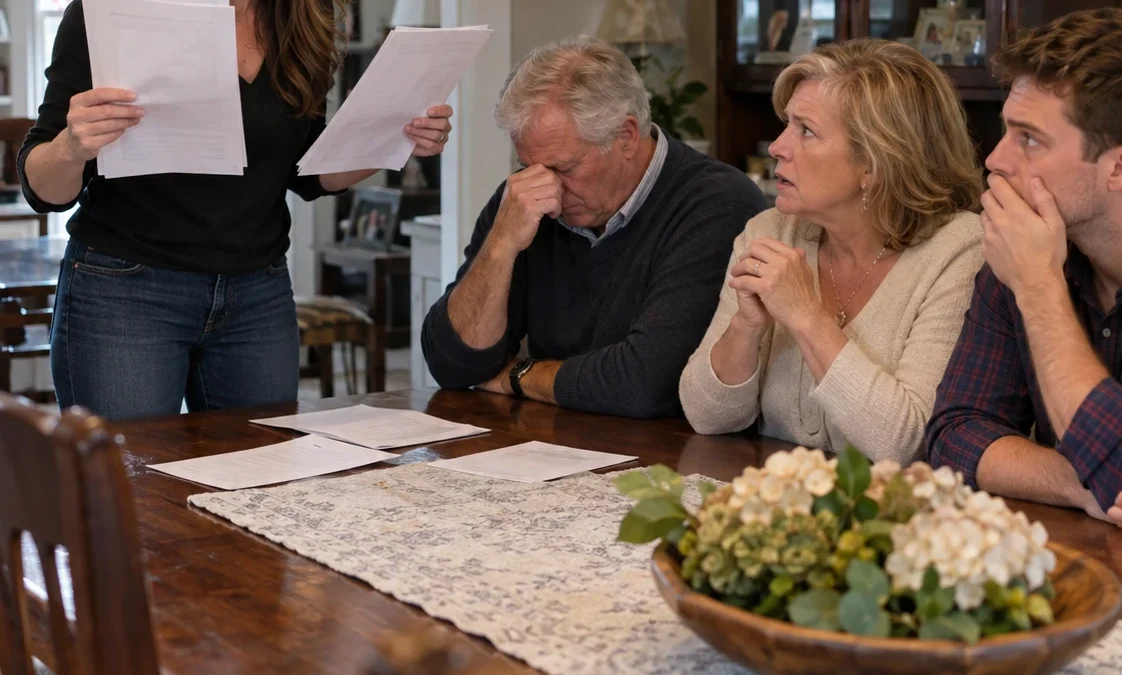
I read the first page standing up. I read the next sitting on the arm of the couch.
The trust said that after my parents died, the house, all fifteen acres, the shop, and its contents would go to their son Nicholas. Nick was also named to manage the trust.
On page five, one sentence sat by itself: “We have intentionally made no provision for our son, Joel.”
They had signed it November 12th.
I photographed every page on my phone, slid the packet back behind the insurance renewal, and carried the renewal out to the shop.
“Premium go up?” Dad asked.
“A little.”
Nick lowered a truck from the lift. “Hey, Joel.”
Like it was a normal day.
I sat in my truck for a while before driving away. It was facing out.
Seventy-two payments. $133,200. That didn’t include the escrow shortage, a water heater, a roof patch, or the time I covered Nick’s tire bill after his card was declined.
And the balloon payment was due January 31st. My parents couldn’t refinance on Dad’s pension and Mom’s three days at the fabric store. Not without help.
That night, I canceled the automatic transfer. It took about four minutes.
January 1st came and went. Nobody called.
On January 16th, the bank’s grace period ended. That afternoon, my phone buzzed on the tailgate of my truck at a job site near Truman.
“You’re late this month.”
No “Are you okay?” No “Did something happen?” Just a bill from my mother for a house she’d signed over to my brother.
I typed, “Ask Nick. It’s his house.”
Mom called four times that night. I let it ring. Dad texted, “Call your mother.”
I didn’t.
A week later, car doors shut outside my rental. Mom walked up in her good coat, clutching a manila folder. Nick followed in a hoodie, his hands in his pockets.
“We need to talk like adults,” Mom said, walking inside before I answered.
She sat at my kitchen table without taking off her coat. Nick leaned against the counter.
“The bank can give us a regular thirty-year mortgage,” she said, opening the folder. “But we need a second name. Someone with a steady income.”
“How does Mr. Haskins know what I earn?”
“I told him you weld.”
She pushed a paper toward me.
“It’s nothing, Joel. You’re paying it anyway, honey. It’s just your name on a paper.”
I looked at the application. “Who gets the house when you and Dad are gone?”
Mom blinked. “That’s a separate thing.”
“Is it?”
Nick shifted against the counter. “The trust is just a legal thing. It’s not personal.”
“It has my name in it, Nick. That’s pretty personal.”
Part 3
Mom closed her eyes for a second, the way she did when a clerk at the fabric store was taking too long.
“The trust is just in case,” she said. “You’d never need it. You have your welding. Nick has nothing to fall back on.”
“Nick has a $9,000 lift bolted into the floor of the house I’ve been paying for.”
“Joel,” Mom warned.
“No. I’m not co-signing. I’m not paying January. I’m not putting my name on a loan for a house I’m not allowed to inherit.”
“Your father will lose his house.”
“Dad signed the trust.”
“Your father doesn’t read what he signs.”
“Then he can start.”
Nick pushed away from the counter. “You’re seriously going to let Mom and Dad lose the house over a piece of paper?”
“You’re the one getting the house. You co-sign.”
He laughed, but there was no humor in it. “The bank won’t take my income. You know that.”
“Yeah. I know.”
Mom buttoned her coat. She left the folder on the table.
“We have an appointment at Delta Ridge on Thursday the twenty-ninth at two. You’ll be there.”
Then she said what she’d said my whole life: “You always do the right thing, Joel. You always come around.”
They drove away with Nick behind the wheel. He clipped my trash can on his way out.
I opened the folder. It was a loan application with my name typed in as co-borrower. My employer was listed. My phone number was listed. The signature line was blank, marked with a yellow sticky arrow in Mom’s handwriting.
She had bought the stickers already.
Nick came back on Monday by himself. He brought a twelve-pack of the soda I liked when I was fifteen.
He sat on my porch step. “Look, I know the trust is weird. Mom gets ideas. But be real with me—you don’t want fifteen acres out in Bono. You’d sell it the day after the funeral.”
“Maybe. That’s not the point.”
“So what is?”
“You get the house. I get the bank.”
“It’s not like that. You’d just be a name on there. Haskins says once you sign, it’s done. Nobody can pull out. It’s thirty years of nobody worrying. Mom and Dad stay, I keep the shop going. Everybody wins.”
“Haskins told you that?”
Nick hesitated. “Mom told me. Whatever. Somebody said it.”
“No.”
He stood and left the soda on the step. This time, he backed out of the driveway without hitting anything. I guess he’d been practicing.
“Once you sign, nobody can pull out” wasn’t how you described a favor. It sounded like somebody describing a trap they thought was clever.
That weekend, I went house hunting for the first time in years. I hadn’t made some grand plan. I’d just realized that $1,850 would remain in my account on February 1st, March 1st, and every first of the month after that.
A small brick house on the north side of Jonesboro caught my eye. One story, carport, big front porch, and two empty hooks hanging from the ceiling. The sign said FOR SALE BY OWNER.
I backed into the driveway.
A woman in hospital scrubs was sitting on the steps with a cup of coffee. She watched me get out.
“My dad parked like that,” she said. “My papa taught me.”
“Did he say you never know when you’ll have to leave?”
She laughed. “Word for word. I’m Tess.”
The house had belonged to her father, Bobby, who had died in October. She’d been caring for him near the end, while her brothers called on Sundays. She said it without bitterness, like she was describing the weather.
The kitchen floor looked like it had been installed in 1979. The house needed paint. The back bedroom window looked out at a pecan tree, and I stood there longer than I meant to.
On the porch, Tess asked, “So, what are you leaving?”
I looked at her.
“You park like you’re leaving,” she said. “Dad always did. Usually it was church. So, what is it?”
I gave her the short version: six years, the trust, page five. She didn’t tell me it was terrible. She looked at the empty hooks above the porch and said, “Huh. Well. This house never asked anybody for anything.”
I made an offer that week.
On Tuesday, two days before the bank appointment, Gerald Haskins called me at a job site near Lake City.
“Joel, I’m just making sure we’re squared away for Thursday. I’ll need two years of tax returns and your signature on the credit authorization. We’ve had the file open since November tenth, so we’re tight on time.”
I stopped walking. “November tenth?”
“Your mother and brother came in that day. I was told you’d be on the loan from the beginning.”
“Was I told that?”
There was a pause. Mr. Haskins was careful with his words. “I think we’d better talk Thursday.”
I hung up and opened the pictures of the trust on my phone. The loan file had been opened November 10th. My parents had signed the trust disinheriting me November 12th.
They opened the loan with my name. Two days later, they signed the house over to Nick.
The pay stubs weren’t for insurance. Mom had asked for them on November 2nd. They were for the bank.
I sat in my truck by a rice field for twenty minutes. Then I drove to the Jonesboro library, printed every page of the trust, and put it in a folder.
Thursday, January 29th, I arrived at Delta Ridge at 1:55. I backed into a spot in front of the window.
Mom was already in Mr. Haskins’s office in her church dress. Dad wore the pressed shirt he saved for funerals. Nick had on a windbreaker with a car dealership’s name across the back.
Mom squeezed Dad’s knee when I walked in. “See? There he is. I told you.”
Mr. Haskins shook my hand and gestured toward a stack of papers with yellow tabs.
“Thank you for coming, Joel. We’ll start with the credit authorization—”
“Can I ask two questions first?”
He glanced at my folder. “Go ahead.”
I took out page five and set it in front of him. Then I read the sentence aloud so Dad couldn’t miss it.
“We have intentionally made no provision for our son, Joel.”
Part 4
Nobody spoke. I could hear a printer running in the next room.
“Question one,” I said. “If both my parents pass, who owns the house?”
Mr. Haskins didn’t look at Mom. “According to the trust, the house and land go to Nicholas.”
“Question two. If I sign this loan today and something happens to them, who owes the bank?”
“You’d be a co-borrower. You’d be responsible for the full balance, jointly.”
“So my brother gets the house, and I get the loan.”
“As written, yes.”
Mom tried to cut in. “Joel, that’s not how it would work. You know your brother would—”
“Mr. Haskins, who’s listed as the contact on this file?”
He turned his monitor so we could all see. The notes field read: “Contact: Nick, son. Brother will co-sign. Has paid it for years anyway. File opened November 10th.”
Nick’s voice rose. “That’s just what I told him. It’s not—”
“You told him I’d co-sign before I knew there was anything to co-sign.”
“You always do,” Nick said. “You’ve paid it for six years. What’s one more paper?”
Mom leaned toward me. “He was just helping, Joel. Nick was helping.”
Then Dad spoke.
He wasn’t looking at me. He was looking at Mom. “Darla, you told me he offered.”
Mom’s face went still.
“You told me Joel came to you and offered to go on the loan,” Dad continued. “You said he’d take the loan and Nick would get the house, and that was fair. That’s why I signed it.”
“Lowell, not here.”
“You told me he offered.”
Dad’s hands rested flat on his knees. They were the same hands that had repaired buses before sunrise, and now they were still on his trousers while he stared at the bass mounted on the wall.
Mr. Haskins cleared his throat. “There is another option. The Gaddis family next door has been interested in the back ten acres for two years. If you sold that section, the loan would be small enough for you and your wife to carry without a second borrower.”
Dad sat up slightly.
Mom said, “No.”
“Ma’am, those acres are Nick’s,” Mr. Haskins said.
Nick answered for her. “That’s where the second building goes. We’ve got plans for that.”
Mr. Haskins put down his pen. “Then I need to be straight with you. Without a co-borrower and without selling acreage, you can’t refinance. The balance comes due Saturday. I can extend the date ninety days so you can sell the property in an orderly way.”
Mom turned to me. “Joel, your father’s house.”
“Dad can sell ten acres to the Gaddis family. That’s Dad’s choice. And yours.”
“After everything we’ve done for you.”
I stood and returned page five to my folder. “Mom, I paid seventy-two of them.”
Mr. Haskins looked down at his yellow tabs. “There’s also the January payment. It’s showing late.”
“I’m not late,” I said. “I’m done.”
I thanked him. He stood and shook my hand.
I walked out, got in my truck, and pulled straight out of the parking spot without reversing.
The next ninety days were mostly text messages. Mom sent long ones about how I’d embarrassed the family in front of a banker who went to our church, how Dad couldn’t sleep, how hard Nick had worked, and how much she’d done for me.
I read them. I didn’t answer.
Nick sent one message: “You’re making Mom and Dad homeless. Hope you’re proud.”
I replied, “The Gaddis family is still buying. Sell them ten acres.”
He didn’t answer.
They didn’t sell the ten acres. Mom kept saying I’d come around. Nick did, too.
Later, I heard from Mr. Haskins’s wife that Mom had told the church prayer chain her oldest son had abandoned her. She could tell the story however she wanted. The bank didn’t read the prayer chain.
With five weeks left on the extension, my parents finally listed the whole property: all fifteen acres, the house, and the shop.
In April, it sold to a couple from Paragould who ran a diesel repair business. They walked into the shop, saw Nick’s lift, and the husband said, “Well, that settles it.”
Nick showed up with a borrowed trailer and a socket set. The buyer’s agent told him the lift was bolted to the slab, listed in the photos, and included in the contract.
It stayed.
Nick still had about twenty payments left on the $9,000 lift. He moved his trucks to a gravel lot behind a tire store and started paying rent by the week.
The Saturday before closing, I drove past my parents’ place. I didn’t stop. I slowed down on the gravel road.
The vinyl letters on the shop door had started peeling. It read “Nick’s Gar” before the rest came off.
Dad was out front, loading his tools into the bed of his truck one at a time. He did it carefully, the way he used to line up wrenches on a bus fender.
Nick wasn’t there. Mom wasn’t there.
Dad looked up when he heard my tires. He didn’t wave. Neither did I. But he watched me until I reached the end of the road, and I watched him in my mirror.
After the mortgage, commission, closing costs, and late fees were paid, my parents had about $70,000 left. They rented a duplex in Jonesboro near the hospital.
The trust still existed. Everything in it still went to Nick. For now, everything in it was a lease.
People ask what happened to the $133,200 I paid. It was gone. I knew it the night I canceled the transfer.
I wasn’t going to sue my parents, and I wasn’t going to send my mother a bill for the roof over her head. But those six years showed me where I stood while I still had time to make a choice.
If I’d found that trust after the funeral, I might have been forty-five or fifty, tied to a loan on my brother’s house. I’d rather learn the lesson early.
My offer on Tess’s father’s house went through. We closed the same week my parents sold theirs.
A few days after I moved in, a coffee can appeared on my porch. Inside were two lengths of chain with hooks. A note was written on the back of a pharmacy receipt.
“Dad took the swing down when he got sick. It’s in the shed behind the carport. These are the chains, in case you want to hang it. —Tess”
I found the swing under a tarp. Its white paint was peeling, but the boards were solid. I sanded it, painted it, and hung it from the hooks that had been empty when I first saw the house.
Dad came by once in May without calling ahead. His truck was parked across the street. He stayed behind the wheel until I walked over.
“Nice place,” he said through the open window.
“Thanks.”
He looked down at the steering wheel. “I should have read it.”
“You should have.”
He nodded. Then he drove off.
Mom sent one more text on Mother’s Day: “I hope you’re happy. Your brother has nothing.”
I read it twice, set my phone in the kitchen drawer, and went outside.
Tess stopped by a few times that spring. First, she showed me where her dad had hidden the water shutoff behind a loose board. Then she brought a pecan pie made from a recipe she admitted she’d copied from a syrup bottle.
The third time, she came over without bringing anything. Neither of us mentioned it.
I kept backing into the driveway every night after work. Twenty-six years of habit didn’t disappear because I’d bought a house.
Then one Thursday in June, I came home sunburned and tired from a job near Marked Tree. Tess’s blue car was already in the driveway. She sat on the porch swing, two glasses of iced tea sweating on the railing beside her.
I waited in the street for a moment with my blinker on.
Then I pulled straight in, nose first, for the first time in my life.
Tess raised an eyebrow. “You pulled in.”
I walked up the steps and sat beside her on her father’s swing. The chains creaked.
“I’m not going anywhere,” I said.
She handed me the tea.
THE END








