I spent nineteen years finding hidden damage in boats, yet I missed the betrayal being prepared inside my own home. Then my missing wife’s belongings appeared in a storage unit rented under my name, and a tide chart showed me where she might be held…
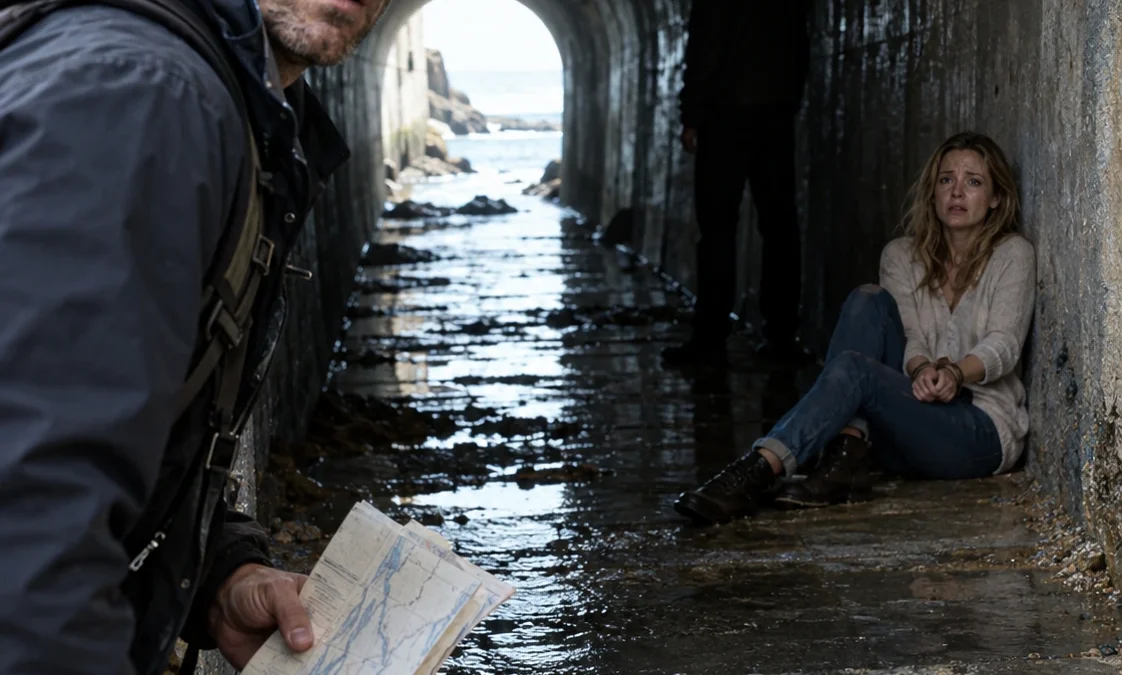
Part 2/5: With the payout date approaching, I follow a swamp-water clue while police struggle to secure a warrant and time runs short.
On Wednesday, Glenda called to say the judge hadn’t approved a warrant. The letter came from a woman presumed dead, the chart named a creek but no address, and no one had seen a crime in progress.
“He asked me to come back with a house,” she said.
“He leaves Friday at dawn,” I replied.
“I’m working it from every direction. Stay put, Caleb.”
I stayed put until the call ended.
At nine that morning, Margaret appeared on my porch with an emergency custody petition and a man in a gray suit. She had heard about the storage unit from someone at the courthouse. She believed I had hidden evidence and wasn’t fit to raise the twins.
“Read this before you give it to anyone,” I said.
I showed her a photograph of the tag from Ruby’s tooth. Margaret stared at the screen. She recognized Elise’s handwriting, especially the way she formed her sevens.
“She’s alive,” I told her. “She was alive in September. I think she still is.”
The lawyer took the petition back. Margaret sat on the porch swing and told me Elise had called her in June from a number she didn’t recognize. Elise had said, “Mama, don’t,” then hung up. Margaret had kept the number under a false contact name, telling herself it had been a wrong number.
She gave it to me. I sent it to Glenda. Within minutes, she told me the area code belonged to a bait-and-tackle shop near Snow Hill. The call had come from a pay phone.
At noon, Ingrid Shaw met me at the boatyard where Marigold sat on blocks under a gray tarp. She wanted me to verify the boat before the insurance claim advanced. I walked the hull, found my old repair by the keel, and tapped it with my hammer.
The sound was bright and familiar.
Then I saw the stain. A faint brown line ran above the white boot stripe. It wasn’t rust or algae. It was tannin, the mark left by days in black swamp water.
“The Chesapeake doesn’t leave this,” I told Ingrid. “A creek with cypress trees does.”
I went below and opened the raw-water strainer. It held black silt and tiny feathery needles from a bald cypress.
“Her engine was drinking creek water,” I said. “She wasn’t on the bay the whole time.”
Ingrid took off her glasses and pressed her fingers to her eyes. She had been waiting months for proof that the policy claim was false.
“Do you know what your affidavit would do?” she asked.
“Freeze the payout.”
“Then why not file it now?”
“Because Austin is expecting the money Friday. If it stops, he may run early, somewhere we can’t find him. Let him keep his schedule. Flag the wire. Tell me where it goes.”
Ingrid looked at me for a long moment. “I’ll wait until Friday night for your affidavit,” she said. “If the money moves, we’ll track it.”
That evening, my father arrived with Miss Lorraine on a flatbed trailer. He had read the tide chart under my porch light and remembered Dividing Creek from his youth. The creek’s bar was shallow, he said, and the passable window lasted less than an hour around a spring high tide.
“A boat drawing more than three feet has to cross at the very top,” he said, tapping the chart. “There may be forty minutes either side.”
“Austin’s boat draws about five,” I said.
Walter studied the red circle at 6:41 a.m. “Then he has to leave Friday or wait weeks.”
The creek was marked with stakes, he explained. If he knew the channel and the tide, he could get a workboat across in the dark. “That channel’s marked by stakes,” he repeated.
The next day, Glenda identified Austin’s likely boat through the pay-phone lead. A white sportfisher called Second Wind, owned by a company connected to him, drew five feet. A man in his fifties had been buying propane and ice every Saturday at the bait shop.
Glenda still needed the warrant. I told her about the boat, the swamp stain, and the cypress needles. I signed an affidavit at the sheriff’s office. At 9:40 that night, she called to say the judge had signed the warrant for the camp and creek. Two deputies and a natural-resources police boat would head out at first light, but they were being launched from far away.
“They won’t reach the creek until after seven,” I said. I had the tide chart on the kitchen table. “Austin will be across the bar before then.”
“Caleb,” Glenda said, “whatever you’re thinking, don’t make me regret giving you a minute.”
“I’m going fishing with my father.”
She went quiet. “Don’t hurt anybody. Not even by accident.”
At two Friday morning, Walter and I launched Miss Lorraine at Shad Landing. The creek was black beneath the fog, its cypress trees barely visible beyond the bow. We moved slowly, using the depth finder and my father’s memory to stay in the deep cut.
At the sandbar, white poles with orange bands marked Austin’s channel. Walter studied their alignment. The true deep water curved left; the poles pointed straight toward a shallow tongue of sand forty feet to the east.
“He’s set them wrong on purpose,” I whispered.
“He knows the real channel,” my father said. “But he trusts those markers in fog. He’ll follow them.”
Miss Lorraine drew a foot and a half. She could cross the bar where Austin’s five-foot sportfisher would ground.
We returned to the creek before sunrise and hid behind a bend near the camp. Then we waited.
Part 3/5: I find Elise at a remote camp and discover that Austin’s escape route depends on the same markers we can quietly move.
At 6:20, the deep rumble of twin diesel engines came through the fog. Red and green running lights appeared, followed by a white hull and a tuna tower. Austin stood at the upper helm with a coffee mug in one hand. On the cockpit deck, sitting on an ice chest in a life jacket, was Elise.
She looked thinner. Her chestnut hair had grown gray at the roots and was pulled back with a rubber band. She wore a man’s flannel shirt and rubber boots. Her hands rested in her lap, and she stared at the water.
I gripped the binoculars so tightly the image shook. Walter steadied them without speaking.
Austin said something to her from the helm. Elise answered quietly, the way someone might speak to a guard. She stood, carried a laundry basket onto the porch, and hung a shirt with careful, measured movements.
“He doesn’t need a lock,” Walter said. “Nearest road’s miles through swamp. No phone, no boat except his.”
Before she went back inside, Austin caught her wrist and drew her close. He said something near her ear. She nodded. He released her. As he watched her disappear through the screen door, his face held the look of a man checking a tool he still intended to use.
I wanted to start the engine and go straight to the camp. Walter held my arm.
“Not yet,” he said.
The warrant was real, but the officers were still too far away. We had to keep Austin from leaving the creek and make sure Elise wasn’t caught between us. We returned to the bar and studied the stakes again.
The poles were the only guide through the shallow cut. In fog, Austin would follow their line, watching the depth sounder but trusting the markers. If we moved them forty feet east, he would take the sportfisher onto a two-foot shoal.
It was a dangerous plan, but it was the only way to make the tide work for us.
That afternoon, Glenda called. The deputies would be waiting at the creek mouth, but the patrol boat couldn’t arrive before seven. I told her Austin was at the camp and Elise was with him. I described the porch, the boat, the flannel shirt, and the way he held her by the wrist.
Glenda asked me to repeat it for the warrant affidavit. I did.
Then we waited for dark.
At two Friday morning, Walter and I returned in Miss Lorraine. Fog lay over the creek like wet wool. We worked from the bow with a hooked staff, pulling each pole free with a slow twist. They made a sucking sound as they came out of the mud.
Walter gave me the bearing. I repeated it back: line up the dead cypress with the tin roof, then set each pole forty feet east of the original channel. The orange bands had to face the creek exactly as before.
We reset the markers in a gentle curve, close enough to the old line that anyone looking through fog would see nothing unusual. The channel now led across the shoal.
At 5:50, we eased back up the creek and tucked Miss Lorraine behind drooping cypress roots. Walter killed the engine. I watched the camp through binoculars.
Nothing moved.
At 6:20, the diesels started.
Second Wind crept down the creek at walking speed, her running lights glowing through the mist. Austin held the helm and kept his eyes on the depth sounder. Elise sat on the ice chest in her life jacket, hands folded, her gaze fixed on the deck.
The sportfisher passed our hiding place close enough for me to read the gold lettering on her transom. Walter’s hand closed around my arm.
Neither of us moved until the boat disappeared around the bend.
We started Miss Lorraine and followed at a distance. Second Wind approached the bar at about three knots. Austin guided her along the line of orange-banded poles, one after another. The sounder showed nine feet, then six.
He was committed before the number fell again.
The hull hit with a grinding shudder. The bow lifted, then dropped. Loose gear slid across the deck. Austin slammed against the console. He pushed the throttles forward, and twin fans of mud and water erupted behind the stern.
The boat didn’t move. At six-thirty-four, she sat on a two-foot shoal with the tide still too low to lift her.
Walter brought Miss Lorraine alongside the stricken vessel. Austin saw him, then me. For a second his charming expression vanished. Then he smiled.
“Caleb,” he called. “I should have known you’d read the bottom.”
“Shut down the engines, Austin. Let’s talk.”
He killed one throttle and left the other rumbling. Then he offered me $300,000, wired that morning, if I would tell the insurer the boat had been lost by accident and say Elise was confused and hungry.
“The twins get their mother back,” he said. “Nobody has to go to prison.”
“You don’t even have the money yet.”
“I will by noon. I’ll send you your share. You’ve got two kids and a van. I can make you stop being poor.”
I climbed from Miss Lorraine onto Second Wind. The deck felt tilted beneath my boots, held at an angle by the sandbar.
“The only thing I sign is what’s true,” I said. “That’s the only job I’ve ever had.”
His smile went out.
Austin grabbed an aluminum boat hook and swung it toward me. I stepped inside the arc, caught the pole with both hands, and drove its butt into his stomach. When he folded forward, I turned him and pinned him across the engine hatch.
“Stay,” I said.
Then Elise stood.
She walked past us to the helm console and reached beneath it. I heard two clicks, followed by the engines winding down. She held up a ring of keys.
“There’s no reverse now,” she said. “No one’s running.”
Part 4/5: As Austin tries to escape, Elise shuts down his engines, and the police close in across the low water.
For a moment, no one moved.
Elise stood by the console with the keys clenched in her fist. She had turned off both engines, not just the one Austin had left running. Without power, Second Wind was stranded on the shoal until the tide rose.
Austin twisted against the boat hook and drove an elbow backward. I lost my grip. He rolled across the cockpit, grabbed the line securing the inflatable skiff, and threw himself into it.
He yanked the starter cord. The outboard caught.
Walter had already moved Miss Lorraine across the narrow cut, placing our workboat broadside in the skiff’s path. Austin came at us at full throttle, looking over his shoulder instead of ahead.
The skiff struck Miss Lorraine’s planking with a heavy crack. Austin flew over its bow and landed in the creek on the far side of the shoal.
He stood in waist-deep water, then took two steps and sank into the soft mud to his thighs. He struggled, but the mud held him.
A siren sounded through the mist. A patrol boat with a blue light appeared beyond the bend, its shallow draft carrying it over the bar. Glenda’s voice came through the loudspeaker.
“Natural-resources police. Mr. Bell, remain where you are.”
Austin wasn’t going anywhere. The tide had begun to turn.
The officers pulled him free with a rope and a boat hook. He was gray with mud and wrapped in a space blanket by the time they brought him aboard the patrol boat. He stopped talking except to ask for a lawyer.
Elise didn’t run toward me. She sat on the stern of Second Wind with her life jacket still buckled and her hands covering her face.
Glenda climbed aboard and called her by name. Elise nodded but didn’t look up.
I crouched in front of her. For days, I had been imagining what I would say if I found her. What came out was simple.
“The kids are at your mother’s.”
Elise began to shake.
“They’re okay,” I added. “Ruby wants her sandal back.”
A sound came from her, small and broken. I didn’t touch her. I stood and went to the rail, where my father put a hand on my back.
The case took most of a year. Ingrid filed my affidavit that Friday night, just as she had promised. Tidewater Mutual froze the insurance wire before it could clear. She called to tell me, calling it the best-timed paperwork of her career.
Austin was charged with wire fraud, insurance fraud, forging my surveyor’s seal, and falsely reporting a vessel lost at sea. The money from Second Wind and the camp eventually went toward restitution for the thirty-one investor households. They didn’t get everything back, but some did. Martin sent me a card with no words inside, only a drawing of a small sailboat.
Elise’s case was harder. She had signed documents for Austin’s charter club. She had put her name on brochures promising shares in boats that didn’t exist. At first, she had believed him when he told her the paperwork was routine. By the time she understood the fraud, she was already at the camp, and Austin was explaining what might happen to women who tried to leave.
The prosecutor asked whether I believed Elise had been a prisoner or a partner.
I took a minute before answering.
“Both,” I said. “She did wrong, and then he held her. I won’t pretend she did less than she did. I won’t pretend she wasn’t afraid.”
Elise pleaded guilty to one count and testified against Austin. The court gave her probation and a restitution order. Family court allowed supervised visits with the twins every other Saturday in a library meeting room, subject to review.
Margaret burned the emergency custody petition in a metal bucket on my back porch. She stayed for supper afterward and didn’t correct me when I overcooked the grilled cheese.
The first visit took place in March. I drove Owen and Ruby to the library and waited in the parking lot with the engine running. Owen went inside holding a shark fact like a shield. Ruby carried the purple unicorn lunchbox I’d scrubbed and repaired after the creek.
I watched the library door for an hour.
When they came out, Owen said Elise had cried. He had told her about Greenland sharks, and she’d listened to the whole thing. Ruby didn’t speak until we were on the highway.
“She gave me the sandal,” she said from the back seat.
“Do you want it?”
“It doesn’t fit anymore.”
She looked out the window. After a while, she added, “I told her I’d think about it.”
“That’s fair,” I said.
I reached back without looking. Ruby took my fingers and held on for the length of a bridge.
Part 5/5: A supervised visit, a child’s honest answer, and a drawing help me accept that rebuilding trust cannot be rushed.
That night, after dishes, I found Ruby at the kitchen table with a box of crayons. She was drawing a boat.
It was small, with a tiny orange sun in the corner. On the deck stood two figures, a careful distance apart. A third figure stood off to the side holding a hammer.
I didn’t ask who they were. I didn’t tell her what the picture meant. She was seven years old, and she deserved to decide what her own drawing was saying.
For nineteen years, I had written surveys and ended them with recommendations. A hull could appear sound and still hide rot. A rudder could look secure until the bolts shifted. A boat could be dry on inspection day and wet by Friday.
My marriage would have earned the same report: not seaworthy. Do not rely on this vessel offshore.
But a survey only says what is there. It cannot tell you what someone intends to do. It cannot tell you who will leave, who will lie, or whether the person who caused damage will ever learn how to name it honestly.
Elise wrote me an apology in the storage unit and another in court. Neither one repaired what happened. Neither one restored the years when the twins believed their mother had died. The letter mattered because it led us to her. The apology that might matter someday would have to be followed by actions, repeated over time, with no promise that the children would forgive her.
Owen could talk about sharks with her for an hour and still be angry. Ruby could accept a repaired lunchbox and decide the sandal meant nothing to her. They didn’t owe either of us a neat ending.
I drove home that night with Ruby’s hand around my fingers. She let go when we reached our street. That was enough.
At the next supervised visit, I waited in the same parking lot. Owen went in with a new fact about the Greenland shark. Ruby carried a sheet of paper folded in half. She didn’t tell me what was on it. I didn’t ask.
When they came out, Owen talked about the books in the children’s room. Ruby said Elise had asked whether she wanted to draw together next time.
“What did you say?” I asked.
“I said maybe.”
I nodded. “Maybe is an answer.”
For a long time, I had thought the truth would arrive like a final report: a clean conclusion, a verdict, an ending. It didn’t. The truth came in fragments: a muddy waterline, a tag on a lost sandal, a tide chart, a key dropped into the creek. Then came the slower work of living with what those fragments meant.
Austin had planned for a boat to disappear, a policy to pay, and the people around him to accept the story he told. He had counted on the fog and the tide and the fact that nobody would think to look in a storage unit.
He had not counted on my father remembering a sandbar. He had not counted on Elise finding a way to leave a letter. And he had not counted on the person who surveyed his boat refusing to sign a lie.
The court could punish Austin. It could order restitution. It could limit Elise’s visits and protect the children while they decided what they wanted. But it could not undo the choices she had made or make the twins feel safe on command.
That part belonged to them. They would set the pace.
A month after the first visit, Ruby drew another boat. This one had three figures, but they weren’t standing together. One was at the bow, one was at the stern, and the third stood on the dock with a small orange sun overhead.
I looked at the picture and thought about the line in Elise’s letter: Please tell Ruby the sandal was an accident.
I had told her. Ruby had heard it. That didn’t mean she had to forgive the person who lost it, or the person who had kept it, or the person who had been gone.
Some things can be repaired. Some can only be acknowledged.
The honest recommendation was the one I had resisted writing: proceed carefully. Watch the water. Give the children room to choose their own direction.
And keep the door open only as far as they want it.
THE END








