The Bank Billed an Eighteen-Year-Old for His Own Bridge—Then His Father’s Forgotten Records Revealed the Lender Had Built Its Entire Loan on a Crossing It Didn’t Own
Part 2/5: A survey confirms the bridge stands on Ethan’s land, while neither the bank nor its borrower can produce a recorded easement.
The attorney Ethan hired was named Maren Doyle. Her office sat above a hardware store in town, and the stairwell smelled of dust and cedar. Ethan brought the bank’s letter, the old permit, the maps, the appraisal pages, and his father’s notebook. He expected her to glance at the stack and tell him what to do. Instead, she read everything carefully, making notes in the margins.
When she finished, she asked one question: had the bank produced an easement?
“No,” Ethan said. “They haven’t produced anything yet.”
“Then we ask for the record, not another explanation.”
Maren ordered a professional survey of the bridge and its approaches. She also requested the neighboring company’s title documents and the bank’s complete loan appraisal. Ethan went home with a list of records to collect and the uncomfortable sense that every answer would raise another question.
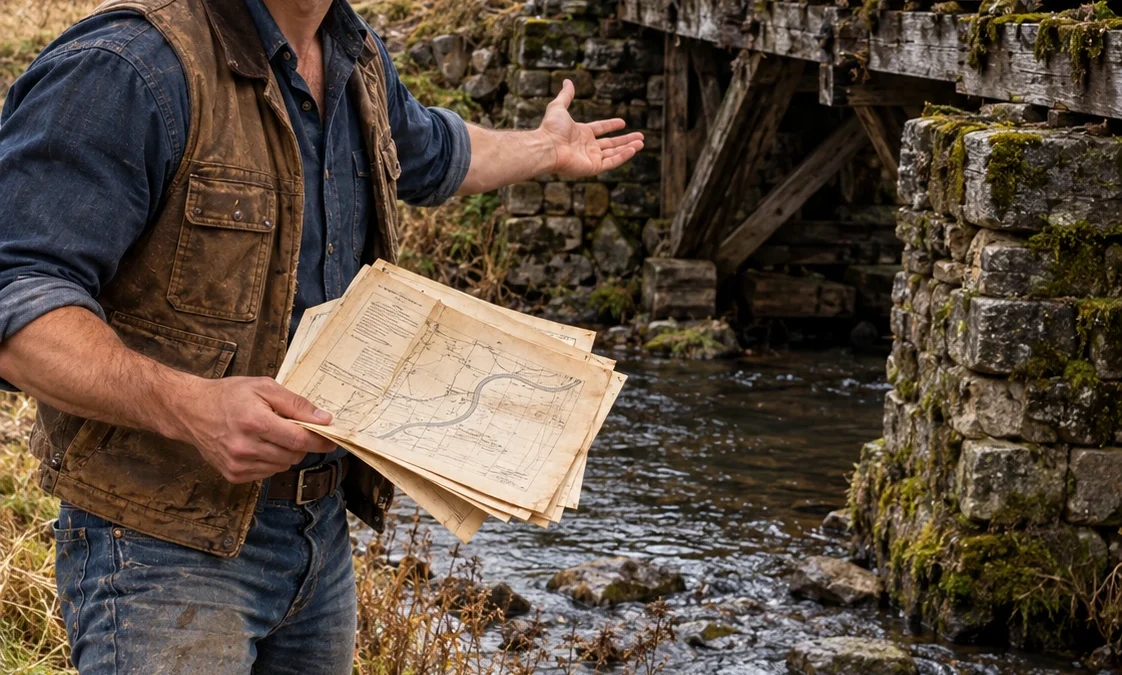
The survey took two days. The crew measured from the old fence line to the creek, then worked along both approaches. Ethan watched them drive stakes into the soil and set equipment on the bank. When they were finished, the surveyor showed him the boundaries on a map.
Every part of the bridge sat within the Whitaker parcel. The approaches did too. There was no shared strip of land, no hidden boundary running through the creek, and no recorded easement marked on the survey.
Maren sent a formal request to the bank and the agricultural company. She asked for a deed restriction, a recorded easement, an access agreement, or any other document establishing a permanent right to cross. She gave them a deadline to respond.
The company’s attorney replied first. The farm had used the bridge for decades, the letter said. Its continued use had become an established pattern, and the company had invested in the property believing that access would continue.
Maren asked for the recorded instrument that created the right.
The reply did not include one.
The bank responded with a history of shared use, maintenance estimates, and copies of appraisal pages. It argued that the bridge served multiple agricultural operations and that the costs should be allocated accordingly. Again, it did not provide a recorded easement.
Ethan could feel his anger growing with every polished paragraph. He wanted to write back that no amount of formal language could turn his father’s bridge into the bank’s property. Maren told him to let the documents make the argument. Every phone call would be followed by a letter, she said, and every claim would be tied to something verifiable.
Then the bank’s tone changed. A representative called to say that removing the bridge could expose Ethan to legal consequences. The neighboring company, the representative added, had relied on its access for years. The farm had equipment, crops, and workers that needed to cross.
Maren asked the bank to identify the specific legal right Ethan would violate by removing a bridge on his own property.
The representative did not have an answer. He said he would consult the legal department.
Ethan kept thinking about the farm on the other side of the creek. Its trucks crossed the bridge, but the men who drove them had never spoken to him about ownership. He knew they were not responsible for the bank’s paperwork. He also knew the land was being operated as a business, one whose financing depended on the crossing remaining in service.
Maren advised him not to close the bridge immediately. Instead, she sent a final notice giving both parties thirty days to produce proof of a permanent right. If they could not, Ethan would end commercial permission and arrange lawful removal.
The company replied with an offer of $5,000. It described the payment as a purchase price for the bridge. Ethan read the offer twice, then set it down.
“They don’t want the wood,” he said.
“They want certainty,” Maren answered. “The question is what certainty they’re buying.”
Ethan declined the offer. A one-time payment would not cover decades of maintenance, future repairs, or the right to keep using the property indefinitely. He did not want the company to purchase an old structure. He wanted a clear agreement that stated who could cross, when, for what purpose, and who would pay for the consequences.
The bank’s appraisal arrived a few days later. Maren spread it over her conference table and pointed to the access section. The valuation assumed the neighboring farm would retain dependable access across the Whitaker bridge. The estimate did not include the cost of building a replacement crossing. It did not mention the old southern route.
Without the bridge, the farm could lose operating flexibility. Its tractors and grain trucks would face a long detour, or the company would have to build an entirely new crossing. The bank’s collateral would be less convenient and possibly less valuable. That was why its officers had started talking about shared expenses instead of producing a legal document.
The twelve-hundred-dollar charge was not a random bill. It was the price the bank had assigned to a risk it had never controlled.
Ethan went home and walked to the bridge. He studied the planks his father had replaced, the steel supports sunk beside the creek, and the approach road that crossed the Whitaker field. The bridge had carried harvesters through rain and mud. It had helped neighbors in an emergency. It had also become the unspoken foundation of someone else’s business plan.
He did not want to punish a farm for having relied on the crossing. He wanted the people who had planned around it to stop treating his property as if it belonged to them.
The thirty-day deadline passed. The bank produced more correspondence, but no easement. The company produced no recorded right either. Maren reviewed the county requirements for closure and removal, then explained the steps Ethan would need to follow.
A removal crew could not simply pull the bridge apart in a day. The creek had to be protected. The supports had to be removed carefully. Permits and notices had to be handled correctly. Ethan listened as Maren laid out each condition, understanding that the decision was becoming real.
The bridge had been built by his father, and the family had maintained it for decades. Taking it down would not feel like a victory. It would feel like letting go of the last thing his father had made that still connected the farm to the world beyond it.
Still, Ethan signed the notice. He had given the bank and the company time to establish their claim. Neither had done so. Now he had to decide whether the bridge would remain a favor that everyone else could redefine, or a piece of his inheritance he was willing to protect.
Part 3/5: Ethan orders the bridge removed, and the farm across the creek discovers how much its daily operation depended on his family’s favor.
The removal crew arrived just after sunrise on a clear Monday. Ethan stood near the house with his father’s notebook in one hand and the signed work order in the other. He had imagined this moment many times, but the reality was smaller and quieter than he expected: a truck backing down the gravel lane, boots in wet grass, men checking permits beside the creek.
Maren had reviewed the plan. The county had approved the work. A crew trained in creekside construction would dismantle the structure without tearing up the banks or dumping debris into the water. Ethan had insisted on keeping the old bridgeboards. They would be stacked and carried to the workshop.
Before the first board came loose, he crossed the bridge alone. He knew which planks creaked beneath his weight. He remembered fishing with his father on the downstream bank, watching him replace a bolt while rain moved across the fields, and standing beside him during the last repair on the east railing.
The bank representative was not there. The agricultural company’s manager was not there either. For a while, it felt as if Ethan were the only person who understood what was being taken apart.
Then the first bolt turned. One of the workers lifted a plank free and passed it down to a colleague. The bridge gave a small groan as the weight shifted. Another board came up, then another. Beneath the decking, dark beams emerged with old marks where his father had cut and measured them.
Ethan stayed until the crew stopped for lunch. He did not feel triumphant. He felt tired, and he kept thinking of his father’s handwriting in the notebook: temporary access only. No permanent rights across Whitaker ground. Daniel had known that a favor could turn into an expectation if no one drew a line.
By late afternoon, half the bridge was gone. The crew returned the next day to remove the supports and restore the bank. They took each section carefully. The last time Ethan saw the bridge standing, it had become an uneven skeleton of timber and steel. When the final support was lifted out, Mill Creek moved beneath the open sky without an obstacle.
The neighbor’s first truck reached the creek the following morning. Its driver slowed at the place where the crossing had been, then turned around. The farm still had machinery, crops, and contracts waiting on the other side. Those had not changed. Its reliable route had.
The company’s manager, Grant Mercer, drove over that afternoon. He was in his early forties, with a worn ball cap and mud on his boots. Ethan recognized him from the appraisal records, though they had never met.
“You really took it down,” Grant said.
“I gave everyone thirty days to show me the right.”
Grant glanced at the bare banks. “The farm has deliveries due this week. We can’t move the combines across here.”
“That’s why the bank should have worked this out before it financed the property.”
Grant’s expression tightened, but he did not argue. He said the company would need to talk with the bank. Ethan told him he was willing to discuss a new agreement, but he would not put the bridge back up on a handshake.
Two days later, an engineering firm visited the property. The company wanted a price estimate for a replacement crossing. The engineers measured the creek, checked the banks, and asked about flood history. They told Ethan the cost would be far higher than twelve hundred dollars. A safe agricultural crossing would require design, environmental review, permits, drainage work, new construction, and a plan for long-term maintenance.
Ethan watched the engineers mark the soil and thought of his father hauling lumber in the back of an old pickup. Daniel had built the bridge with money, time, and stubbornness. He had repaired it whenever weather or heavy traffic wore it down. The neighboring operation had depended on those repairs without asking who paid.
The bank asked to meet. Its regional representative, Lionel Price, arrived with Grant and two attorneys. They sat around a long table in Maren’s office, with a folder of engineering estimates in the center. No one mentioned the original bill at first.
Lionel said the bank wanted to find a workable solution. The property needed dependable access, and the company needed to move equipment. The bank hoped Ethan would consider restoring the bridge under a formal agreement.
Ethan looked at the stack of paper. “What would be different this time?”
“We would define the terms,” Lionel said. “We’d document the access and allocate the costs.”
“Who would pay for construction?”
The bank’s attorney began to answer, but Ethan asked who would pay for inspections, future repairs, flood damage, insurance, and any damage caused by heavy equipment. He asked whether the easement would expire if the property changed hands. He asked whether public access would be allowed. He asked what would happen if the company stopped operating the farm.
The room went quiet. Those were the questions the first letter had skipped.
Maren explained that Ethan was open to negotiations if the agreement was permanent in the legal sense but limited in purpose and clear in its obligations. Any bridge would need professional design, a defined maintenance plan, and a reliable source of funding. The Whitaker farm would not quietly inherit the burden again.
Grant said the company could consider an easement with compensation. The bank would contribute to the crossing, though it did not yet know how much. The attorneys exchanged notes. Ethan listened, but he did not agree to anything that day.
After the meeting, Maren warned him that the pressure would continue. The company’s business could suffer, and the bank might push for a quick solution. Ethan understood. He also understood that he had already taken the bridge down. There was no reason to rebuild it just because other people had finally noticed what it did.
He asked for the engineering report and a proposed term sheet. Until he could read them, the creek would remain open.
That evening, he carried a salvaged bridgeboard to the workshop. The weather had faded its top surface to gray, but on one edge he could still see a pencil mark in his father’s handwriting: “East rail—replace after harvest.” Ethan set it beside the old notebook.
The next day, Maren called. The county had found a missing road file related to the southern route. It was not among the records Ethan had reviewed, and it had not appeared in the bank’s appraisal. The file was being scanned now.
“What does it say?” Ethan asked.
“I don’t know yet,” Maren replied. “But the county says it’s not an abandonment record.”
Ethan looked toward the empty crossing. For the first time since the bridge came down, he wondered whether the biggest problem had never been the bridge at all.
Part 4/5: A forgotten county file changes the negotiations, revealing that the southern road may never have lost its legal right-of-way.
The county file arrived in Maren’s inbox the next morning. It contained a faded map, a road commission minute, and a short letter written in 1994. The road commission had discussed the southern crossing after a flood damaged its old culvert. The minutes authorized a temporary closure while the culvert was assessed. They did not authorize the county to vacate the road.
A later handwritten note said the road had been “removed from active maintenance.” That was all. It had not been transferred to a private owner. It had not been permanently abandoned through the required process. The route had simply disappeared from newer maps as brush grew over the old approach.
The right-of-way, if it still existed, could provide legal public access to the neighboring farm. It did not mean the road was usable. The crossing itself was gone, and the approach needed inspection. But it changed the story the bank had been telling.
The bank’s appraisal assumed the Whitaker bridge was the farm’s sole reliable access. No one had checked whether the southern right-of-way remained on the county books. The appraisal treated the bridge as indispensable, yet it did not price the legal alternative or explain why the old route had been left out.
Maren asked the county for a formal status review. She wanted a written determination, not a guess based on an old map. While they waited, she sent the new records to both attorneys.
The bank requested another meeting. This time, the company’s attorney brought a transportation consultant. The bank’s representative, Lionel, opened with an apology for the original bill. He said the charge had been based on the bank’s understanding of the access arrangement, and that understanding was incomplete.
Ethan remembered the employee’s confidence on the phone and the twelve hundred dollars printed in a box. “Did the bank check who owned the bridge before charging me?”
Lionel looked down at his folder. “The review should have been more thorough.”
“That isn’t the same as answering me.”
Maren let the silence sit. Then she asked whether the bank had known about the southern route when it financed the property. Lionel said the file they had received did not include the old county records. Grant said the investment company had not been told the route might still exist either. He had bought the farm believing the bridge was its dependable connection to the road.
The consultant explained that restoring the southern route could cost less than building a new bridge on Ethan’s land, but no one could promise that until engineers inspected the site. The route might be blocked, the banks might have shifted, and the old culvert could be beyond repair. If the road remained legally public, the county would have to decide what level of maintenance it was willing to provide.
For the first time, there was a path that did not depend entirely on Ethan. It was not a quick solution. The company could not drive a loaded grain truck across an old, overgrown route the next day. But the record suggested the farm might have another way out.
Grant leaned forward. “If the road can be restored, would you still consider a bridge easement?”
Ethan took a moment before answering. “If the county confirms the road is public, then you can pursue it with them. If you still want a crossing here, the terms need to reflect that it’s an option you’re asking me to grant.”
The bank’s attorney looked toward Lionel. The balance of the meeting had shifted. The company no longer had to insist that Ethan restore the only route. The bank could not present the bridge as an unavoidable public service. It had to negotiate with him as a property owner.
The county’s determination came a week later. The southern road had never been formally vacated. The right-of-way remained on the county records, though the county had not maintained the crossing for years. A survey would be needed to reestablish the route, and the old creek crossing would require engineering approval. Access was legally possible, but repairs and construction would take time.
The investment company hired engineers to assess the route. Their first report found that the southern approach was passable to light vehicles after clearing brush, but heavy agricultural equipment would need a new crossing. The estimate was substantial, though still less than constructing a new bridge on Ethan’s property. The county would consider permits but would not promise to fund the project.
Grant called Ethan after receiving the report. He said the company was weighing its options. “We may need the Whitaker bridge during construction,” he said. “Could we arrange temporary use?”
Ethan looked at Maren, who was sitting across from him. She nodded for him to ask the important question.
“Who would pay for it, and how would it be documented?”
Grant said the company would cover a temporary-use fee and the cost of inspection. The access would end when the southern route was ready. Heavy loads would be limited. The company would carry insurance and repair any damage caused by its vehicles. The agreement would be filed with the county and would not create a permanent easement.
Maren revised the draft. She included dates, vehicle limits, insurance requirements, inspection procedures, and a firm expiration clause. Ethan also required payment for the temporary access and a deposit for potential damage. It was not a fortune, but it was a real agreement.
The bank agreed to contribute to engineering and restoration costs on the southern route. It did not admit that the appraisal had been wrong in a legal sense, but it acknowledged that its earlier access assumption required review. The company, for its part, accepted responsibility for funding its operational needs.
When the temporary agreement was signed, Ethan felt a knot in his chest loosen. He had not needed to rebuild the bridge to prove his point. The company could cross for a limited period under written terms, and it would work toward restoring the route the county had never formally closed.
On the morning the first truck crossed again, Ethan watched from the field. The driver stopped at the entrance, waited for the inspection crew’s signal, and moved slowly over the temporary decking placed for light loads. It was not the old bridge, and it was not a permanent right. Every detail had been agreed to in writing.
As the truck passed, Grant stepped down from the passenger side and walked toward Ethan. He held a folder in one hand.
“The bank sent this over,” he said. “It’s the original appraisal file. They found a supplemental page that wasn’t included in the copy you received.”
Ethan took it. The paper was dated the month his father had died.
Part 5/5: The supplemental appraisal reveals Daniel had warned the bank about the forgotten road, and Ethan turns that discovery into a lasting solution.
The supplemental page was brief. It did not mention the bridge by name. Instead, it recorded a site visit with Daniel Whitaker two years earlier. The appraiser had asked whether the neighboring farm’s access depended on the bridge. Daniel’s answer had been written in the margin:
“Temporary access. South road right-of-way still exists. County never vacated it. Check before valuing.”
Ethan read the note twice. His father had not merely understood the temporary arrangement. He had warned the bank that the southern route might still exist. The appraiser had acknowledged the warning, then recommended further research. The loan file showed no sign that anyone had completed it.
The bank’s first bill had not come from a careful review of the facts. It had come from an assumption carried forward until it looked like a right.
Ethan felt no satisfaction at the discovery. He thought of Daniel spending a morning with an appraiser, pointing out the old road and the bridge. Perhaps his father had hoped the county would restore the route one day. Perhaps he had simply wanted the bank to know that the bridge was not theirs to count on forever.
The note did not prove that the bank had deliberately hidden the road. It did prove that the possibility had been raised, and then lost in a file. Ethan’s father had left him more than a boundary line and a bridge. He had left a warning in the margins.
Maren sent the page to the bank’s legal department. She asked them to correct the appraisal record and confirm that the original maintenance charge would be withdrawn. The bank agreed. It also agreed to reimburse Ethan for the survey and legal costs directly caused by its demand, without requiring him to sign away any rights.
The company’s engineers finished their assessment of the southern route. The old right-of-way could be restored, but not overnight. The creek crossing needed a new culvert and reinforced approaches. Brush had to be cleared, drainage improved, and a section of the road rebuilt to support agricultural traffic.
The company applied for permits. The county approved the work subject to inspections and load limits. The bank extended the company’s financing for the access project, and the company agreed to pay construction and maintenance costs. The road would remain a public right-of-way, available under county rules, instead of becoming another private arrangement left to assumption.
For several months, the temporary crossing remained in place at the Whitaker property. The company paid for inspections, maintained insurance, and kept heavy vehicles off the bridge. When its route opened, the temporary agreement ended on the date stated in the contract. No one had to argue about what “temporary” meant.
The day the first combine used the restored southern crossing, Grant called Ethan from the road. He told him the machine had made it through safely. Ethan drove to the site later and watched workers remove the temporary decking from his property. The creek looked open again.
In the months that followed, the bank corrected its records. It withdrew the shared maintenance bill and changed the neighboring property’s access documents to reflect the county route. Ethan received reimbursement for the professional survey and a negotiated payment for the limited temporary use. The money helped cover urgent expenses left behind by his father’s final illness.
It was not a windfall. It was enough to steady the farm while Ethan learned how to manage it. He kept the fields, repaired the farmhouse roof, and worked with a local accountant to understand the debts and costs that came with the land. He had not wanted to sell the property. He had wanted a chance to keep it without unknowingly giving away pieces of it.
Years passed. The neighboring farm continued operating, now using the southern road. Grant and Ethan were never close friends, but the arguments stopped. When they saw each other in town, they spoke without bitterness. Grant once told Ethan that the company had underestimated how much it relied on the old crossing. Ethan told him the same had been true of the bank.
In the workshop, Ethan kept one weathered bridgeboard beside his father’s notebook. He placed the original appraisal page in a clear sleeve and set it on the shelf behind them. The board reminded him of the structure his father had built. The note reminded him that Daniel had tried to make people understand what the structure did—and what it did not give them.
The bank had called the bridge shared infrastructure. Its first letter made Ethan believe that his father’s work had somehow become a bill he owed. But the records told a different story: a neighbor had received temporary help, an old public route had been forgotten, and a lender had relied on an assumption without checking the land beneath it.
The bridge had mattered because of what lay on the other side. But the forgotten road mattered too. It was the clue that turned a fight over a crossing into a solution that did not require the Whitaker family to carry someone else’s responsibility forever.
Ethan sometimes walked down to Mill Creek at dusk. Without the bridge, the water moved through the property as it had before Daniel built the crossing. The banks had recovered. Grass grew where the approaches had once met the ground. He could still picture his father there, measuring timber and showing him how to hold a level.
Ethan had been eighteen when the bill arrived. He knew tractors better than contracts and fences better than deeds. The bank had counted on him being too young, too tired, or too unsure to question the letter. For a time, even he had wondered whether challenging it would cost more than paying.
Then he learned to ask for the record behind every claim. He learned that a neighbor’s use did not automatically decide ownership, that a map could hide a route without erasing it, and that a structure could carry more value than its lumber suggested.
The final surprise was not that his father had secretly owned the bridge in some new, complicated way. He had owned it plainly. The surprise was that he had left the bank a warning about the other road—and that the warning had been sitting in the file all along.
Ethan never got to ask Daniel why he had written that note. He could only guess that his father had wanted the truth recorded somewhere it might survive. In the end, it did.
The bank had sent an eighteen-year-old a bill for twelve hundred dollars. Ethan answered by finding the paper that showed the bridge was his, the route was public, and the bank’s certainty had never been earned.
THE END
Names and changes: Ethan Whitaker and his father Daniel Whitaker; attorney Maren Doyle; neighbor’s manager Grant Mercer; bank representative Lionel Price. The setting is rural America at Mill Creek, and the currency is U.S. dollars.
New ending: A forgotten appraisal page reveals Ethan’s father had warned the bank that the neighboring farm’s southern public right-of-way might still exist. The county confirms it was never legally vacated, so the farm restores that route, while Ethan receives reimbursement and temporary-use compensation without granting a permanent easement.








