They Called Her Windmill a Lost Cause—Then an Eighteen-Year-Old Rancher Found the Hidden Mistake That Had Been Starving Her Family’s Herd for Six Years…
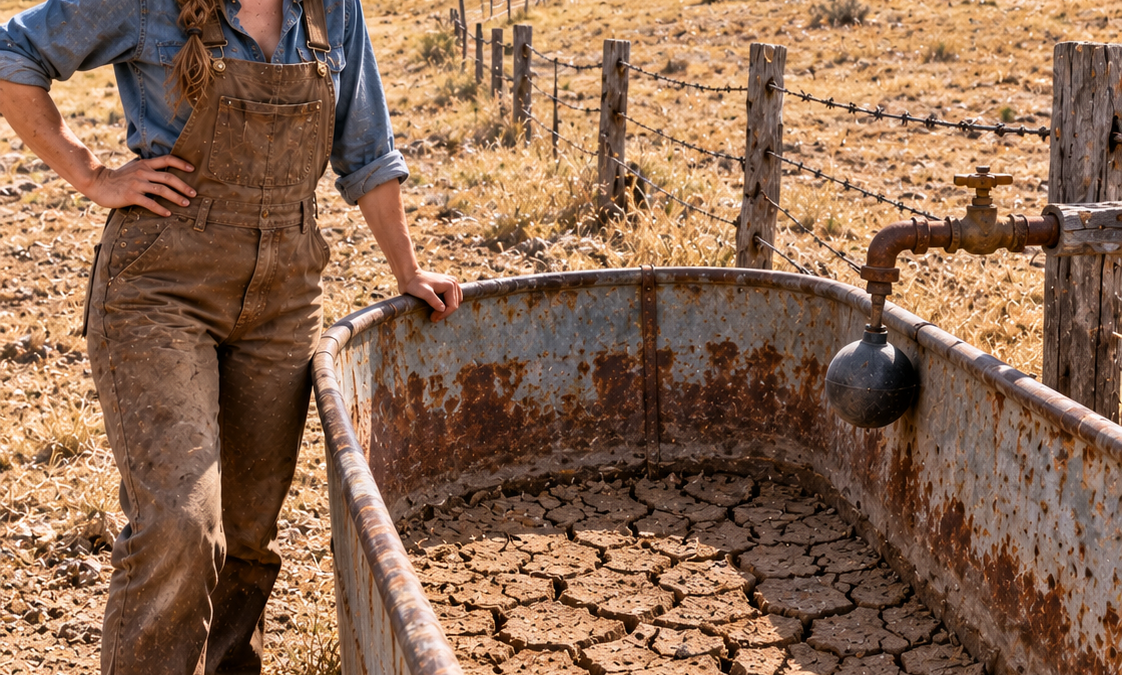
Part 2/5: A frozen pivot, a failing pump, and a brief rush of water reveal fresh questions
Tessa cut the fence wire that held the tail vane against the wheel. The vane swung loose with a sigh of rust, and the head tried to turn. It didn’t. The pivot was frozen solid.
She sprayed penetrating oil into the joint, tapped it with a rawhide mallet, waited, and sprayed again. On the fifth round, with her weight pressed against the tail boom, the pivot groaned and moved an inch.
“Heard that?” Eli called from below.
“Go slow,” he added before she could answer.
It took an hour to swing the head from one side to the other. Then she turned to the gear case. One bolt twisted off flush with the housing. She oiled the stub, went down for lunch, and when she came back, it backed out as if it had never been stuck.
The smell reached her first: old oil with something sour under it. What drained from the case was the color of coffee with cream. Water had been getting in through a dried gasket, settling in the head and working on the iron for years.
Tessa wrote down what she saw, then what she thought. The head hadn’t quit because it wore out. It had quit because it sat.
She took the head apart over eleven days. The wheel shaft drove the gear, the gear carried the crank, and the crank sent motion down the rod through the tower. Most of the parts were still good. One worn bushing had to be turned new at the machine shop, but the main shaft was true.
Tessa crossed out “replace” in her notebook and wrote “reusable.”
The crank pin could be set at different distances from center. A short stroke was gentler. A long stroke asked more of the wheel and more of the pump.
“Look at the metal around the holes,” Eli said. “Where it’s been moved, it’ll show.”
It showed three settings: short, then long, then short again. Someone had lengthened the stroke and later shortened it. Tessa wrote down the sequence and added a question: Who changed it, and why?
“Short is how most of them come,” Eli said. “Somebody wanted more water. Then somebody wanted less trouble. Or the other way around. It’s your mill.”
It was the first time anyone had called it hers.
By the last week of May, the head was clean. Tessa put in fresh oil, a gasket cut from heavy paper and soaked in grease, and the new bushing. She set the crank pin on the short setting, the original position marked by the iron.
Then she wrote her second rule in the notebook and said it aloud to the empty hill: One change at a time.
She pulled the furl lever. The tail swung free. The head turned smoothly on its pivot until the wheel faced the wind. For a moment, nothing moved.
Then one blade lifted, followed by another. The wheel began to turn, first creaking, then faster, and the tower shivered beneath her boots.
Tessa laughed on the platform.
“That’s her,” Eli called. She could hear that he was smiling.
It was a real victory, and it proved nothing about water. Turning was not pumping.
That evening, Owen came by and stood at the foot of the tower, looking up at the wheel.
“Well,” he said. “It’s moving.”
“It’s not pumping,” Tessa said. “The rod isn’t hooked on. Tomorrow, I’ll hold the line.”
The next morning, Owen held the rod while she coupled it to the crank. The wheel slowed under the load. Tessa counted eleven strokes a minute in a steady wind.
Eli frowned from the pickup. “Turning slow.”
“Eleven a minute,” Tessa said.
“For that wind, it ought to do better. A mill will tell you how hard it’s working if you watch it. That one’s working harder than it ought to.”
“Is the pump tight, or something heavy?”
“Don’t know.”
They counted again in a different wind. For two days, the rod moved and the pump did whatever it did below ground, but nothing reached the tank. At the wellhead, Tessa opened the union and caught no water.
The hill stayed green. On the other pastures, the stubble crept farther up the creek fence. The round bales went out every other morning.
At supper, Owen said, “If we’re feeding in August,” to nobody in particular.
On the third evening, he stood beside Tessa at the dry tank. “Same as before,” he said.
“It isn’t the same. The head’s been rebuilt.”
“Then why is it dry?”
Tessa didn’t pretend to know. “I don’t know.”
Eli’s next idea was to prime the pump. They would pour water down the open drop pipe to swell the leathers and help them catch. Tessa carried a bucket up the hill, poured it in, and set the wheel to work.
After eight or nine strokes, the pipe coughed and gave a gulp of water. Then another. A thick, clear stream pulsed with each stroke.
Tessa stood holding the bucket while water ran over its rim and into her boots. For a few seconds, she didn’t think at all.
It ran for about twenty strokes. Then it thinned, spat, and quit. The rod kept moving, pumping nothing.
Eli had come over on his bad hip, leaning on his cane. “There,” he said. “Leathers will do that. Swell on the water, pull a little, then they’ve got nothing to hold.”
“So I replace them?”
“That’s what we do.”
He didn’t look pleased with the answer. Twenty strokes had shown Tessa that the machine could work, even briefly. That made it harder to give up.
She didn’t replace anything that afternoon. At the kitchen table, she wrote the facts in order: tank sound, head sound, wheel turning, rod moving, twenty strokes after priming, then nothing.
Under them, she wrote, “Replace nothing till I’ve seen it.”
The next morning, she pulled the pump. She stopped the mill with the rod at the bottom of its stroke, marked the rod, uncoupled it, and clamped each section before lifting the string one length at a time. Owen worked the rope.
“Where do you want me?” he asked.
“On the rope.”
By noon, the rod sections lay in order on sawhorses in the grass. The plunger came up last, and the leather around it was ragged.
Tessa turned it in the light. The leathers weren’t shrunken. They were cut. Their lips had been chewed into little teeth, and fine, straight lines scored the outer face from top to bottom.
She drew her thumb across the surface. Grit came away on her skin.
“Sand,” Eli said from the pickup. “Or scale.”
He sounded doubtful.
“Scale flakes,” Owen said. He took the plunger and held it to the light. “I’ve seen worn leather. That’s not worn.”
“No,” Tessa said. “It’s cut.”
He handed it back more slowly than he had taken it. She wrapped the plunger in a clean rag and set it on the tailgate.
The drop pipe took two more days to pull, coming up in lengths heavy with water. Tessa stood each length on end, filled it from a barrel, and watched the level. It held. She had expected a leak; the couplings were rusty, but the pipe was sound.
The cylinder came last. It was brass-lined, tarnished green, and heavier than it looked. Tessa measured its bore and checked it against Eli’s chart for a wheel like theirs at that depth.
It was larger than the chart allowed—not by a little, but by enough that a careful person would have asked why.
“Somebody wanted more water,” Eli said, standing very still as he looked at it.
“Is it too big?”
“It’s a hard pump for that wheel. It might run all day in a stiff wind and stall in a breeze.”
“It stalled in a light wind.”
“It would.”
Tessa wrote down the third fact of the day and underlined it twice: The cylinder is not the size this mill was built for. This mill has been changed. The chart describes what someone built, not what someone modified.
She fitted fresh, wet leathers to the oversized cylinder, set the pump back down, left the crank on short, and unfurled the mill. Water came. It ran past twenty strokes, then forty.
By afternoon, four inches stood in the tank. Owen squatted and put his hand into it, keeping it there longer than he needed to.
It was the first water in that tank since 1983.
“Well,” he said. “There you go.”
“It’s not finished.”
“It’s water. Four inches is four inches more than it was.”
He was right. But the margin of Tessa’s notebook still said 450 gallons a day, and four inches in a large stock tank was not a herd supplied.
She watched the inlet instead. A thin stream flowed steadily, something she could have stopped with one finger.
For one evening, new leathers and water in the tank looked like the answer.
Part 3/5: Falling output exposes the buried evidence behind years of failed repairs
Tessa recorded the time and water depth every morning. The tank rose a little less each day, and by the end of the second week, it had stopped rising.
So she stopped watching and started measuring. Each morning, she timed a five-gallon bucket at the wellhead, counted strokes for a minute, checked the wind from the kitchen radio, and entered everything in a table.
On a strong-wind day early in the test, the mill produced more than 900 gallons. Two weeks later, in the same wind, it gave her less than 300. Nine hundred was plenty. Three hundred wasn’t even two-thirds of what thirty pairs needed.
The tank was losing the race. The quote in the drawer was beginning to look more reasonable every day.
“Slower,” Eli said, reading her columns with his lips moving. “I’d have bet the leathers.”
“They helped,” Tessa said.
“They did.” He tapped the page. “Don’t write that down.”
She laughed and wrote it down. Eli didn’t.
“Every week it runs like that, it’s costing you something,” he said. “Leathers, maybe more. I just don’t know what.”
That evening, she sat on the tailgate thinking about how glad she had been when the first water came. She had let one good result stand in for a proven one.
On the inside cover of her notebook, she wrote her third rule: Never trust the first success.
Under it waited the harder question she had not said aloud. What if her father was right? What if the leathers kept dying because the whole system was finished, and she was spending her last summer at home proving it?
The last week of August was still ten weeks away. The contractor would hold his price until September first.
Owen found the table on the kitchen counter that night, open beneath the lamp. He stood reading it with his glasses pushed up on his forehead. He studied the strong-wind days first, then the later numbers.
“What was the wind on this one?”
“The same as that one. The radio said so.”
He put a finger beside each number. Nine hundred. Under three hundred. He took off his glasses.
“Then it isn’t the wind.”
“No.”
“Something’s getting worse,” he said to the page, not to her.
It was not what he had said at supper a month earlier. He closed the notebook gently and left it where he had found it.
That evening, Tessa went back to the shop. The coffee can contained two paper bags marked “81” and “83.” Under them lay a folded sheet gone soft at the creases: an invoice from a pump supplier, in Henry Calder’s hand, dated 1972, for a cylinder.
She laid the old leathers on the bench and set the ones she had pulled that spring beside them. The cuts, the vertical scoring, and the grit looked nearly identical. Each pair had failed sooner than the one before it.
She heard the screen door. Owen stood in the doorway in his shirt sleeves, looking at the bench.
“Those are from ’81,” he said. He came in and picked up one of the bags. “Couldn’t throw them out.”
“Why not?”
He turned the bag over in his hand. “Figured they were telling me something. Couldn’t tell what.”
It was the longest thing he had said about the mill in a year. Tessa didn’t interrupt.
After a moment, she held up the invoice. “Dad, tell me about 1972.”
The blowout had begun around the old tank, where cattle had worn the ground bare until wind started carrying the sand away. Henry moved the tank downhill to save the hill and routed a buried line around the damaged ground.
Because the water had farther to travel and the herd needed it, he ordered a larger pump.
“Granddad wrote everything down,” Owen said. He almost smiled. “Except what mattered.”
“Did it work?”
“Near ten years. Everything he did was right. I’d have done the same.”
Tessa had been about to say something sharp. She let it go. What she needed to understand was what those two sensible decisions had done together.
She opened her notebook to the marks on the tower leg: WB 1946, 72, OC 83. She compared them with the three crank-pin settings.
“The short stroke is original. The long one was Granddad’s from ’72, and the short again was yours.”
Owen nodded slowly. “I thought if it pulled less, it might quit eating leathers. Went back to short in ’83. Didn’t change a thing I could see.”
“The cylinder was still big.”
“Two things at once,” he said. “He changed two things at once.”
“The tank and the pump. Nobody ever ran one without the other.”
“No.”
Tessa took the short brass tube from its nail and wiped it until the brass shone like old gold. She measured the bore and wrote the number beside the oversized cylinder’s. The small tube matched Eli’s chart for that wheel at that depth.
“That was Dad’s original,” Owen said. “He put it on the wall. Said somebody might want it.”
Tessa didn’t trust herself to answer. She turned the old cylinder over in her hands that night, thinking about Henry’s decision to save the hill and Owen’s efforts to keep the pump working.
Every decision on that mill had a reason. Every reason was sound. Somewhere inside all those sound reasons, something was cutting leather.
The old leathers had been scored by something hard and fine. She had found flour-fine sand at the bottom of the tank. If sand was moving through the system, the only place it could come from was the well.
She couldn’t see into the well. She could measure it.
Henry’s note gave its original depth. Tessa lowered a greased weight on a cord knotted every foot and measured three times. The bottom was eleven feet higher than Henry had recorded. When she pulled up the weight, the grease carried pale, fine sand.
Eli had a tool for that. In the back of his shop, wrapped in a feed sack and hung from the rafters, was a length of heavy pipe about as long as Tessa, with a flap valve at the bottom and a ring at the top for a cable.
“A bailer,” he said. “You drop it. It hits bottom, sand and water go up inside. You pull it, the flap shuts, and the sand stays. Dump it and do it again.”
“How many times?”
“A lot.”
She ran the cable over a pulley and used the pickup to lift the bailer. Each trip brought up gray slurry with pale sand in it.
Owen came by on the second day and took a turn without a word. He stood watching as the slurry slid out across the grass.
“One foot of it,” Tessa said.
“I looked at that well,” Owen said, then stopped and shook his head.
She let him.
Part 4/5: A controlled test connects the oversized cylinder to the sand cutting the leathers
The work took three days. By the first week of July, the well was nearly clean, and Tessa measured its depth again. The bottom was back where Henry had recorded it.
That proved what had been in the well. It did not prove where the sand had come from, or whether it would return.
Eli, quiet most of the afternoon, studied the measured depth. “So now you know what was in it,” he said. “You don’t know what it does.”
Tessa set up a test. She put the oversized cylinder back into the cleaned well, held the crank on short, and changed nothing else. The only thing left to change was the wind.
Every half hour, she filled a clear jar at the union, held it to the light, and wrote down what she saw. The first days brought a gentle breeze. The wheel turned slowly, laboring at eight strokes a minute, then nine. The jars came up clear as a window.
On the third day, wind came hard out of the northwest. The mill took it with a will. The wheel spun, the tower trembled, and the rod flew up and down so fast it blurred.
Fourteen strokes a minute. Then fifteen.
Tessa filled a jar and held it up. Sand settled through the water, a fine dusting that grew thicker in each jar as the wind rose.
Eli took one, tilted it, and handed it back. “Furl it.”
She did. The rod sank, the wheel slowed, and by the next jar, the sand had stopped.
She kept testing through changing winds. The pattern held. Gentle pumping gave clear water. Hard pumping brought sand, and the faster the stroke, the more sand appeared.
Tessa wrote only what the tests proved: This well can give clear, steady water at a gentle rate. Ask for more, and it gives up sand.
The rest followed. The oversized cylinder asked more of the well than the source could provide. Hard pumping pulled sand into the water. The sand cut the leathers, settled back into the well, and made the next failure come sooner.
The mill wasn’t weak. It was being asked for more than its source could sustain.
For the first time, Tessa could draw the whole failure on one page: the tank moved, the pump enlarged, the sand, the cut leathers, and the falling output. Henry’s two sensible changes had been made together and never tested apart.
She found Owen at the corral and explained what she had measured. She set two jars on the fence rail in the sun, the clear one beside the sandy one.
He looked at them for a long time. Then he picked up the sandy jar, tipped it, and watched the grains slide down the glass.
“Dad’s pump,” he said. “He just wanted more water.”
“He got it,” Tessa said.
For a while, the wind moved over the corral. Owen set the jar down carefully, like something that might still break.
That night, Tessa looked at the quote in the kitchen drawer. A new well, pump, and line might have fixed the symptom. They also might have thrown away a machine nobody had finished understanding—and built the same mistake again.
She folded the quote and put it back in the drawer.
On paper, the repair was simple: install the original cylinder, leave the crank where it was, and change nothing else. Tessa took the brass cylinder from its nail, checked the bore and its condition, fitted new leathers, and set it at the depth Henry had recorded.
The first strokes sounded wrong.
Eli heard it before she did. “Hear that?”
Tessa was on the platform and could hear only the wind.
“Come down. Listen from here.”
She stood beside the pickup. Beneath the gears’ whisper and the tower’s hum came a small, flat knock at the bottom of every stroke. It was faint, regular, metal on metal.
“She’s touching,” Eli said. “Rods are a hair long. Plunger’s hitting bottom. Another day and you’d crack something. Shorten the rod.”
Tessa had been ten feet from that rod and hadn’t heard it because she had been listening for water. She shortened it, and the knock disappeared.
Then she ran the mill for a day in a steady wind, using the bucket and watch as she had all summer. She filled her notebook line by line, added the numbers, and added them again.
Five hundred and twenty gallons.
She stood at the wellhead and looked at the jar. The water was clear. She held it against the sky, and it was as clear as the air behind it.
The next day, the wind was lighter. The bucket gave her 490 gallons, and the jar remained clear. The day after that, it gave her 540.
Three days, three different winds, each day above the line she had drawn in the margin in May—and not one grain of sand in any jar.
Eli read the three lines without moving his lips. He took off his cap and held it.
“That’s a pump,” he said.
It was the first thing he had said about the work that wasn’t a correction.
Tessa sat on the tailgate because her legs had decided to, and laughed until she had to wipe her face with her sleeve. Owen had come up behind her with the thermos. He poured her a cup without saying anything and set it beside her hand.
Four hundred and fifty had been the number. For three days, she had beaten it.
Eleven weeks of work sat in that column. She let herself sit with it for the length of one cup of coffee.
Then she walked down the hill to log the evening level. The tank had barely moved. She stood at the stake with a pencil in her hand.
Five hundred gallons a day were leaving the wellhead. At the tank, perhaps a third of that arrived. The inlet came in a thin stream, stopped, coughed, and started again.
She timed it against the wellhead flow and found the gap. Water entered at one end of the line and failed to emerge at the other in the same amount.
The pump was right. Something between the well and tank was wrong.
Part 5/5: A hidden air pocket yields, and the old hill finally carries the herd
A leak should have left evidence. Tessa walked the line looking for wet ground and probed along it with a steel rod. There was no soft spot, no green stripe, and no seep.
The water wasn’t getting out. It was being held back.
She sat on the tank rim thinking about the cough.
“Air does that,” Eli said when she described it. “Somewhere it’s getting into the line at a joint.”
“I walked the line. The ground’s dry.”
“Then I’m wrong. Don’t write that down.” He rubbed his jaw. “Could be air in the water itself. Little bubbles from the pump. If the water’s moving fast enough, they go along. If it isn’t, they collect at the high spot and sit.”
“Is there a high spot?”
“Nobody knows. That line was buried in ’72. There aren’t any drawings.”
Tessa knew where the pipe left the well and where it came to the tank. She knew Henry had routed it around the blowout to save the ground. Everything between was a guess.
She traced the route by the faint line in the grass and leveled it with a long, clear hose, stake by stake. The pipe climbed from the well, rose two or three feet over the shoulder of the hill, then dropped toward the tank.
At the top of that rise, she pressed a screwdriver to the ground and put her ear against the handle. The steady rush of water changed to a hollow slosh, then returned on the downhill side.
She repeated it on three different days. It was the same place every time.
“Might be an air pocket sitting on your hump,” Eli said, cane planted beside the stake. “Might not.”
“Why wouldn’t it have done this before?”
He thought about it. “A bigger pump moves more water every stroke. Could be it swept the air along. Could be the crest was always there and the big pump hit it.”
Tessa stood on the crest in the wind. Beyond it lay the old blowout, pale in the sun. Her grandfather had routed the pipe around that damaged ground. The same route that saved the hill had placed a rise in the line.
She decided to dig the next morning.
Owen brought the tractor and loader without asking whether he could help. He set the bucket down at the edge of the mark.
“Where?”
“Not close. I’ll do the last foot by hand. I don’t want to hit the pipe.”
“I won’t hit it.”
“I know you won’t,” she said. “I’d like to be the one.”
He nodded, took the loader down to a foot above her stake, and shut off the tractor. They stood in the sudden quiet.
Tessa cut back the sandy sides so the trench would hold. She climbed in with a short-handled spade and scraped away the sand in thin layers until the pipe lay exposed, dark and ordinary, with a bead of water on its surface.
She put her palm on it and felt each stroke arrive from five hundred feet away. Then came a short, soft stretch under her hand where the water seemed to gather itself.
She cut into the pipe and fitted a tee with a clear hose standing upright. It was a diagnostic, not the repair. She wanted to see what the water and air were doing at the high point.
Owen climbed the hill to the wellhead and unfurled the mill. They waited.
For a minute, nothing happened. Then a long, soft sigh came from the top of the hose. Air that had been trapped for years began to leave.
The sound continued: hiss, gurgle, hiss. Then the water climbed in the clear hose, rose a foot, rose two, fell back, and climbed again with each stroke.
The pump was pushing water. The air had been there all along, waiting for somewhere to go.
Eli watched the water climb. “Huh,” he said. “I’d have put in a vent and hoped. Never had one tell me first.”
Tessa marked the highest level in the hose. She built a permanent riser above it with a vented cap and a screen, then buried the line downhill toward the tank.
The cough stopped. Water came through all at once, a full, steady stream pouring across the mud, bright and loud in the afternoon sun.
Tessa ran down the slope in her work boots. She stopped beside the tank and put both hands over her mouth.
Owen followed and stood a little behind her, as he often did.
“Dad’s big pump,” he said. “You figure it was pushing that air out of there every stroke?”
“I don’t know. It might have been. Or it might have been there all along.”
He nodded slowly. “I never knew there was air in it. Nobody did.”
He watched the water without taking the discovery as an accusation. His father’s decision had saved the hill, and the bigger pump had hidden a problem no one could see. The frustration on Owen’s face gave way to something closer to relief.
That evening, Tessa compared the inlet with the morning’s wellhead measurement. They matched as closely as a bucket could tell her. She watched the repaired system for nine days and changed nothing.
Each morning, she timed the flow at the wellhead. Each evening, she checked the tank. On the fourth day, the float arm rose and shut the valve by itself. The tank stood full for the first time in six years without anyone carrying a drop of water to it.
On the sixth day, the wind died. The wheel turned a few lazy strokes an hour, and the bucket gave her barely 200 gallons. No cattle were drinking from the hill yet, so the tank dropped only an inch and held. Tessa wrote that inch in her notebook.
The system worked in wind. She still didn’t know what it would do in a calm with a herd standing at the water.
Owen had begun walking up the hill in the evenings. He didn’t say he was checking the tank. He stood by the stake with his hands in his back pockets, read the pencil marks, and walked back down.
At supper on the ninth day, he asked what the numbers said.
Tessa hesitated. She had never heard him ask that before—not when would she be done, not what was she doing, but what the measurements meant.
“It delivers four to five hundred gallons a day in an average wind once the tank is up,” she said. “Less in a light wind. More in a stiff one.”
“And the herd?”
“Thirty pairs need about 450 gallons in summer heat. It’ll carry them in a wind.”
“In a wind,” Owen repeated. He looked out the kitchen window at cattle crowded on grass that had mostly been grazed down.
“I don’t know about a calm,” Tessa said. “That’s what I want to find out with the herd on it.”
She proposed turning them in, furling the mill, and marking the water morning and night. If the tank carried thirty pairs for two days with nothing pumping, it would hold through a calm.
Owen considered the risk. If the tank ran short, cattle would be standing at an empty trough in August heat.
“I’ll put the tank truck at the gate,” he said. “Full.”
“If it gets low, I’m not waiting,” Tessa said.
“That’s fair.”
Before the test, she measured the tank. It stood twenty-eight inches full. She scratched an emergency line on the stake eight inches above the bottom. Below that, thirty pairs wouldn’t have a safe reserve.
The truck waited at the gate with its hose coiled. If the water touched the scratch, the test ended. Owen would open the gate, and the quote would come out of the drawer. They both understood, and neither said it aloud.
The next morning, thirty cow-calf pairs came up the draw, dust rising behind them and calves trotting to keep up. They crossed grass that had stood unused for six years. The cows lowered their heads as if no one needed to tell them what it was for.
The lead cow smelled water before she saw it, lifted her nose, and quickened her pace.
A herd drinking has a sound like nothing else: deep and wet, with breathing in it. Tessa had heard it a thousand times, but never from that pasture.
She looked at the sky, climbed the tower, and furled the mill. The wheel turned out of the wind and stopped. The hill went quiet.
For the first time, Tessa understood what Owen had done in 1983 with a twist of fence wire. Sometimes stopping a machine is the responsible choice.
At noon, she walked down to the stake. The cattle had cleared a half circle around it. When they shifted, she measured the water: three inches down.
At dusk, she checked again. Five and a half inches down.
She stood with the pencil and did arithmetic she didn’t need it for. Above her, the wheel stood still against a sky full of light wind, the kind that would have turned it. She could have climbed up and let it go. She kept her hands in her pockets. The point was to leave it alone.
At dawn, the water stood nine inches down. The cattle were already moving toward it. Tessa marked the stake and walked back to the house. Owen was at the table, but he didn’t ask.
On the second afternoon, the heat climbed, and the herd drank harder. By dusk, the water was fourteen inches down—exactly half. Tessa stood at the rim while the cattle moved around her, steaming and jostling. A calf nudged at its mother’s flank.
The tank truck remained at the gate. Owen leaned against its fender with his arms crossed. He looked at the stake, then at his daughter, then back at the stake.
Tessa had one hand on the tower ladder. She took it off and put it in her pocket.
She slept poorly. Before first light, she reached the tank with a flashlight. The water stood seventeen inches down, eleven inches deep, three inches above the emergency mark. The cattle were beginning to stir toward it.
Two days. Thirty pairs. Nothing pumping.
The tank had carried them with three inches to spare. Nine days of measurements had shown how the system performed in wind. The test proved the tank held a reserve through a calm, and the water remained clean.
The mill didn’t need to be fast. It needed to hold.
Tessa climbed the tower once more. Owen held the corner leg while she went up. At the top, she put her hand on the lever and stood for a moment, her face in a breeze just beginning to stir.
Then she let it go.
The tail swung free. The head came around, and the wheel found the wind. It was a light morning breeze, not enough to hurry anything. The blades lifted, the wheel turned, and the rod began its long, slow stroke through the tower.
By the end of the week, the tank stood full again. The float arm lifted and held.
Tessa walked the system in the order the water moved: wind, wheel, head, rod, cylinder, well, buried line, vent, tank, herd. The wind turned the wheel. The wheel turned the head she had freed from rust and old water. The head sent its stroke down the rod she had shortened by a hair.
At the bottom, the original cylinder lifted what the well could afford: clean water. The buried line carried it five hundred feet and over the crest, where the new vent breathed out the air that had held everything back. At the end, the tank filled and stayed full. The cattle drank.
At the wellhead, Tessa felt the double beat of the cylinder lifting water. At the crest, the vent gave a quiet breath. At the tank, the inlet ran steadily while the cattle stood around it. A calf looked up with water running from its mouth.
The failures no longer looked like separate problems. They were one system, each part answering the one before it, with the well setting the limit for all of them.
After a while, Owen came to stand beside her. Eli stood a little behind them. The three of them listened to the windmill, the cattle, and the tank filling.
“Well,” Eli said at last. He took off his cap, scratched his head, and put it back on. “That’s a mill.”
Owen called the contractor that evening and canceled the quote. He thanked the man for his time. Then he took the folded paper from the kitchen drawer and put it in the burn barrel.
At supper, he said nothing about it. When the dishes were done, he asked Tessa what she would do with the system from then on.
“Measure first,” she said. “Every year. Sound the well, look at the leathers, check the vent, and write down what happened and why.”
Owen nodded. He looked at her for a second longer than he needed to. It was a small question, but Tessa knew what it meant.
In the shop, she put a folded page from her notebook into the coffee can, beside the cut leathers and Henry’s invoice. It listed each repair and the reason behind it.
“Come up the hill,” Owen said.
They drove up in the long light after supper. The mill turned in the evening breeze, slow and steady, while cattle grazed the grass that had stood unused for six years.
At the foot of the tower, on the inside of the northeast leg, the old marks remained: WB 1946, 72, OC 83. Owen handed Tessa a sixteen-penny nail, the one Henry had used.
She scratched a new line under the old marks: the date, the original cylinder, the original stroke, the cleaned well, and the vented line.
People remember what they did. It’s the reason that goes missing. The knowing leaves with the people who had it.
So Tessa added the reason: The tank was moved to save the hill. The pump was enlarged to serve it. The two changes were never tested apart. The hard pump brought sand. The buried rise held air.
Owen read it with his hat in his hand. It took him a long time.
“Put your name under it,” he said.
“I wrote the reason.”
“I see that.” He cleared his throat. “Put your name.”
Tessa scratched “TC 1989” at the bottom, small beneath the rest.
Owen laid his hand flat on the tower leg over the marks. For a moment, it looked like the way a man rests a hand on a horse’s shoulder.
They drove down the hill in the last light. Behind them, the windmill turned above cattle grazing the long grass. It turned slowly. It had always been meant to.
The wheel, the pump, the well, the buried line, and the tank were finally asking the same amount of the ground. It turned at exactly the pace the well could afford.
For the first time in a long while, nobody on that ranch wanted it to go any faster.
THE END
Tóm tắt kết thúc: Tessa tìm ra rằng máy bơm quá lớn kéo cát làm rách da bơm, còn đoạn ống có điểm cao giữ khí. Cô khôi phục bơm nguyên bản, lắp ống thoát khí, chứng minh bể đủ nước cho đàn bò và ghi lại nguyên nhân lên chân tháp.








