They Laughed When a Young Widow Traded Her Father’s Silver Watch for a Collapsing Clay Bank—Until Buyers From Three Counties Fought Over What Rose From Its Kiln…
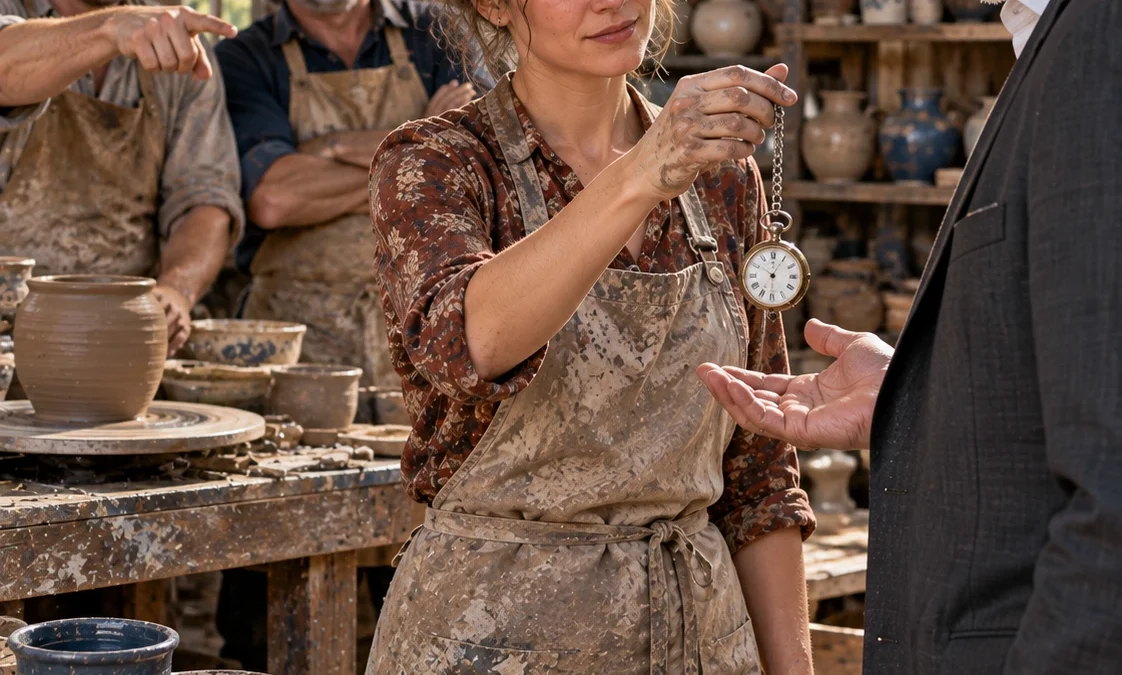
Part 2/5: Mara learns the old trade with stubborn patience, then watches one reckless night turn forty hopeful pieces into an unforgettable lesson.
Ezra returned the repaired wheel in early May. Its shaft moved silently, the treadle answered her foot, and Mara finally faced the part no tool or notebook could do for her: teaching her hands to make something useful.
She began with wedging. Harlan’s notes made it sound simple—cut, fold, press, turn—yet clay fought her for days. Hidden air pockets could explode inside a kiln, and she learned to slice each lump with wire, stack the halves crookedly, and work them together again until the clay became dense and even.
Her forearms ached. Her palms cracked. At night, she sometimes woke with the rhythm still running through her wrists.
The wheel was worse. She set a lump of clay on the wheel head, pushed the treadle, and watched it fling itself sideways. Again and again, mud sprayed the wall while her elbows trembled with effort.
Harlan had written only: Steady pressure. Brace yourself. Patience before strength.
For two weeks, those words irritated her. Then Ezra came by to check the bearing and watched her fail four times in a row. He did not touch the clay. He only said, “You’re bracing against your ribs. Put your elbows on your knees.”
The fifth lump ran true beneath her palms. Mara stared at it as if the wheel had performed a miracle. Ezra merely grinned and said he would expect his jars to have straight sides.
She learned jars first, then crocks, jugs, and finally butter churns. Every shape had its own betrayal. Jars leaned. Crock handles tore loose because she had not scored and slipped the joints properly. Jug necks collapsed when she tried to pull them inward too fast.
The tall churns were cruelest. Three of them folded over like wet cloth before she understood that height came in stages. She had to pull a little, wait, let the walls firm, then pull again. The clay did not reward force. It rewarded attention.
By late May, a rough shelf along the coolest wall held small jars and squat crocks slowly drying beneath cloths. Mara marked their capacities with a nail near the handles: one, two, three, four gallons. The marks had always been ordinary to her. Now she understood that they were the language of a whole rural trade.
She made drying racks from scraps Ezra gave her and saved every failed piece that had not been fired. A collapsed jug went back into water, then into the pit, then through her hands again. Waste felt personal when she had traded a watch for the chance to learn.
At last, in the third week of June, she had forty pieces that seemed sound enough to risk. The kiln sat built into the hillside behind the shop, low and round with an arched firemouth and a short chimney. Mara loaded jars, crocks, jugs, and one ambitious churn, separating them with small wedges of clay so their surfaces would not fuse.
She sealed the door with brick and mud. Then she lit the fire.
The first hours should have been slow. The notes said so, though Harlan had written the warning as if everyone alive already understood it. Instead, Mara imagined every day of digging, soaking, wedging, throwing, trimming, and drying locked inside the brick chamber. She wanted to know whether it had meant anything.
By evening, she fed the fire too hard. By the next day, the kiln glowed hotter than her judgment. She told herself she was being brave. In truth, she was being impatient.
On the third morning, she broke open the door.
Six pieces near the firemouth had split through their shoulders. Three had slumped into ugly heaps. Others were blistered or cracked, their trapped moisture having turned to steam too quickly. Mara counted twenty-four ruined pieces before she could force herself to continue.
The sixteen survivors were flawed: rough glaze, crooked rims, thin cracks, handles that sat wrong. Fired clay could not be reworked. Once the kiln had taken it, every mistake became permanent.
She sat on the ground outside the kiln with ash on her skirt and both hands clenched in her lap. The loss was not just forty objects. It was the entire spring, broken into pieces she could not turn back into possibility.
For one night, she let herself wonder if Silas Barlow had been right. Perhaps she had traded the one thing she loved most for a lesson she could not afford.
The next morning, she swept the kiln clean. Then she examined the brickwork, found only one hairline crack, and wrote the truth in her ledger: Fired too fast. Clay not fully dry. My fault.
A traveling peddler named Jasper Cole came through the crossroads that week. Mara sold him the sixteen seconds for ten cents each, warning him about every flaw. Jasper said poor families still needed containers and paid her one dollar and sixty cents.
It was not enough to redeem the kiln. But it was the first money the clay bank had ever placed in her hand.
News of failure went through Blue Hollow with astonishing speed. Silas’s wife stopped Mara outside the store and asked whether it was wise for a widow to take on a dead bachelor’s troubles. Mara went home angry enough to work past dark.
Instead of throwing more clay, she read Harlan’s notebook line by line. On the third night, she found a passage she had skimmed: low heat first, long enough to drive water from the walls before the kiln was urged toward its true heat.
It told her what she had done wrong, but not how to judge when the fire was ready. So Mara did the hardest thing for a woman who had just failed publicly. She rode to Walter Crain’s pottery across the creek and asked for help.
Walter was older, broad in the chest, and known for keeping a steady business without ever needing applause. He listened to her account with his arms crossed.
“Everyone loses a first firing,” he said. “Most lose a second. Then they blame the clay and quit.”
“I don’t blame the clay,” Mara replied. “I built the fire too fast. I need to know how not to do it again.”
Something in his face softened. He showed her the peepholes in his kiln wall, explaining the colors of heat: dull cherry red for the long beginning, orange later, then bright yellow near maturity. He showed her a small iron hook used to draw out a test tile without opening the kiln.
“The kiln tells the truth,” Walter said. “It just charges dearly for instruction.”
On the ride home, Mara asked Ezra to forge her the same kind of hook. Then she began again, slower than before, because she finally understood that slow was not the same as weak.
Part 3/5: After learning to trust the kiln instead of her fear, Mara’s second firing transforms the town’s ridicule into the first whispers of demand.
Mara let the next batch of clay weather ten days longer than the first. When a test coil cracked around her finger, she waited another week. She rebuilt her stock one piece at a time after the farm work was done, throwing forty-six jars, crocks, jugs, and two churns through the long June evenings.
Before the clay dried, she opened a small tin of cobalt pigment she had bought from Amos Bell’s store in Washington. The color had cost her one dollar and ten cents, an extravagant sum for a blue powder from far away, but Harlan’s pieces had sometimes carried simple decoration.
Mara mixed the cobalt with water and clay slip. She practiced on the shards of her ruined firing: birds, tulips, curling leaves. The first marks looked stiff. The tenth looked alive enough that she painted a single bird onto a four-gallon crock.
She loaded the second kiln in July. This time, she made the fire small and kept it small. For nearly a full day, the peepholes glowed only dull red. Her nerves begged her to add more wood, to hurry past the waiting, to force an answer from the bricks.
She did not.
She fed half logs instead of whole ones. She sat through the night with a blanket around her shoulders and Harlan’s notebook open on her lap. When the heat deepened to orange, she added wood more often. When it climbed toward yellow, she drew a test tile with Ezra’s hook.
The tile came out firm and true.
On the third evening, Ezra joined her for the salting. They opened the ports in the crown of the kiln and threw in coarse rock salt, shovel after shovel. The salt vanished in the heat, and a white plume surged from the chimney, sharp-smelling and strange against the summer sky.
Two boys from neighboring farms ran down the road to ask whether her shop was on fire. Mara walked them home after explaining that the smoke was meant to be there. It surprised her to realize that people had begun coming to her for an answer.
When the salting was done, she closed the ports, lowered the fire, and waited two full days for the kiln to cool. Those two days felt longer than the entire spring. Still, she refused to touch the door.
At sunrise on the third day, she broke the seal.
The first crock rang when she tapped it with her knuckle. Clear. Clean. Solid.
The salt glaze covered it in a hard, faintly dimpled sheen. Her cobalt bird had turned a rich deep blue. Piece after piece came out sound, each one brighter in her hands than the last.
Forty-two of forty-six had survived. The six-gallon churn stood straight from base to rim, its painted bird curved across the shoulder as though it had always belonged there. Mara lowered herself onto the ground beside the kiln, not because she was defeated this time, but because certainty had made her knees weak.
She brought Ezra his promised two jars and a butter crock that afternoon. His wife held the crock up to the light, turning the tulip decoration toward the window. “That trade was worth every hour he spent at your wheel,” she said.
The next morning, Celia Mercer arrived with tomatoes in a basket and two dollars folded into her apron. Her old pickling crocks had failed over the winter, and Ezra’s wife had told her Mara had new ones.
Mara sold Celia two four-gallon crocks for eighty cents. The coins were warm in her palm. The price was modest, but to Mara it felt like the first stone placed beneath a bridge.
Within a week, two more women came. One bought a churn and a jar. Another, newly married, came with her husband’s wagon and chose a pair of small jars for her new shelves. By early August, Mara’s display rack emptied faster than she could fill it.
She priced her pieces at ten cents a gallon at the shop door. Then she loaded her finest remaining stock into the wagon and traveled to Washington, where Amos Bell kept a tidy store with a neat ledger and a cautious manner.
Amos examined a churn’s glaze, tapped a crock’s rim, and checked the gallon marks. Finally, he looked at Mara with the expression of a man who had just identified a solution to a problem he had not known how to name.
“Harlan Voss’s death left every store around here short of stoneware,” he said. “I’ll buy every sound gallon you bring me. Seven cents at wholesale, cash when delivered.”
Mara sold him ninety gallons’ worth that day for six dollars and thirty cents. She rode home with an empty wagon and a standing order.
The change did not make her life easy. The farm still demanded her mornings. Clay still had to be dug, soaked, wedged, thrown, trimmed, dried, loaded, fired, and carried. But the labor had direction now.
Her third firing in August held fifty-two pieces. Forty-nine came out sound. She was faster at the wheel, surer with each handle, and more confident in her firing. Amos raised his wholesale price for her decorated ware. At the shop door, women began asking if Mara could paint initials beside the gallon number.
She could, and did. A small favor, a blue flourish, a personal mark on a useful thing.
By the middle of August, she could no longer haul enough raw clay alone. She hired a neighbor boy, Luke Hensley, for two afternoons each week. Paying him in coin, not trade, made the business feel suddenly real.
Silas Barlow did not visit the pottery. But his wife did, quietly, in late September. She bought a three-gallon crock for thirty cents and carried it home without a joke.
Mara wrote the sale in her ledger and said nothing about the change. The numbers said enough.
Part 4/5: With every kiln firing, Mara becomes the craftswoman people need—and saves her finest work for one risky day that could change everything.
By September, the wheel no longer felt like a borrowed machine. Mara’s foot found the treadle without thought, and her hands knew when the clay was centered before her eyes did. Harlan’s notebook remained beside her, but she opened it now to compare observations rather than to beg it for permission.
Her fourth firing was the largest yet: fifty-eight pieces. Fifty-five emerged sound, their glazed surfaces hard and bright. Most of them sold within days to Amos Bell or to families who came straight to Blue Hollow.
But Mara did not sell all of them.
She set aside twenty-two pieces that made her pause when she passed the shelf: a matched pair of five-gallon churns painted with cobalt birds facing one another, several four-gallon crocks banded with tulips, and one six-gallon churn with thin, even walls and a full spray of blue leaves around its shoulder.
Ezra saw the collection and asked why she was holding money on a shelf. Mara answered before she could change her mind.
“The Washington County Fair is next week.”
Saying it aloud was more frightening than losing a kiln. A failure at the fair would not be private. It would happen before merchants, strangers, competitors, and every neighbor who had already formed an opinion about her.
Walter Crain rode over a few days later. He examined the pieces without speaking, running a thumb over the tulip churn and tapping the rim. Mara waited through the silence.
“That is as fine a decorated piece as anything I’ve turned out in two years,” he said at last. “You asked the right questions, Mrs. Givens. And you didn’t waste the answers.”
He offered to introduce her to storekeepers in nearby counties if her output grew. Walter’s praise was measured, but Mara carried it like a medal.
Ezra lent her a wider wagon for the trip to Washington. On the first Tuesday of October, they packed the twenty-two pieces in straw and traveled under a bright, cold sky. The fairgrounds were crowded with cattle, quilts, produce tables, music, smoke, and children running between wagon wheels.
Mara had attended county fairs all her life. She had never stood behind a table as someone people might stop to see.
At first, visitors merely touched the stoneware and moved on. Then a jobber from Allegheny County lifted the six-gallon churn, studied its glaze, and called a second buyer over. A storekeeper from Fayette County joined them. Soon, three men were standing in front of Mara’s table, offering prices as if the pieces might vanish if they waited too long.
The tulip churn that Mara had hoped might bring seventy cents sold for two dollars and ten cents. The bird churns went for a dollar sixty each. Smaller jars and crocks followed, bought by a traveling peddler whose circuit crossed farms Mara had never seen.
The bidding did not feel real. The same kind of people who had treated the blue bank as a joke were now discussing supply, scarcity, and quality over work shaped by Mara’s hands.
One buyer, a storekeeper named Gideon Pike, counted coins into her palm and said he had driven half a day because he had heard of the widow in Blue Hollow making blue-decorated stoneware from the clay everyone called worthless.
“Keep two kilns running by spring,” he told her. “A county cannot depend on one dead man’s memory forever.”
By early afternoon, every one of the twenty-two pieces had sold. The total came to nineteen dollars and fifty cents. The fair judges awarded a small blue ribbon to the six-gallon churn before its buyer loaded it into his wagon.
Mara pinned the ribbon inside Harlan’s notebook that night.
Silas Barlow appeared at her table after the crowd thinned. He had watched from a distance while buyers bid. His hat moved between his hands, once, twice.
“I owe you an apology,” he said. “Or near enough to one. I said you threw away a watch on a mud hole.”
Mara met his eyes. “It was a strange trade,” she said. “I only had one fact you didn’t bother to check.”
Silas gave a short nod. It was not a graceful apology, but it was honest enough to be useful. Mara accepted it without making his discomfort the center of her victory.
For a moment, the old bitterness rose in her anyway. She remembered his laughter in the rain, and the way his friends had looked at her as if grief had made her simple. Then she looked past him at the empty places on her table and understood that she did not need to punish him in order to be free of him.
“You were wrong because you never looked,” she said, more gently than he deserved. “That is different from not knowing.”
Silas seemed to have no answer to that. He tipped his hat and left through the fair crowd, diminished not by her anger but by the plainness of the truth.
Ezra came back carrying two paper cups of cider and stood beside her table. “You ought to enjoy it for five minutes,” he told her. “You have spent half a year making every good thing sound like the beginning of another chore.”
Mara laughed, surprised by the sound. They stood together near the livestock shed as the brass band stumbled into a lively tune, and she drank the cider slowly enough to taste the apples and the smoke in the air. It was the first time since Caleb died that a future success had not immediately made her afraid of the next thing it could take away.
Before leaving, she walked through the exhibitors’ hall once more. She studied quilts stitched by women she did not know, hand-forged farm tools, jars of honey, and one carved walnut chest that had taken a blue ribbon. Every maker had brought an object into the world and placed it under the judgment of strangers. The knowledge made her feel less alone, and more responsible to the work she would make next.
She left the fair before sunset with eighteen dollars separated from the rest of her earnings. Ezra asked where she was going. Mara only smiled and told him she had one more errand.
Part 5 (THE END): The widow who risked her past returns for the watch, but discovers her greatest reward is the business and future she built from blue clay.
Edwin Mayfield still kept the silver watch in his strongbox. He had never sent it to a dealer in Pittsburgh, though Mara suspected he could have sold it within a day. When she arrived at his house after the fair, he brought it out without pretending surprise.
Mara placed eighteen dollars on his desk. “Will you sell it back?”
Mayfield studied her for a long moment. Then he counted the coins, pushed the watch across the desk, and said, “A watch that bought the best clay in Washington County belongs with the woman who proved it.”
Mara fastened the ribbon around her neck before she left his house. The silver case rested against her collarbone, familiar and heavier than she remembered. It had gone away as a sacrifice. It came back as proof that loss did not always stay loss.
At her kitchen table that night, she opened Harlan Voss’s notebook and placed her ledger beside it. The first pages contained his spare handwriting. The later pages were crowded with hers: firing schedules, orders, prices, sketches, mistakes, questions, and answers.
She totaled the season twice, as she had learned to total every number after Caleb died. One dollar and sixty cents from the flawed first firing. More than eleven dollars from the first sound sales. Thirty-eight dollars from the late summer firings. Nineteen dollars and fifty cents from the fair.
The total was just under ninety-six dollars.
For a widow who had walked into an estate sale with nine dollars already promised elsewhere, it was a number large enough to change the shape of winter. But the figures were not what made her sit quietly for a while with the watch in her hand.
The real change was that she could see next year.
The farm itself had changed in smaller ways, too. The store ledger no longer frightened her because she had paid it clean. The cow had winter feed stacked in the shed. She had ordered seed without borrowing against a promise she could not keep. None of those things would make a dramatic story in the township, but Mara knew ordinary security was built exactly from such quiet victories.
She also knew that the pottery could fail if she treated success as an excuse to stop paying attention. The fourth firing had gone well because she still tested clay, watched the weather, measured wood, and waited for the kiln to answer. She wrote that thought across a blank page in Harlan’s notebook: Do not confuse confidence with haste.
Luke Hensley had begun lingering at the shop whenever he finished hauling clay, watching the wheel with a concentration Mara recognized. He was fourteen, quick with his hands, and asked questions that most men were too proud to ask. Mara had decided to hire him properly in the spring and teach him the work fairly.
She had also begun drawing plans for a second kiln thirty yards down the blue bank, larger than Harlan’s first one, able to carry eighty pieces in a single firing. Ezra had promised to help with the iron fittings. The materials would cost about fifteen dollars, more cash than Mara had ever spent on one thing besides her farm.
This time the thought did not frighten her. It was not desperate hope. It was arithmetic.
Mara thought of the people who had helped her without flattering her: Ezra, who repaired what could be repaired; Walter, who explained the fire after she admitted her mistake; Amos, who bought steady work at a fair price; even Harlan Voss, whose quiet notebook had survived him.
She thought of Caleb, too. He had not lived to see the blue bank become anything, but he had spent four years treating her judgment as something worth trusting. In the hardest months after his death, she had remembered that faith as a tenderness; now, for the first time, she could use it as a strength.
Her father’s watch lay against her heart, ticking with the small, stubborn sound it had made when she was a girl waiting on the river landing for him to come home. Mara realized that she had not bought back the past. She had bought back the reminder that love could travel with her into a life she had not expected to make.
Most of all, she thought of the spring day when she had knelt in cold mud while the rest of the county saw a ruined bank. The blue clay had not made her successful by itself. It had asked for labor, humility, patience, and the courage to seek help when she needed it.
The following spring, word came through Walter that three storekeepers in three counties were asking for Mara Givens’s mark by name. Not just stoneware. Hers.
She walked out to the kiln after dark. The brick shoulder still held a trace of warmth from the last firing. Behind it, the four-acre blue bank rose beneath the stars, as plain and scarred as it had looked the morning Silas Barlow laughed.
Mara laid one hand against the kiln and the other over the watch at her throat. She no longer thought of the estate sale as a gamble. A gamble depended on luck. What she had built came from seeing clearly, learning honestly, and returning to the work after it broke her heart.
By spring, the second kiln would stand on the hillside. Luke would learn the wheel. New shelves would hold jars and crocks waiting for buyers beyond Blue Hollow. And somewhere, perhaps, another woman with a hard choice ahead of her would see Mara’s mark on a piece of stoneware and understand that useful things could rise from ground everyone else had dismissed.
The creek would still rise each March, and the clay bank would still look like difficult land to anyone passing too fast. Mara had learned that some futures only revealed themselves to people willing to stop, kneel down, and pay attention.
THE END








