They Laughed When He Spent His Last $55 on a Burned Bank Safe—Until Its Door Opened, Exposing the Secret That Had Ruined His Father’s Name
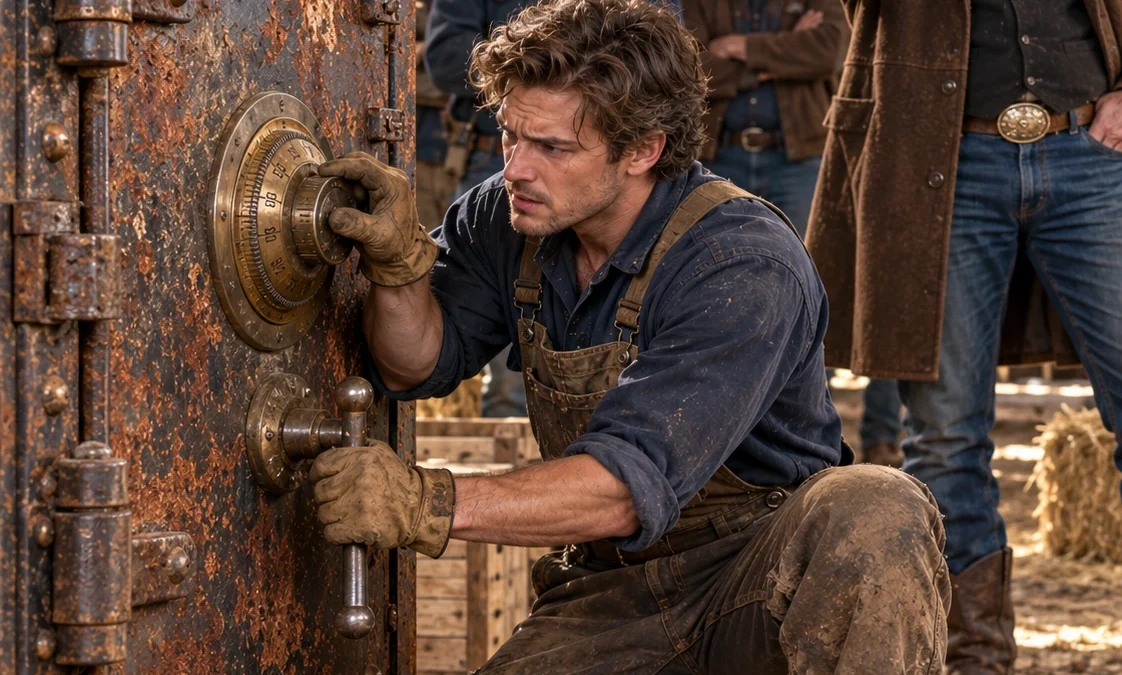
Part 2/5: Records inside the safe connect Darius’s father to the bank and reveal property deals that may have profited from hidden discrepancies.
Darius did not touch the money again. His eyes stayed on the documents and the leather pouch beside them. The old tools were worn smooth where a hand had held them for years, and the scratched initials on the brass handle looked like they had been made in a hurry.
M.C.
He knew those initials before his mind finished reading them. Marcus Cole.
The discovery didn’t feel like triumph. It felt like a door opening onto a room that had been kept dark on purpose. Darius sat at the workbench until the sky turned gray, arranging the papers in the order he found them and resisting the urge to decide what they meant before he understood them.
The ledgers were difficult to read at first. Some pages had warped. Others bore faint water stains from the night the fire was put out. But the entries still held their shape: names, addresses, loan numbers, payment dates, and signatures.
Darius compared one ledger with a stack of loan releases. Several local families appeared in both. The bank’s records showed that certain debts had been paid or formally cleared before the fire. Yet later paperwork treated those same loans as unresolved.
The discrepancy appeared again and again. A loan had a release in one set of documents, then appeared as unpaid in another. A property was marked clear in the ledger, then listed as available for foreclosure. The names of the people who lost those properties were familiar to Darius, though he knew them mostly as people who still rented homes in Mill Creek or worked long shifts at the county plant.
One buyer’s name surfaced in several transactions that followed. Everett Vale.
The papers were serious, but they were not a complete explanation. They didn’t prove who had altered a record, when it happened, or what Everett had known. They did show that Thomas Whitaker had noticed the discrepancies and planned to send the documents to an attorney.
A letter in the sealed packet was dated the day before the fire. Thomas wrote that the loan records needed an independent review. He said the original files should not remain in the bank’s routine storage. He had arranged to send them out the next morning.
The fire came first.
Darius went back to the service slip, tucked beneath the packet. It bore Thomas’s signature and described a job at Mill Creek Savings & Trust the day before the blaze: service the commercial safe, inspect the locking system, change the combination. The locksmith listed on the form was Marcus Cole.
Darius read the line once, then again. His father had not been some stranger who wandered into a burning bank. He had been hired to secure the very safe that held Thomas’s records.
That didn’t tell Darius who started the fire, or why his father hadn’t made it out. The papers didn’t explain whether Marcus had known about the disputed loans. They didn’t settle who had hidden the files or whether Everett had known the bank’s paperwork was wrong.
But the old story no longer fit the evidence. If Marcus had been inside to steal, why were his tools locked in the safe he had been hired to service? Why had the bank’s president left the original loan records there? And why had the county never mentioned that a locksmith’s kit had been recovered with them?
Silas arrived at the shop just after opening time. He stopped at the doorway when he saw the safe standing open, the document box on the bench, and Marcus’s tools laid out on a clean cloth.
He didn’t ask what Darius had found.
His face had already answered.
Darius held up the brass-handled driver. “You knew these were his?”
Silas crossed the room slowly. He picked up the tool and ran his thumb over the initials. For a moment, the old locksmith looked as if the years had caught up with him all at once.
“Yes,” he said.
The two men sat on opposite sides of the workbench. Darius listened as Silas described the past he had refused to tell. Marcus had once worked beside him, before Darius was born. He was careful, honest, and better with commercial locks than most locksmiths in the county.
When Thomas Whitaker needed a technician to service the bank safe, Silas recommended Marcus. Thomas trusted him and knew he would do the work quietly. Marcus went to the bank the day before the fire. Silas knew that much because he had given the recommendation himself.
After the fire, Silas had heard the rumors. People said Marcus had returned to the bank in the confusion, hoping to take money. Silas doubted it from the start. Marcus had been paid for his work. His tools had never been recovered.
But doubt had not felt like proof. The bank was gone, Thomas Whitaker was dead, and people with power were already buying or managing properties connected to the bank’s remaining accounts. Silas worried about his shop and the few customers who kept it open. He decided to stay quiet until he had something solid to say.
Then one week became a year. One year became fourteen.
“You let them say it about him,” Darius said.
Silas didn’t try to defend himself. “I did.”
“You let them say it about my family.”
“I did,” Silas repeated. His voice had gone thin. “I told myself I was waiting for proof. Then I was ashamed I’d waited so long. Shame made it easier to keep waiting.”
Darius looked down at the documents. He wanted to be angry, and some of him was. But he could see that Silas was not trying to make himself the hero of the story. He was admitting that fear had made him a witness who stayed silent.
“Did my father know what was in the safe?” Darius asked.
“I can’t tell you that. I don’t know.”
“Did he start the fire?”
Silas met his eyes. “I don’t know that either.”
The answer was honest. Darius could feel the difference between an honest unknown and a convenient lie. It didn’t repair the years of silence, but it gave him something real to work with.
The documents had to be protected. Darius placed them in separate folders and wrote down where each page had been found. Silas helped him make an inventory of the box and its contents, then signed it. They agreed not to remove or spend any of the money. The county would need to determine what belonged to whom.
By midmorning, Darius had decided to take the records to the courthouse. Silas suggested waiting for a lawyer, but Darius shook his head. If the old files were as important as they looked, leaving them in the shop would only give someone else time to make them disappear again.
“I’m not going to make a claim about who did what,” Darius said. “I’m going to show them what’s there.”
Silas looked at the leather pouch and the service slip. “Then I’ll go with you.”
Darius didn’t thank him. Not yet. But he didn’t tell him to stay behind.
By the time they reached the courthouse, word had already spread. Someone from the auction barn had heard that the safe was open. A handful of people gathered on the stone steps, expecting to see Darius carrying money.
Everett Vale was among them.
He smiled when Darius set the document box on the ledge. “I hope the ashes are keeping you warm.”
Darius lifted the ledger out of the box and placed it beside Thomas Whitaker’s letter. “These are bank records from the safe. Some loan releases don’t match the files used after the fire. Mr. Whitaker was preparing to have them reviewed.”
The smile stayed on Everett’s face, but it had lost its ease.
Part 3/5: Darius lays out the records publicly, and Silas breaks his silence while investigators begin tracing the disputed loans.
Darius did not raise his voice. He didn’t need to. The crowd had gone quiet enough to hear the paper edges scrape against the stone ledge as he arranged the records.
“This ledger shows loans marked paid or released,” he said. “These later records show some of the same loans as unpaid. I’m not saying who changed them. I’m asking the county to investigate.”
Everett’s expression hardened. “You have no idea what those documents mean.”
“Then somebody should explain them.”
A few people in the crowd shifted closer. One woman recognized her family’s name in the ledger. A man who had spent most of his life renting the house his parents once owned reached for the page, then stopped himself.
Everett glanced at the names. He had seen those files before. Darius could tell by the way his eyes moved across the lines. The recognition lasted only a second, but the crowd saw it too.
“You bought a burned safe for fifty-five dollars,” Everett said. “Now you think you’ve found a fortune and a conspiracy.”
“I bought the safe because it came from the bank where my father died,” Darius replied. “I found records. The county can decide what they mean.”
Silas stepped forward. For fourteen years, he had kept his knowledge tucked away behind fear and regret. Now he stood beside Darius, facing the people who had repeated the story of Marcus as if it were established fact.
“I recommended Marcus Cole for the bank job,” he said. “Thomas Whitaker hired him to service that safe. Marcus was a locksmith, not a thief. I knew that after the fire, and I should have said it when the rumors started.”
He didn’t present himself as a brave man who had rescued Darius from doubt. He admitted he had been afraid to speak when speaking might have cost him customers or work. That confession landed harder than a polished defense would have.
The crowd’s mood changed. Nobody laughed. Everett looked from Silas to the service slip, then to the tools on the cloth.
“That form could have been written by anyone,” Everett said.
“It has Mr. Whitaker’s signature,” Darius answered.
“It doesn’t prove anything about the fire.”
“No,” Darius said. “It doesn’t.”
That answer took some of the force from Everett’s attack. Darius was not claiming to know how the fire began. He was not accusing Everett of causing it. He was showing documents and asking officials to examine them.
A county clerk came out after someone reported what was happening. She asked Darius to put the papers away and bring them inside so they could be logged properly. Darius handed over the documents only after she gave him a signed receipt listing each item.
Silas signed a statement about Marcus’s work. Darius signed another about finding the papers inside the safe. The locksmith’s tools were photographed, inventoried, and placed in a secure storage cabinet with the records.
The courthouse hallway filled with people who had heard the news. Some came because their families were named in the ledger. Others came because they remembered the bank fire and had never been sure what to believe.
By late afternoon, county officials had contacted a state investigator. The first examination was slow and procedural. The original records had been exposed to heat and water; the handwriting needed to be compared with surviving copies, and the property transfers had to be traced through old court files.
Everett hired attorneys before the week was over. He said he had purchased properties through legal channels and had relied on the records available at the time. He denied knowing that any loan release had been ignored. No one could settle that argument in a day.
Darius had expected the discovery to produce an immediate answer. Instead, it produced more questions, requests for records, and long stretches of waiting. The old town’s certainty had been built in a few sentences. The truth arrived in folders.
Silas did not retreat into silence again. He gave investigators everything he remembered about Marcus and the job at the bank. He admitted that he had recommended his friend, that he had heard the rumors, and that he had failed to challenge them in public.
At the shop, he began telling Darius the parts of the past he had avoided. Marcus had been quick to laugh and slow to anger. He had worked odd hours because the best-paying commercial jobs came whenever a business had an urgent problem. He had saved carefully, and he believed a skilled worker should be paid fairly for doing the job right.
Silas said Marcus had taken pride in his work. The day before the fire, he came back to the shop after servicing the bank safe and said the lock was operating smoothly. He didn’t mention the bank’s records or suggest he had seen anything suspicious.
“Was he worried?” Darius asked.
“Not when I saw him.”
“Did he tell you he was going back the next day?”
“No.”
Silas did not fill the gaps with guesses. That mattered to Darius. He had spent his life hearing other people turn missing facts into whatever story suited them. Silas’s willingness to say “I don’t know” became its own kind of testimony.
Weeks passed. Investigators compared the ledger with surviving loan files and county property records. They found that several loan releases were genuine. The signatures matched documents signed by bank officers. Some properties had been transferred after debts marked paid in the original ledger were later treated as overdue.
Everett Vale had acquired multiple parcels through those transactions. His company had bought some at foreclosure auctions and others from intermediaries. In at least a few cases, the families who had lost their homes had no record of receiving notice that their loans had been cleared.
The evidence did not establish that Everett had personally altered the records. It did establish that his companies had benefited from transactions connected to files that could no longer be trusted. Investigators sought more documents, including correspondence from the bank and the county’s original foreclosure notices.
Some of the families named in the records visited the courthouse. One was a retired school custodian named Mae Holloway, whose parents had lost a small home outside town when she was a child. She brought the old payment receipts her mother had kept in a biscuit tin.
Another family had no paperwork left. They remembered the bank sending a letter that said their loan was settled, then a new letter months later demanding payment. Their house had been sold before they could find a lawyer.
The records did not restore those years. But they gave the families a way to challenge what had happened, and they gave investigators something firmer than memory to follow.
Darius kept working at the shop. He still swept the floor, sorted keys, and repaired locks. But when customers came in, they looked at him differently. Some apologized for laughing at the auction. Others avoided his eyes.
He didn’t ask anyone to apologize. He had no interest in becoming a public symbol or a hero. He wanted the facts to be checked, Marcus’s name to be cleared of what had never been proven, and the families named in the ledger to receive a fair hearing.
One evening, after closing, Darius found Silas cleaning the brass-handled driver from the pouch. He held it carefully, as though the tool might break.
“You don’t have to keep proving you’re sorry,” Darius said.
Silas set the tool down. “I’m not trying to prove anything. I’m trying to stop hiding.”
Darius looked at him for a long moment. Trust would not return because of one courthouse statement. But silence had been broken, and that was a beginning.
Part 4/5: Months of investigation bring partial justice to the families, while Darius learns what can and cannot be proven about his father.
The review lasted months. Investigators pulled bank files from storage, checked court records, and compared the documents recovered from the safe against surviving copies. Some pages confirmed what the town had suspected; others complicated it.
The clearest finding was that multiple loans had been paid or released before the fire, yet the later files treated them as unsettled. Those records had led to foreclosures or distressed sales. Everett Vale’s companies had purchased several properties connected to the disputed accounts.
Everett continued to deny wrongdoing. His lawyers argued that his companies had relied on the official records available at the time. Investigators could not prove that he had personally altered a ledger, ordered anyone to change a file, or started the bank fire.
That limit mattered. Darius would not repeat what the town had done to Marcus by claiming certainty where the evidence stopped. But the transactions could no longer be treated as unquestionably legitimate.
Some families were able to recover property through settlements. Others received financial compensation after years of legal work. In a few cases, the original homes had been sold again or rebuilt, making a return impossible. Those families received money, but money could not give them back the years they had spent believing they had lost everything because of their own mistake.
The county acknowledged that its old files had been incomplete and that the bank’s surviving records had not been properly reconciled after the fire. It did not erase every consequence of those failures. But it agreed to reopen the affected cases and review the claims one by one.
The official record about Marcus changed more slowly. Investigators confirmed that he had been hired to service the bank safe the day before the fire. His tools had been found inside the safe, along with the documents the bank president planned to have independently reviewed.
No evidence supported the town’s confident claim that Marcus had entered the bank to steal. Investigators could not reconstruct every decision he made during the fire, or determine exactly how he died. They could not prove he had hidden the records, rescued them, or even known what they contained.
But they could say what the evidence showed: Marcus had a legitimate professional reason to be at the bank. He had been hired to work on the safe. His tools were inside it. The records preserved there were bank documents, not stolen money.
The county removed language in its archived summary that had described him as a suspected thief. A revised notice acknowledged that the old accusation had never been substantiated. It was a small statement, written in careful official language, but Darius read it three times.
For the town, that was enough to change the way people spoke. Some still remembered the rumor. But now they had to admit that it had never been proven. A few people who had once repeated it came to Darius and offered apologies. He accepted some and declined others.
He didn’t need to make peace with everybody. He needed to know that the next child in Mill Creek would not grow up hearing that Marcus Cole was a thief as if it were a fact.
The safe’s money went through a separate legal process. Nobody could simply claim the bills and bonds. Officials had to determine what belonged to the bank, what might be part of a deposit, and what claims could be made by people affected by the disputed accounts.
Darius never expected to keep the contents. He had bought the safe, not the bank. Whatever came from its locked compartment needed to be handled in a way the law recognized. Part of the recovered funds went toward settlements connected to the affected families. Some was held while ownership questions were resolved.
The settlement connected to Marcus’s work gave Darius enough to move out of the tiny room behind the shop, buy proper tools, and pay for advanced training in commercial safe repair. It did not make him rich. He was grateful for the chance to build a life without wondering whether an unexpected bill would undo him.
He stayed at Mercer Lock & Hardware.
His relationship with Silas changed. For a while, Darius could not look at him without thinking about all the years he had known enough to speak and had chosen not to. Silas did not ask to be forgiven. He answered questions honestly, even when the answers made him look worse.
Over time, they learned how to work together again. Silas showed Darius the tricks he had learned in fifty years at the bench. Darius challenged him when a repair could be done more carefully. They argued over stubborn locks, bad customer instructions, and how much coffee a person could drink before lunch.
One afternoon, Silas gave Darius the key to the shop’s old training cabinet. Inside were manuals, broken lock parts, and a set of tools that had belonged to Marcus before they vanished from the family’s belongings. Darius asked how Silas had kept them all those years.
Silas said he had found the tools among Marcus’s effects after the fire. He had held on to them because he believed they should belong to Darius one day. Then he had been too ashamed to explain why he had them.
Darius closed the cabinet. “You should have told me.”
“I know.”
The answer was not an excuse. It was only the truth.
They began training apprentices on Saturdays. Some were high school students looking for a trade; others were adults who wanted a practical skill that didn’t require leaving town. Silas taught them how to cut keys and repair simple locks. Darius taught them how to observe before applying force.
“Listen first,” he told them. “If you don’t know what the mechanism is doing, forcing it just makes your mistake more expensive.”
The phrase began as advice about locks. It became the way Darius thought about the past. Rumors were easy because they required no patience. Facts took time to hear.
Mill Creek’s vocational board proposed using part of the settlement money and a county grant to create a small learning center. It would offer training in trades the town needed: welding, carpentry, electrical work, and locksmithing. Darius did not want the center named after him. He insisted that it carry no grand title at all.
The old bank safe became the center’s first exhibit. They wheeled it into the entrance with the scorched side facing the door. The black paint remained blistered. The handle remained bent. No one polished it until it shone or pretended the fire had left no mark.
A plaque beside it described Marcus Cole as a locksmith who had serviced the bank safe before the fire. It explained that documents recovered from the safe helped reopen questions about disputed loans and property transfers. It also stated that the old accusation against him had never been proven.
Darius read the plaque before it was installed. He changed one sentence that made it sound as if his father had been officially declared innocent. The records did not establish everything that had happened that night, and Darius would not let the center turn a careful correction into another unsupported story.
The plaque was simpler after the edit: it said what could be known, and it left room for what could not.
Part 5/5: At the learning center, the open safe becomes a lesson in patience, evidence, and the danger of judging people before hearing their story.
On opening day, the learning center filled with the sounds of people who had come to see what Mill Creek had built. Children ran from classroom to classroom. Adults lined up for coffee and looked over the new workbenches. Near the entrance, the burned bank safe stood with its door open.
Mae Holloway came with her daughter and two grandchildren. She stood before the plaque, reading it quietly. Darius recognized the name from the ledger and remembered the biscuit tin of receipts she had brought to the courthouse.
“Your mother kept those papers for a long time,” he said.
“She never stopped believing the bank had made a mistake,” Mae answered. “Everybody said she was confused. She kept the receipts anyway.”
The words stayed with him. One family’s memory had survived in a tin. Another family’s records had survived in a burned safe. The proof had been fragile, incomplete, and nearly discarded, but it had lasted long enough for someone to listen.
A few minutes later, Everett Vale arrived. He had not been invited, but the center was open to the public. His suit was crisp, his expression controlled. He stood at the safe longer than anyone else.
“Your father’s name is on that plaque,” he said when Darius came near. “You got what you wanted.”
Darius looked at the words carved beside the safe. “I wanted the record to say what we know.”
“And what don’t we know?”
“We don’t know who started the fire. We don’t know who changed every file. We don’t know everything my father did that night.”
Everett’s eyes narrowed. “Then you still don’t know whether he went into that bank to steal.”
“The evidence says he was hired to work on the safe. It says his tools were inside it. That’s more than the town had when it called him a thief.”
Everett didn’t answer. His company had lost several properties after settlements and reviews. He had not been convicted of starting the fire or personally altering the records. His lawyers continued to maintain that the purchases had been made in good faith.
Darius had no new accusation for him. The records had said what they could say. The rest belonged to the people who had investigated them and to the history that still had gaps.
Everett studied the bent handle. “You spent your last fifty-five dollars on a safe that might have held nothing.”
“I know.”
“You could have bought better tools.”
“I did.”
Everett glanced at him. “With what?”
“Work.”
The older man seemed to have expected anger, or a demand for apology. Darius offered neither. After a moment, Everett looked away and walked into the center.
Silas had heard the conversation from the doorway. He came to stand beside Darius, holding two cups of coffee. He passed one over without speaking.
For a while, they watched the children gather near the safe. A young girl leaned toward the open compartment, trying to see how the heavy door had moved. Her teacher reminded her not to climb on it.
“What do you think your father would say?” Silas asked.
Darius watched the children instead of answering. He could imagine Marcus lifting him onto a kitchen counter, his hands warm and steady. He could imagine the sound of his laugh, though he wasn’t sure whether the memory was real or something his mother had told him until it felt real.
“He’d probably tell me not to force the door,” Darius said at last.
Silas smiled faintly. “He’d say the same thing to me.”
The auction receipt still sat in the drawer of Darius’s workbench. He had kept it folded between two sheets of paper so the ink wouldn’t rub away. It didn’t remind him that he had won a valuable safe. It reminded him of the moment the crowd decided he was foolish, before anyone knew what was inside.
He kept Marcus’s tools in a cloth-lined case. He cleaned and oiled them but never polished away the scratches. The marks belonged to the hands that had used them.
The safe remained at the center. They could have repaired the door, painted it, or hidden the worst of the fire damage with a new finish. They chose not to. Its warped edge and burned steel showed what had happened. Its open door showed that the past did not have to remain closed forever.
At first, some people treated the exhibit like a local legend. They asked whether Darius had found a fortune or whether he had become famous. He answered that the safe held old money, bank records, and his father’s tools. The records had helped families challenge property losses. His father’s professional connection to the bank had finally been recorded.
The rest, he told them, had taken time.
The learning center grew. Silas taught basic lock repair twice a week, and Darius led the advanced workshop. Young people who had once seen a trade as something to fall back on began taking it seriously. They learned that craftsmanship was more than knowing which tool to use. It was knowing when not to use force.
One apprentice asked Darius whether he thought the safe had been worth fifty-five dollars.
Darius paused. “If you’re asking about the cash, I don’t know. If you’re asking whether I’d buy it again, yes.”
“Even if it had held nothing?”
“Even then.”
The apprentice frowned. “Why?”
“Because I needed to know what was there. And because it was too easy for everybody else to decide they already knew.”
The answer was not a guarantee that every locked door contained something important. Most locks held ordinary things. Some safes were empty. Sometimes patience revealed nothing except the limits of what anyone could know.
But judgment made without patience could bury the truth deeper than steel. Mill Creek had decided what Marcus Cole was before it understood why he had been at the bank. A whole town had repeated an accusation because it was easier than admitting there had never been proof.
Darius never claimed the safe had made him rich. Its most important contents were not the old bills or bonds. They were the records, the service slip, and the tools bearing his father’s initials.
The documents had given families a chance to be heard. The service slip had established that Marcus belonged at the bank. The tools had connected him to the safe he had been hired to protect. None of them answered every question about the fire, but together they made the old story impossible to repeat as certainty.
Years later, Darius still remembered the auction barn. He remembered Everett’s smile, the laughter, and the words about a box of ashes. In one small way, Everett had been right: Darius had bought a burned box.
What Everett had not understood was that fire could destroy paper, wood, and metal without destroying every truth hidden inside them. Some truths survived in ledgers. Others survived in the memory of an old locksmith who finally chose to speak. And one survived in the steady hands of a young man who refused to force a damaged mechanism before listening to it.
Darius never learned exactly what Marcus had done during the last minutes of the fire. He never learned who had first set it or whether his father had understood the danger waiting in the bank. The gaps remained gaps.
But the town could no longer fill them with theft and call the story settled. The record said Marcus was a locksmith hired to service the safe. It said his tools were inside. It said the accusation had never been proven.
Sometimes that was the bravest kind of ending: not a perfect answer, but a correction strong enough to make people stop repeating a lie.
When the center closed for the night, Darius stood alone before the safe. Its door hung open. He ran his fingers lightly along the scorched edge, feeling the roughness left by the fire.
He thought of the fifty-five dollars, the sleepless night, and the tiny sideways movement he had almost missed. He thought of all the people who had looked at the safe and seen only scrap. Then he turned off the lights and left the door open.
THE END








