They Laughed When She Paid $35 for an Engine-Less Tractor—Then a Dealer Offered Her $5,000 After Spotting What Everyone Else Had Missed Beneath Its Rusted Frame
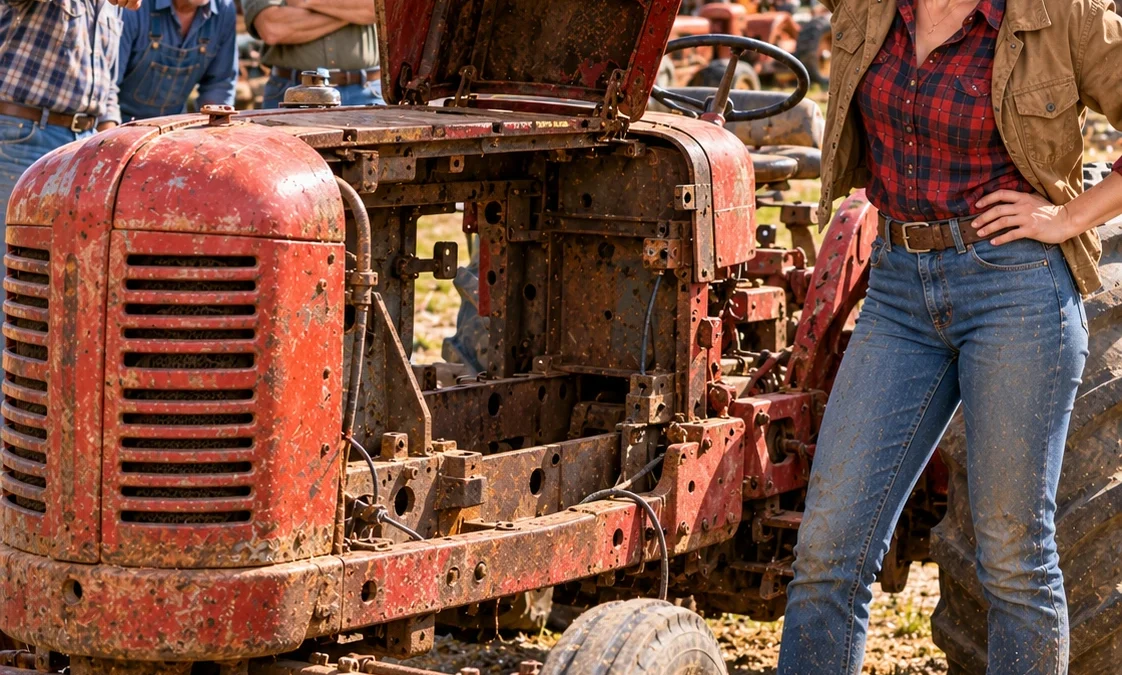
Part 2/5: While neighbors wait for her failure, Elaine rebuilds the Farmall from salvage parts and uncovers strange factory markings buried beneath years of grease.
The salvaged engine was ugly enough to discourage anyone who judged machinery by paint.
Its valve cover was coated in oily dust, the manifold had surface rust, and a mouse had built a nest inside the governor housing.
But the crankshaft turned.
More importantly, the block was sound.
Elaine spent the next ten evenings dismantling it.
She measured cylinder wear with borrowed gauges, checked the crankshaft journals, cleaned the oil passages, lapped the valves, replaced worn rings, and installed new bearings and gaskets wherever she could afford them.
Money dictated every decision.
A full professional rebuild would have ruined the entire point of buying the tractor.
Elaine bought only what she could not repair.
For everything else, she cleaned, measured, adjusted, or fabricated.
Her neighbor, Raymond Sutter, wandered into the machine shed one evening and stared at the engine hanging from a chain hoist.
“You planning to farm this spring,” he asked, “or become a machinist?”
Elaine kept tightening a bolt.
“Whichever pays first.”
Raymond laughed, but unlike the men at the auction, he came back the next night with an old torque wrench and a box of unused gaskets.
By early May, the engine was ready to install.
That was when Elaine encountered the first serious problem.
The engine would fit the Super M.
The clutch arrangement would not.
The mysterious additional housing between the clutch and transmission had changed the distance just enough that a standard coupling setup left everything misaligned.
Elaine spent an entire Sunday comparing measurements.
The extra casting was not homemade.
Its bolt pattern was too precise.
Its machining was too clean.
And on the inside surface, beneath an inspection plate, she found another mark.
IH ENG. TEST.
The letters were small.
They had been covered by grease and hidden for years.
Elaine sat back on the concrete floor.
Her father had taught her never to make an expensive conclusion from one strange clue.
So she made none.
She simply wrote the letters in her notebook.
The next morning she drove to Cade Farm Equipment.
Russell was behind the counter.
He glanced at her greasy hands.
“I heard the corpse is getting a heart transplant.”
“I need a clutch coupling machined.”
“For the Super M?”
“Yes.”
Russell smiled.
“Should’ve spent that money on something complete.”
Elaine slid her measurements across the counter.
Russell looked down.
His smile disappeared.
He read the dimensions once.
Then again.
“Where’d you get these?”
“Measured them.”
“That center section isn’t standard.”
“I know.”
Russell raised his eyes.
For the first time since the auction, he seemed more interested than amused.
“What’s stamped on the casting?”
Elaine did not answer immediately.
Russell tried to make the question sound casual.
“Could matter for parts.”
“X-17.”
The room went quiet.
Russell stared at her for half a second too long.
Then he shrugged.
“Probably a repair-shop number.”
Elaine folded the paper.
“Can you machine the coupling?”
Russell said his shop was backed up for three weeks.
Elaine thanked him and left.
She drove directly to a small machine shop in the next county.
The owner finished the coupling in four days.
On May 18, Elaine lowered the rebuilt engine into the Farmall.
She connected fuel, ignition, cooling lines, governor linkage, and exhaust.
She installed a used starter from a salvage tractor and borrowed a battery from her truck.
At 6:42 that evening, with Raymond standing beside the workbench and two neighbors watching from the doorway, Elaine pressed the starter.
The engine turned twice.
Nothing.
She adjusted the distributor.
Tried again.
The engine fired once and stopped.
Raymond leaned closer.
Elaine changed the timing slightly and pressed the starter a third time.
The old six-cylinder came alive.
The sound filled the machine shed so suddenly that everybody stepped backward.
Gray exhaust rolled from the temporary pipe.
The engine coughed, stumbled, then settled into a steady mechanical rhythm.
Elaine did not cheer.
She simply stood there with both hands on the tractor and listened.
Oil pressure rose.
Temperature remained stable.
No knocking came from the crankshaft.
No coolant appeared in the oil.
After fifteen minutes, Elaine shut it down.
Raymond grinned.
“Thirty-five dollars, huh?”
“Thirty-five for the tractor.”
“How much now?”
Elaine added it mentally.
Engine, bearings, rings, gaskets, hoses, starter, machine work, ignition parts.
“Two hundred ninety-eight dollars.”
Raymond shook his head.
“You’re still missing paint.”
“Paint doesn’t pull.”
Three days later, she drove the Farmall out of the shed under its own power.
The first trip was only around the yard.
The second was down the lane.
The third was into a small field with a three-bottom plow.
That was where the strange lever became impossible to ignore.
In one position, the tractor behaved normally.
When Elaine pulled the lever under light load, engine speed remained almost unchanged, but ground speed dropped sharply while pulling power increased.
She nearly stopped the tractor from surprise.
She pushed the lever forward.
Ground speed increased again.
Elaine stopped at the end of the field and stared down at the housing.
She knew what a torque amplifier was.
International Harvester had introduced production tractors using the system after her 1952 Super M had been built.
Her father had demonstrated one years later at a dealership.
It allowed a driver to reduce ground speed without stopping to shift the main transmission.
But this tractor was dated too early.
Elaine drove another round.
The mysterious unit worked.
Not perfectly.
It made a faint growl under heavy pull, and the lever travel felt crude compared with production machinery.
Still, it worked.
That evening Elaine pulled every old farm magazine she owned from a cabinet.
She found articles about the later Super M-TA.
She compared photographs.
Her tractor was different.
Older.
Rougher.
Experimental-looking.
On Friday afternoon, Russell Cade drove slowly past Elaine’s farm.
He did not stop.
On Saturday, he drove past again.
That evening, Elaine locked the machine shed for the first time in years.
By June, the Super M had become her main field tractor.
The salvaged engine pulled strongly.
The transmission was quiet.
The rear end that everyone had assumed must be worn out was tighter than the one in her old Farmall H.
Every hour Elaine operated it convinced her of the same thing.
Before its engine disappeared, this tractor had not worked many hours.
Someone had taken care of it.
Someone had deliberately preserved the drivetrain.
And someone, she now suspected, had known exactly what X-17 meant.
Part 3/5: The rebuilt tractor proves itself during a brutal haying window, but one retired mechanic recognizes a hidden feature that changes Elaine’s bargain forever.
June brought one of the worst haying stretches Cedar Bluff had seen in years.
Rain came every three or four days.
Farmers would cut hay under clear skies, watch clouds build by afternoon, then rush machinery into fields before the next storm flattened everything.
Elaine could not afford to lose a cutting.
Her dairy herd depended on that hay.
On June 21, the weather service predicted a thirty-hour dry window followed by three days of thunderstorms.
Every farmer in the township moved at once.
Elaine started before sunrise.
The Super M pulled her mower through heavy first-cut alfalfa until noon, then switched to a rake after the crop wilted.
By the following morning, she was baling.
The old Farmall looked absurd beside the newer machines operating on neighboring farms.
Its hood was three different shades of red.
One side panel came from a salvage yard.
The exhaust stack leaned slightly forward.
The engine still carried traces of industrial gray paint beneath Elaine’s red brushwork.
But it ran.
At three that afternoon, Raymond’s nearly new tractor developed a hydraulic problem.
At four, another neighbor lost a water pump.
Shortly after five, Elaine heard thunder beyond the western ridge.
She had eighteen acres left.
Instead of stopping to shift each time the baler hit heavy windrows, she began using the mysterious reduction lever.
Pull.
The tractor slowed without losing engine speed.
The baler swallowed the thick section.
Push.
The tractor accelerated.
Again and again, the crude old experimental unit saved seconds.
Seconds became minutes.
Minutes became acres.
Elaine finished the last windrow as the first hard drops hit the tractor hood.
Raymond stood at the gate watching.
He looked at the sky, then at the Farmall.
“You’ve got something strange in that tractor.”
Elaine wiped rain from her forehead.
“I’m starting to think so.”
Two weeks later, Cedar Bluff held its annual machinery and dairy exhibition at the county fairgrounds.
Elaine had no intention of entering the Farmall.
Raymond did it for her.
He signed the tractor up for the antique and unusual equipment row, arguing that any machine built in 1952 and resurrected for less than three hundred dollars deserved to be seen.
Elaine reluctantly drove it into town.
That decision changed everything.
Most visitors noticed the missing factory engine first.
Older farmers leaned over the side rails and tried to identify the industrial replacement.
Children liked the mismatched paint.
A few men from the auction recognized the tractor and became suddenly less enthusiastic about remembering how loudly they had laughed.
Around noon, an elderly man wearing a faded International Harvester cap stopped in front of it.
He did not look at the engine.
He looked underneath.
His name was Orson Bell.
He was seventy-one and had spent almost thirty years as a field service mechanic before retiring from International Harvester.
Orson crouched beside the tractor.
Then he became very still.
“Who owns this?”
Elaine stepped forward.
“I do.”
“Where’d you get it?”
“Colburn liquidation sale.”
Orson stood slowly.
“Henry Colburn?”
“You knew him?”
“I knew the tractor.”
Elaine felt every hair on her arms rise.
Orson asked permission to climb onto the platform.
He examined the lever beside the seat, then looked at the center casting.
“Does it work?”
“Yes.”
“All ranges?”
“As far as I can tell.”
Orson smiled in disbelief.
“I haven’t seen this machine since 1953.”
Elaine said nothing.
Orson explained that in the early 1950s, International Harvester engineers had been developing a way to give tractor operators an additional under-load speed range without requiring the driver to stop and use the clutch.
Production versions eventually became known through the Torque Amplifier system.
Before that happened, experimental units were tested in ordinary-looking tractors.
Most never left company control.
A few were sent to selected farms and field technicians.
According to Orson, Elaine’s tractor had been one of them.
“X-17 wasn’t a repair number,” he said.
“It was a test chassis designation.”
Elaine glanced at the rusted tractor.
“Why would Henry Colburn have it?”
“He didn’t originally.”
Orson remembered the machine being operated by a regional test crew west of Madison.
The tractor had pulled plows, wagons, and tillage equipment while engineers recorded temperatures, gear wear, clutch behavior, and operator complaints.
Then one day it disappeared from the program.
Orson had assumed it had been dismantled.
“What happened to the motor?” Elaine asked.
“That’s the part I don’t know.”
Orson walked around the tractor once more.
Near the right rear axle, he scraped away dirt with his thumbnail.
Another tiny stamped mark appeared.
A date.
11-53.
Orson nodded.
“Last inspection.”
Elaine asked what the tractor was worth.
Orson laughed softly.
“To a farmer? Whatever work you can get from it.”
He touched the experimental housing.
“To the right person? That gets complicated.”
Across the fairgrounds, Russell Cade had been watching.
He approached less than ten minutes after Orson left.
Russell suddenly had no jokes.
He complimented Elaine on the rebuild.
He asked how much she had invested.
Then he asked whether she had considered selling.
Elaine looked at him.
“Three months ago you said I bought half a tractor.”
“I was wrong.”
“How wrong?”
Russell smiled carefully.
“I’d give you twelve hundred dollars.”
Elaine almost laughed.
That was four times what she had invested.
It was also the first offer Russell had ever made for the tractor.
“No.”
“Fifteen hundred.”
“No.”
“Two thousand.”
Elaine’s expression changed.
People did not jump eight hundred dollars in ten seconds unless they were afraid someone else knew more.
“Why do you want it?”
Russell shrugged.
“Advertising. Conversation piece.”
Elaine looked toward Orson Bell, who was speaking with another retired mechanic.
“Then we’re done talking.”
Russell left.
The following Monday, he appeared at Elaine’s farm.
This time he carried a cashier’s check.
Five thousand dollars.
Elaine stared at the number.
Five thousand dollars could replace her failing barn roof.
It could pay off most of her machinery debt.
It could buy another good used tractor and leave money in the bank.
Russell placed the check on her kitchen table.
“For an old machine you bought for thirty-five dollars,” he said, “that’s a remarkable profit.”
Elaine looked at the check.
Then at Russell.
“What did Orson Bell tell you?”
Russell’s jaw tightened.
“Nothing important.”
Elaine slid the check back.
“Then you’re offering five thousand dollars for nothing important.”
Russell did not pick it up.
For the first time, Elaine saw real frustration in his face.
“Machines are worth what somebody will pay.”
“Exactly.”
Elaine pushed the check another inch toward him.
“And now I know somebody must be willing to pay you more.”
Part 4/5: Russell’s sudden $5,000 offer reveals he knows far more than he admits, forcing Elaine to learn why the engine had vanished fifteen years earlier.
Russell left without the tractor.
He also left Elaine with a problem.
Five thousand dollars was too much money to ignore.
Not because she planned to accept it.
Because she needed to understand it.
Elaine called Orson Bell that evening.
He arrived the next morning carrying a cardboard box filled with old service bulletins, notebooks, and photographs.
They spread everything across Elaine’s kitchen table.
One black-and-white photograph showed three Farmall tractors parked outside a test building.
Two looked ordinary.
The third had a slightly longer center section.
Orson turned the photograph over.
On the back, someone had written X-15, X-16, X-17.
Elaine felt her stomach tighten.
The third tractor was hers.
Not similar.
Hers.
A small dent on the hood matched.
The rear wheel weights matched.
Even the oddly positioned hydraulic line bracket was identical.
Orson found another document dated November 1953.
It recorded experimental drivetrain testing on X-17 and contained several handwritten notes about excessive heat under sustained heavy drawbar load.
The final line said:
Unit removed from active test. Power plant to be returned to engineering pool. Chassis retained for inspection.
That explained the missing engine.
The motor had not failed.
It had been intentionally removed because it belonged to International Harvester’s engineering inventory.
But the chassis was supposed to remain under company control.
Instead, sometime after the program ended, it had disappeared into private hands.
Orson remembered hearing that a regional storage building had been cleared in the late 1950s.
Obsolete test equipment was sold cheaply, often with poor paperwork.
A local machinery hauler named Silas Colburn—Henry’s older brother—had bought several lots.
Silas died in 1961.
His property passed to Henry.
The engine-less test tractor apparently went with it.
Nobody understood what it was.
Henry pushed it beside the fence.
Six years later, Elaine bought it for thirty-five dollars.
“But why does Russell care?” Elaine asked.
Orson opened a second folder.
“Because he called me yesterday.”
Elaine looked up.
“He wanted to know if I was certain.”
“What did you tell him?”
“That I was certain enough to make some telephone calls.”
Orson had already contacted a retired engineer in Illinois named Franklin Weller, who had worked on early torque-amplifier development.
Franklin remembered X-17 immediately.
According to him, three principal experimental chassis had been used during that phase of field testing.
X-15 had been dismantled.
X-16 had suffered a catastrophic housing failure and was scrapped.
X-17 had survived.
Then it vanished.
For fourteen years, several former engineers had assumed it no longer existed.
Franklin wanted photographs.
Elaine sent them.
Three days later, a registered letter arrived.
It was not from Russell.
It was from a historical equipment collector near Rockford who had been working with former International Harvester employees to preserve unusual engineering machines before they disappeared into scrap yards.
He offered Elaine eight thousand dollars.
The letter made something else clear.
The collector had previously contacted implement dealers across Wisconsin asking them to watch for unusual early test tractors with experimental center housings.
Cade Farm Equipment had received one of those notices eleven months earlier.
Elaine read that sentence twice.
Russell had known someone was searching for X-17 before the liquidation auction.
He simply had not recognized the tractor when Elaine hauled it past his dealership.
The missing engine had fooled him too.
Once he saw the odd clutch measurements and heard Orson confirm the test markings, he understood exactly what Elaine owned.
His five-thousand-dollar offer had not been generosity.
It had been a business opportunity.
Russell planned to buy the tractor from her for five thousand and immediately resell it for more.
Elaine could almost respect the idea.
What she did not respect was pretending the machine was merely an advertising curiosity.
The following afternoon, Russell returned.
He had increased his offer to six thousand.
Elaine handed him a copy of the collector’s letter.
Russell read the first paragraph and stopped.
His shoulders dropped.
“You called them directly.”
“They called me.”
“Eight thousand is strong money.”
“For something unimportant?”
Russell folded the letter.
“You really going to sell?”
Elaine looked through the window toward the machine shed.
She had expected the question to be easy.
Eight thousand dollars was more money than she had ever held at one time.
But the tractor was no longer just a bargain.
Elaine had spent months bringing it back to life.
More importantly, the machine had become proof of something she had spent years trying to explain without words.
Useful things were often dismissed because the obvious part was missing.
People had looked at Elaine after her father died and seen a farm without a man running it.
They had looked at the Farmall and seen a tractor without an engine.
In both cases, they had decided the missing thing mattered more than everything that remained.
Elaine declined Russell’s offer.
Then she declined the collector’s eight thousand.
Two weeks later, Franklin Weller came from Illinois to inspect X-17 personally.
He spent nearly four hours measuring the center housing, examining cast numbers, and testing the lever.
When he finished, he stood beside the tractor with both hands in his pockets.
“There’s something nobody told you,” he said.
Elaine waited.
“The housing in this tractor isn’t just an early test piece.”
Franklin crouched and pointed toward a nearly invisible casting mark behind the clutch linkage.
P-1.
“Prototype One.”
Elaine stared at him.
Franklin explained that X-17 had been fitted with the first full field-serviceable version of that particular experimental reduction assembly.
Later units were redesigned.
Production units were redesigned again.
The mechanism under Elaine’s seat represented an engineering step that existed for only a short period.
There might never have been another complete one.
That changed the conversation completely.
The collector withdrew his eight-thousand-dollar offer.
Then he replaced it with twelve thousand five hundred.
Russell stopped calling.
Elaine still did not sell.
Instead, she made a proposal nobody expected.
Part 5/5 (THE END): A factory letter exposes the tractor’s real identity, the dealer’s hidden motive, and the reason an empty engine bay became Elaine’s greatest advantage.
Elaine offered to loan X-17 for historical display on one condition.
Nobody was allowed to restore away the story.
She did not want a perfect coat of red paint hiding every scratch.
She did not want the replacement industrial engine disguised as original.
She did not want the improvised coupling removed simply because an engineer in 1952 would not have used it.
The tractor’s importance, Elaine argued, came from two separate histories.
International Harvester had built the first one.
She had built the second.
Franklin agreed.
By September 1967, X-17 was scheduled to appear at a regional agricultural engineering exhibition in Illinois.
Before it left Wisconsin, Elaine used it for one final harvest season.
The tractor pulled wagons.
It ran the forage blower.
It hauled manure.
It worked exactly the way a machine should work when nobody is asking it to become a museum piece.
Then something arrived in the mail that surprised even Franklin.
It was a letter from a former International Harvester engineer named Paul Hendricks, who had supervised part of the 1953 testing program.
Paul had heard that X-17 survived.
He remembered the final weeks before the tractor disappeared.
His letter finally explained why the machine had been preserved so carefully before being abandoned.
After testing ended, X-17’s experimental transmission was supposed to be dismantled for engineering analysis.
But the project team was already working with a newer design.
Nobody wanted to spend the labor.
Instead, a mechanic drained the contaminated fluids, refilled the transmission and rear housing with clean oil, greased the bearings, wired the experimental lever in its forward position, and covered several openings to keep moisture out.
The engine was returned to the engineering pool.
The chassis waited for disassembly that never happened.
Eventually paperwork changed.
People transferred departments.
The storage building was cleared.
X-17 became an unidentified red tractor without an engine.
That mistake saved it.
If the original engine had remained installed, the tractor almost certainly would have been sold as usable farm equipment in the 1950s.
Someone would have worked it hard.
The experimental unit might have broken.
A mechanic might have replaced it.
The tractor might have been traded, rebuilt, modified, or scrapped.
Because it looked incomplete, nobody considered it valuable enough to use.
Because nobody used it, the rarest part survived.
The empty engine bay was not the tractor’s greatest weakness.
It was the reason the tractor still existed.
Elaine read that paragraph three times.
Then she laughed alone at the kitchen table.
Every man at the auction had been correct about one thing.
The Farmall really had been useless when she bought it.
They had simply been wrong about whether useless meant worthless.
In October, representatives from the historical exhibition arrived with a transport truck.
Russell Cade showed up too.
He parked near Elaine’s barn and watched while Franklin photographed X-17 before loading.
Russell finally walked over.
“I should’ve bid thirty-six dollars.”
Elaine smiled.
“You had your chance.”
“I thought it was scrap.”
“So did everybody.”
Russell looked at the tractor.
“You ever regret turning down twelve-five?”
Elaine shook her head.
The loan agreement paid her a modest annual exhibition fee, but ownership remained hers.
More importantly, the organization had agreed to supply technical assistance and parts necessary to preserve the experimental drivetrain.
Elaine could still use the tractor at demonstrations.
Its history would be documented under her name as the person who rescued it.
But there was one more surprise.
Franklin had quietly contacted International Harvester representatives after seeing the condition of Elaine’s farm equipment.
The company had no legal claim to X-17 after the old liquidation paperwork was reviewed.
They did, however, want Elaine’s cooperation documenting the prototype.
In exchange for a five-year renewable exhibition agreement, a regional distributor offered her an unusually favorable trade arrangement on a newer tractor.
Elaine sold her tired Farmall H.
With the money she had saved, the exhibition payments, and the special financing arrangement, she put a modern tractor in her barn without selling X-17.
The thirty-five-dollar Farmall had effectively done what everyone said an engine-less tractor could never do.
It helped buy its own replacement.
During the winter, X-17 returned from Illinois.
The exhibit staff had cleaned it carefully without repainting it.
A small removable plaque came with it.
The plaque described the tractor as an experimental 1952 Farmall Super M test chassis associated with early under-load drive development.
At the bottom were three words Elaine had not expected.
Recovered by Elaine Rourke.
She mounted the plaque on the wall of the machine shed instead of attaching it permanently to the tractor.
The following spring, she drove X-17 in Cedar Bluff’s machinery parade.
The mismatched red paint remained.
The salvaged industrial engine still showed traces of gray.
The exhaust stack still leaned slightly forward.
And the strange little lever beside the seat still clicked firmly between its two positions.
People lined the road.
Some knew the story by then.
Others only saw an old tractor.
As Elaine passed Cade Farm Equipment, Russell stood near the same service entrance where he had laughed one year earlier.
This time he removed his cap.
Elaine lifted one hand from the steering wheel.
Nothing more needed to be said.
Years later, people in Cedar Bluff would remember the twelve-thousand-five-hundred-dollar offer.
They would remember the experimental casting.
They would remember the factory photographs and the engineers who came looking for a tractor everyone had assumed was junk.
But Elaine remembered something simpler.
She remembered standing in the mud at that liquidation auction while an auctioneer begged someone to bid more than scrap price.
She remembered looking through an empty engine compartment and realizing that everyone else had stopped thinking the moment they saw what was missing.
She had looked at what remained.
A good rear end.
A tight transmission.
Solid castings.
A strange lever.
Thirty-five dollars worth of possibility.
That difference had changed everything.
The real twist was not that a rare prototype had been hiding beneath layers of Wisconsin mud.
It was that the very thing that made the tractor appear worthless—the missing engine—had protected the experimental machinery long enough for Elaine to find it.
The tractor had survived because nobody wanted it.
Elaine had succeeded because she did.
THE END








