They Mocked a Homeless Woman for Buying Sixty Acres of Thorns for $60—Then a Blizzard Hit, and Her Mule Uncovered What the Entire Town Had Forgotten.
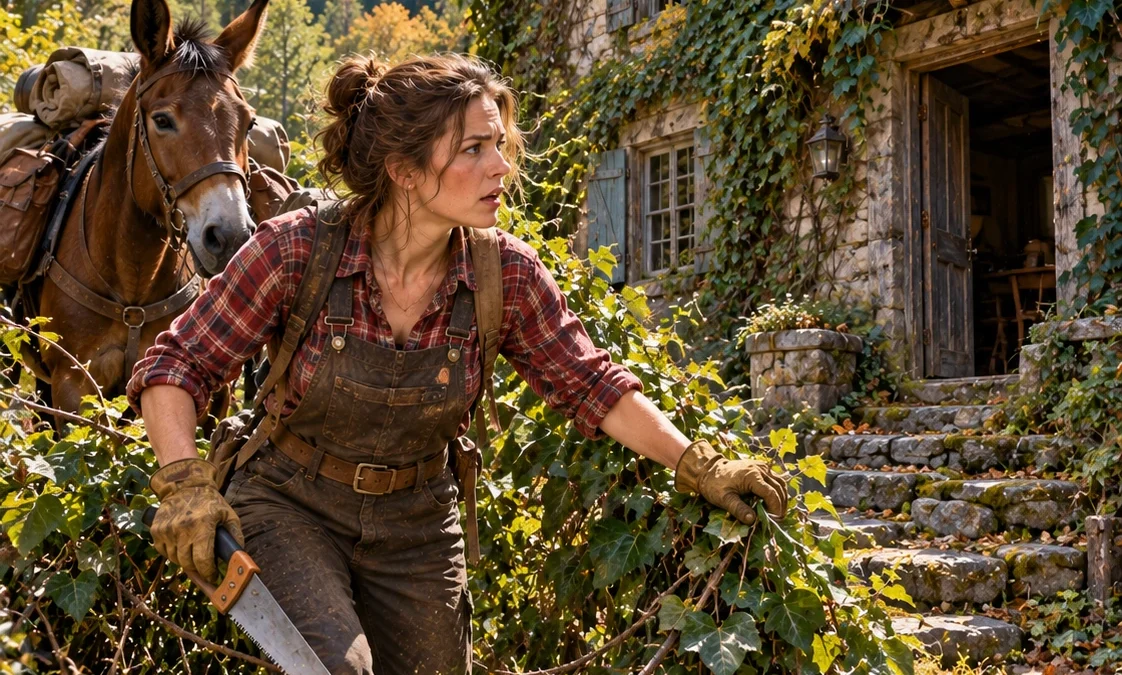
Part 2/5: Weeks of punishing work nearly broke Tessa, until her stubborn mule heard something beneath the vines that no human had noticed.
By the third morning, Tessa had stopped thinking in acres. She measured progress by the length of a felled branch, the width of her shoulders, and whether she could take another step without a thorn catching her coat.
The vines were older than she expected. Thick woody stems had wound around trunks and grown together into knots she had to saw apart with the machete, and every knot seemed to conceal three more beyond it. A day’s work sometimes gained her less than six feet.
The hardest part was moving what she cut. She tied rope around a bundle of tangled briars, fastened the other end to Otis’s harness, and walked beside him as he hauled it backward toward the road. The mule pulled without complaint until she asked for a turn he considered unreasonable, then planted his feet and waited for her to reconsider.
“Fine,” she would mutter, changing the angle. “You’re the expert.”
They developed a rhythm out of necessity. Before dawn, she ate beans and warmed her hands around a small fire if the wet wood would catch. By daylight, she was cutting; by late afternoon, Otis was dragging brush, and she was stacking it far enough from the camp to keep a spark from turning everything into a blaze.
At first she imagined making a clearing for a timber shelter. There were trees on her land, and she could split smaller trunks, dig posts into the earth, and patch together a roof before the worst of winter. After a week, that plan began to feel less like a goal than a story she told herself to keep moving.
Each night she inspected her hands by lantern light. Blisters rose, burst, and reopened; she wrapped them with strips cut from an old shirt, knowing the bandages would be filthy again by noon. When her boots leaked, she dried her socks as best she could and put them back on damp.
During the second week, she uncovered a strip of flat stones under the dead leaves. The stones lay too evenly to be natural, but roots had pulled several out of place, and she assumed they were remnants of an old farm track.
She followed them when she could. Whenever the vines became too dense, she cut around the obstruction and returned to the stones farther ahead, using their line as a guide into the darkness beneath the overgrowth.
Three weeks after the auction, the passage extended roughly fifty yards from the roadside ditch. It was narrow, muddy, and roofed by vines; from outside it looked less like an improvement than a wound hacked into a wall of thorns.
Her food had dwindled to a handful of beans and some oats she hesitated to take from Otis. She tightened her belt another notch and learned to ignore the hollow feeling in her stomach, but the dizziness that struck when she stood too quickly frightened her.
The fourth week brought a cold silence she recognized from winters spent in the valley. Birds vanished from the branches. Wind died without bringing warmth, and clouds pressed over the ridge in a heavy purple bank.
A major storm was coming. She had seen forecasts posted in town before the auction, but nobody had expected the cold front to arrive so fiercely or so early. Her tent would not survive deep snow, and she knew it.
She worked until her arms felt detached from her body. The blade struck a hidden stone as she tried to sever a root, twisted in her grip, and wrenched her right wrist with such force that she dropped to one knee.
Pain shot toward her elbow. She grabbed her arm, stumbled backward into the wet leaves, and remained there, stunned, while the machete lay beyond her reach.
For the first time since leaving town, she stopped pretending there was enough time. The tunnel was still a tunnel, the slope still exposed, and no proper roof stood between her and the weather moving over the mountains.
“I can’t keep doing this,” she whispered.
There was no one to hear except Otis. She was forty-five, hungry, and injured, with land she owned but could not live upon, and the thought that the townspeople had been right hurt almost as much as her wrist.
Tears came before she could stop them. She pressed her face against her good sleeve and let herself cry, not for the money alone, but for all the years she had believed that steady work would eventually buy her some security.
Otis snorted. She expected him to nudge her for food, but instead he stepped toward the deepest thicket, lowered his broad head, and pushed his chest into the vines.
“Otis, leave it,” she called. “We’re finished for today.”
He kept going. Dead stalks snapped against his shoulders, and he forced his way ten feet beyond the point where she had stopped, then suddenly planted his hooves and brayed so loudly that the sound bounced off the ridge.
Tessa raised her head. Otis scraped at the leaves with one iron shoe, struck something hard, and did it again: clack, clack, clack. It was not the soft thud of earth or the hollow crack of a fallen branch.
Holding her injured wrist against her chest, she got up and took the machete in her left hand. She followed the opening Otis had forced, ducking beneath a curtain of ivy until she reached the spot where he stood pawing at a square gray flagstone.
A flagstone made sense with the old track. What didn’t make sense was the surface rising behind it: a vertical mass of vines, too straight and broad to be a tree, stretching thirty feet across and fifteen feet above her head.
Tessa caught a hanging rope of ivy and pulled. Its roots loosened with a dry tearing noise, and an entire sheet collapsed at her feet, exposing a wall built from carefully fitted fieldstone.
She forgot the pain long enough to pull again. Dust showered her hair, dead leaves slid down her collar, and the black opening of a shuttered window appeared beneath the roots.
“Otis,” she breathed, “somebody built a house here.”
The mule only blinked. Tessa moved along the wall, tearing vines from a pair of iron hinges, until the outline of a heavy oak door emerged in the deepening gloom.
Thirty years of growth had hidden it from the road, the valley, and everyone who claimed the old Whitlock property was nothing but useless brush. Tessa put her left palm against the wood and felt, beneath the cold and dirt, something that might actually keep them alive.
Part 3/5: As the blizzard swallowed the ridge, an abandoned stone house offered shelter, but discovering it was only the beginning of surviving.
Tessa leaned into the oak door with her left shoulder. The iron latch resisted, then shifted with a grinding sound, and the door swung inward just far enough to reveal a room swallowed by darkness.
She stepped across the threshold and stopped. The air smelled of dust, old wood, and cold ashes, but it was dry; unlike the tent, the room held no driving wind, and unlike the tunnel, it offered a ceiling she could trust.
A fireplace covered most of the far wall, its stone hearth wide enough to sit three people. Along another wall stood timber shelves lined with glass jars, their waxed lids unbroken beneath decades of dust. Above them, massive log rafters supported a roof that showed no obvious gaps.
Tessa touched the nearest wall. Two feet of fitted stone separated her from the weather, a thickness no ordinary cabin in the valley could boast. Gideon Whitlock hadn’t left behind a rotting shed; he’d built something intended to outlast him.
Then the first hard pellets of snow struck the exposed stones outside. Tessa looked over her shoulder and saw the trees bending against a wind that had arrived almost without warning. The storm was not waiting for her to admire anything.
“Back to camp,” she told Otis, catching his halter. “Now.”
She hurried through the thorn tunnel with her damaged wrist pinned against her body. The ground had already whitened, and gusts were lifting dry leaves into the air so violently that they looked like startled birds.
At the ditch she abandoned any idea of packing neatly. She ripped the frozen stakes free, gathered the tent in a stiff bundle, and pushed it onto Otis’s load beside the skillet, remaining beans, oats, blanket, ax, and rope.
By the time they reached the door, she could barely distinguish the far end of the tunnel. She pulled Otis inside, dropped the supplies onto stone, and fought to push the door closed against the wind.
The first attempt failed. Her injured wrist flared when she reached for the edge, and she bit back a cry, shifted her weight, and drove the door shut with her hip and good shoulder.
The iron bolt slid home. Outside, the storm roared; inside, its voice fell to a low pressure against the walls, and Tessa stood panting in almost complete darkness.
She had shelter, but shelter alone wasn’t warmth. The room was cold enough to show her breath, and her hands had begun to lose their feeling. She set down the lantern and searched for wood, praying the hearth hadn’t been left empty.
Under a layer of dust beside the fireplace lay a stack of split oak. It was old and dry, sheltered from the rain for thirty years, and when she broke a splinter from one log it snapped cleanly between her fingers.
A rotten wooden box in the corner gave her kindling. She built a small fire on the grate, checked that the chimney would draw rather than fill the room with smoke, and struck a match from the tin she carried inside her coat.
The first broke. The second sputtered and died. On the third try, a flame caught the splinters and crept across them until the oak began to burn with a steady crackle.
Tessa sank onto the hearthstone as heat reached her face. Otis stood with his hindquarters near the door, steam lifting faintly from his wet coat, and she laughed once at the absurdity of sharing her first proper home with a mule.
“You found it,” she told him. “I owe you more than oats.”
As the fire strengthened, she inspected the room by lantern light. The heavy shutters were sound enough to close against snow; a stone trough near one wall would hold melted water for Otis, and the shelves contained more than seeds.
In marked jars she found dried apples and winter wheat, together with other carefully stored grain. A few containers were spoiled, and she set those aside; the sound ones gave her the first real prospect of eating through the storm.
She boiled snow in the skillet, cooked a portion of beans, and ate slowly, stopping herself from swallowing more than she could afford. Outside, branches struck the roof and slid away; beneath them, the stone remained quiet and solid.
Down in Alder Fork, the same storm arrived with a violence that startled people who had lived there all their lives. Snow swept across the main street, visibility vanished, and ice gathered on the power lines until the first cables snapped.
Irene Pruitt closed the general store early, only to discover that the wind leaked through every window frame. With the electric heat gone, she dragged wool blankets from her shelves, wrapped them around her shoulders, and watched ice form on the inside of the glass.
Across town, Benton Sykes struggled to keep his stove drawing properly as gusts hammered the chimney of his large house. He had dismissed Tessa’s decision as foolish, yet he had not imagined a storm capable of frightening him beneath his own roof.
By midnight, several roads were blocked. By morning, drifts rose above fence rails; the county’s snow crews could barely clear the hospital approach, much less reach the remote track running toward North Ridge.
Irene pictured Tessa’s tent in the ditch. “She won’t have made it,” she whispered, though the certainty sounded hollow.
On the ridge, the first night passed without a break in the storm. Tessa woke often to feed the fire, rotate her damp clothing near the hearth, and make certain the shutters remained fastened, but each time she opened her eyes, the roof was still over her head.
The blizzard raged through a second day and into a third. The path she’d carved disappeared under deep drifts, yet the fireplace continued to warm the thick stone walls, and the house held that warmth whenever the flames settled low.
Tessa rested her injured wrist, boiled water, and rationed grain while Otis dozed on a folded piece of canvas. For the first time in nearly a month, she could sleep without waking afraid that a gust would carry away everything she owned.
She did not know what the valley believed about her. She knew only that the place everyone called worthless had become the safest roof she’d ever lived beneath, and that somewhere beyond the sealed door, the snow kept falling.
Part 4/5: While the valley fought darkness and frozen roads, Tessa fought hunger and isolation inside a home everyone believed had vanished.
When the wind finally quieted on the fourth morning, Tessa opened one shutter and looked out upon a landscape she barely recognized. Snow covered the courtyard, erased her work in the tunnel, and piled against the trunks in drifts almost as high as her waist.
The silence was so complete she could hear the fire settling in the hearth. Then Otis nudged her from behind, reminding her that neither of them could live forever on warm walls and the satisfaction of being right.
She began by taking inventory. The dried beans would last if she mixed them with grain; there was enough winter wheat for several careful weeks, though the jars had plainly been intended for planting rather than feeding a stranded woman. Otis’s oats needed stricter rationing.
There was no running tap and no electric light. Tessa gathered clean snow in her skillet, melted it by the fire, and carried the water to a trough she’d scrubbed with sand and a scrap of cloth. She repeated the journey until both of them had enough to drink.
Her wrist improved slowly, but lifting a heavy log still brought an ache that made her stop and reconsider every movement. Instead of pretending she wasn’t injured, she learned to work one-handed when she could, and to rest before pain turned her clumsy.
By the fifth day she had opened a space outside the door. Otis stepped into it with an offended shake of his ears, rolled once in the powder, and then investigated every twig that protruded from the snow. Tessa had to laugh at the sight.
She cleared a corner where wind had swept the ground nearly bare and exposed coarse grass beneath the trees. It wasn’t generous feed, but together with the rationed oats and what safe browse she could collect, it helped sustain Otis while the road stayed impassable.
For fuel, she used the house’s dry wood sparingly and dragged in fallen limbs whenever conditions allowed. She kept the chimney drawing cleanly, banked the fire overnight, and learned that the stones retained warmth long after the flames dropped.
What astonished her most wasn’t the strength of the house but its careful planning. The shutters closed flush against the frames, the roof carried snow without sagging, and the seed jars sat high above the floor on shelving protected from damp.
Gideon Whitlock had known the ridge would be hard. He had built for the cold anyway, using the materials the land offered and the kind of patience Tessa understood better than most.
She found handwritten labels on the jars, the ink faded but legible: winter wheat, climbing beans, orchard apples. The writing made the place feel less like a ruin and more like a conversation with someone who had worked out how to survive here before her.
Sometimes she caught herself speaking to the absent builder. “You could have warned people about this place,” she said one evening, tapping a stone wall. “Would’ve saved me three weeks of swinging that blade.”
In Alder Fork, the blizzard had stopped, but its damage kept the valley in distress. Frozen pipes split in houses where the heat had failed; grocery deliveries were delayed, and county crews worked from daylight to darkness to reopen the main roads.
Irene’s store survived, though several windows had cracked, and some stock was ruined by the freezing temperatures. Benton complained about damaged shingles and the expense of repairing his chimney, but even he understood how fortunate he was to have had four walls around him.
Tessa’s name came up whenever people discussed the isolated ridge. Nobody had seen her come back, and none of the roads toward her land had been cleared. The lack of news hardened into a story repeated with a certainty nobody had earned.
“She had a tent,” someone said at the diner. “A woman can’t survive this on a mountain in a tent.”
Irene heard the remark and remembered the way Tessa had placed her sixty dollars on Benton’s desk without asking anyone for permission. She hadn’t understood that expression then; now she found herself wondering whether determination had carried Tessa farther than anyone imagined.
One morning, a customer asked whether Irene had ever offered to sell the woman supplies on credit. Irene looked at the shelves behind her counter and answered, “No.” The word shamed her more than the questioner intended.
Meanwhile, on North Ridge, Tessa refused to leave the front of the stone house buried. She carved a narrow route to the old track, marked its edges with branches, and cleared just enough for Otis to pass whenever he needed to stretch or graze.
It was exhausting work, but it was different from cutting the original tunnel. Then she’d been fighting blind through a wall she didn’t understand; now every foot she reclaimed led back toward a solid door and a fire.
At night she sat beside the hearth, repaired her clothes, and planned the spring. There would be a vegetable patch in the old courtyard, fences along the cleared track, and a dry place to stack enough wood for another winter. None of it would happen quickly, but she had stopped thinking of the land as a mistake.
Nearly three weeks after the storm, crews finally opened the main road toward North Ridge. That same morning, thirty-two-year-old Levi Whitlock arrived at the courthouse carrying documents and questions about his grandfather’s sixty-acre property.
Levi lived away from Alder Fork. He had grown up hearing about Gideon’s stonework and the old ridge place, but he had pictured a collapsed roof and forgotten fields, not a property sold for back taxes barely a month earlier.
Benton explained the auction with visible discomfort. He said a woman named Tessa Rowan had bought it for sixty dollars, gone up the mountain before the storm, and never returned. Then he made a remark about the county needing to determine what had happened to her.
“You don’t know she’s dead,” Levi said.
Benton shifted in his chair. “No one’s seen her.”
“Then that’s what you know,” Levi answered. “Nothing else.”
Levi asked for directions and drove toward the ridge. Benton came along, claiming county business, and Irene insisted on joining them after hearing where they were going; she wanted to know whether the woman she’d mocked had survived.
Their vehicles stopped beside the frozen wall of vines. A narrow passage cut through it, and in the snow before them lay unmistakable hoofprints beside the marks of a woman’s boots.
Levi studied the tracks, then turned toward the tunnel. “Somebody’s been walking here,” he said, and went in before either of the others could offer another explanation.
Part 5 (THE END): The people who expected to find a frozen body instead found smoke rising above the vines and a woman guarding her future.
The passage through the briars was longer than Levi expected. Its walls rose on either side like a frozen hedge, and every few feet he found another clean cut where somebody had dragged a stubborn vine out of the way.
Benton followed more slowly, slipping on the packed snow. Irene came last, holding her coat closed against the wind and glancing at the tracks underfoot as if she were afraid they might vanish before she understood what they meant.
Then the tunnel opened into a courtyard. Levi stopped so suddenly that Benton nearly collided with him, and all three stared at the building standing beyond the snowbank.
The old Whitlock house rose from the clearing in walls of neatly laid gray stone. Its shutters were fastened open, the roof stood straight, and a thick ribbon of smoke climbed from the chimney into the clear winter air.
Irene stared at the smoke. Someone had lit that fire recently; someone had fed it, cleaned the hearth, and survived long enough to need another log. The realization made her cheeks burn harder than the cold.
The heavy oak door opened. Tessa Rowan stepped out, one hand resting on the iron latch, her patched coat hanging around shoulders made thinner by weeks of hard work.
She looked exhausted, and a pale scar crossed one cheek where a briar had cut her. But her back was straight, her eyes were clear, and behind her stood Otis, chewing lazily beside a fireplace that glowed with steady light.
Tessa looked first at Levi, a stranger, and then at the county clerk. “Benton,” she said. “You’re standing on my property.”
Benton opened his mouth, shut it, and tried again. “We came to see if you were alive.”
“You could have started by asking instead of telling everyone I wasn’t.” Her voice was level, and that seemed to unsettle him more than shouting would have.
“The storm was terrible,” he answered. “We thought—”
“I know what you thought. You told me what would happen the day I bought it.”
Levi stepped forward before the argument could grow. He removed one glove and held out his hand, careful not to come so close that she had to retreat into the doorway.
“I’m Levi Whitlock,” he said. “Gideon Whitlock was my grandfather. I came to see whether anything he built was still standing.”
Tessa’s expression changed. She looked once at the stone behind her, then back at the man whose family name was written on the old survey records.
“He built well,” she said. “Those walls kept us alive.”
Levi studied the doorway. The shape of the oak lintel, the ironwork, even the enormous stones at the foundation matched drawings his grandfather had made for him when he was a boy. Tears came unexpectedly to his eyes, and he pressed his lips together until he could speak again.
“I wish he’d known it was still here,” he said.
“Maybe he did,” Tessa answered. “He stored grain and seeds like he expected people to need them. Whoever lived here understood winter better than the rest of us.”
Benton cleared his throat. “There may be questions about the property paperwork. We thought the owner might have—”
Tessa pulled the folded deed from an inside pocket. She had kept it dry beneath her clothes through every day of cutting, every cold night in the tent, and the long storm inside the stone house.
“You sold it,” she said, looking Benton in the eye. “I paid.”
“The county recorded it. And being missing during a blizzard doesn’t give you permission to take it back.”
“She’s right,” Levi said quietly. He didn’t look at Benton.
“I saw the transfer before we came. This is her home now.”
The clerk’s face reddened. For the first time, the man who had laughed at Tessa in a full courthouse seemed unable to find an audience willing to laugh with him.
Irene stepped closer. “Tessa, what I said about this land was cruel. I thought you were throwing your money away, and when the storm came, I thought we’d never see you again.”
“You said quite a bit more than that,” Tessa replied.
“I know.” Irene glanced toward Otis and the glowing hearth. “I’m sorry.”
Tessa let the apology stand. She didn’t reach for it, didn’t push it away, and didn’t pretend that weeks of ridicule could be settled in one cold conversation.
“Would you mind if I saw the inside? I remember Grandpa talking about a fireplace big enough for three men to stand in. I never knew whether he was exaggerating.”
Tessa moved aside. “Come in and find out. You can tell me what you remember while we get warm.”
Levi crossed the threshold, looking up at the old beams and shelves as if he had entered a room from his childhood stories. When he saw the handwritten labels on the grain jars, he recognized his grandfather’s careful block letters and smiled through the tears he’d been trying to hide.
Outside, Benton and Irene remained by the courtyard gate. Tessa rested her hand on the door, looked at them once, and said, “The rest of you can wait a little while.”
Inside, Levi found a flat stone beside the fireplace with the Whitlock name chiseled into it, nearly hidden beneath soot. He brushed away the dust, then told Tessa that his grandfather had always insisted good land wasn’t necessarily easy land; it was land someone cared enough to understand.
“I came here thinking there’d be nothing left but memories,” Levi said. “I was wrong about that.”
“So was the whole town,” she answered.
Levi asked whether he might return in spring to help identify the old seeds and repair the approach to the house. Tessa considered it, then nodded; her land did not have to remain isolated simply because she’d first reached it alone.
Otis stretched his neck toward the warm hearth, and Tessa rubbed the gray hair between his ears. A month earlier, sixty dollars had seemed like the price of her final mistake; now it had bought sixty acres, a shelter, and the right to choose who entered her door.
She added another log to the fire. The stone walls caught its warmth as the winter sun lowered over North Ridge, and for the first time in twenty years, nobody could tell Tessa Rowan that she had to leave.
THE END








