They Mocked a Twelve-Year-Old for Spending $40 on a Sealed, Rusted Airplane—Until She Opened Its Cabin and Revealed the Pilot’s Name
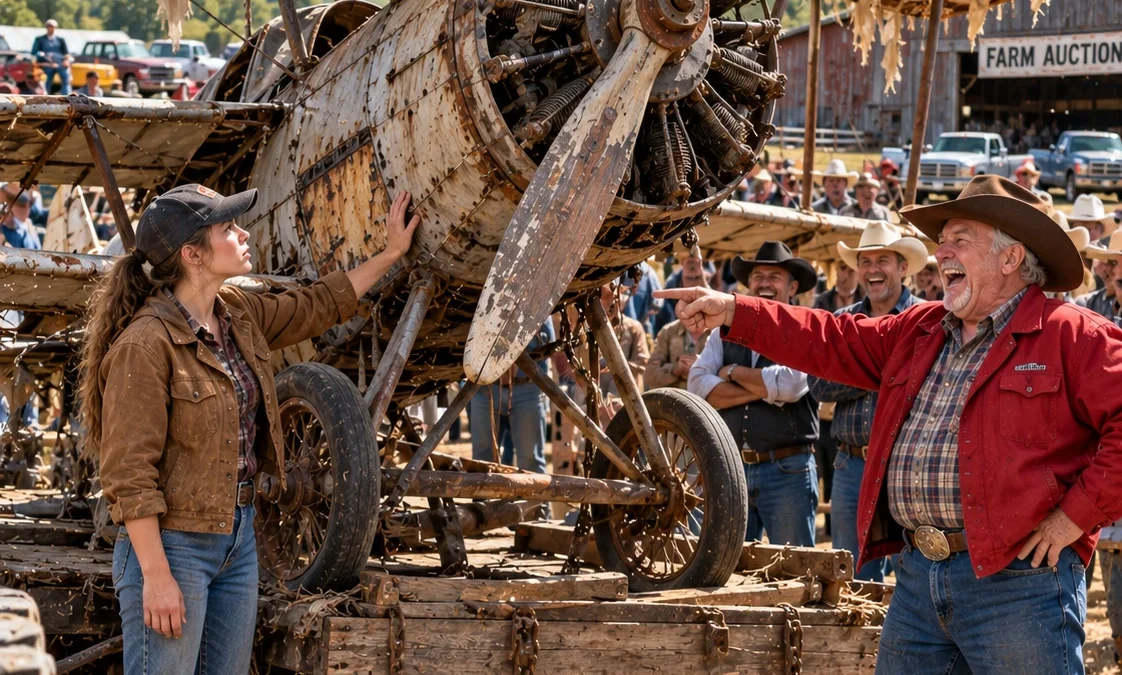
Part 2/5: Tess researches Opal Wren’s flight, while the town laughs and Dwayne Rusk raises his offer to buy the airplane.
By Monday morning, nearly everyone in Arbon had heard that Tess Pruitt had bought an airplane for forty dollars. By lunch, the town had decided it was a joke.
At the Prairie Rose Cafe, men at the round table by the window called it Tess’s flying chicken coop. At school, a sixth grader named Colby Doll asked her if it came with a parachute. Three lunch tables laughed before Tess had time to answer.
She picked up her tray and sat beside a girl from her math class who didn’t say anything about the airplane.
Dwayne Rusk told the story wherever he went. He told it at the co-op, at the hardware store, and on the Thursday morning farm show broadcast from the Arbon radio station.
“I’ve been in the scrap business thirty-three years,” he said over the radio. “I’ve seen people pay too much for junk, but I’ve never seen a little girl pay forty dollars for a pile of rotten bed sheets with a motor on the front. If Ida Pruitt wants to get rid of it before the county writes her up, my offer’s still good. Sixty dollars, and I haul.”
June Lindahl, who ran the Prairie Rose, switched off the radio in the middle of the broadcast. Plenty of people had already heard it.
Tess heard it at the breakfast table. She rinsed her bowl, put on her jacket, and went to the library after school.
“What are you looking for?” her mother asked.
“Everything about Opal Wren. And the airplane.”
The Arbon Public Library occupied one long room in the old Masonic Hall. Its librarian, Mrs. Okonkwo, had never told a child that a question was too big. Tess laid out what she knew on a reading table: Opal Wren, the Kessler Model 9, a forced landing near Arbon in March 1931.
It took three weeks of afternoons to find the first clue. Old copies of the Arbon paper were stored on microfilm in a gray steel cabinet. Tess sat at the machine with Ida on one side and Mrs. Okonkwo on the other, turning the crank a quarter turn at a time.
They found the story on the twelfth reel, after two reels of cattle prices. It was a short item on page three, beneath the weather report.
“Airmail flyer down in storm near cattle farm. Lady pilot safe, machine damaged.”
Tess read the line slowly. Ida reached over and squeezed her shoulder when she reached the words “lady pilot.”
After that, they found more. Mrs. Okonkwo contacted the state library and got a book about early airmail pilots. Opal Wren appeared in half a page, beside a photograph of a slim young woman in a leather helmet standing on the wheel of a high-wing airplane. A dark stripe ran down the fuselage.
The caption said the Meadowlark was the third of only nine Kessler Model 9s ever built. None had survived.
“None survived,” Tess said, looking up from the page. “That’s wrong.”
“Then we’d better tell somebody,” Mrs. Okonkwo said.
She knew Dr. Helen Marsh, curator of aviation history at the Platte Valley Air Museum in Kearney. The museum had a hangar devoted to early mail planes. Tess wrote Dr. Marsh a four-page letter at the kitchen table.
Carla read it afterward and corrected two words. Tess described the airplane, the old newspaper story, and Ruth’s memory. She enclosed a copy of the newspaper clipping. At the end, she added that she hadn’t opened the cabin.
“Mr. Kettle promised Miss Wren nobody would touch it,” she wrote. “I’d like somebody who knows about airplanes to be there when it gets opened, so it gets done right.”
She mailed the letter on Friday.
Eight days later, Dr. Marsh called. Ida was hemming a grain truck tarp, and Carla was getting ready to drive a bus route when the phone rang. Tess answered.
Dr. Marsh asked how many cylinders the engine had, whether the stripe was green, and whether the cabin door had a small round window.
“Seven cylinders,” Tess said. “The stripe is green where you can still see it. I can’t tell about the window. The tin covers the whole door.”
There was a pause.
“Tess, I’d like to drive out and look at it,” Dr. Marsh said. “Just look. I won’t touch it, and I won’t ask you to open it. If it’s what you think it is, I’m going to ask you not to let anyone else open it until we can do it properly.”
“That’s what I want,” Tess said.
Dr. Marsh came the next Saturday in a museum van with Rosa Delgado, a conservator who carried a camera, a notebook, and a small bag of soft brushes. For four hours, the two women measured the wings, photographed each rivet, and recorded the numbers cast into the engine crankcase.
When they stepped into the yard, Dr. Marsh was quiet for a moment.
“I can’t tell you for certain until the door comes off,” she said. “But the engine is the right engine. The wing is the right wing. There isn’t supposed to be one of these left anywhere in the world.”
By Monday, people knew the museum van had been at the Pruitt place. Dwayne heard, too. He came to the canvas shop in his red jacket, something he’d never done before.
“Ida,” he said, “I may have spoken too quickly on the radio. I’d like to make it up to the girl. Five hundred dollars in cash, and I’ll haul it out of the shed. You’ll have your room back.”
“You’d better ask her,” Ida said. “She’s in the back.”
Tess came out with a spool of thread in her hand and listened.
“No, thank you, Mr. Rusk.”
“A thousand, then,” he said. “Missy, that’s twenty-five times what you paid. You’ll never see a deal like that again.”
“It isn’t for sale.”
Tess went back to winding the thread. Dwayne stood at the counter a moment longer. Then he put his cap on and walked out.
Part 3/5: Tess chooses to open the cabin in Arbon, inviting the people who laughed, as the museum prepares for a careful inspection.
Dr. Marsh offered to take the Meadowlark to the museum. The hangar had more space, better lights, and the right tools. She could arrange a quiet examination with trained staff before anyone tried to move the airplane again.
Tess listened, then thanked her.
“Could we open it here instead?” she asked.
“In Arbon?”
“In the Quonset shed. People laughed at it here. I’d like them to see it here.”
Dr. Marsh didn’t answer right away. She glanced at Rosa, who closed her notebook.
“If we do that, we’ll need to control the crowd and make sure nobody handles anything,” Dr. Marsh said. “We’ll also need the right person to remove the rivets.”
“I understand.”
They set the date for the last Saturday in October at ten in the morning. Rosa would remove the rivets. Dr. Marsh would identify the airplane and document what she found. Because the museum might want to buy it, Dr. Marsh called an independent appraiser from Kansas City, Graham Hollis, who handled insurance work for vintage aircraft.
Tess made the invitation list at the kitchen table. Her mother and grandmother came first. Then Walt Severson, who had hauled the airplane home; Mrs. Okonkwo from the library; June Lindahl from the Prairie Rose; and Colonel Bellamy, who had sold it.
At the bottom, Tess wrote Dwayne Rusk.
Carla read the name over her shoulder. “Why him?”
“He laughed the loudest,” Tess said. “He should be there when it gets opened.”
Her mother studied her for a moment, then said nothing. Tess wrote each invitation by hand.
Two days later, word came back from the salvage yard. Dwayne would attend. He told the men at the co-op he was coming to watch a twelve-year-old discover she’d bought mouse nests.
The night before the opening, Tess and Ida swept the shed floor. They borrowed folding chairs from the Lutheran church and arranged them in a half circle in front of the sealed cabin. Ida hung two work lights from the rafters.
Tess stood in the quiet shed with her hands in the pockets of her chore jacket. The tin plate had become familiar to her. She knew the pattern of its rivets by heart. She knew where the wire crossed the mail hatch and where the old straps held the tail.
She still didn’t know what was inside.
The crowd began to arrive before nine-thirty. Every folding chair filled. People stood along the walls between the bolts of canvas. Tess had invited seven people, but the story had spread, and no one had the heart to send anyone home.
June Lindahl closed the Prairie Rose for the morning. Colonel Bellamy came in his white straw hat. Mrs. Okonkwo brought a camera. Dr. Marsh and Rosa arrived with their tools. Graham Hollis set a leather case beside the wall and checked the light in his notebook.
At five minutes to ten, Dwayne appeared in his red jacket. He stood at the back with his arms folded.
“Well,” he said to no one in particular, “let’s see the chickens.”
A few people laughed. The sound was smaller than it had been at the estate sale.
Tess stood beside the cabin door, Ida on one side and Dr. Marsh on the other. Rosa knelt in front of the tin plate with a small drill and a tray for the rivets.
“Miss Wren asked Mr. Kettle to keep it shut until she came back,” Tess said. Her voice shook at first, then steadied. “She never came back. Mr. Kettle kept his word, and so did his son. So I kept it, too. Today we’re opening it because I want her airplane to be somewhere people can see it. That’s all.”
She nodded to Rosa.
The work took forty minutes. Rosa drilled each rivet carefully, one at a time, catching it in the tray with a small ring of metal against metal. No one spoke. When the final rivet came loose, Rosa sat back on her heels.
“It’s yours,” she said to Tess.
Tess took one edge of the plate in her gloved hands. Ida took the other. Together, they lifted it away and leaned it against the wall.
Underneath was a cream-colored cabin door with a dark green stripe across it. The paint was faded, but whole. A small round window sat near the top. Beneath it, in gold letters, was a single word.
Meadowlark.
Someone in the second row whispered, “Oh, my lord.”
Dr. Marsh opened the door. The hinges groaned. The cabin appeared in the work lights: a cracked leather pilot’s seat, a wooden control wheel, and an instrument panel still carrying every gauge. The glass was unbroken. A leather flying helmet hung from the throttle, as if someone had set it there in the snow and expected to return.
Under the dust on the panel was a brass plate. Dr. Marsh leaned close with her flashlight and read it aloud.
“Kessler Aircraft Company, Wichita, Kansas. Model 9. Serial number three.”
She straightened and turned to the crowd. Her eyes were wet.
“This is Opal Wren’s airplane. This is the Meadowlark. It flew the airmail between Omaha and Cheyenne in 1930 and 1931, with the only woman on that route at the controls. Every history book in my museum says it was destroyed. It wasn’t. It’s here.”
People crowded closer, but Rosa asked them to stay behind the chairs. Dr. Marsh continued, pointing out the original fabric, finish, engine, and instruments. All of them had survived in remarkable condition because the airplane had been left alone.
“Somebody kept a promise,” she said. “And a girl who bought it kept it after him.”
She stepped aside for Graham Hollis.
Part 4/5: The appraiser confirms the Meadowlark’s rare history and value, while Dwayne watches the girl he mocked claim the choice.
Graham Hollis examined the cabin and walked around the engine, making notes as he went. He checked the cast numbers and inspected the fabric where it had survived beneath the wing. He asked Dr. Marsh questions about the records and took photographs of the brass plate.
The crowd waited. Dwayne had not moved from the back wall. His arms remained folded, but his mouth had closed.
After twenty minutes, Graham stepped away from the airplane and opened his notebook.
“For the record,” he said, “this is the only surviving Kessler Model 9 of the nine built. It has a documented history as a contract airmail aircraft flown by a pioneering woman pilot. It’s unrestored, with its original covering, finish, and instruments intact. That’s almost unheard of for an airplane of this age.”
He paused, then gave his appraisal.
“For insurance and sale purposes, my fair market value today is two hundred forty-six thousand dollars.”
The shed went silent.
Walt Severson sat down hard in his chair. Ida slipped an arm around Tess’s shoulders and held on. At the back, Dwayne stared at the cream-and-green door and the girl standing beside it in gloves too large for her.
He said nothing.
Dr. Marsh took a breath. “The Platte Valley Air Museum wants the Meadowlark,” she said. “The board has agreed to pay the full appraised value if Tess is willing to sell. We’ll conserve it as it is and give it a place in the main hangar.”
Tess looked at her mother. Then her grandmother. Then Dr. Marsh.
“I have two conditions,” she said.
Dr. Marsh smiled. “I thought you might.”
“The sign beside it has to say Opal Wren’s name first. Then it has to say Amos Kettle kept it for her, and Ruth Pruitt carried her coffee.”
“Done,” Dr. Marsh said. “Done and done.”
The crowd began talking all at once. Questions and congratulations filled the shed. Some people came to shake Tess’s hand. Others went to look again at the airplane, no longer at the mice-chewed fabric, but at the small gold name on the cabin door.
Dwayne remained where he was until the crowd thinned. Then he walked over.
“I was wrong about it,” he said.
Tess looked up at him.
“I thought it was scrap,” he continued. “I made a fool of myself on the radio, and I made a fool of you in front of everybody. I’m sorry.”
The apology sounded awkward, like a tool he didn’t use often. Tess studied his face. She didn’t smile, but she didn’t look away.
“You called it junk before you knew anything about it,” she said.
“I did.”
“You offered money because you thought I didn’t know what I had.”
Dwayne glanced toward the airplane. “I did that, too.”
Tess turned back to the cabin. “I’m not selling it to you.”
“I understand.”
She didn’t ask him to leave. He stood beside the chairs while Dr. Marsh explained how the museum would move the airplane and how the conservation team would keep its original paint and fabric. For once, Dwayne listened without interrupting.
Two weeks later, the sale papers were signed at the Pruitt kitchen table. The money went into a trust for Tess’s education. Ida used some of it to put a new roof on the canvas shop, and Carla paid off the family pickup.
Tess kept one thing for herself. Dr. Marsh gave her a rivet from the tin plate, cleaned and polished. Tess threaded it onto a cord and wore it under her shirt.
The Meadowlark left Arbon on a museum flatbed in November. Half the town lined Main Street to watch it pass. The wings had been protected, the cabin secured, and the gold letters covered for the trip.
Outside Rusk Salvage and Iron, Dwayne stood by his gate in the red jacket. As the flatbed rolled by, he raised one hand and held it there until the airplane was out of sight.
Part 5/5 (THE END): At the museum, Tess sees the promise honored in public, and the Meadowlark’s forgotten story finds a permanent home.
The following spring, the Platte Valley Air Museum opened the hangar doors to visitors. A new sign stood beside the Meadowlark. Tess had insisted that Opal’s name come first, and the museum had followed her request exactly.
OPAL WREN’S MEADOWLARK
Amos Kettle kept it for her.
Ruth Pruitt carried her coffee.
Beneath those lines, in smaller letters, the museum had added one more:
Saved from the scrapyard for $40 by Tess Pruitt, age 12.
Tess read the sign twice. Her mother stood on one side of her, Ida on the other. Dr. Marsh waited nearby while a small crowd gathered around the airplane.
The museum had cleaned only what was needed to preserve it. The cream-and-green paint still showed its age. The torn fabric had been stabilized, not replaced. The cockpit remained the way Rosa and Dr. Marsh had found it, with the cracked leather seat, the wooden control wheel, and Opal’s helmet hanging from the throttle.
A little boy pointed up at the wings. “Did it really fly?”
“It did,” Tess said.
“Who flew it?”
“Opal Wren.”
“Was she famous?”
“She should have been.”
The boy’s father looked at the sign and nodded. “I guess now she is.”
Tess reached under her collar and felt the rivet against her skin. It was small, cool, and smooth from being handled. She thought of the tin plate that had hidden the cabin for almost a century, and of how every hand that kept it closed had also kept the promise.
The airplane had been worth far more than forty dollars. That was what the appraiser said, and what the newspaper wrote. But Tess had never thought of it as a bargain.
It was a promise that had waited through blizzards, farm sales, decades of silence, and a town’s laughter. It had belonged to Opal, then to the Kettles who kept it safe, then to Ruth and Ida, who carried its story forward.
Tess had bought the airplane because she knew it mattered. She had refused to open it in front of the crowd because she knew the promise mattered, too.
Later that afternoon, Dr. Marsh invited Tess to stand beside the Meadowlark for a photograph. Tess didn’t look at the camera. She watched a group of children gather by the display, reading Opal’s name.
In Arbon, Dwayne Rusk’s radio joke had traveled farther than he expected. People remembered the girl with the forty dollars, the sealed airplane, and the man who had called it scrap. When the newspaper ran a follow-up about the museum opening, Dwayne clipped the article and pinned it inside his office.
He never told anyone why.
Tess returned to the museum that summer and found a handwritten note in the guest book from someone in Omaha. The visitor had known Opal’s niece, who had spent her life believing the Meadowlark had been destroyed. The note thanked Tess for helping Opal’s family learn what had happened to the airplane.
That was the surprise Tess hadn’t expected. The promise hadn’t only survived in Arbon. It had been waiting for someone else, too.
She read the note to Ida in the parking lot. Her grandmother listened, then smiled.
“Your great-grandmother would have liked that,” Ida said.
Tess looked back through the open hangar doors. The Meadowlark rested beneath the lights, its green stripe stretching along the cream-colored fuselage. For the first time in ninety-four years, people could stand beside it without wondering what was hidden behind the tin.
The airplane could not fly again. Its engine would remain still, and its propeller would never cut through a Nebraska sky. But it had made one final journey: from a locked shed to a place where its story could be seen and heard.
Tess had spent forty dollars to bring it home. The museum paid two hundred forty-six thousand dollars to preserve it. Yet the value she remembered most had never appeared on Graham Hollis’s appraisal.
It was the value of keeping a promise long after the person who made it was gone.
And somewhere in the sign beside the airplane, Opal Wren’s name finally stood where it belonged.
THE END








