They Mocked a Widow for Buying Sixty Acres of Worthless Rock for $3,000—Until Eleven Trucks Appeared on a Road Her Powerful Neighbor Couldn’t Close.
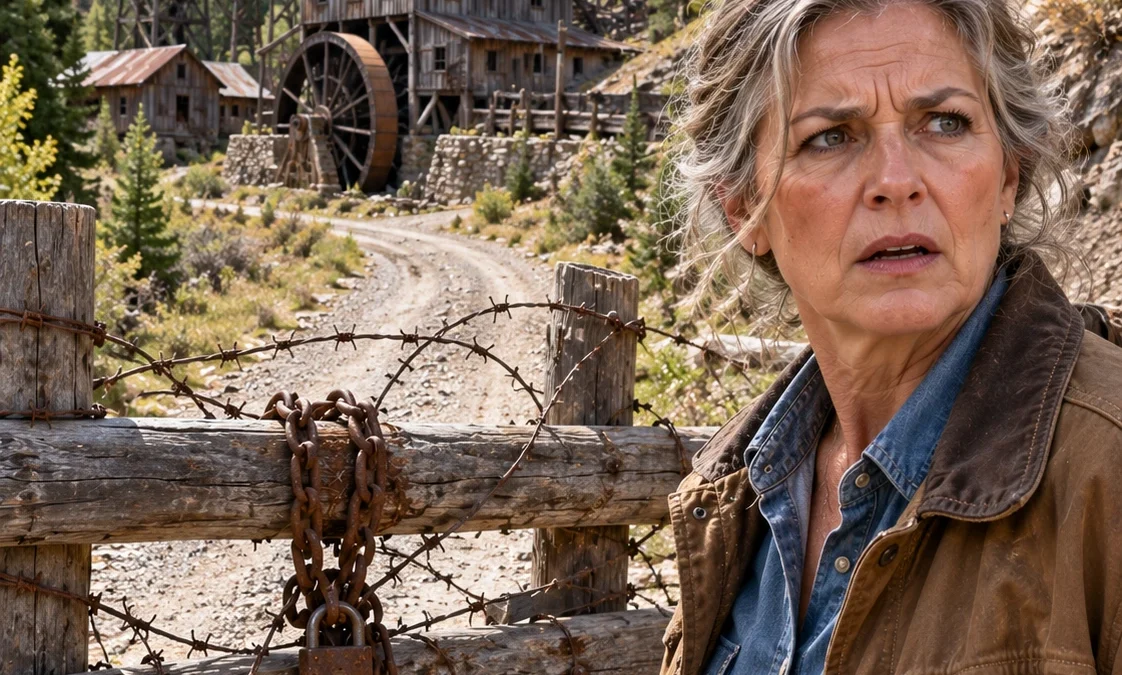
Part 2/5: As the farm’s debts tighten, a hidden road and her husband’s unfinished research reveal why the supposedly worthless hillside was worth protecting.
Preston appeared on Mara’s porch less than a week after her walk with Silas. He brought his customary smile, his clean hat, and a revised offer for the Whitcomb bottomland, behaving as though he had stopped by to discuss the weather.
“Three hundred dollars an acre,” he said. “You keep the house and garden. That’s better than you’ll get from anyone else.”
Mara stood behind the screen door.
“I’m not selling.”
Preston glanced toward the hills.
“I hear Silas Crowder has been telling you about an old road. Even if you manage to put trucks on that rock, you still have to cross my corner. You understand that, don’t you?”
“I understand.”
“The bank board meets on the eighth.”
He let those words settle before returning to his truck.
Nine days later, Mara received a letter informing her that her operating note would be due in full on October 15.
For years, the bank had allowed farmers to settle such notes after harvest. Mara had never missed a payment, and Calvin had maintained a reliable relationship with the same institution for decades.
Now the rules had changed.
When Mara confronted Miles Pritchard at the teller’s window, he kept his eyes on the documents.
“The board reviewed the collateral,” he said. “They have concerns about access.”
“Did the board review my payment history?”
Miles straightened a pile of papers.
“I don’t make those decisions, Mrs. Whitcomb.”
“Somebody does.”
She left before he could answer.
At the county extension office, Mara encountered another problem she had spent years trying to understand. Her bottomland produced good corn, but the yields fluctuated more than they should have on ground that dark and deep.
She carried a quart jar of soil to Leonard Burke, the extension agent, and asked him to examine it.
The results showed a pH of 5.1.
“That’s acidic,” Leonard explained. “Your soil needs agricultural lime. Probably three tons per acre to bring it where it ought to be.”
Mara asked about the cost.
The nearest commercial quarry selling suitable material was fifty-eight miles away. Limestone cost approximately $3.25 per ton at the quarry, but the delivered price would run around $13.50 per ton.
Treating her 160 acres would cost more than six thousand dollars.
Mara folded the report and placed it inside her coat.
Six thousand dollars might as well have been sixty thousand.
Back home, she set the report beside Calvin’s old coffee mug and stared through the kitchen window. A fist-sized piece of pale stone sat on the windowsill, exactly where it had been when her husband was alive.
A paper tag hung from it on a piece of string.
Mara looked away without reading it.
The following week, the local agricultural cooperative held its annual meeting at the Grange Hall.
More than sixty farmers attended. Mara took a seat in the third row, clutching her purse while men discussed fertilizer prices, equipment purchases, and hauling schedules.
Preston eventually rose beneath the wall clock.
He proposed removing the Sandy Creek bottomland from the cooperative’s custom hauling route until questions about access could be resolved.
His explanation sounded reasonable.
“No sense sending our drivers into a property dispute,” he said. “We have to protect the cooperative.”
The motion passed by voice vote.
Only two men openly opposed it.
Fern Haskins, who worked part-time keeping the cooperative’s records, wrote the decision in the minutes. She noticed Mara sitting perfectly still, though her knuckles had whitened around her purse handle.
Afterward, Preston approached her with a doughnut in his hand.
“Nothing personal, Mara. Just business.”
Mara looked at him for several seconds.
Then she stood and left.
The cooperative had abandoned her hauling route, the bank had demanded early payment, and the only convenient lane from her farm remained padlocked.
There was no longer any reason to wait for someone else to solve the problem.
Within days, the neighbors began hearing explosions from the northern slope of Bender Hill.
Mara had hired Jesse Kincaid, an experienced blasting specialist from a nearby shale operation, for twelve dollars a day and two days of her own welding labor.
Jesse drilled into the exposed limestone while Mara marked the line of the old road. Three controlled blasts broke sections of ledge into manageable stone.
The reports echoed across the valley, frightening cattle and sending curious farmers toward the roadside.
Nobody understood what she was doing.
A week later, Mara purchased a used jaw crusher at an equipment auction for $340. The machine had a cracked swing jaw, worn bearings, and enough rust to convince most buyers that it belonged in a scrapyard.
Mara hauled it home on a borrowed trailer.
For three nights, she worked beneath the lights of Calvin’s equipment shed, cleaning the damaged metal, rebuilding the assembly, and welding the cracked jaw.
At two in the morning, sparks flashed across the concrete as she laid another careful bead with Calvin’s old stick welder.
By dawn, the crusher could turn broken limestone into coarse agricultural material.
She rented a bulldozer for fourteen dollars an hour, with Lowell Briggs operating it while Mara directed him along the abandoned roadway. They pushed cedars aside, cleared accumulated soil, and uncovered stonework that had been hidden for decades.
Then Mara did something the county considered proof that she had lost her judgment.
She hauled twelve tons of crushed white limestone into her own fields and spread it across a twenty-acre section of corn ground.
At the feed store, the laughter became relentless.
“She’s covering her corn with gravel,” Everett Stroud announced. “Maybe next she’ll plant potatoes in the driveway.”
Even farmers who had once respected Calvin began questioning Mara’s decisions.
But Preston didn’t join their laughter.
He drove past the Whitcomb farm one evening and watched the white material being worked into the dark soil.
For several minutes, his truck remained parked beside the road.
Then he drove away.
Mara’s only son, Owen Whitcomb, returned home during the final weekend in May.
At twenty-four, Owen worked at the grain elevator and was saving money to marry June Mercer. He had always admired his mother’s toughness, but the unfamiliar machinery in the barnyard unsettled him.
He found Mara beside the crusher, inspecting a bearing.
“Mom, what is all this?”
“Equipment.”
“I can see that. Why are you spending money on blasting a hill when the bank is coming after the farm?”
Mara continued working.
Owen raised his voice.
“This is about Dad, isn’t it? Preston shuts one gate and you start tearing apart a mountain because you can’t accept losing what Dad built.”
Mara put down her wrench.
“Owen, your father built more than you remember.”
“Then sell the bottom. Keep the house. You could finally stop working yourself into the ground.”
“Supper’s in the oven.”
“I’m not hungry.”
He left before sunrise.
For eleven days, neither mother nor son called the other.
That silence finally drove Mara to the smokehouse, where Calvin had stored a small metal box on a high shelf beneath an old feed sack.
She had avoided opening it since his funeral.
Inside she discovered a county highway map dated 1946, an 1897 survey tracing, and twenty-two years of agricultural records written in Calvin’s compact handwriting.
The survey showed a public road crossing Bender Hill, complete with switchbacks and a stone drainage culvert.
The agricultural notebooks recorded soil acidity, planting dates, lime experiments, and yields from different sections of the Whitcomb bottomland.
Then Mara found a letter dated August 4, 1961.
It came from a state agricultural laboratory.
Calvin had submitted a rock sample from the north face of Bender Hill. Laboratory testing reported a calcium carbonate equivalent of ninety-four percent, making the limestone suitable for agricultural liming.
Mara read the result three times.
The limestone her farm desperately needed had been waiting just two miles away.
Beneath that letter lay another document.
Preston had held a purchase option on the sixty-acre hillside since 1958, renewing it every year for twelve dollars.
The option had prevented Calvin from purchasing the property for eleven years.
But Preston had allowed it to expire in March, the same month he installed the gate across Mara’s hauling lane.
He had released his claim on the worthless-looking hillside because he believed blocking the easier route would force Mara to sell the bottomland.
Mara carried the laboratory letter into the kitchen.
She lifted the pale stone from the windowsill and finally turned its faded tag toward the light.
Calvin had written four short words and a number.
“North face. 94%. Tell Mara.”
She sat at the table holding the sample.
For three years, the answer to one of her farm’s greatest problems had been sitting beside the kitchen window.
And for eleven years before his death, Calvin had been trying to reach the limestone that could change everything.
Part 3/5: Bank pressure and a bargain to protect her son leave the widow isolated, until a costly storm teaches her how to rebuild.
Mara returned to Bender Hill the next morning with Calvin’s survey tracing and a measuring tape. She followed the abandoned road until she reached its northern boundary, then studied the section crossing Preston’s property.
If the route had been a public road in 1897, she reasoned, perhaps the county still had some responsibility for it. The drawing showed survey marks and official signatures, but she needed the courthouse records to establish what those marks legally meant.
In June, Mara attended a meeting of the county commissioners and formally requested that Bender Hill Road be reopened. Chairman Walter Hensley listened without much interest, then explained that the county had no money to rebuild an old hillside road serving one farm.
Mara pointed out that she had already purchased the hillside and was willing to provide equipment and stone. Walter replied that the final section crossed private property and would require further examination.
The commissioners took no action.
Sixteen days later, Owen’s hours at the grain elevator were reduced to half days.
His supervisor blamed declining business, though the elevator continued handling grain from surrounding farms. Owen was furious because he and June had already begun planning their wedding and making payments toward their future home.
When Mara heard about the reduction, she immediately understood what had happened.
That evening, she drove to Preston’s house.
He stepped onto the porch with a glass of iced tea, apparently unsurprised to see her.
“Put Owen’s hours back,” Mara said.
Preston rested against the porch railing.
“The elevator board makes its own decisions.”
“Your board.”
“Our board,” he corrected.
Mara resisted the urge to argue.
“If his hours are restored, I’ll withdraw my petition to open Bender Hill Road. I’ll sign the withdrawal in front of the county clerk.”
Preston considered the offer for only a moment.
“Now you’re being sensible.”
The following morning, Fern Haskins typed the withdrawal. Six men waiting in the courthouse hallway saw Mara sign it.
By noon, Preston was telling the feed store that Mara had finally accepted reality.
Owen’s hours were restored.
Mara never told him about the agreement.
She knew he would feel responsible for what she had surrendered, and she refused to let Preston turn her son’s future into another weapon against her.
But withdrawing the petition did not mean Mara abandoned the hillside.
She continued breaking limestone, widening the old grade, and rebuilding damaged stretches of stone shoulder. Every dollar she earned or saved went back into machinery, fuel, and the road.
By August, the farm’s financial position had become desperate.
On August 8, Mara loaded twelve Jersey cows onto a livestock trailer and took them to auction. Among them was Pearl, the registered cow Calvin had treasured and whose milk checks had helped buy groceries for nine years.
The animals brought $1,890.
Mara stood beside the loading gate while the buyers led the cows away. When Pearl’s turn came, she looked down at the muddy ground rather than watch the animal disappear into the transport trailer.
An auction worker asked whether she wanted a separate receipt for the registration papers.
“Yes, please,” she answered.
Owen happened to be at the sale barn and saw the trailer.
He followed her into the alley.
“Mom, I had eleven hundred dollars saved. Why didn’t you tell me you needed help?”
Mara looked at her son’s worried face.
“That money is for your house.”
“I would’ve given it to you.”
“I know.”
He reached for her arm.
“Then why are you doing this alone?”
For a moment, Mara almost told him about Preston and the elevator board. Instead, she squeezed his hand and walked toward her truck.
The livestock money purchased additional blasting supplies, bulldozer hours, replacement truck tires, and 209 gallons of diesel.
Mara used part of the limestone she produced to improve forty more acres of her northern cornfield. The remainder went toward stabilizing the road and stockpiling material beside the crusher.
By the final week of August, the route stretched 1.3 miles along the hillside. It was eighteen feet wide in the improved sections, with rock shoulders and two long switchbacks following the contours of Bender Hill.
The work had cost nearly everything she owned.
Then, on August 29, the rain began.
Nine inches fell over two days, turning Sandy Creek brown and sending sheets of water down the hillside.
When the storm ended, Mara climbed the road and discovered that forty feet of the lower switchback had vanished. The shoulder had collapsed into the hollow, carrying weeks of labor and hundreds of dollars’ worth of material downhill.
Silas was hospitalized with pneumonia in the county seat. Owen was working in town, and Mara had only twenty-six dollars left.
Forty-seven days remained before the bank demanded payment.
She sat on a wet stump and studied the destruction until the afternoon light began fading.
Then she remembered something Silas had told her during their first walk.
“Old road builders didn’t try to beat the water. They gave it someplace to go.”
Mara looked again at the original survey.
She had shortened one switchback by cutting forty feet below the historic grade, believing a more direct route would save time and money. Lowell had warned that the hillside would need additional drainage, but she had convinced herself the compacted stone would hold.
The old builders had taken the longer route for a reason.
The next morning, Mara carried Calvin’s tracing up the hill, marked the original alignment with string, and began rebuilding.
For nine consecutive days, she worked with a steel bar, shovel, and wheelbarrow, resetting shoulder stones and restoring the culvert’s outlet. She positioned the longer stones upright, matching the construction she had discovered beneath the cedars.
When the repairs were finished, water could pass beneath the road without cutting through its foundation.
Mara stood on the rebuilt switchback, exhausted and nearly penniless.
She had finally built the road correctly.
But unless she found paying customers for her limestone, she would lose the farm before she ever had a chance to use it.
Part 4/5: The hillside begins paying its own way, but a second gate threatens everything until forgotten county records overturn her neighbor’s claim.
Mara’s first customer was Harvey Dillard, a farmer whose fields lay downstream from the Whitcomb bottom. His corn had struggled with acidic soil for years, and he understood exactly what commercial limestone cost when transportation was included.
Mara arrived at his farm carrying Leonard Burke’s soil report and Calvin’s 1961 laboratory letter.
“Four dollars a ton,” she told him. “You pick it up at my crusher.”
Harvey frowned.
“Everybody else wants thirteen fifty delivered. What’s wrong with yours?”
“Nothing.”
“Then why so cheap?”
Mara unfolded the laboratory report.
“Ninety-four percent calcium carbonate equivalent. You can have Leonard verify it yourself.”
Harvey studied the paper.
“What’s the catch?”
“You bring your truck and loader two days a week and help me finish the road. You get limestone at four dollars a ton. I get enough help to make the grade usable.”
She explained that she had also treated sections of her own cornfield and was waiting for harvest to measure the difference.
Harvey agreed to visit the hill.
Mara made the same offer to three other farmers struggling with acidic soil. Three of the four accepted, and soon trucks began climbing the lower portion of Bender Hill to carry limestone home.
Arden Brenner, who farmed higher ground near the ridge, heard about the arrangement and joined them.
For the first time since Preston installed his gate, Mara had people arriving at her farm because they wanted something she possessed.
The change spread quickly.
Wade Fenwick, the grain mill operator, drove out to inspect the limestone and the road. He walked halfway up the grade, watched the crusher operate, and collected a sample to examine.
Then he ordered sixty tons for improving the mill yard.
Wade wrote a check for $1,200 against the order on the hood of his truck.
Mara held the check with both hands.
After months of watching money disappear, she finally had a payment large enough to purchase materials without sacrificing another piece of the farm.
By late September, six trucks a day were working on Bender Hill. Neighbors hauled stone, supplied equipment, and helped Mara finish the upper sections while continuing their own harvest preparations.
The eighteen-foot-wide roadway followed the old switchbacks, its crushed limestone surface bright against the darker slope. Below it, the repaired culvert carried runoff through its stone-lined channel.
Mara had brought a forgotten route back into service.
But two hundred feet still stood between her road and the public highway.
Preston had been watching the construction all summer.
He knew the hillside was no longer worthless, and he knew that the neighboring farmers were beginning to regard Mara as a business partner rather than a woman waiting to be rescued.
On a Sunday morning near the end of September, he installed another gate.
This one stood across the final two hundred feet of the old roadway, where it crossed the northeast corner of his land.
Steel posts were set in concrete.
A heavy chain stretched between them.
Preston informed the county commissioners that Mara had withdrawn her road petition in June, with six witnesses present.
“She signed it herself,” he said. “There’s no county road there. It’s my property.”
Mara learned about the new gate from one of the limestone customers.
She drove to the ridge, stopped beside the freshly poured concrete, and examined the chain.
It was an almost perfect repetition of the gate that had started the dispute.
Except now she had invested every available dollar in building the road leading to it.
When Harvey arrived behind her, he looked at the barrier and shook his head.
“What are we supposed to do?”
Mara returned to her truck.
“Come to the hearing.”
The county scheduled the matter for October 2.
The meeting room was filled beyond capacity. Farmers stood against the walls while others crowded into the hallway, hoping to hear whether the county would protect Mara’s route or uphold Preston’s claim.
Preston arrived with copies of the June withdrawal.
He was confident because the document bore Mara’s signature, and he knew how much weight the commissioners placed on written agreements.
Mara sat in the third row, holding the same purse she had carried to the cooperative meeting in April.
Then Fern Haskins entered with two heavy record books.
She set them on the commissioners’ table.
“I’ve been going through the old road records,” she announced.
Chairman Walter Hensley looked irritated.
“Miss Haskins, we’re discussing a current access dispute.”
“That’s why I brought these.”
Fern opened the older book.
“In August 1897, the county surveyed, approved, and recorded Bender Hill Road as a public roadway. The original order is on page 241.”
Preston leaned forward.
“That road hasn’t been used in decades.”
Fern opened the second book.
“In 1949, someone filed a petition to vacate the road after the lower bridge was lost. The petition is still in the file.”
“Then that settles it,” Preston said.
Fern shook her head.
“No, sir. There is no commission order approving the vacation. No recorded decision closing the road.”
The room grew silent.
County Attorney Simon Keller examined the documents, compared the original survey with the later records, and asked Fern to confirm that she had searched the subsequent minute books.
She had.
Simon addressed the commissioners.
“The county established this roadway in 1897. A petition to abandon it was filed in 1949, but the commissioners never legally acted on that petition. The public right-of-way therefore remained in existence.”
Preston stood.
“I’ve grazed cattle on that corner for thirty years.”
Simon glanced at the survey.
“You’ve been grazing cattle on a public road, Mr. Bellamy.”
A murmur moved through the room.
Preston pointed toward Mara.
“She withdrew her petition!”
“She withdrew a request to reopen the road,” Simon replied. “That withdrawal cannot extinguish a public right-of-way that was never legally closed.”
For the first time, Preston had nothing to say.
The county ordered the obstruction removed.
On October 4, workers arrived with equipment, removed the gate, and graded the remaining two hundred feet where the road joined the mill highway.
Mara supplied forty-one tons of her crushed limestone without charging the county.
When one commissioner asked why she was donating stone after spending so much money on the project, she gave a simple answer.
“It’s a public road. Other people ought to be able to use it.”
By the following week, farmers were arranging their grain deliveries through Bender Hill.
Wade Fenwick sent word that the mill would accept Mara’s corn as soon as she could bring it in.
Owen, who had finally learned how extensively his mother had rebuilt the hillside, asked whether she needed another driver.
Mara handed him the keys to the second truck.
On the evening of October 11, they prepared the vehicles together, checked the tires, secured the loads, and planned the following morning’s procession.
Across the valley, Preston stood beside his original chained gate, watching lights move through the Whitcomb barnyard.
He had spent seven months trying to make Mara surrender.
The next morning, he would discover just how completely his own plan had failed.
Part 5/5 (THE END): Eleven trucks climb the restored road, a public harvest test reveals the value of limestone, and an unexpected deed settles an old injustice.
The morning of October 12 was clear and cool, with sunlight spreading across the harvested fields and a pale haze hanging over Sandy Creek.
Preston Bellamy stood beside his original locked gate as neighbors gathered along the fence. Some had come out of curiosity, others because they had spent months watching Mara work and wanted to see whether her gamble would finally succeed.
At first, nothing moved on the hillside.
Then the sound of engines reached the valley.
Mara’s old Chevrolet appeared on the upper grade, followed by Owen driving a second truck with his arm resting outside the window.
Behind them came vehicles belonging to Harvey Dillard and other neighboring farmers, some carrying grain toward the mill and others heading uphill to collect limestone.
Wade Fenwick’s tandem truck climbed the lower switchback, its empty bed ready for another load.
Eleven trucks were moving along the restored road.
Their tires pressed white tracks into the crushed limestone, and the steady rumble of their engines echoed between the hills.
Someone in the crowd whispered that Mara had built a highway.
A handmade sign stood beside the entrance, painted on a board attached to a cedar post.
BENDER HILL ROAD — PUBLIC.
Near the back of the gathering, Silas Crowder climbed slowly from his flatbed.
He had been out of the hospital for eleven days and still looked weak from pneumonia.
When Mara’s truck passed the upper switchback, Silas removed his hat and held it against his chest.
He remembered hauling stone over that same hillside as a sixteen-year-old boy.
Now, more than half a century later, he had lived long enough to see the road working again.
But Mara had arranged another demonstration that morning.
Leonard Burke, the county extension agent, was waiting at the mill with a moisture tester and weighing equipment.
At Mara’s request, he had agreed to compare the harvest from two twenty-acre sections of her bottomland.
The two plots had been planted with the same corn variety, on the same date, and had received the same rainfall.
One section had received the crushed limestone from Bender Hill.
The other had been left untreated for comparison.
Throughout the morning, the trucks delivered grain while Leonard inspected the loads and checked the scale tickets.
Farmers gathered near the mill office to watch him calculate the results.
The untreated field yielded sixty-one bushels per acre.
The limestone-treated field yielded one hundred eighteen.
Leonard checked his figures.
Then he read them aloud again.
“Fifty-seven additional bushels per acre.”
Harvey Dillard repeated the difference in disbelief.
At a market price of approximately $1.80 per bushel, that improvement represented more than one hundred dollars in additional gross crop value per acre.
Mara had not merely discovered a way around Preston’s gate.
She had discovered a practical method for improving the productivity of the soil her family had struggled to farm for decades.
And the limestone that made it possible was coming from land everyone had mocked her for purchasing.
Across the valley, Preston watched the trucks traveling along the ridge.
His gate remained locked, but nobody needed to pass through it anymore.
The land he had tried to acquire was still Mara’s, and the hillside he had dismissed was becoming a source of income.
On October 14, Mara entered the bank carrying an envelope containing $4,180.
She approached the same teller’s window where Miles Pritchard had refused to meet her eyes months earlier.
“I’d like to pay my operating note,” she said.
Miles counted the money, completed the paperwork, and slid the paid receipt across the counter.
“You’re all settled, Mrs. Whitcomb.”
Mara examined the receipt.
“Thank you.”
There was no celebration in her voice.
She folded the paper, put it in her purse, and went home.
Her corn had reached the mill before the November 1 contract deadline, her operating obligation was satisfied, and the limestone business was producing money.
For the first time since Calvin’s death, she could imagine a future for the farm that did not depend on working herself to exhaustion.
The first week of November brought an unexpected visitor.
Preston drove into the Whitcomb barnyard and parked beside the crusher.
Mara was greasing the machine when he approached.
He waited while she finished.
Finally, Preston cleared his throat.
“I’ve got a quarter section that’s been going sour.”
Mara wiped her hands on a rag.
“Have you had it tested?”
“Yes.”
“Needs lime?”
“Three tons an acre, according to the extension office.”
Mara waited.
Preston glanced at the crusher.
“What’s your price?”
“Four dollars a ton. Same as everybody else.”
He nodded.
“Could you supply twelve hundred tons for my operation?”
“Load it yourself on Tuesdays and Thursdays.”
For a moment, Preston looked almost relieved.
He extended his hand.
Mara glanced at it before turning toward a small wooden box beside the crusher.
She took out a receipt book, wrote down the requested quantity, price, and loading arrangement, and tore off the top sheet.
Then she placed it in Preston’s outstretched palm.
“Paper holds,” she said.
Preston stared at the receipt.
He recognized the words.
They were almost identical to what he had told everyone after locking the original lane.
But Mara wasn’t finished.
She reached into her coat and removed another document.
It was a formally prepared, recorded easement granting Preston Bellamy and his heirs the permanent right to move cattle across Bender Hill Road at the upper crossing.
There would be no charge.
Preston read the paper twice.
“Why would you give me this?”
Mara looked toward the road winding through the trees.
“Because your father shook Calvin’s father’s hand in a hayfield forty years ago.”
Preston said nothing.
“That promise served both families until you decided it didn’t count anymore. I’m putting this one on paper so nobody has to wonder.”
For the first time, Preston lowered his eyes.
He folded the easement carefully and placed it inside his coat.
Then he returned to his truck without another word.
He continued purchasing limestone from Bender Hill for nineteen years.
In 1970, he removed his original steel gate and sold the metal.
Years later, a younger farmer named Neal Hensley dismissed the hill as an old rock pile during breakfast at the diner.
Preston set down his coffee.
“You’d better take a look at what comes off that hill before you call it worthless.”
Nobody at the table argued.
The following spring, Owen resigned from the elevator and returned to the Whitcomb farm at twenty-five.
He began operating the crusher alongside Mara and remained her business partner for eleven seasons.
That June, he married June Mercer.
Together, the young couple helped expand the limestone operation while Mara continued farming the bottomland.
One afternoon, Owen found the pale limestone sample sitting on the kitchen windowsill.
He turned it over, read Calvin’s fading handwriting, and asked his mother why she still kept it there.
Mara told him about the laboratory letter, the purchase option, and the years his father had spent searching for a way to improve their soil.
Owen listened without interrupting.
Then he asked whether she wished Calvin had told her everything before he died.
“Of course,” she said.
“Would it have changed what happened?”
Mara looked through the window toward Bender Hill.
“It would’ve saved us some hard years.”
She paused.
“But we still had to build the road.”
Owen placed the stone inside a small oak frame with glass over the front.
He preserved the original tag and string exactly as Calvin had left them.
They hung it on the kitchen wall above the sink, where morning sunlight could reach it.
The writing remained visible.
“North face. 94%. Tell Mara.”
For decades afterward, people in the county told the story of the widow who spent three thousand dollars on sixty acres of useless rock and built a road that a wealthy landowner couldn’t close.
Some remembered the eleven trucks. Others remembered the public hearing, the limestone test, or the day Preston walked into Mara’s barnyard asking to become her customer.
But Mara remembered something different.
She remembered a padlocked gate, an envelope holding nearly everything she owned, and an old stone sitting unnoticed on her windowsill.
Calvin had discovered the answer years before she needed it. He had left the evidence behind without ever getting the chance to explain what it meant.
And when someone finally tried to take away the land they had spent their lives building, Mara found a way to finish the work he had begun.
Not by breaking Preston’s gate.
Not by surrendering the farm.
But by finding a road that had belonged to everyone all along.
THE END








