They Sold Almost Everything to Save Her Mother, Then a Lawyer Gave Her Eight Days to Leave the Ranch—Until a Tornado Led Her to the Proof Her Family Had Hidden
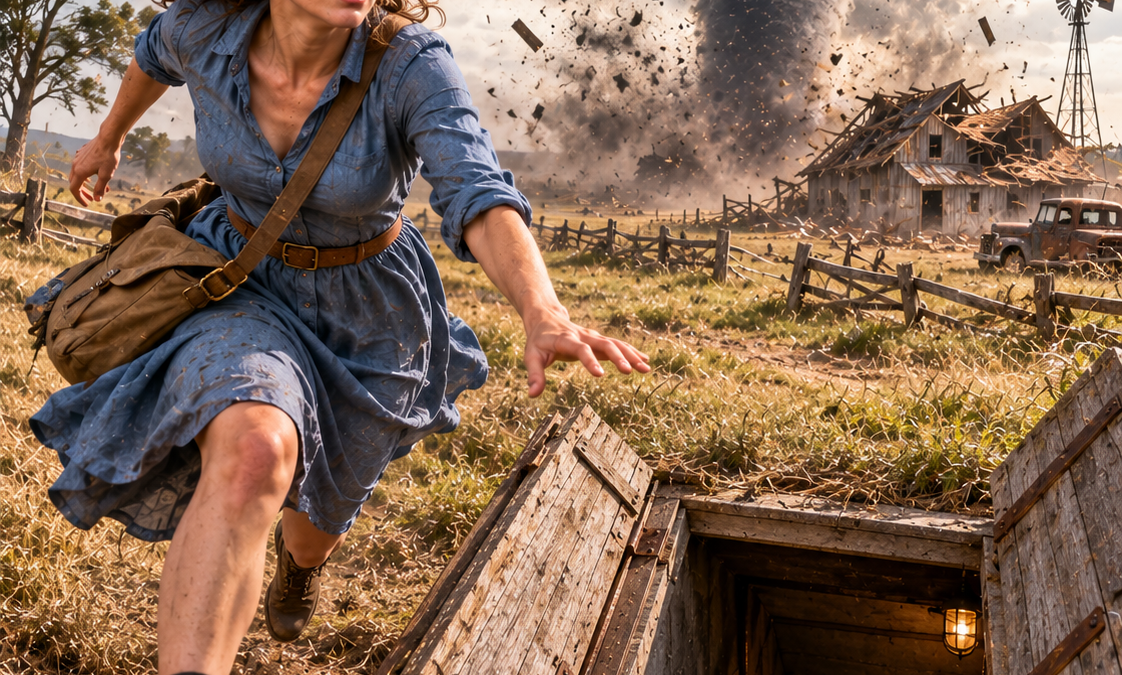
Part 2/5: Ruth’s hidden records turn the storm shelter into the first step of Willa’s fight.
Willa read the first line again, then a third time. Above her, the tornado tore across Pine Hollow, but its roar seemed far away. She was focused on the word they.
Her mother’s letter explained that questions had begun years earlier. Men had asked about the boundaries. Old records had gone missing. Someone had suggested that Ruth’s marriage to Gideon had never been properly recorded. That was when Ruth began making copies, one document at a time.
Willa looked around the hidden room. These weren’t simply old family papers. They were a defense.
She opened the document bearing Gideon’s name and read each line carefully. It described the acreage along Pine Hollow Creek. His signature appeared near the bottom. Another paper carried a county seal. A third listed years of property taxes.
Then Willa opened a yellowed envelope. Inside was a marriage certificate: Gideon Voss and Ruth Voss, lawfully married.
Willa pressed a hand over her mouth. Pierce had said there were questions about her parents’ marriage. Here was the proof.
For months after Ruth died, Willa had believed her mother had left the world defeated. She remembered the medicine bottles, the nights Ruth was too weak to cross the bedroom without help, the hours Willa spent lifting her from bed. Willa had mistaken weakness of the body for helplessness of the mind.
Even while illness took Ruth’s strength, she had been thinking beyond her own death. Even while Willa sold cattle to pay for medicine, her mother had been making sure her daughter would have a chance.
“Why didn’t you tell me?” Willa whispered.
There was no answer. Rain dripped somewhere above.
Willa returned to the letter. Ruth warned her not to trust a document simply because it carried an official stamp. Compare the dates, names, witnesses, parcel numbers. Then came a sentence that made Willa sit still.
If the claim comes through Everett Vale, understand that Everett is only the hand you can see.
Willa looked toward the staircase. The tornado’s roar had begun to fade into distant thunder. But a different storm had started inside her.
She opened the tin box. Inside were $43, two keys, and a small notebook wrapped in cloth. The money was more than five times what Willa had left, but the notebook caught her attention.
Page after page held Ruth’s handwriting: dates, names, trips into town, references to courthouse records and a church register. One name appeared more than once beside notes about Gideon’s deed.
Everett Vale.
Ruth had written: Asked again about Gideon’s deed. Pretended it was family curiosity. It was not.
Anger rose in Willa—not wild anger, but something colder. For eight days, everyone expected her to behave like a frightened orphan who didn’t understand legal papers. The day before, she might have done exactly that.
Not anymore.
Willa gathered the documents and returned them to their oilcloth. Then she read the letter’s final paragraph.
If you found this room, my darling girl, I’m probably no longer there to stand beside you. I’m sorry for that more than I can say. But listen to me now. Don’t let grief convince you that you’re alone. Ask questions. Read everything. Trust slowly. When you become frightened, do the next necessary thing. Then do the one after that.
Willa’s tears finally fell. For fourteen months, she had thought she was carrying her mother’s last warning. Now she understood: she had been carrying her mother’s first instruction.
She folded the letter and placed it over her heart. Then she took the marriage certificate and climbed the stairs.
By the time she emerged from Zeb Tate’s cellar, the tornado had moved east. Pine Hollow looked wounded. Fence posts leaned at odd angles. Cottonwood branches littered the fields. Across the basin, part of a barn roof had been dropped into a pasture.
Willa stood in the wet grass with Ruth’s papers wrapped beneath her coat. Yesterday, she had walked toward town with nothing but questions. Now she carried answers, or at least the beginning of them.
She reached Pine Hollow shortly before dusk and went directly to the county courthouse. The front doors were locked.
For one awful moment, she simply stood there. Eight days had become seven.
“Miss?”
Willa turned. An elderly man was sweeping rainwater from the steps of the building next door. His name was Harlan Webb. He had worked in the county records office for thirty-two years before retiring.
Willa almost thanked him and walked away. Then she remembered Ruth’s words.
She showed him the land record. Harlan adjusted his spectacles and studied it beneath the doorway light. His expression changed.
“Where did you get this?”
“It belonged to my parents.”
“That isn’t what I asked.”
Willa hesitated. “My mother hid it.”
Harlan studied her for a moment, then carefully handed it back. “Come here tomorrow morning when the doors open.”
“Can it help me?”
“It might.”
That word followed Willa all night. The pastor’s wife found her sitting beneath the courthouse awning and let her sleep in the church’s back room.
At eight the next morning, Harlan was waiting. Together they searched the old property ledgers. The books were so heavy Willa needed both hands to lift them. They compared dates, parcel numbers, tax entries, and signatures.
For three hours, they found nothing.
Then Harlan stopped turning pages.
There, in a transfer entry from more than twenty years earlier, was Gideon Voss listed as the purchaser of the Pine Hollow acreage. Beside his name sat a reference number, but the corresponding deed was missing from the county file.
Willa’s heart sank. “That proves nothing.”
“No,” Harlan said quietly. “It proves something was here.”
He tapped the reference number. “Records don’t usually invent themselves.”
Willa pulled Ruth’s notebook from her bag. One entry mentioned the same number. Harlan read it, then another. His face grew serious.
“Your mother knew what she was looking for.”
They spent the rest of the morning following her notes. At the marriage registry, they found a record confirming Gideon and Ruth’s marriage. At a small church six miles outside town, an aging minister opened a cabinet and produced an old register with the same date and the names of two witnesses.
Willa stared at the page until the letters blurred. Her mother had told the truth. Her parents had been legally married. Her father’s ownership had been recorded. Ruth had paid property taxes on the ranch for years.
For the first time since Pierce entered her kitchen, Willa felt something dangerously close to hope.
“Don’t celebrate yet,” Harlan said.
The hope vanished. “Why?”
“Because Vale has an original claim. You have pieces.”
“Good pieces,” he added when she looked at him. “But a court won’t hand you the ranch because your story feels right. You need a chain they can’t break.”
“What am I missing?”
Harlan pointed to a line in the land ledger. The original transfer had been signed before two witnesses. One was dead. The other name was hard to read.
Willa leaned closer to the page. She had seen that surname before—not at the courthouse, but in Ruth’s hidden room.
She went back through the letters until she found an envelope tied with blue thread. The name on it matched the ledger.
Harlan’s eyes widened.
Part 3/5: A witness’s letter gives Willa a lead, but she must earn his help before Vale’s deadline.
Inside the blue-thread envelope was a letter written years earlier by the surviving witness. It described the day Gideon paid for the ranch and signed the transfer papers. At the bottom was an address.
Harlan read it twice. “He may still be alive.”
“Where?”
“About eighteen miles north of here.”
Willa had no horse, no wagon, and almost no money. But the distance no longer felt impossible. It was simply difficult.
“I’ll walk,” she said.
Harlan looked at her, then reached into his coat for a ring of keys. “No, you won’t. My truck may be older than you are, Miss Voss, but it still knows the road north.”
The truck coughed twice before its engine caught. It was loud, old, and pulled hard to the right. To Willa, it felt like a gift. She put Ruth’s notebook beside her and drove north, repeating her mother’s words whenever fear crept in.
Do the next necessary thing.
The address led to a weather-beaten farmhouse near Red Creek. An elderly man answered the door. His name was Elias Mercer. When Willa said Gideon Voss, his expression changed.
“I haven’t heard that name in twenty years.”
Willa showed him the letter. Elias read it slowly, then invited her inside. He remembered Gideon. He remembered Ruth. Most importantly, he remembered the land transfer.
“I stood right there when your father signed it,” he said. “He paid for that ranch honestly.”
Relief rushed through Willa so quickly she had to grip the edge of the table. “Would you tell that to a judge?”
Elias looked toward the window. His hands began to tremble. “I’m eighty-four years old, child. I don’t travel well anymore.”
Willa felt her hope sink. For a moment, the old version of her returned—the girl who had sat silently while Pierce explained why her home was no longer hers.
Then she touched the silver thimble in her pocket. Ask questions.
“What would you be willing to do?” she asked.
The question changed everything.
By late afternoon, Harlan had arranged for a local notary to visit the farmhouse. Elias gave a sworn statement describing Gideon’s payment and identifying the signatures. He confirmed Ruth had been present.
Before Willa left, he told her something she hadn’t expected.
“Your mother came here once, years ago. She asked me to write down what I remembered.”
“Why didn’t she tell me?”
Elias smiled sadly. “Maybe she was trying to let you be young.”
Those words stayed with Willa on the drive back. She had spent years thinking Ruth needed her protection. Now she saw it differently. Her mother had been protecting her—not only from Vale, but from fear and suspicion, from carrying an adult burden before she had to.
The next morning, Willa walked into the courthouse with Elias’s sworn statement, the marriage record, tax receipts, Ruth’s notebook, and the original documents from the hidden room.
Alden Pierce was there. So was Everett Vale.
It was the first time Willa had seen him. He was well-dressed, silver-haired, and surprisingly calm. He looked at her as though she were a problem that should already have been solved.
“I understand you found some family papers,” he said.
“I found the truth.”
Vale smiled. “Those aren’t always the same thing.”
A week earlier, that sentence might have frightened her. Now it made her listen more carefully.
Vale’s attorney argued that old letters were unreliable, memories faded, and a missing deed remained missing. Willa felt panic rise as legal terms filled the room. Then she remembered Ruth: Read everything. Trust slowly.
She opened her mother’s notebook. One date matched a county tax entry. Another matched the church marriage register. Elias’s statement matched the land ledger. Document after document pointed to the same account.
Gideon and Ruth Voss had not simply occupied Pine Hollow Ranch. They had owned it.
The county clerk agreed there was enough evidence to suspend Vale’s claim while the records were formally reviewed. Willa did not win the ranch that day, but she was no longer being thrown off it.
For the first time, Vale stopped smiling.
Outside the courthouse, Willa sat alone on the steps. Her hands were shaking. Only then did she realize how frightened she had been.
Harlan sat beside her. “You did well.”
“My mother did this.”
“Some of it,” he said. “Your mother collected those papers. But she didn’t drive eighteen miles. She didn’t ask Elias the right question, and she didn’t stand in that room while a man twice your age tried to make you doubt what you knew.”
Willa looked down at her hands. They were the same hands that had washed Ruth’s sheets, repaired fences, buried her mother, sold her horse, and counted $8.15 at the kitchen table.
She had always thought strength was something a person felt. Now she understood it was often what someone did while still afraid.
She closed her fingers around the thimble. For the first time since Ruth died, she did not wish her mother were there to tell her what to do next. She already knew.
The ranch was only part of what had been taken. Someone had tried to erase Gideon and Ruth Voss from the story of their own land. Willa intended to put their names back. And she wanted to learn who had tried to make her leave—and why.
Part 4/5: A formal review tests the evidence Ruth preserved and brings Willa’s claim before a judge.
Three weeks later, Willa stood inside the county courthouse again, this time with Harlan beside her and Elias’s sworn statement among the documents on the table.
Along the back wall stood neighbors from Pine Hollow. They remembered Ruth bringing soup when someone was sick, helping deliver babies during winter storms, and sitting through the night with families who had nowhere else to turn.
Everett Vale sat across the room. He did not look at Willa.
The review had uncovered what Ruth suspected years earlier. Gideon’s land transfer had been recorded. The original deed had disappeared from the county file, but the ledger entry, tax records, marriage certificate, witness testimony, and Ruth’s preserved copies formed a chain too strong to ignore.
Vale’s claim depended on that chain being broken.
It wasn’t.
The judge spoke for several minutes. Willa heard almost none of it. She kept her hands folded in her lap and her eyes on the silver thimble in her pocket. Then came the words she had been waiting to hear.
“The Voss claim is valid. Pine Hollow Ranch belongs to Willa Voss.”
For a moment, she didn’t move.
Harlan touched her shoulder. “Willa.”
Only then did she understand. It was over.
Vale rose without a word, gathered his papers, and walked toward the door. Willa watched him go. She had imagined this moment many times and expected to feel triumphant.
Instead, she felt tired—and strangely peaceful.
She didn’t need to watch Vale lose. She needed to know that Gideon and Ruth had finally been heard.
Outside, people gathered around her. Someone hugged her. Someone else shook her hand. But Willa kept looking toward the western road, toward home.
That evening, she walked alone beneath the cottonwoods. Weeds had grown around the two wooden crosses, and several storm-broken branches lay nearby. Willa knelt first beside Gideon’s grave.
“I kept it,” she said.
Her voice broke. Then she moved to Ruth’s grave. For a while, she said nothing. She took the silver thimble from her pocket and held it in her palm.
“You knew,” she whispered. “You knew I would need you.”
Wind moved through the grass.
“No,” Willa said, wiping her cheek. “You knew I would need to learn how to do it without you. That was the difference.”
Ruth had not left behind a miracle. She had left breadcrumbs: a document, a notebook, a name, and a question worth asking. When Willa reached the end of one clue, there was just enough light to find the next.
Do the next necessary thing. Then do the one after that.
Willa stood and looked across Pine Hollow Ranch. The barn still leaned east. The fences still needed repairs. There were bills waiting inside the house, too few cattle in the pasture, and winter would come soon enough.
Nothing about her life had suddenly become easy. But it was hers—not because a judge had given it to her, but because Gideon had built it, Ruth had protected it, and Willa had found the courage to stand for it.
She went back to the farmhouse as the last light faded. The kitchen looked exactly as it had when Pierce sat at the table: the blue cup on the shelf, the work coat by the stove, the faint marks where Ruth used to roll dough. But Willa no longer saw a house she might lose. She saw the place her parents had made a life.
On the table lay the papers she would need to file with the county. She arranged them carefully, one by one, and set the thimble beside them.
For the first time in months, she slept without imagining a sheriff at the door.
Part 5/5: Willa keeps the ranch, honors her parents, and learns that courage can begin with one necessary step.
The following spring, Willa planted two young cottonwoods beside the old ones, one for Gideon and one for Ruth. The work took most of the morning. The earth was hard, and her hands were sore by the time both saplings stood straight.
She watered them and sat beneath the branches for a while, listening to the ranch settle around her. A fence needed mending. The barn roof still required work. There was no sudden wealth, no easy harvest, and no promise that the years ahead would be gentle.
But there was the land. There was the house. And there was the knowledge that her parents’ names had not been erased.
Years later, when people asked Willa how she had saved Pine Hollow Ranch, she never began with the courthouse. She began with the storm.
The worst tornado she had ever seen had driven her into a dark cellar beneath an abandoned ranch. Under three crooked boards, she found more than hidden papers. She found evidence that her mother had believed in her long before Willa knew she would need to believe in herself.
Ruth had known she might not be there when the fight came. She had prepared the documents, preserved the dates, and left a letter with instructions. But Willa still had to take each step: walk to town, ask Harlan for help, follow the notebook, find Elias, and stand in court.
The papers mattered. So did the people who chose to help. And so did the girl who kept moving even when she was frightened.
Willa came to understand that love did not always arrive as a rescue. Sometimes it was a lesson repeated until it stayed with you. Sometimes it was a mother’s careful handwriting, a father’s warning about the sky, or a neighbor’s old truck offered at the right moment.
Sometimes it was the quiet voice that said: You’re frightened. You’re tired. You don’t know how this ends.
That’s all right. Do the next necessary thing. Then do the one after that.
When storms came over Pine Hollow, Willa watched the western sky. She moved the cattle to safer ground, checked the cellar doors, and made sure the two new cottonwoods were braced against the wind.
She never forgot that the tornado had frightened her. She never pretended the discovery underground had been anything other than chance. But chance had led her to Ruth’s plan, and Ruth’s plan had given Willa a way to defend the home her family had built.
The ranch had not been saved by a single dramatic moment. It had been saved through small acts of persistence: comparing a date, reading an old ledger, asking an elderly witness what he remembered, and refusing to let someone else’s confidence decide what was true.
When the first spring leaves appeared on the young trees, Willa stood beneath them with the silver thimble in her palm. She could not bring back the people buried beneath the cottonwoods. She could not restore the cattle or the horse she had sold to pay for Ruth’s medicine. She could not undo the long months of grief.
But she could keep the ranch alive. She could keep her parents’ names attached to it. She could live in the house they had made and look toward their graves without wondering whether she would soon be forced to leave.
That was enough for now.
Willa returned to the farmhouse and set the thimble on the shelf beside Ruth’s chipped blue cup. Then she picked up the tools she needed to repair the fence.
The work was waiting. So was the next necessary thing.
THE END








